
Estimated reading time: 14 minutes
If you’ve ever wondered what it means for a story to contain everything — every moral dilemma humanity has ever faced, every relationship that can exist between people, every shade of loyalty, grief, ambition, and grace — the Mahabharata is your answer. Composed in Sanskrit and attributed to the sage Vyasa, this ancient Indian epic is not merely a long poem. It is, as the text itself proclaims, “Whatever is here is found elsewhere. What is not here is nowhere.”
At roughly 1.8 million words spread across 100,000 verses (shlokas), the Mahabharata is the longest literary work in human history — nearly ten times the combined length of Homer’s Iliad and Odyssey, and four times longer than the Bible. Yet length is perhaps its least remarkable quality. What makes the Mahabharata extraordinary is its depth: a sprawling narrative about a dynastic war that somehow becomes a meditation on the nature of dharma (righteousness), the complexity of human choice, and what it means to live and die with honour.
Whether you are a student of world literature, a curious reader drawn to mythology, or someone exploring the philosophical traditions of South Asia, this introduction will walk you through everything you need to know: what the Mahabharata is, who wrote it, what it’s about, why it still matters, and how to begin engaging with it today.
What Is the Mahabharata? An Overview for First-Time Readers
The Mahabharata (Sanskrit: महाभारत, Mahābhārata) is an ancient Indian epic narrative that belongs to the genre of itihāsa — a Sanskrit word meaning “thus indeed it was,” often translated as “history.” Unlike mythology in the Western sense, which tends to describe the deeds of gods in a separate divine realm, the Mahabharata is set in a recognisably human world: a world of kingdoms, marriages, gambling, jealousy, warfare, and death.
At its core, the epic tells the story of a great war — the Kurukshetra War — fought between two branches of the same royal family: the Pandavas (five brothers) and the Kauravas (one hundred brothers). The conflict is ostensibly about succession to the throne of the Kuru kingdom. But as the story unfolds across eighteen books (parvans), it becomes clear that Vyasa is exploring something far more universal: the nature of righteousness when righteousness itself is ambiguous.
Beyond the central narrative, the Mahabharata contains hundreds of sub-stories, philosophical discourses, cosmological myths, legal texts, and didactic passages. It is simultaneously an epic poem, a philosophical treatise, a legal compendium, a cosmological text, and a storehouse of folklore. Many scholars describe it not as a single text but as a literary tradition — assembled over centuries, continuously revised, and read differently by different communities across South and Southeast Asia.
Who Wrote the Mahabharata? The Legend of Sage Vyasa
The Mahabharata’s traditional author is Veda Vyasa (also known as Krishna Dvaipayana Vyasa), one of the most revered sages in Hindu tradition. According to legend, Vyasa composed the entire epic mentally and then dictated it to Ganesha, the elephant-headed god, who agreed to transcribe it on one condition: that Vyasa would dictate without pause. Vyasa accepted, but on his own condition: that Ganesha would not write a single verse without first understanding its meaning. This clever arrangement explains, tradition says, why the epic contains passages of such deliberate complexity — Vyasa would compose difficult verses to give himself a moment to think, while Ganesha puzzled over their meaning.
This charming origin story tells us something important about how the Mahabharata was understood by those who transmitted it: as a divinely inspired, intellectually inexhaustible work — one that demands active engagement, not passive reception.
Historically, scholars believe the Mahabharata was composed and compiled over many centuries, with the earliest layers dating to roughly 400 BCE and the text reaching something close to its current form by around 400 CE. The core narrative around the Kurukshetra War likely reflects real historical memory from an earlier period — perhaps as far back as 1000–800 BCE — though the epic as a literary-philosophical monument is the product of a much longer tradition of oral composition, recitation, and written compilation.
Vyasa himself is a character within the epic — a fascinating meta-fictional choice. He appears at key moments, advises characters, and is described as the grandfather of both the Pandavas and the Kauravas (being the biological father of both Dhritarashtra and Pandu through niyoga, a form of levirate marriage). The author is literally inside his own story.
The Structure of the Mahabharata: Eighteen Books and More
The Mahabharata is traditionally divided into eighteen parvans (books), each covering a distinct phase of the narrative. These are:
- Adi Parva (The Book of the Beginning) — Origins, genealogies, and the early lives of the Pandavas and Kauravas.
- Sabha Parva (The Book of the Assembly Hall) — The building of the Pandavas’ palace, the infamous dice game, and Draupadi’s humiliation.
- Vana Parva / Aranyaka Parva (The Book of the Forest) — The Pandavas’ thirteen years of exile in the forest.
- Virata Parva (The Book of Virata) — The Pandavas’ year of disguised exile in the kingdom of Virata.
- Udyoga Parva (The Book of Effort) — Diplomatic attempts to avoid war; Krishna’s failed peace mission.
- Bhishma Parva (The Book of Bhishma) — The first ten days of the Kurukshetra War. Contains the Bhagavad Gita.
- Drona Parva (The Book of Drona) — Days eleven through fifteen of the war.
- Karna Parva (The Book of Karna) — Days sixteen and seventeen of the war.
- Shalya Parva (The Book of Shalya) — The final day of the eighteen-day war.
- Sauptika Parva (The Book of the Sleeping Warriors) — The night massacre by Ashvatthama.
- Stri Parva (The Book of the Women) — The lamentations of the women after the war.
- Shanti Parva (The Book of Peace) — Yudhishthira’s crisis of conscience; Bhishma’s long discourses on statecraft and dharma from his deathbed.
- Anushasana Parva (The Book of Instructions) — Bhishma’s continued teachings.
- Ashvamedhika Parva (The Book of the Horse Sacrifice) — Yudhishthira performs the ritual horse sacrifice to purify his kingdom.
- Ashramavasika Parva (The Book of the Hermitage) — The elder generation retires to the forest.
- Mausala Parva (The Book of the Clubs) — The destruction of the Yadava clan; Krishna’s death.
- Mahaprasthanika Parva (The Book of the Great Journey) — The Pandavas renounce the world and begin their final journey.
- Svargarohanika Parva (The Book of the Ascent to Heaven) — The Pandavas reach heaven.
Additionally, the Harivamsha is considered an appendix (khila) to the Mahabharata and focuses on the life and deeds of Krishna.
The Central Story: The Pandavas, the Kauravas, and the Kurukshetra War
To understand the Mahabharata, you must know its central families.
The Kuru Dynasty
Both sets of protagonists belong to the Kuru clan, descended from the legendary king Bharata (from whom the epic takes its name — Mahābhārata means “the great [tale of] the descendants of Bharata”). The two key brothers in the generation before the war are:
- Dhritarashtra — Born blind; the elder son, who is technically entitled to the throne but passed over due to his disability.
- Pandu — The younger son, who becomes king but is cursed and cannot father children. He dies young.
The Pandavas: The Five Brothers
After Pandu’s death, his five sons — the Pandavas — become the central heroes of the epic:
- Yudhishthira — The eldest, son of Dharma (the god of righteousness). Calm, just, and deeply committed to truth — but fatally drawn to gambling.
- Bhima — The second son, born of Vayu (the wind god). Immensely strong, fiercely protective of his brothers and their shared wife Draupadi.
- Arjuna — The third son, born of Indra (king of gods). The greatest archer in the world and the recipient of the Bhagavad Gita’s teachings.
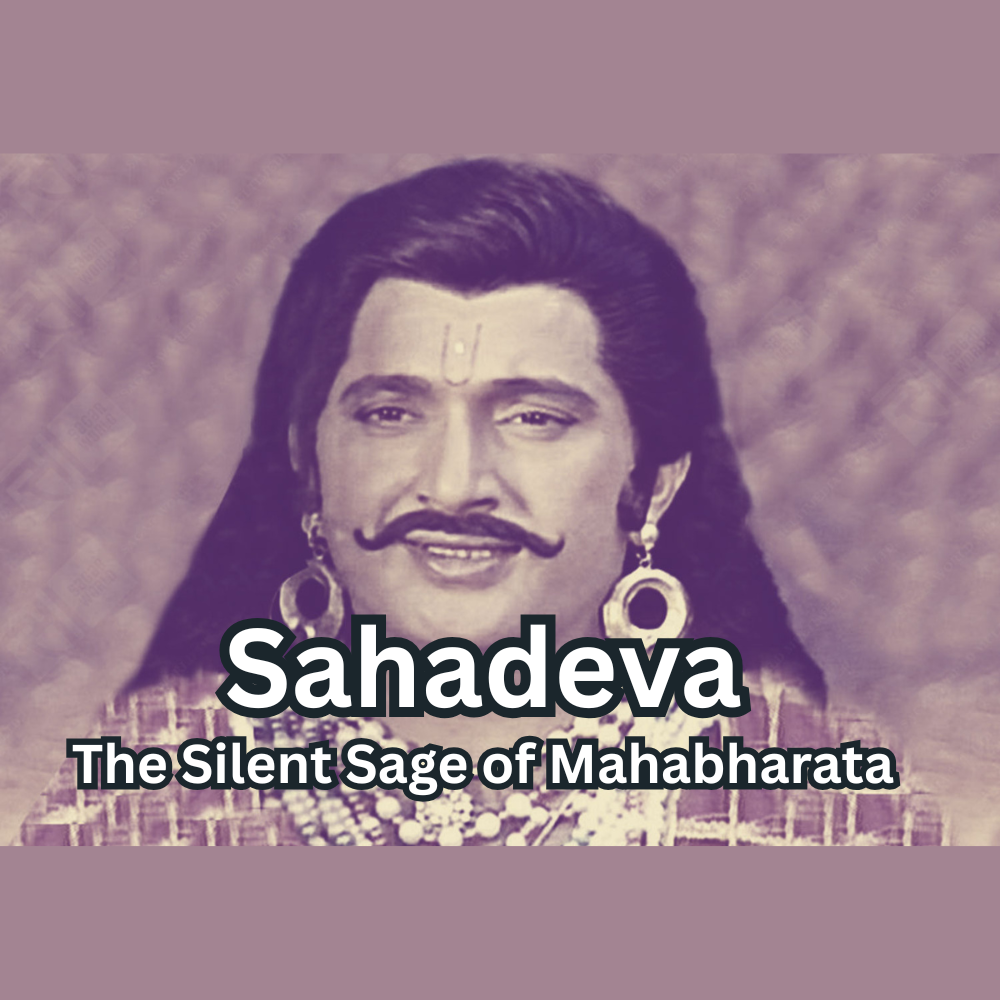
- Nakula and Sahadeva — The twin sons of the Ashvini Kumaras, known for their beauty, skill with horses, and astrology respectively.
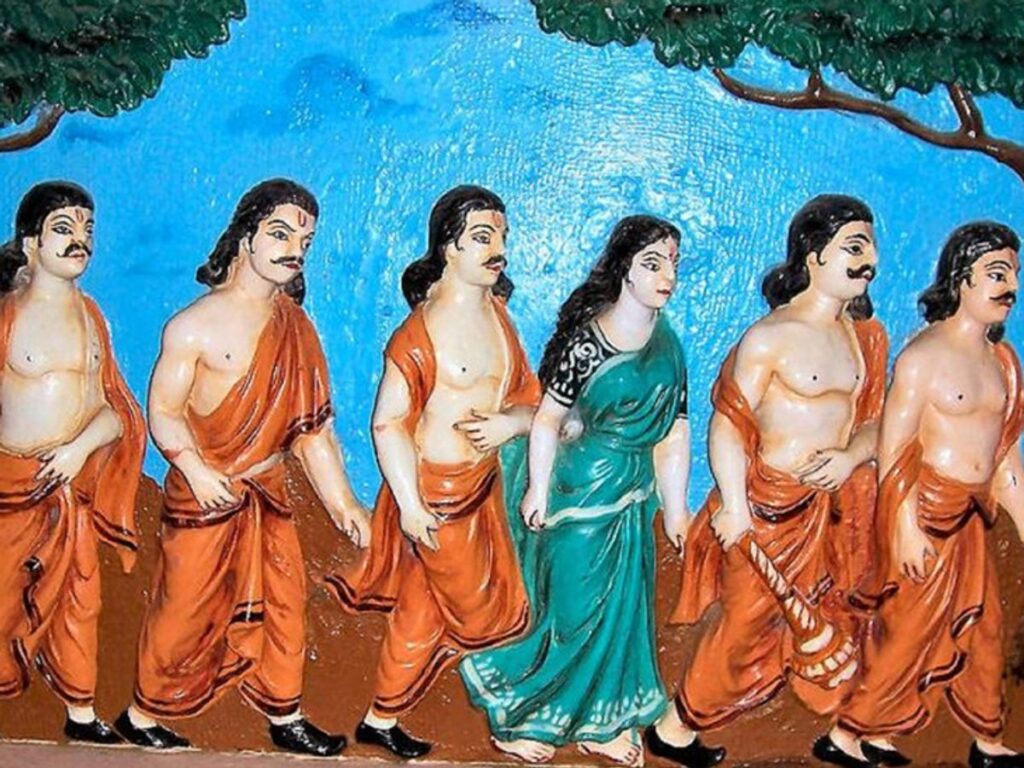
The five brothers share one wife: Draupadi (also called Krishnaa or Panchali), the daughter of King Drupada and one of the most complex, fully realised female characters in world literature.
The Kauravas: The Hundred Brothers
Dhritarashtra’s sons number one hundred, fathered by his wife Gandhari, who famously bound her eyes in cloth to share in her husband’s blindness. The eldest and most significant is Duryodhana — a man consumed by envy and pride, yet not without his own code of honour. The Mahabharata notably refuses to make Duryodhana a simple villain; his grievances are real, his loyalty to his friends (particularly Karna) is profound, and his courage in battle is undeniable.
Krishna: The Divine Architect
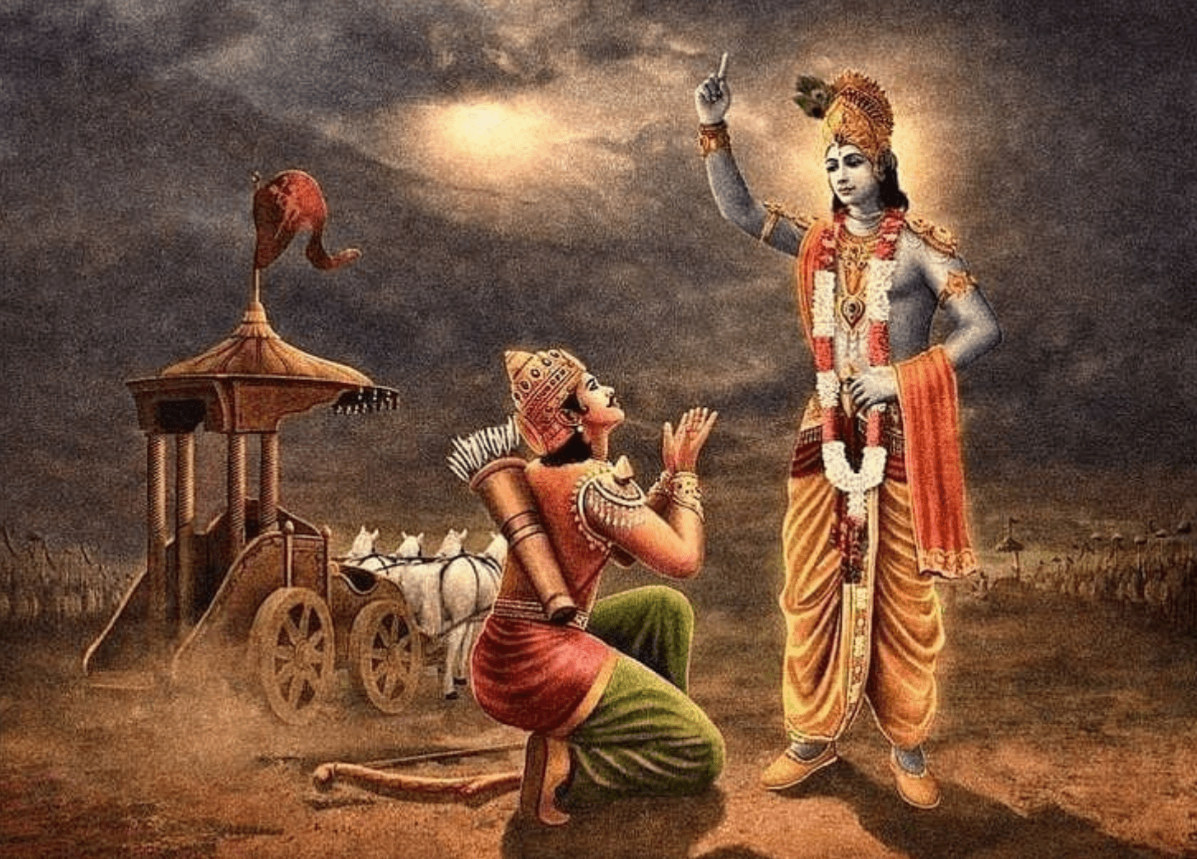
No introduction to the Mahabharata is complete without Krishna, the eighth avatar of Vishnu. Krishna is Arjuna’s cousin and closest friend, and chooses to serve as his charioteer during the Kurukshetra War. He offers both armies a choice: they can have his armies, or they can have him — as a non-combatant advisor. Duryodhana greedily chooses the armies; Arjuna chooses Krishna.
It is this choice that shapes the epic’s most celebrated text: the Bhagavad Gita.
The Dice Game: The Point of No Return
The central pivot of the Mahabharata narrative is not a battle — it is a game of dice. Yudhishthira, the eldest Pandava and a compulsive gambler, is invited by Duryodhana (through the scheming uncle Shakuni) to a game he cannot possibly win. Shakuni plays on Yudhishthira’s behalf for Duryodhana, and the dice are loaded — Shakuni’s dice are carved from his own father’s bones and do his bidding.
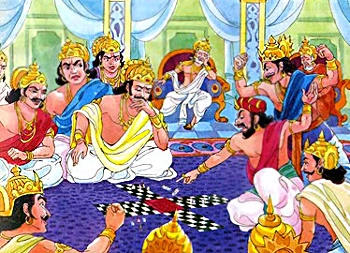
In a series of devastating losses, Yudhishthira gambles away his kingdom, his brothers’ freedom, his own freedom, and finally Draupadi herself. What follows is one of the most harrowing scenes in world literature: Duryodhana orders his brother Dushasana to drag Draupadi — a queen and a wife — into the assembly hall by her hair, and attempts to disrobe her in public. Draupadi’s prayer to Krishna is answered miraculously (her sari becomes endless as it is pulled), but the humiliation is never forgotten. It is this moment, more than any strategic dispute over a throne, that makes the war inevitable.
The War of Kurukshetra
After twelve years of forest exile and one year of disguised living, the Pandavas return to claim their share of the kingdom. Duryodhana refuses. Krishna’s peace mission fails. The two sides assemble their armies on the field of Kurukshetra (in present-day Haryana, India), and an eighteen-day war begins.
The war is brutal and tragic. Almost every significant character dies — including Bhishma, the family patriarch who lies on a bed of arrows for fifty-eight days awaiting an auspicious moment to die; Drona, the guru of both sides; Karna, Arjuna’s great rival and secretly his own eldest brother; and all five of the Pandavas’ sons. In the end, the Pandavas win — but the victory is hollow. The kingdom they inherit is emptied of the warriors who gave it meaning.
The Bhagavad Gita: The Heart of the Mahabharata
Embedded within the sixth book (Bhishma Parva), the Bhagavad Gita (“Song of God”) is the Mahabharata’s most globally famous text. It consists of 700 verses of dialogue between Arjuna and Krishna, set on the battlefield just before the war begins.
Arjuna, faced with the reality of fighting and killing his own family members, teachers, and friends, collapses in grief and despair. He refuses to fight. Over the course of 18 chapters, Krishna counsels him through a rich philosophical discourse touching on:
- Karma Yoga — The yoga of right action; doing one’s duty without attachment to outcomes.
- Jnana Yoga — The yoga of knowledge; understanding the true nature of the self (atman) and the cosmos.
- Bhakti Yoga — The yoga of devotion; surrendering to the divine.
- The nature of the self — The atman is eternal and cannot be killed; only the body dies.
- Dharma — One’s duty in the world, specific to one’s role, time, and circumstance.
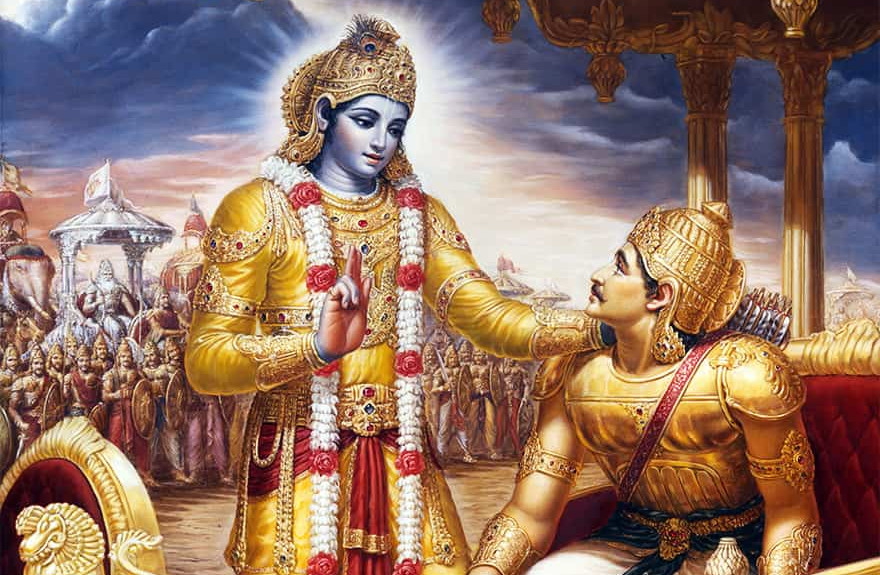
The Gita’s most famous verse — “You have a right to perform your prescribed duties, but you are not entitled to the fruits of your actions” — is among the most quoted philosophical statements in history. It has influenced thinkers from Mahatma Gandhi (who called it his “spiritual dictionary”) to Aldous Huxley, J. Robert Oppenheimer (who famously quoted it at the Trinity nuclear test), and countless millions of ordinary people navigating moral complexity.
The Bhagavad Gita is often read as an independent philosophical text, but reading it within the context of the full Mahabharata gives it an entirely different emotional weight. It is not an abstract treatise — it is advice given to a grief-stricken man on the edge of a catastrophic war, in which there are no clean choices.
Major Themes in the Mahabharata
1. The Complexity of Dharma
The central preoccupation of the Mahabharata is dharma — a word with no exact English equivalent, encompassing duty, righteousness, cosmic order, and ethical law simultaneously. The epic is relentless in demonstrating that dharma is never simple. Characters who try to be righteous make catastrophic errors. Characters who seem morally compromised sometimes act with profound nobility. Yudhishthira, the son of Dharma himself, tells a lie. Krishna — a god — counsels deception on the battlefield. The Mahabharata does not offer easy moral resolutions; it offers the honest acknowledgment that living righteously in an unrighteous world is the hardest thing a human being can attempt.
2. The Inevitability of Fate vs. the Importance of Choice
The Mahabharata is deeply interested in the relationship between karma (action and its consequences) and niyati (fate). Characters are given prophecies; curses shape events across generations; the war seems foretold from the beginning. And yet, at every turn, the epic insists that choices matter — that individuals are morally responsible for the worlds they make. The war is fated; it is also chosen, again and again, by human beings who could have acted differently.
3. The Cost of War
The Mahabharata is not a glorification of warfare. It is one of the most devastating anti-war texts ever written. The victory of the Pandavas brings not joy but ruin: their sons are dead, their kingdom is a graveyard, and Yudhishthira is so consumed by guilt that he can barely govern. The Stri Parva — the Book of the Women — gives voice to the grief of the widows, and it is among the most emotionally overwhelming sections of the epic. The Mahabharata understands that war, even a “just” war, leaves nothing intact.
4. Loyalty, Friendship, and Betrayal
The relationship between Karna and Duryodhana is one of world literature’s great portraits of friendship. Karna, born the eldest Pandava but raised by a charioteer’s family, is mocked and excluded by the Pandavas for his low birth. Duryodhana alone accepts him, crowns him king, and stands by him. Their loyalty to each other, though it serves the “wrong” side of the war, is genuinely moving. Similarly, the bond between Arjuna and Krishna — between human limitation and divine guidance — is a foundational template for the devotional relationship at the heart of later Hindu bhakti traditions.
5. Gender, Power, and Agency
Draupadi is perhaps the most remarkable character in the Mahabharata. She is polyandrous, outspoken, highly educated, and refuses to be silent about injustice. Her questioning of the assembly after the dice game — “Was I legally wagered? Did Yudhishthira lose himself first, before wagering me? If so, did he have the right to stake me at all?” — is a legal and philosophical challenge that the assembled men cannot answer. Kunti, the mother of the Pandavas, is another figure of immense complexity: a woman whose choices shape the entire epic, who carries secrets that only the reader fully understands.
The Mahabharata’s Influence on World Culture
The reach of the Mahabharata extends far beyond the Indian subcontinent. Its stories and characters have shaped the cultures of Southeast Asia profoundly — in Indonesia, Thailand, Cambodia, and Myanmar, versions of the Mahabharata are performed in classical dance, shadow puppetry (wayang), and theatrical traditions that are living arts to this day.
The Bhagavad Gita has been translated into virtually every major world language and continues to be one of the most widely read philosophical texts on the planet. Scholars from Friedrich Wilhelm Joseph Schelling to T.S. Eliot, from Ralph Waldo Emerson to Arthur Schopenhauer, have engaged with it.
In modern India, the Mahabharata remains a living text — retold endlessly in films, television serials (B.R. Chopra’s 1988 TV series was watched by an estimated 650 million viewers, making it arguably the most watched television programme in history at the time), comics, novels, and political rhetoric. Prime ministers and revolutionaries alike have reached for its language when describing moral crises.
In world literature, the Mahabharata has inspired or directly influenced works by authors including Rabindranath Tagore, R.K. Narayan, Irawati Karve, Shashi Tharoor (The Great Indian Novel, 1989), and Chitra Banerjee Divakaruni (The Palace of Illusions, 2008, which retells the epic from Draupadi’s perspective). It has also influenced fantasy writers including J.R.R. Tolkien (who was familiar with the Sanskrit epics) and, more directly, the Mahabharata adaptations by director Peter Brook, whose 1985 nine-hour theatrical production and 1989 film version brought the epic to international audiences as never before.
How to Read the Mahabharata: A Guide for New Readers
Given its scale, approaching the Mahabharata can feel daunting. Here are the most practical paths in:
Start with a Literary Translation
Bibek Debroy’s complete 10-volume translation (Penguin, 2010–2014) is the most accessible complete English translation currently available. It is readable, scholarly, and unabridged. For those wanting the most rigorous scholarly translation, the University of Chicago Press Critical Edition translation (begun by J.A.B. van Buitenen, later continued by other scholars) is the gold standard — though it covers only the first five parvans.
Try a Condensed Retelling First
C. Rajagopalachari’s Mahabharata (1951) is a beloved single-volume retelling that captures the essence of the narrative in elegant prose. William Buck’s Mahabharata (1973) is a poetic, novelistic English retelling. Either makes an excellent entry point before tackling a fuller translation.
Read the Bhagavad Gita Separately
Barbara Stoler Miller’s translation (The Bhagavad-Gita: Krishna’s Counsel in Time of War, 1986) is widely considered the most literary English translation. Begin there to understand the philosophical heart of the epic before engaging with the full narrative.
Follow a Thematic Thread
Rather than reading the entire Mahabharata linearly, some readers find it richest to follow a single character — Karna, Draupadi, Bhishma — across the text, using an index or guided reading notes to track them through the various parvans.
Why the Mahabharata Matters Today
In an age of polarised politics, broken institutions, and the constant temptation to believe in simple moral narratives, the Mahabharata offers something rare: a text that refuses to be simple. Its good characters do terrible things. Its villains love their children and honour their friends. Its gods are fallible, its heroes are broken, and its one figure of perfect righteousness — Bhishma — destroys himself and everyone around him through an excess of loyalty to a vow.
The Mahabharata asks the questions that governance, ethics, psychology, and theology have never stopped asking: What do you owe your family when it conflicts with what you owe the world? Can a just war produce a just peace? Is it ever right to lie in service of truth? What does it mean to fulfil your duty when every available duty is compromised?
These are not ancient questions. They are this morning’s questions. And the Mahabharata, composed at the dawn of recorded history, is still one of the most intelligent places to take them.
Frequently Asked Questions About the Mahabharata
How long is the Mahabharata? The Mahabharata contains approximately 1.8 million words and 100,000 verses (shlokas). It is roughly ten times the combined length of Homer’s Iliad and Odyssey and is considered the world’s longest epic poem.
Who wrote the Mahabharata? The Mahabharata is traditionally attributed to the sage Veda Vyasa, who is also a character within the text. Scholars believe it was composed and compiled over many centuries, from roughly 400 BCE to 400 CE.
What is the Mahabharata about? At its core, the Mahabharata tells the story of the Kurukshetra War between two branches of the Kuru royal family — the five Pandava brothers and the hundred Kaurava brothers. More broadly, it is a meditation on dharma (righteousness), karma, the nature of the self, and the ethics of action in a morally ambiguous world.
What is the Bhagavad Gita and how does it relate to the Mahabharata? The Bhagavad Gita is embedded within the sixth book of the Mahabharata and consists of a 700-verse dialogue between the warrior Arjuna and the god Krishna on the eve of the Kurukshetra War. It is the most widely read section of the Mahabharata and one of the most influential philosophical texts in world history.
Is the Mahabharata a Hindu text? The Mahabharata is a foundational text of Hindu tradition and contains much of the philosophical and theological content that defines classical Hinduism. However, it predates many Hindu sectarian distinctions and has been read, performed, and adapted by diverse communities — Hindu, Buddhist, Jain, and secular — across South and Southeast Asia for over two millennia.
An Invitation to the Longest Story Ever Told
The Mahabharata is not a text you finish reading — it is a text you enter, and keep entering, at different stages of your life. Adolescents find adventure and heroism; adults find the unbearable weight of moral responsibility; the old find the quiet wisdom of the Shanti Parva. Every reader finds Draupadi’s burning question unanswered, Karna’s loneliness familiar, and the moment before the battle — the moment Arjuna sets down his bow — the most honest portrait of human doubt they have ever encountered.
The world’s longest epic is not long because it is padded. It is long because human experience is long, and because Vyasa refused to leave any of it out.
Whether you come to it as a lover of world literature, a student of philosophy, a practitioner of yoga, or simply someone who has heard the name and wondered what the fuss is about — the Mahabharata will not disappoint. It will challenge you, confuse you, move you, and stay with you.
Begin anywhere. The story will find you.
References for further reading:
- The Mahabharata — Complete translation by Bibek Debroy (Penguin, 10 vols.)
- Mahabharata — Condensed retelling by C. Rajagopalachari
- The Bhagavad-Gita: Krishna’s Counsel in Time of War — Translated by Barbara Stoler Miller
- Yuganta: The End of an Epoch — By Irawati Karve (a brilliant essay-based literary analysis of the Mahabharata’s characters)
- The Palace of Illusions — By Chitra Banerjee Divakaruni (retelling from Draupadi’s perspective)