
Estimated reading time: 16 minutes
The Mahabharata is not simply a long story — it is a library disguised as an epic. Across 18 books (parvans), the world’s longest poem moves from the birth of a dynasty to the death of an age, covering war and its aftermath, philosophy and folklore, statecraft and the supernatural, grief and transcendence. Each parva is a distinct world unto itself, and together they form one of humanity’s most complete portraits of what it means to be alive.
If you’ve ever felt overwhelmed trying to navigate the Mahabharata — unsure of where to start, what each section contains, or why the structure matters — this guide is for you. Here, we walk through all 18 parvas of the Mahabharata in order, explaining what happens in each book, which characters take centre stage, and why each section matters to the epic as a whole.
We also cover the 18-book structure’s symbolic significance, the sub-parvas contained within each major book, and practical advice on which parvas to read first if you’re approaching the text for the first time.
Why Are There 18 Parvas in the Mahabharata?
The Significance of the Number 18
Before diving into each book, it’s worth pausing at the number itself. 18 is no accident in the Mahabharata — it is one of the epic’s most deliberately repeated numbers:
- The war lasts 18 days
- There are 18 parvans (books)
- The Bhagavad Gita has 18 chapters
- The two armies together command 18 akshauhinis (military divisions)
- The Udyoga Parva lists 18 attempts at peace before the war begins
In the Hindu tradition, 18 is considered a sacred number — it appears in the 18 Puranas, the 18 Upanishads (in some counts), and recurs throughout Vedic numerology as a number of completion and cosmic wholeness. By structuring the Mahabharata around 18, Vyasa signals that the epic is not merely historical but cosmological — a complete account of an age, from its beginning to its end.
The 18 parvans are further divided into 100 sub-parvans (upa-parvans), and those into individual chapters (adhyayas) and verses (shlokas). The Mahabharata’s smallest unit is the shloka — a two-line verse in Sanskrit — and the text contains approximately 100,000 of them, though some recensions count upward of 200,000 verses when including regional variants.
The 18 Parvas of the Mahabharata: A Complete Guide
1. Adi Parva — The Book of the Beginning
Sanskrit meaning: Ādi = beginning, origin
Sub-parvans: 19
Approximate length: ~8,884 shlokas
The Adi Parva is the Mahabharata’s grand overture — establishing the dynasties, the world, and the characters before the central conflict begins. It opens with Ugrasrava Sauti, a storyteller, recounting the epic to the sages assembled in the Naimisha Forest. This outer frame of storytelling — a narrator within a narrator — signals immediately that the Mahabharata is self-aware about its own nature as a literary act.
What happens: The book traces the genealogy of the Bharata clan all the way back to the lunar dynasty, establishing the cosmic stakes of the war to come. Key episodes include:
- The birth of Bhishma and his famous vow of celibacy (bhishma-pratigya), which binds him to the throne of Hastinapura at the cost of his own happiness.
- The story of Amba, the princess whose life Bhishma inadvertently ruins — and who vows to destroy him across lifetimes.
- The births of Dhritarashtra, Pandu, and Vidura through the ritual of niyoga.
- Pandu’s curse and his subsequent retirement to the forest, where the five Pandavas are born.
- The early lives of the Pandavas and Kauravas: their education under the guru Drona, the revealing archery tournament (Rangabhoomi) where the lowborn Karna challenges Arjuna, and Duryodhana’s growing enmity.
- The burning of the house of lac (Lakshagriha) — Duryodhana’s first attempt to murder the Pandavas, from which they escape in secret.
- The Pandavas’ disguised wandering in the forest, their encounter with Hidimba, and Bhima’s marriage to her.
- The swayamvara of Draupadi — the archery contest for her hand — and the extraordinary moment when all five brothers become her husbands.
Why it matters: The Adi Parva lays the entire emotional foundation for what follows. Every death in the war, every betrayal and loyalty, has its roots here. Crucially, it establishes that the Mahabharata’s tragedy is not the result of one bad decision but of generations of choices accumulating toward catastrophe.
2. Sabha Parva — The Book of the Assembly Hall
Sanskrit meaning: Sabhā = assembly hall, court
Sub-parvans: 10
Approximate length: ~2,511 shlokas
If the Adi Parva is the Mahabharata’s setup, the Sabha Parva is the moment everything breaks. It is one of the most dramatically concentrated sections of the epic — and one of the most devastating.
What happens:
- Maya the architect builds the Pandavas a magnificent palace — the Maya Sabha — in Indraprastha, with a floor so polished it looks like water, and a pool so clear it looks like floor. Duryodhana famously mistakes one for the other and falls in; Draupadi laughs. This humiliation lodges like a splinter in Duryodhana’s pride.
- Yudhishthira performs the Rajasuya Yagna — a royal consecration ceremony that establishes him as overlord of all kings — inviting Duryodhana’s deepest envy.
- The dice game (dyuta): Yudhishthira accepts Duryodhana’s invitation and plays Shakuni’s loaded dice. In successive rounds, he loses his kingdom, his treasury, his brothers’ freedom, his own freedom — and finally stakes Draupadi, the queen herself.
- Draupadi’s disrobing (vastraharan): Dushasana drags Draupadi into the assembly hall by her hair. She is in her menstrual period, in a single garment. Duryodhana exposes his thigh, inviting her to sit on it. The assembled elders — Bhishma, Drona, Vidura, Dhritarashtra — are silent or ineffectual. Only Vidura protests. Draupadi calls upon Krishna, who miraculously multiplies her sari.
- A second dice game sends the Pandavas into twelve years of forest exile plus one year of incognito living, after which they are promised their kingdom’s return.
Why it matters: The Sabha Parva is the Mahabharata’s moral earthquake. Draupadi’s question to the assembly — “Was I legally staked? Was the wager even valid?” — echoes through every subsequent parva. The silence of the elders is the original sin of the Kuru court. The war that follows is, at its deepest level, the world righting itself after this profound violation.
3. Vana Parva (Aranyaka Parva) — The Book of the Forest
Sanskrit meaning: Vana / Araṇyaka = forest, wilderness
Sub-parvans: 21
Approximate length: ~11,664 shlokas (the longest single parva)
The Vana Parva is the longest book in the Mahabharata — and in many ways its richest. Spanning the Pandavas’ twelve years of forest exile, it functions as an encyclopaedia of the epic’s wisdom, folklore, and cosmology.
What happens:
- The Pandavas wander through forests and holy sites, accompanied by Draupadi, Kunti, and a retinue of Brahmins.
- Embedded narratives: The Vana Parva contains dozens of sub-stories told by visiting sages and pilgrims — including the complete story of Nala and Damayanti (one of the Mahabharata’s most celebrated love stories), the story of Savitri and Satyavan (Savitri outwits Yama, the god of death, to win back her husband’s life), and the story of Rama — an abridged Ramayana told to Yudhishthira for comfort.
- Bhima’s encounter with Hanuman, who tests his pride and teaches him humility.
- Arjuna’s tapasya: Arjuna leaves the forest to perform austerities and obtain divine weapons from the gods, including a personal encounter with the god Shiva disguised as a hunter (Kiratarjuniya).
- Karna receives Indra’s divine earrings: The god Indra (Arjuna’s father) visits Karna in disguise and asks for his natural armour (kavach) and earrings (kundal), which Karna gives away magnanimously — knowing he is being deceived, but refusing to deny a suppliant. In return, Indra gives him the infallible Vasavi Shakti spear, which can be used only once.
- The Yaksha Prashna: Near the end of the exile, the Pandavas encounter a yaksha (spirit) who has killed their brothers for drinking from his pool without answering his riddles. Yudhishthira alone agrees to the contest — and his answers to the yaksha’s philosophical questions form one of the Mahabharata’s most celebrated passages of moral wisdom.
Why it matters: The Vana Parva is the Mahabharata’s heart in exile. It transforms twelve years of dispossession into an education — in patience, in philosophy, and in the nature of suffering. The embedded stories are not digressions; they are mirrors showing the Pandavas (and the reader) what human endurance looks like.
4. Virata Parva — The Book of Virata
Sanskrit meaning: Named after King Virata
Sub-parvans: 4
Approximate length: ~2,050 shlokas
The Virata Parva covers the Pandavas’ thirteenth year — the year they must live in disguise, known to no one. It is the Mahabharata’s most novelistic section: tightly plotted, character-driven, and at moments almost darkly comic.
What happens:
- The five brothers and Draupadi enter the service of King Virata of the Matsya kingdom in disguise. Yudhishthira becomes a dice instructor; Bhima a cook; Arjuna a dance and music teacher in the women’s quarters, living as the transgender figure Brihannala; Nakula a horse keeper; Sahadeva a cattle keeper; Draupadi a handmaiden to the queen.
- Kichaka, the commander of Virata’s army and the queen’s brother, attempts to sexually assault Draupadi. Bhima kills him in a night encounter — his identity barely concealed.
- The Kauravas, suspecting the Pandavas may be hiding in Matsya, invade. Arjuna (as Brihannala) fights the entire Kaurava army single-handed to defend Virata’s cattle — revealing himself in the process, on the very last day of the incognito year.
- Abhimanyu, Arjuna’s son, is betrothed to Uttara, the daughter of King Virata — beginning the alliance that will form the Pandavas’ military coalition.
Why it matters: The Virata Parva is a study in identity, dignity, and survival. Its humour and tension (particularly around Bhima’s barely-disguised fury) provide tonal relief before the darkness of the war books. More significantly, it establishes the Pandavas as having fulfilled every condition of their exile — making Duryodhana’s subsequent refusal to return their kingdom completely indefensible.
5. Udyoga Parva — The Book of Effort
Sanskrit meaning: Udyoga = effort, preparation, enterprise
Sub-parvans: 10
Approximate length: ~6,698 shlokas
The Udyoga Parva is the Mahabharata’s diplomatic book — the tense, frustrating, ultimately doomed attempt to prevent a war that everyone can see coming.
What happens:
- Both sides assemble armies and seek alliances. The famous moment: both Arjuna and Duryodhana arrive at Krishna’s palace simultaneously to seek his support. Krishna, asleep, places himself so that Duryodhana (who sits at his head) will be seen first, and Arjuna (at his feet) will be asked first. Duryodhana greedily chooses Krishna’s massive army; Arjuna chooses Krishna himself as a non-fighting advisor and charioteer.
- Krishna’s peace mission: Krishna travels to Hastinapura as the Pandavas’ envoy, offering Duryodhana a negotiated settlement: just five villages for the five brothers. Duryodhana refuses even this. He attempts to arrest Krishna; Krishna reveals his Vishwarupa (universal form) briefly, stunning the court.
- Karna’s secret: Krishna, in a private meeting, reveals to Karna that he is the eldest Pandava — Kunti’s firstborn son. Karna already knows. Krishna offers him the Pandavas’ side, the throne, and Draupadi. Karna refuses. His loyalty to Duryodhana, who gave him dignity when the world gave him none, is unshakeable.
- Kunti meets Karna: In a moving encounter, Kunti approaches her abandoned firstborn and begs him not to fight. Karna refuses to abandon Duryodhana — but promises that he will not kill any Pandava except Arjuna, keeping her five sons alive regardless of the outcome.
Why it matters: The Udyoga Parva demonstrates that the war is not inevitable through fate alone — it is chosen, actively and repeatedly, by human pride and human loyalty. Karna’s refusal of Krishna’s offer is the most morally complex moment in this section: a “wrong” choice made for entirely understandable reasons.
6. Bhishma Parva — The Book of Bhishma
Sanskrit meaning: Named after the patriarch Bhishma
Sub-parvans: 4
Approximate length: ~5,884 shlokas
Contains: The Bhagavad Gita (Chapters 23–40)
The Bhishma Parva opens the war — and contains the Mahabharata’s most famous text.
What happens:
- The two armies mass on the field of Kurukshetra. Vyasa offers the blind king Dhritarashtra the gift of sight to witness the battle; the king declines, unwilling to see. Instead, the charioteer Sanjaya is given divine vision and narrates the entire war to Dhritarashtra — making him the frame narrator for all the war books.
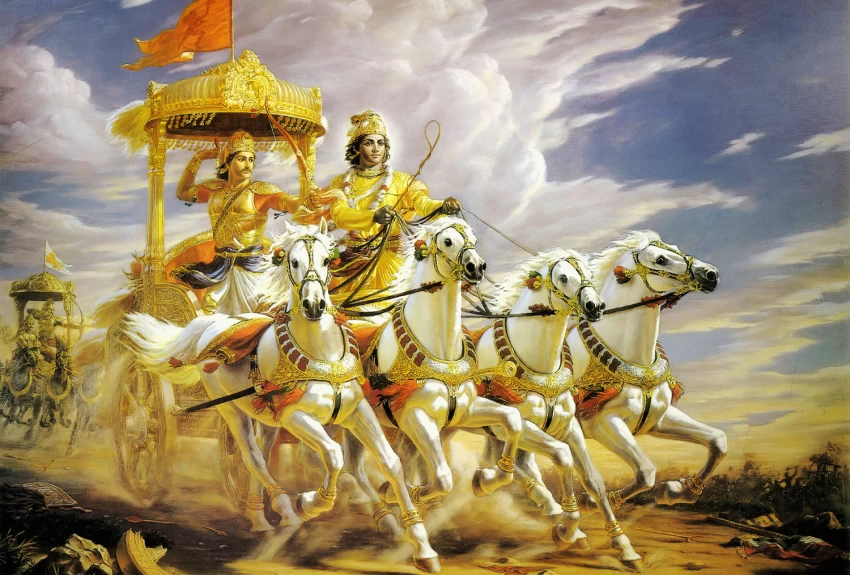
- The Bhagavad Gita: On the first morning of battle, Arjuna surveys the opposing army and sees his grandfather Bhishma, his guru Drona, his cousins and friends. He collapses, refuses to fight, and lays down his bow. Over the next 18 chapters (roughly 700 verses), Krishna counsels him on dharma, karma, the immortality of the soul, the nature of action, and the path to liberation. “You have a right to perform your prescribed duty, but not to the fruits of action.”
- The first ten days of battle under Bhishma’s command. Bhishma is a nearly invincible commander — but he has pledged not to kill the Pandavas and will not fight Shikhandi, the reborn Amba, who is recognised as a woman in a male body.
- On the tenth day, Arjuna uses Shikhandi as a shield, and Bhishma allows himself to be struck by Arjuna’s arrows — falling from his chariot onto a bed of arrows. Because of his boon of choosing his own death (iccha mrityu), he remains alive.
Why it matters: The Bhagavad Gita transforms this parva from a battle book into the Mahabharata’s philosophical summit. Bhishma’s fall on a bed of arrows is one of the epic’s most iconic images — the great patriarch brought low not by an enemy but by his own choice, watched by both armies in stunned silence.
7. Drona Parva — The Book of Drona
Sanskrit meaning: Named after the guru Drona
Sub-parvans: 8
Approximate length: ~8,909 shlokas
The Drona Parva covers days eleven through fifteen of the war and contains some of the Mahabharata’s most morally troubling episodes.
What happens:
- Drona takes command of the Kaurava forces after Bhishma’s fall. He is brilliant and devastating — but deeply susceptible to grief.
- The death of Abhimanyu: Arjuna’s young son Abhimanyu, just sixteen, knows how to enter the Chakravyuha (a spinning disc military formation) but not how to exit it. On the thirteenth day, trapped inside and surrounded, the Kaurava commanders violate the rules of war and attack him collectively — shattering his bow, killing his horses, and finally killing the boy in a manner the text describes as profoundly unjust. Arjuna’s grief and fury become one of the war’s defining emotional pivots.
- Yudhishthira’s lie: To break Drona’s will, Krishna orchestrates a deception: Bhima kills an elephant named Ashvatthama (the same name as Drona’s beloved son) and shouts the news. When Drona asks Yudhishthira — the one man he would believe — Yudhishthira says, “Ashvatthama is dead” — and adds quietly, “the elephant,” at which moment Krishna has drums beaten loudly. Drona, devastated, lays down his weapons. He is then beheaded by Dhrishtadyumna. The moment destroys Yudhishthira’s famous reputation for perfect truthfulness — the earth itself is said to tremble.
Why it matters: The Drona Parva dismantles the myth of a “clean” war. By the end of this book, both sides have violated the codes of honourable warfare. The grief over Abhimanyu and the moral cost of Yudhishthira’s lie establish that victory, when it comes, will be hollow.
8. Karna Parva — The Book of Karna
Sanskrit meaning: Named after Karna
Sub-parvans: 1
Approximate length: ~3,870 shlokas
The Karna Parva covers days sixteen and seventeen of the war — and the death of the epic’s most tragic figure.
What happens:
- Karna takes command of the Kaurava forces. His command is immediately troubled: he quarrels with Shalya, his own charioteer (assigned deliberately by Yudhishthira’s stratagem), who mocks him instead of encouraging him.
- On the seventeenth day, during his decisive duel with Arjuna, Karna’s chariot wheel sinks into the earth — the curse of a Brahmin he once accidentally wronged coming to fruition. He steps down to free it, appealing to Arjuna’s sense of fair play: “Wait — a warrior does not strike a defenceless man.” Krishna counsels Arjuna to strike regardless, reminding him of every rule of war Karna himself has violated. Arjuna releases the Anjalikastra and beheads Karna.
- After Karna’s death, Krishna reveals to Arjuna that Karna was his eldest brother. Arjuna is shattered.
Why it matters: The Karna Parva is the Mahabharata’s elegy for its most beloved tragic hero. Karna is not the villain of the story — he is its most pitiable victim: born great, denied recognition, forced to fight on the wrong side out of unbreakable loyalty. His death is not triumphant for Arjuna. It is a wound.
9. Shalya Parva — The Book of Shalya
Sanskrit meaning: Named after King Shalya
Sub-parvans: 4
Approximate length: ~3,220 shlokas
The Shalya Parva covers the war’s final day — the eighteenth — and its immediate aftermath.
What happens:
- Shalya commands the Kaurava forces on the last day. Yudhishthira kills him in a duel.
- Only Duryodhana survives among the major Kaurava warriors. He hides in a lake, using a yogic technique to remain submerged. The Pandavas find him; he emerges for a final mace duel with Bhima.
- The duel is a masterpiece of combat — Duryodhana is arguably the better fighter. But Bhima, on a barely concealed signal from Krishna, strikes him below the belt — on the thigh (the same thigh Duryodhana had exposed to Draupadi in the assembly hall). This is against the rules of mace combat.
- Duryodhana falls. He dies not defeated but defiant, denouncing the Pandavas for winning through deception at every turn.
- Balarama, Krishna’s elder brother and Duryodhana’s teacher, is furious at the foul blow and has to be restrained.
Why it matters: Duryodhana’s death is deeply ambiguous. He is the war’s architect, certainly — but his final words carry weight. He was right that the Pandavas won partly through deception. The war’s victory does not feel clean. The Mahabharata refuses a triumphant ending.
10. Sauptika Parva — The Book of the Sleeping Warriors
Sanskrit meaning: Sauptika = related to sleep, the sleeping
Sub-parvans: 2
Approximate length: ~870 shlokas
The shortest of the war books, the Sauptika Parva is also the most horrifying.
What happens:
- Three surviving Kaurava warriors — Ashvatthama (Drona’s son), Kripacharya, and Kritavarma — survive the war’s last day. Maddened by grief, Ashvatthama leads a night raid on the Pandava camp while everyone sleeps.
- He kills Dhrishtadyumna, who killed his father; Shikhandi; and the five sons of the Pandavas — Draupadi’s children, the Upapandavas — mistaking them for the brothers themselves.
- Draupadi demands Ashvatthama’s death. Arjuna captures him. Ashvatthama, as a last desperate act, releases the Brahmastra against the Pandavas; Arjuna releases his own Brahmastra in response. The collision of the two ultimate weapons would destroy the world. The sage Vyasa intervenes and commands both warriors to withdraw their weapons. Arjuna withdraws his. Ashvatthama, not knowing how, redirects his into the wombs of Pandava women — cursing all their unborn children. (Uttara’s unborn child — Parikshit — is saved by Krishna, who will become the next king.)
Why it matters: The Sauptika Parva is the war’s darkest postscript. Even after the fighting ends, the violence cannot stop — it has its own momentum, its own grief-born logic. The attack on sleeping warriors and unborn children is the Mahabharata’s starkest statement: war does not end when the last soldier falls.
11. Stri Parva — The Book of the Women
Sanskrit meaning: Strī = woman
Sub-parvans: 3
Approximate length: ~775 shlokas
The Stri Parva is among the most emotionally devastating sections of the Mahabharata — and one of its most underread.
What happens:
- Gandhari, Kunti, Draupadi, and the widows of the Kaurava warriors come to the battlefield at Kurukshetra to see the dead.
- The lamentation scenes are visceral: Gandhari walks among the mangled bodies of her hundred sons, and the text describes her grief without restraint.
- Gandhari, in her fury at Krishna, whom she holds responsible for not preventing the war, curses him: that he will watch his own clan, the Yadavas, destroy each other, and will himself die alone, unlamented, in the forest. Krishna accepts the curse calmly — he knows it to be just.
- Vidura provides the philosophical consolation: the dead were warriors who died in dharmic battle and have ascended to heaven. But the women’s grief will not be philosophised away, and the text gives it full weight.
Why it matters: The Stri Parva forces the Mahabharata’s reader to sit with the consequences of the war they have followed. It is not victors’ history — it is the history of those left behind. Gandhari’s curse of Krishna is one of the epic’s most significant moments: even the divine must be held accountable.
12. Shanti Parva — The Book of Peace
Sanskrit meaning: Śānti = peace, tranquillity
Sub-parvans: 3
Approximate length: ~14,732 shlokas (the second-longest parva)
The Shanti Parva is the Mahabharata’s great philosophical compendium — and one of the most challenging books for modern readers. It is also the book that explains why the Mahabharata calls itself more than a story.
What happens:
- Yudhishthira, paralysed by grief and guilt over the war’s devastation, refuses to rule. He wishes to renounce the world. Draupadi, Arjuna, Bhima, and eventually Krishna argue him back into kingship.
- The Pandavas visit Bhishma on his bed of arrows — the patriarch, shot through on the tenth day of battle, has been waiting on his arrowhead deathbed for the auspicious moment of Uttarayana (the winter solstice) to depart. For dozens of chapters, Bhishma discourses to Yudhishthira on:
- Rajadharma — the duties of a king; the philosophy of governance and justice.
- Apaddharma — the ethics of action in times of crisis; when rules may be bent.
- Mokshadharma — the path to liberation; detailed discussions of samkhya, yoga, and vedanta philosophy.
- The section includes the Vishnu Sahasranama — the thousand names of Vishnu — one of the most sacred and widely recited texts in Vaishnavism.
Why it matters: The Shanti Parva is the Mahabharata’s answer to the question the rest of the epic raises: How does one live after catastrophe? Bhishma’s deathbed teaching is not abstract philosophy — it is wisdom offered by a dying man who caused and witnessed enormous suffering, and who now tries to give meaning to what happened.
13. Anushasana Parva — The Book of Instructions
Sanskrit meaning: Anuśāsana = instructions, disciplines
Sub-parvans: 2
Approximate length: ~8,000 shlokas
The Anushasana Parva continues Bhishma’s teachings as he nears death.
What happens:
- Bhishma continues his discourses on dana (charity), dharma, and moksha — the obligations of generosity, the nature of righteousness, and the path to liberation.
- He speaks extensively on the duties and rights of different social classes, the ethics of kingship, the proper conduct of everyday life, and the relationship between the individual and the cosmic order.
- At the very end, Bhishma departs: he withdraws his breath through yogic practice and dies — his eyes fixed on Krishna, whom he recognises as Vishnu.
Why it matters: Bhishma’s death is one of the Mahabharata’s most peaceful moments after unrelenting tragedy. His discourses, though long, represent the distilled moral wisdom of a man who lived an exceptionally long and painful life in service of a flawed institution. In dying, he gives everything he knows.
14. Ashvamedhika Parva — The Book of the Horse Sacrifice
Sanskrit meaning: Aśvamedha = the horse sacrifice, a Vedic royal ritual
Sub-parvans: 2
Approximate length: ~3,320 shlokas
What happens:
- To purify his kingdom of the sin of war and establish supreme sovereignty, Yudhishthira performs the Ashvamedha Yagna (horse sacrifice) — a great Vedic ritual in which a consecrated horse is released to roam freely for a year, followed by an armed escort (led by Arjuna), and finally sacrificed.
- Arjuna travels across the subcontinent following the horse, fighting off kings who challenge the ritual. He encounters his own son Babhruvahana, who mortally wounds him — and is revived by the naga Ulupi, his former wife.
- The parva also contains the Anugita — a second, condensed philosophical discourse by Krishna to Arjuna, who admits he has forgotten much of the Bhagavad Gita’s teaching in the trauma of war.
Why it matters: The Ashvamedhika Parva is the Pandava kingdom’s attempt at renewal — a ritual acknowledgment that governance after mass killing requires active purification, not just political normalcy.
15. Ashramavasika Parva — The Book of the Hermitage
Sanskrit meaning: Āśramavāsika = dwelling in the hermitage
Sub-parvans: 3
Approximate length: ~1,506 shlokas
What happens:
- Dhritarashtra, Gandhari, and Kunti — the elders of the Kuru clan — renounce the world and retire to a forest hermitage, as is proper for those in the vanaprastha (forest-dweller) stage of life.
- The Pandavas visit them in the forest. In a remarkable scene, Dhritarashtra is given the opportunity to “see” his dead sons through Vyasa’s divine power — their spirits are called up from the afterlife for a single night of reunion.
- Dhritarashtra, Gandhari, and Kunti die in a forest fire — calmly, in meditation, as the smoke rolls over their ashram. They are cremated where they fall.
Why it matters: The Ashramavasika Parva marks the passing of the founding generation — the people whose choices made the war. Their deaths are quiet, voluntary, and almost serene: a profound contrast with the blood and noise of the Kurukshetra War.
16. Mausala Parva — The Book of the Clubs
Sanskrit meaning: Mausala = clubs, iron maces
Sub-parvans: 1
Approximate length: ~320 shlokas
The Mausala Parva is among the shortest books of the Mahabharata — and the saddest.
What happens:
- Thirty-six years after the war, Gandhari’s curse comes to fulfillment. The Yadava clan — Krishna’s own people — destroy themselves in a drunken brawl, fighting with reeds that miraculously become iron clubs. Krishna watches, makes no attempt to stop it.
- Balarama, Krishna’s elder brother, meditates under a tree and releases his soul.
- Krishna retires to the forest alone. He is mistaken for a deer by a hunter named Jara (meaning “old age”), who shoots an arrow that strikes his foot — his one vulnerable point. Krishna dies, calm and forgiving.
Why it matters: Krishna’s death is among the most deliberately humbling moments in all of world mythology. The god who spoke the Bhagavad Gita, who orchestrated the greatest war in history, dies alone in a forest, accidentally, shot in the heel like Achilles. The Mahabharata insists that nothing — not even divinity — escapes impermanence.
17. Mahaprasthanika Parva — The Book of the Great Journey
Sanskrit meaning: Mahāprasthāna = the great departure, the final journey
Sub-parvans: 1
Approximate length: ~120 shlokas (the shortest parva)
What happens:
- Hearing of Krishna’s death, the Pandavas and Draupadi renounce their kingdom, crown Parikshit (Abhimanyu’s son, the sole heir) as king, and begin their final journey northward toward Mount Meru — a pilgrimage of renunciation and death.
- One by one, Draupadi and the brothers fall as they walk, each for their moral failing: Draupadi for having loved Arjuna most among her husbands; Sahadeva for pride in his own wisdom; Nakula for pride in his beauty; Arjuna for having once claimed he would destroy all enemies in a single day; Bhima for excess in eating and boasting.
- Only Yudhishthira walks on — accompanied by a dog that has followed them through the entire journey.
Why it matters: The Mahaprasthanika Parva is the Mahabharata’s renunciation — the shedding of everything the story has been about. The death of each brother according to their flaw is the epic’s most unsparing act of honesty about its own heroes.
18. Svargarohanika Parva — The Book of the Ascent to Heaven
Sanskrit meaning: Svargārohaṇika = the ascent to heaven
Sub-parvans: 1
Approximate length: ~209 shlokas
What happens:
- The god Indra descends to take Yudhishthira to heaven, but Yudhishthira refuses to abandon the dog that has walked with him. Indra insists; Yudhishthira holds firm: “I will not abandon one who is devoted to me.” The dog then reveals itself as Dharma (the god of righteousness) — Yudhishthira’s own divine father — come to test him one last time.
- In heaven, Yudhishthira is shown a vision of the Kauravas in paradise and the Pandavas in torment. He chooses to remain in hell with his brothers rather than stay in a heaven without them. The torment dissolves — it was a final test.
- The epic ends with the Pandavas and Draupadi reunited in heaven in their divine forms, purified of their earthly identities.
Why it matters: The final parva is the Mahabharata’s grace note — a reminder that dharma, sincerely practiced, is ultimately rewarded not with worldly triumph but with spiritual wholeness. The dog-god scene is among the most beloved passages in all of Sanskrit literature: a king who has lost everything refusing to abandon the last faithful creature beside him. It is the Mahabharata’s final definition of righteousness.
Reading the 18 Parvas: A Practical Guide
If you’re new to the Mahabharata and want to engage meaningfully without reading all 100,000 verses immediately, here is a suggested reading path:
Start here (essential parvas for first-time readers):
- Adi Parva — For the characters and their origins
- Sabha Parva — The dice game and Draupadi’s humiliation
- Udyoga Parva — Krishna’s peace mission; Karna’s choice
- Bhishma Parva — The Bhagavad Gita
- Karna Parva — Karna’s death
- Stri Parva — The women’s lament
- Shanti Parva (selected chapters) — Bhishma’s deathbed wisdom
- Mausala Parva — Krishna’s death
- Svargarohanika Parva — The ending
For the philosophical Mahabharata: The Bhagavad Gita (Bhishma Parva), the Yaksha Prashna (Vana Parva), and the Mokshadharma section of the Shanti Parva form a coherent philosophical curriculum within the epic.
For the narrative Mahabharata: Follow the arc from Sabha Parva through Shalya Parva — the dice game to the end of the war — as a continuous narrative. This is perhaps the most dramatically compelling section.
FAQs About the 18 Parvas
What does “parva” mean in the Mahabharata? Parva is a Sanskrit word meaning “node,” “joint,” or “section” — as in the joint of a bamboo stem. It implies a natural break or division in the flow of a larger whole.
Which is the longest parva in the Mahabharata? The Vana Parva (Book of the Forest) is the longest, containing approximately 11,664 shlokas. The Shanti Parva is second at roughly 14,000 shlokas in some recensions.
Which parva contains the Bhagavad Gita? The Bhagavad Gita is found within the Bhishma Parva, specifically in chapters 23 through 40 of that book.
Which parva describes Karna’s death? Karna’s death during his duel with Arjuna is described in the Karna Parva, the eighth book of the Mahabharata.
How many sub-parvas does the Mahabharata have? The Mahabharata is traditionally divided into 100 sub-parvans (upa-parvans) within the 18 major books.
The 18 Books as One Complete Human Story
Taken together, the 18 parvas of the Mahabharata are not simply the chapters of an epic — they are the chapters of an age. They move from the optimistic world-building of the Adi Parva, through the shattering dice game of the Sabha, the long philosophical education of the Vana, the brilliance and horror of the war books, the deep grief of the Stri Parva, the hard-won wisdom of the Shanti Parva, and finally the transcendence of the Svargarohanika. The arc is not triumphant — it is honest.
The Mahabharata tells us that every dynasty falls, every great warrior dies alone or in battle, every act of pride extracts its price, and every act of genuine loyalty and righteousness leaves its trace in the cosmos. The 18 books are 18 different angles on the same inescapable truth: life is dharma, and dharma is difficult, and the attempt to live it fully is the whole of the human story.
That is why this 3,000-year-old text still commands attention. Not because it is ancient, but because it is — in every parva, in every shloka — still present.
References for further reading:
- Introduction to the Mahabharata — The World’s Longest Epic
- Who Is Krishna in the Mahabharata? The Complete Character Study
- The Bhagavad Gita Explained: Themes, Philosophy, and Key Verses
- Draupadi in the Mahabharata: The Most Complex Woman in Ancient Literature
- The Mahabharata vs. The Ramayana: Similarities, Differences, and Connections