
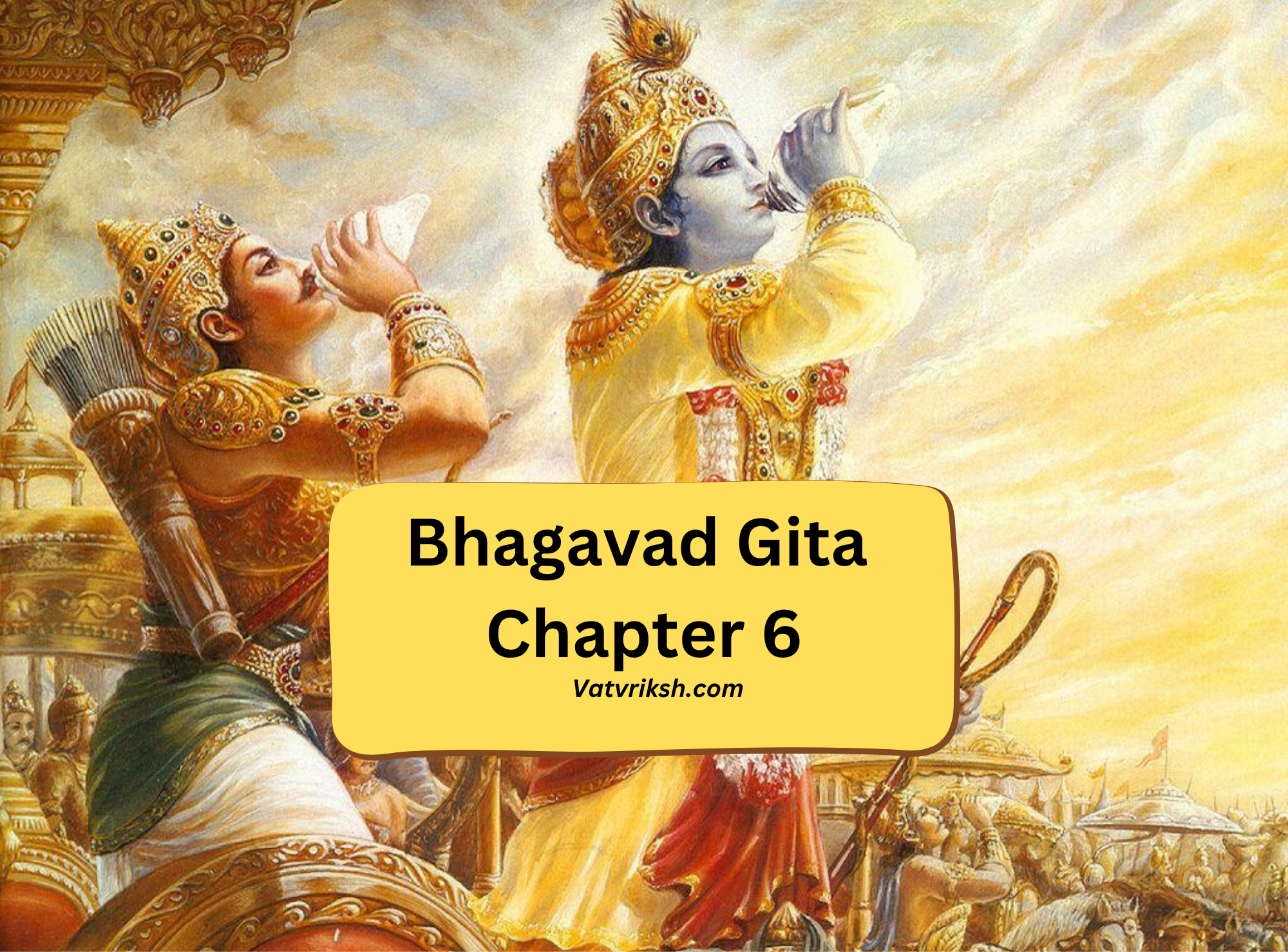
Anyone who has tried to sit quietly with their own mind for even a few minutes knows the truth Arjuna is about to confess to Krishna: the mind does not want to be still. It jumps, wanders, argues, plans, and resists — sometimes most fiercely in the very moments we most want it to settle. This universal, deeply relatable struggle sits at the heart of Chapter 6 of the Bhagavad Gita, one of the most practically instructive chapters in the entire text.
Having spent the previous chapters establishing the philosophy of selfless action and the unity of renunciation and engagement, Krishna now turns to the actual mechanics of inner practice. Chapter 6, known as Dhyana Yoga — “The Yoga of Meditation” — offers something the Gita has not yet given Arjuna: concrete, practical instruction on how to actually sit, breathe, focus the mind, and cultivate the inner stillness that the previous five chapters have been describing in more abstract terms.
From Philosophy to Practice
By Chapter 6, Arjuna has received a substantial philosophical education. He understands, at least intellectually, that the self is eternal, that selfless action is a path to liberation, that Krishna periodically incarnates to restore dharma, and that true renunciation is an internal, mental event rather than a physical one. But understanding a teaching intellectually and being able to live it are two very different things.
Chapter 6 bridges this gap. It opens by reaffirming the unity between renunciation and action established in Chapter 5, then moves into detailed, almost technical guidance on meditative practice — posture, breath, diet, discipline of the mind — before closing with one of the most reassuring passages in the entire Gita, addressing the fear of spiritual failure.
The Story Narrative
The True Sannyasi and Yogi Are the Same Person
Krishna opens by clarifying, once more, who truly deserves to be called a sannyasi (renunciate) and a yogi. He says it is one who performs their prescribed duty without depending on the fruits of that action — not one who has merely abandoned the sacred fire or ritual activities. What is called renunciation, Krishna says, is simply another name for Karma Yoga properly understood, since no one becomes a true yogi without first renouncing personal desire and selfish intention.
He adds a memorable clarification about the relationship between action and stillness at different stages of spiritual growth: for a sage who wishes to climb toward the heights of meditative absorption (dhyana yoga), selfless action is described as the means; but for one who has already attained that height, stillness (shama) itself becomes the means to further progress.
Why It Matters: This teaching resists a common misunderstanding — that meditation and action are simply opposites, with meditation reserved for advanced practitioners and action for everyone else. Instead, Krishna describes a developmental sequence: engaged, selfless action is often the very training ground that prepares a person for deeper meditative stillness, rather than something to be abandoned once “real” spiritual practice begins.
Be Your Own Friend, Not Your Own Enemy
Krishna offers a striking and often-quoted teaching here about self-relationship: a person should elevate themselves through their own effort, and should not degrade themselves, because the self alone is the friend of the self, and the self alone is also the enemy of the self.
He explains this further: for one who has conquered the lower self through the higher self, the self is indeed a friend; but for one who has failed to do so, the very self behaves antagonistically, like an enemy. This teaching, though brief, offers a psychologically rich framework — placing responsibility for a person’s inner state squarely within their own hands, while acknowledging just how real and difficult the inner struggle for self-mastery can be.
The Qualities of the Self-Controlled Yogi
Krishna then describes the person of self-mastery (the one who has “conquered themselves,” in the language of the previous verse): such a person remains steady and undisturbed amid cold and heat, pleasure and pain, honor and dishonor — the same dvandva (pairs of opposites) discussed in earlier chapters. Their higher self rests in deep serenity, and they treat a clump of earth, a stone, and gold with equal regard — a vivid image emphasizing complete freedom from craving toward material wealth or possessions.
Such a person is described as superior among all — friends, well-wishers, enemies, neutral parties, mediators, the hateful, relatives, the righteous, and the unrighteous — treated with the same equanimity, since this yogi has transcended reactive, partisan judgments of others based on personal gain or loss.
Practical Instructions for Meditation
This is where Chapter 6 becomes distinctly different from the chapters preceding it — Krishna moves into genuinely practical, almost step-by-step guidance for meditative practice, likely the most detailed instruction on the mechanics of meditation found anywhere in the Gita.
He instructs the yogi to withdraw to a solitary, secluded place, to hold body, mind, and self under control, free from expectation and possessiveness. He describes preparing a firm seat (asana) in a clean spot, neither too high nor too low, covered with cloth, deerskin, and kusha grass in sequence.
Seated there, Krishna says, one should fix the mind on a single point, restraining the activities of the thinking mind and senses, and practice yoga for the purification of the self. He describes maintaining the body, head, and neck erect and still, gazing steadily at the tip of the nose without letting the eyes wander in other directions, remaining serene and fearless, firm in the vow of celibacy or restraint (brahmacharya), with mind controlled and thoughts fixed, sitting in this posture with the highest aim being union with the divine.
Why It Matters: These verses have functioned, historically, almost like a foundational meditation manual within the broader Gita text. They ground the philosophical teaching of the previous chapters in bodily, practical reality — a reminder that spiritual growth, in this tradition, is not purely an intellectual or emotional matter, but involves disciplined engagement with posture, attention, and breath.
The Middle Path: Neither Excess Nor Extreme Denial
Krishna offers guidance here that feels remarkably balanced and non-extreme, especially compared to some ascetic traditions of the time. Yoga, he says, is not for one who eats too much or too little, nor for one who sleeps excessively or remains excessively wakeful.
Rather, for one who is moderate in eating and recreation, moderate in effort during action, and moderate in sleep and wakefulness, yoga becomes the destroyer of all sorrow. This teaching of the middle path — avoiding both self-indulgence and harsh self-denial — echoes similar teachings found in other Indian spiritual traditions of the era, and offers Arjuna (and readers today) a reassuring counterbalance to any temptation toward extreme asceticism.
The Restless Mind Compared to a Flickering Lamp
Krishna describes the ultimate aim of this practice: when the well-disciplined mind rests only in the self, free from craving for any object of desire, then a person is said to be established in yoga. He offers a beautiful, enduring image here — comparing the steady mind of a true yogi to a lamp sheltered from the wind, which does not flicker.
In this state, Krishna says, the mind, restrained through the practice of yoga, becomes still; the self perceives the true self through the self, and finds contentment within itself. In this condition, one experiences a boundless joy that lies beyond the senses, perceivable only through the purified intellect; established here, one does not waver from this reality, even amid the heaviest of sorrows.
He identifies this state as true yoga — a severing of the very union with suffering (duhkha-samyoga-viyoga) — and urges Arjuna to practice this yoga with determination, undistracted by discouragement.
Arjuna’s Honest Objection: The Mind Is Restless
Here comes one of the most relatable moments in the entire Bhagavad Gita. Arjuna, having just heard this description of perfect meditative stillness, responds with what almost every practitioner of meditation across every tradition has felt: he says the mind is restless, turbulent, powerful, and obstinate — and that trying to control it feels as difficult as trying to control the wind.
This is not a rhetorical objection; it’s a deeply sincere, almost vulnerable admission of the gap between the ideal Krishna has just described and the lived reality of trying to sit still with one’s own thoughts.
Krishna’s response is notably compassionate rather than dismissive. He agrees — the mind is indeed restless and difficult to restrain, he says — but adds that through consistent practice (abhyasa) and detachment (vairagya), it can indeed be controlled. He acknowledges the genuine difficulty of the path while affirming, clearly, that it is not impossible.
The Fear of Spiritual Failure — and Krishna’s Reassurance
Arjuna then raises a question that speaks to a very human anxiety: what happens to a person of faith who begins the path of yoga sincerely, but whose mind wanders away from practice, and who fails to attain perfection? Does such a person, having fallen short of both worldly success and spiritual attainment, simply perish, “like a dissolving cloud,” without a foothold in either domain?
Krishna’s answer here is among the most comforting passages in the entire Gita. He states plainly that neither in this world nor beyond is there ever ruin for such a person — because no one who does good, he says, ever comes to a bad end. One who has fallen from the path of yoga, Krishna explains, attains the worlds of the righteous after death, dwelling there for a long time, and is then born again into a family of the pure and prosperous — or, more remarkably still, into a family of yogis endowed with wisdom, where such a birth is described as exceedingly rare in this world. In that fortunate birth, Krishna adds, the person spontaneously reconnects with the spiritual understanding developed in their previous life, and continues striving toward perfection from that renewed starting point, carried forward by the very momentum of their earlier sincere effort.
He closes the point simply: the sincere seeker, through this accumulated effort across lifetimes, purified of imperfection and perfected through many births, eventually attains the supreme goal.
Why It Matters: This teaching directly addresses the fear of wasted effort or spiritual failure — a fear that quietly discourages many sincere seekers from even beginning a serious practice. Krishna’s reassurance is unambiguous: sincere spiritual effort is never lost, even if outward perfection is not achieved within a single lifetime.
The Best of All Yogis
The chapter closes with Krishna’s declaration of the yogi’s superiority over other paths — considered greater than ascetics who perform severe austerities, greater than scholars of scripture, and greater than those devoted purely to ritual action. And among all yogis, Krishna says, the one who worships him with a mind absorbed in devotion, filled with faith, is considered by him to be the most deeply united in yoga of all. This closing line quietly foreshadows the devotional (bhakti) themes that will become increasingly central in the chapters ahead.
Deeper Philosophical Meaning
Chapter 6 accomplishes something the Gita has not quite done before: it moves from philosophical argument to embodied practice, providing an experiential bridge between understanding a teaching and actually living it.
The developmental relationship between action and meditation: Krishna’s teaching that action serves as the training ground for the beginner, while stillness becomes the method for the advanced practitioner, offers a nuanced, non-contradictory way of understanding the relationship between Karma Yoga (Chapters 3–5) and Dhyana Yoga (this chapter).
The self as both ally and adversary: The teaching that “the self is the friend of the self, and the self is also the enemy of the self” is a compact but profound statement about personal responsibility and inner conflict, locating the true battlefield of spiritual life within one’s own mind rather than in external circumstances.
Reassurance as spiritual method: Krishna’s response to Arjuna’s fear of falling short is itself a teaching technique worth noticing — rather than intensifying anxious striving, Krishna removes the fear of failure entirely, on the principle that this removal of fear itself supports genuine progress.
What This Chapter Means for Life Today
A restless mind is not evidence of spiritual failure — it’s the starting condition everyone begins with. Arjuna’s honest admission that his mind feels as difficult to control as the wind is deeply reassuring for modern readers who often assume that a wandering, distracted mind during meditation or quiet reflection means they’re “doing it wrong.” Krishna’s calm acknowledgment — yes, it’s difficult, and yes, it’s possible through sustained practice — offers a realistic, non-judgmental starting point for anyone beginning a meditation or mindfulness practice today.
Balance outperforms extremes. Chapter 6’s teaching on moderation — neither excessive indulgence nor excessive denial in eating, sleep, or effort — anticipates modern conversations about sustainable habits and burnout prevention. The chapter suggests that lasting inner peace is built through consistent, moderate discipline rather than dramatic, unsustainable extremes.
Effort is never wasted, even when outcomes fall short. Krishna’s reassurance to Arjuna about the fate of the “fallen” yogi speaks directly to a very modern anxiety: the fear that unfinished projects, incomplete self-improvement efforts, or interrupted spiritual and personal growth somehow erase the value of the effort already made. The Gita’s answer is unambiguous: sincere effort accumulates and carries forward, rather than disappearing.
Self-relationship shapes everything else. The teaching that the self can be either one’s greatest friend or greatest enemy remains a strikingly modern insight into the importance of self-talk, self-discipline, and self-compassion as foundations for any other kind of growth or achievement.
Frequently Asked Questions
What is the main teaching of Bhagavad Gita Chapter 6? Chapter 6 provides detailed, practical instruction on meditation (Dhyana Yoga) — covering posture, moderation, and mental discipline — while addressing the common fear of spiritual failure and reassuring that sincere effort is never wasted.
What meditation posture does Krishna describe in Chapter 6? Krishna instructs sitting on a firm, clean seat with body, head, and neck held steady and erect, gazing at the tip of the nose, remaining calm and fearless, with the mind focused on a single point of concentration.
What does Krishna mean by “the self is the friend and enemy of the self”? This teaching emphasizes that a person’s own disciplined effort determines whether their mind supports or undermines their growth — one who has mastered their lower impulses finds the self acts as an ally, while one who has not finds the self behaves like an adversary.
What happens to a yogi who fails to complete their spiritual practice, according to this chapter? Krishna reassures Arjuna that such a person is never ruined; they attain favorable realms after death and are reborn into circumstances — sometimes into a family of wise yogis — that allow them to resume their spiritual progress from where they left off.
What does Krishna say about moderation in Chapter 6? Krishna teaches that yoga is not attained through excessive eating, excessive fasting, excessive sleep, or excessive wakefulness, but through moderation in eating, recreation, effort, and rest.
How many verses are in Bhagavad Gita Chapter 6? Chapter 6 contains 47 verses, making it one of the more detailed chapters in terms of practical instruction, particularly regarding meditative technique.
Chapter 6 offers something rare within a philosophical or scriptural text: genuinely usable, step-by-step guidance for quieting a restless mind, paired with one of the most compassionate reassurances in all of Indian spiritual literature — that sincere effort toward inner peace, even when imperfect or unfinished, is never lost.