
Estimated reading time: 17 minutes
There is a story told across Asia — in Sanskrit and Tamil, in Thai and Javanese, in Tibetan and Malay — about a prince who loses everything and walks into the forest with his wife and brother, about a demon king who steals what is most precious to him, and about the war that follows. The story has been told for over two thousand years without interruption. Children hear it before they learn to read. Kings have staged it at coronations. Philosophers have argued over it. Devotees have wept over it. And poets, in every generation and every language, have found in it something they could not say any other way.
This is the Ramayana.
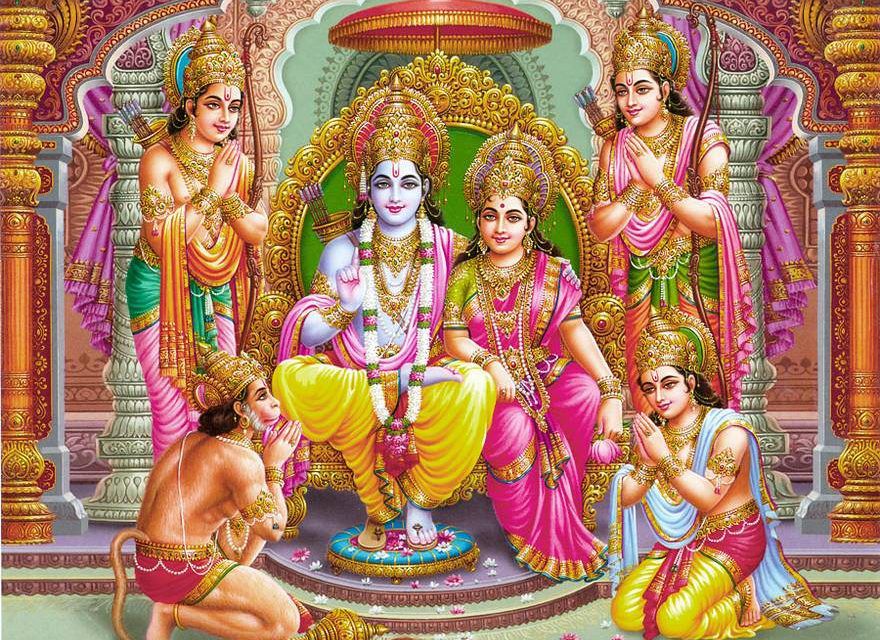
At roughly 24,000 verses (shlokas) divided into seven books (kandas), the Ramayana is the shorter of the two great Sanskrit epics — the other being the Mahabharata. But brevity, here, is not the same as simplicity. The Ramayana is one of the most emotionally concentrated, philosophically rich, and culturally consequential works ever composed. Its hero, Rama, is not merely a fictional prince — he is Hinduism’s ideal of dharmic (righteous) human life, worshipped by hundreds of millions as the seventh avatar of Vishnu and regarded in the bhakti (devotional) tradition as the very name of God.
Whether you are approaching the Ramayana as a student of world literature, a curious reader, a practitioner of Hindu philosophy, or simply someone who has heard the name and wanted to know more — this introduction covers everything: the story, the characters, the authorship, the philosophy, and the lasting cultural meaning of one of humanity’s defining epics.
What Is the Ramayana? A First Overview
The Ramayana (Sanskrit: रामायण, Rāmāyaṇa) — the word means “the journey of Rama” or “the ways of Rama” — is an ancient Indian epic narrative attributed to the poet-sage Valmiki, widely honoured as the Ādi Kavi, the “first poet.” Valmiki is credited with inventing the shloka — the two-line Sanskrit verse form that became the dominant metre of Sanskrit poetry — and the Ramayana is considered the Ādi Kāvya: the “first poem.”
Like the Mahabharata, the Ramayana belongs to the genre of itihāsa (“thus indeed it was” — history, in the Sanskrit sense), though it is also classified as kāvya (poetry, literary art). The distinction matters: unlike the Mahabharata, which reads partly as a historical chronicle, the Ramayana was consciously composed as a work of literary beauty. Valmiki was not just preserving a story — he was crafting it with the deliberate artistry of a poet.
At the core of the Ramayana is a deceptively simple narrative: a prince is exiled, his wife is abducted, and he wages war to win her back. But around this spine, Valmiki builds a world of immense moral complexity — exploring what it means to be a good son, a good king, a good husband, a good brother, and a good servant, and asking what happens when these obligations conflict with each other.
The epic has been estimated to have reached its current form sometime between 500 BCE and 100 BCE, though the story it tells is likely far older — rooted in oral traditions going back to the second millennium BCE or beyond. It has been continuously recomposed, retold, translated, and adapted ever since.
Who Wrote the Ramayana? The Legend of Valmiki
Valmiki: The First Poet
The Ramayana’s traditional author is Maharshi Valmiki — one of the most celebrated figures in all of Sanskrit literature. His origin story is as compelling as the epic he composed.
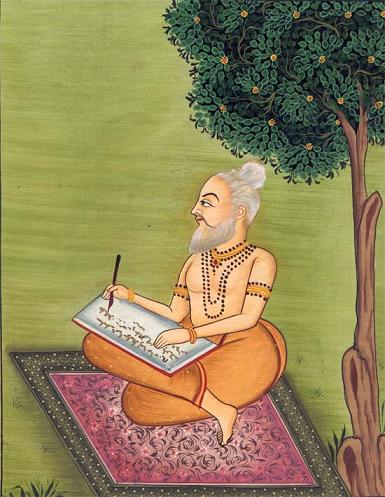
According to tradition, Valmiki was originally a highway robber named Ratnakara, who lived by plunder. One day he waylaid the sage Narada, who asked him a question that would change his life: “You commit these crimes to support your family — but will your family share the burden of your sins?” Ratnakara went home to ask and discovered that his family, though happy to receive what he brought, wanted no part in the moral consequences of how he earned it. Shattered by the revelation, he returned to Narada, who taught him to meditate on the name of Rama. Ratnakara sat in meditation for so many years that an anthill (valmiki in Sanskrit) grew over him. When he emerged, transformed, he had become Valmiki — and was ready to receive the story of Rama.
This origin story is thematically significant: the first poet began as a man of violence and was redeemed through devotion. The Ramayana is, in part, a story about the redemptive power of virtue — and its author’s own transformation embodies that theme.
The Divine Spark: The Shloka’s Origin
The Ramayana contains a celebrated story about the invention of poetry itself. One day, Valmiki witnessed a hunter shoot an arrow at a pair of mating cranes (krauncha birds), killing the male as it flew. The female’s cry of grief pierced the sage so deeply that his sorrow spontaneously expressed itself in a verse — the first shloka — which he then recognised as a new form of utterance: rhythmic, metrically structured grief. The word shloka, in fact, is derived from shoka — sorrow. The first poem was born from compassion for suffering.
The god Brahma then appeared to Valmiki and commanded him to compose the story of Rama in this newly discovered form. The Ramayana was thus both divinely commissioned and artistically innovative — a poem that knew itself to be a poem.
Is Valmiki a Character in His Own Epic?
Like Vyasa in the Mahabharata, Valmiki appears within the Ramayana itself. In the seventh and final book, after Rama exiles Sita to the forest, she takes refuge in Valmiki’s ashram and gives birth to her twin sons, Lava and Kusha, there. Valmiki raises the boys and teaches them to sing the Ramayana. The story culminates in Lava and Kusha performing the entire epic in Rama’s court — the author’s fictional creations singing the author’s poem to its hero. This meta-literary gesture is one of the most sophisticated moments in ancient literature.
The Structure of the Ramayana: Seven Kandas
The Ramayana is divided into seven kandas (books):
- Bala Kanda — The Book of Youth: Rama’s birth, childhood, education, and marriage to Sita.
- Ayodhya Kanda — The Book of Ayodhya: The eve of Rama’s coronation, his exile, and Dasharatha’s death.
- Aranya Kanda — The Book of the Forest: The forest years; Sita’s abduction by Ravana.
- Kishkindha Kanda — The Book of Kishkindha: The alliance with the monkey king Sugriva; Hanuman’s appointment.
- Sundara Kanda — The Beautiful Book: Hanuman’s flight to Lanka and his meeting with Sita.
- Yuddha Kanda (Lanka Kanda) — The Book of War: The battle for Lanka; Ravana’s defeat.
- Uttara Kanda — The Concluding Book: Sita’s exile; Lava and Kusha; Rama’s return to heaven.
Scholars note that the first and seventh books (Bala Kanda and Uttara Kanda) are likely later additions, with the original core of the epic being books two through six. The central five books have a remarkable narrative unity — a tightly structured story of loss, endurance, friendship, and redemption.
The Story of the Ramayana: A Complete Summary
Bala Kanda — The Prince of Ayodhya
The epic opens in the kingdom of Kosala, whose magnificent capital is Ayodhya — a city of legendary beauty on the banks of the river Sarayu. Its king is Dasharatha, a powerful and beloved ruler of the Solar Dynasty (Suryavamsha) — the same lineage said to have produced the god-kings of the Vedic age. Dasharatha is aged, virtuous, and deeply unhappy: despite three wives — Kaushalya, Kaikeyi, and Sumitra — he has no sons to succeed him.
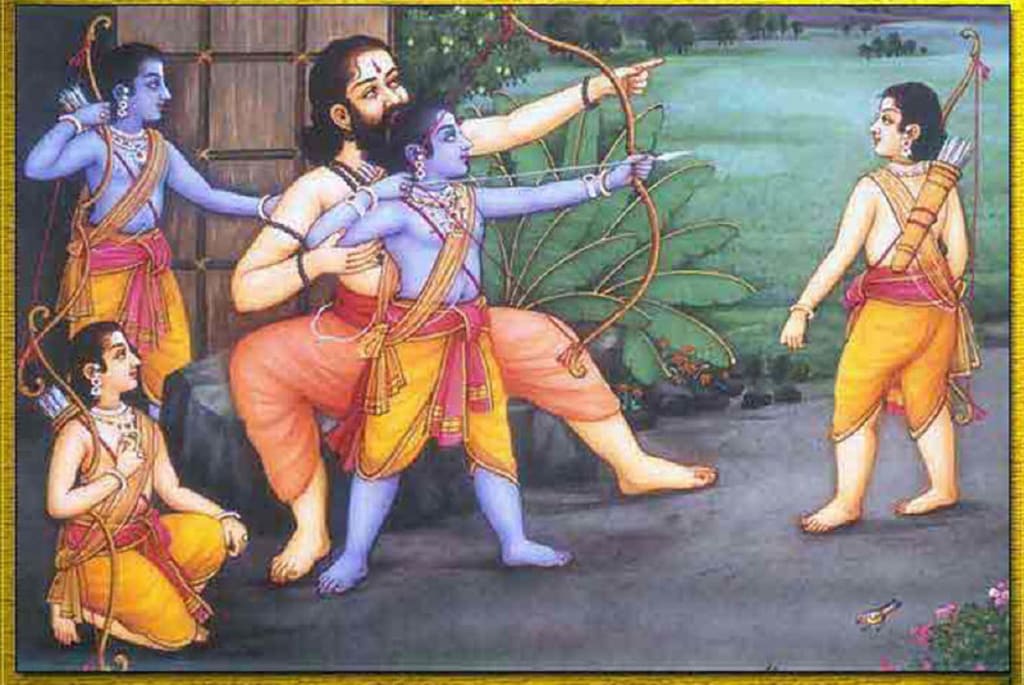
Performing the Putrakameshti Yagna (a Vedic ritual for sons), Dasharatha receives a divine vessel of payasam (sacred rice pudding) from Agni, the fire god. He divides it among his queens: Kaushalya receives the largest portion and gives birth to Rama; Kaikeyi receives the next and gives birth to Bharata; Sumitra receives two portions and gives birth to Lakshmana and Shatrughna.
The four princes are extraordinary, but Rama is exceptional among them: he possesses divine beauty, matchless archery skill, and a quality the Sanskrit text calls maryada — adherence to the boundaries of righteous conduct. He is, from boyhood, a person in whom virtue and power exist in perfect balance.
As young men, the brothers are sent to study under the sages. Rama and Lakshmana accompany the sage Vishwamitra to protect his forest ashram from demons, killing the demoness Tataka and the demon Subahu. Vishwamitra then takes them to the court of Janaka, the philosopher-king of Mithila — and to a swayamvara (a royal bride-choosing ceremony).
King Janaka has a condition for any man who wishes to wed his daughter: he must string the divine bow of Shiva — the Shiva Dhanush — a bow so massive that hundreds of kings have been unable even to lift it. Rama steps forward, lifts the bow with one hand, strings it — and in drawing it back, breaks it with a sound like thunder. King Janaka weeps with joy: Sita will marry Rama.
Sita (also called Janaki, daughter of Janaka) is herself a figure of mythic origin. She was not born of woman — she was discovered as an infant in a furrow of the earth as Janaka plowed his field, a child of the earth goddess. This origin will reverberate through the entire epic, ending in her return to the earth that bore her.
Ayodhya Kanda — The Exile
This is the Ramayana’s dramatic pivot — and one of the great episodes in world literature.
Dasharatha, now old, decides to crown Rama as his heir. The entire kingdom rejoices. But on the eve of the coronation, Manthara — a hunchbacked maid and the manipulative confidante of Queen Kaikeyi — poisons Kaikeyi’s mind. Years ago, Kaikeyi once saved Dasharatha’s life on a battlefield, and in gratitude the king granted her two boons of her choosing. Manthara persuades her to cash both boons now: the first, that her son Bharata be crowned king instead of Rama; the second, that Rama be exiled to the forest for fourteen years.
Dasharatha is shattered. He cannot break his promise. He pleads with Kaikeyi through the night. She is immovable.
When Rama is informed, his response defines his character entirely: he does not protest, does not argue, does not accuse his stepmother. He says — calmly, completely — that he will go. He will honour his father’s promise. He will not allow Dasharatha to become a man who broke his word.
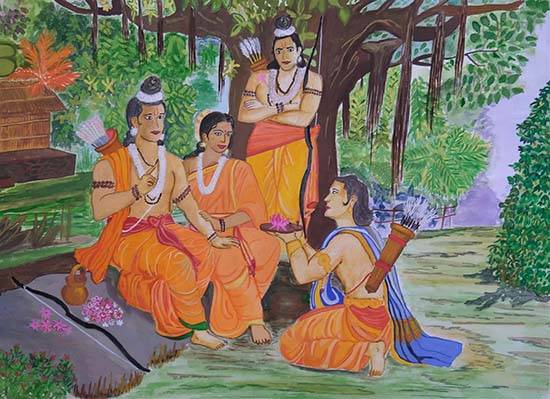
Sita insists on accompanying him, despite his every attempt to dissuade her. Her argument is among the Ramayana’s most celebrated passages: “The forest where you go becomes Ayodhya for me. Any place without you is a foreign land.”
Lakshmana, fiercely devoted to Rama, refuses to stay behind. He accompanies his brother in rage at the injustice and total loyalty to the man he serves.
The three walk out of Ayodhya. The citizens follow them weeping. Dasharatha, whose heart cannot survive the separation, dies of grief within days. Bharata, who was away at his maternal uncle’s home, returns to find his father dead and his mother’s catastrophic ambition laid bare. He is horrified. He rejects the throne, goes to the forest to beg Rama to return, and when Rama refuses — bound by his word — Bharata places Rama’s sandals on the throne and rules as regent in his name, refusing even to enter the palace.
Aranya Kanda — The Forest, and the Abduction
Rama, Sita, and Lakshmana spend their years in the beautiful and dangerous Dandaka Forest. They live simply, visit sages, and protect the forest hermitages from demon incursions.
In the forest, the demoness Shurpanakha — sister of the demon king Ravana of Lanka — falls obsessively in love with Rama. When he gently rejects her (pointing to Lakshmana as an alternative, a playful misdirection he will later regret), she attacks Sita in jealousy. Lakshmana cuts off her nose and ears. Shurpanakha flees to Lanka and presents Ravana with two irresistible provocations: the insult to her honour, and a description of Sita’s beauty so vivid it inflames Ravana’s desire.
Ravana, the ten-headed, twenty-armed demon king, is the Ramayana’s great antagonist — and one of the most complex villains in world literature. He is a scholar of the Vedas, a master musician, a devoted worshipper of Shiva, and the ruler of the most magnificent city in the world. He is also consumed by desire, pride, and an inability to hear counsel that contradicts his will.
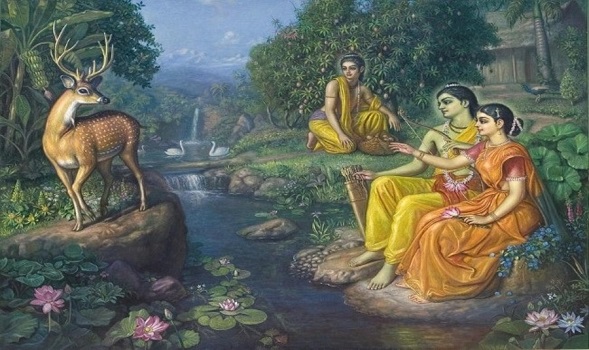
Ravana devises a plan. He sends the demon Maricha — disguised as a golden deer of unearthly beauty — to catch Sita’s eye. Sita is enchanted and begs Rama to catch it for her. Rama, sensing a trap yet unable to refuse Sita, goes in pursuit, leaving Lakshmana to guard her. Maricha, dying, cries out in Rama’s voice: “Lakshmana, help me!” Sita, terrified, forces Lakshmana to leave her and go to his brother’s aid. Before he goes, Lakshmana draws the famous Lakshmana Rekha — a protective line around the cottage — and warns Sita not to cross it for any reason.
Ravana arrives disguised as a wandering mendicant, begging alms. Sita, moved by the sacred obligation of hospitality to a Brahmin, steps across the Lakshmana Rekha to offer him food. In that instant, Ravana seizes her and carries her away in his flying chariot. The ancient vulture king Jatayu — an old friend of Dasharatha — sees the abduction and attacks Ravana with heroic ferocity. Ravana cuts off Jatayu’s wings. The old bird falls.
Rama returns to find Sita gone. Lakshmana returns to find Rama — for the only time in the epic — broken. His grief for Sita fills the Aranya Kanda’s final chapters with extraordinary emotional intensity. The man who accepted exile without a tremor weeps in the forest for the wife he could not protect.
Kishkindha Kanda — The Alliance
Travelling south in search of Sita, Rama and Lakshmana encounter the dying Jatayu, who tells them Ravana carried Sita southward before he expires. They enter the forest of Kishkindha, the realm of the Vanaras (a race of intelligent, semi-divine monkeys).
Here they meet Sugriva, the exiled monkey king, hiding from his brother Vali — who has usurped his throne and taken his wife. Rama makes an alliance with Sugriva: he will kill Vali and restore Sugriva’s kingdom; Sugriva will deploy his vast monkey army to find Sita.
Rama kills Vali in a controversial episode that has generated centuries of philosophical debate: he kills Vali from behind a tree while Vali fights Sugriva — a method widely considered dishonest. Vali, dying, challenges Rama directly on this point, and Rama’s explanation — that dharma here demanded an exception — is notably not wholly satisfying. The Ramayana is not afraid to leave moral questions open.
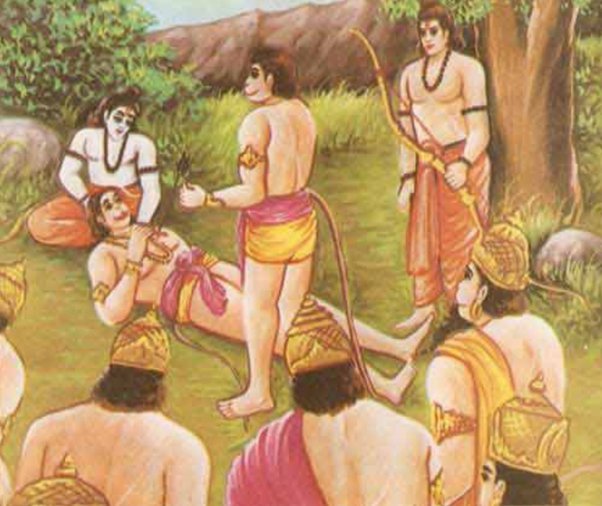
And then there is Hanuman — Sugriva’s minister, son of the wind god Vayu, the most beloved figure in the entire Ramayana and one of the most beloved in all of world mythology.
Sundara Kanda — The Beautiful Book
The Sundara Kanda — “the beautiful book” — is named for Hanuman, whose beauty is understood not just physically but spiritually: he is the perfect devotee, the ideal servant, the being whose strength is inseparable from his love. It is the most widely read and independently recited section of the Ramayana, chanted as a complete text in homes, temples, and public recitations for the blessings it is believed to carry.
Hanuman alone among the Vanaras can leap across the ocean to Lanka. He does so — shrinking to the size of a cat to slip past the guards, then expanding to the size of a mountain to terrify them. In Lanka, searching through the demon city, he finds Sita imprisoned in the Ashoka Grove (Ashokavana), surrounded by demoness guards, refusing food, draped in sorrow but unbroken in spirit.
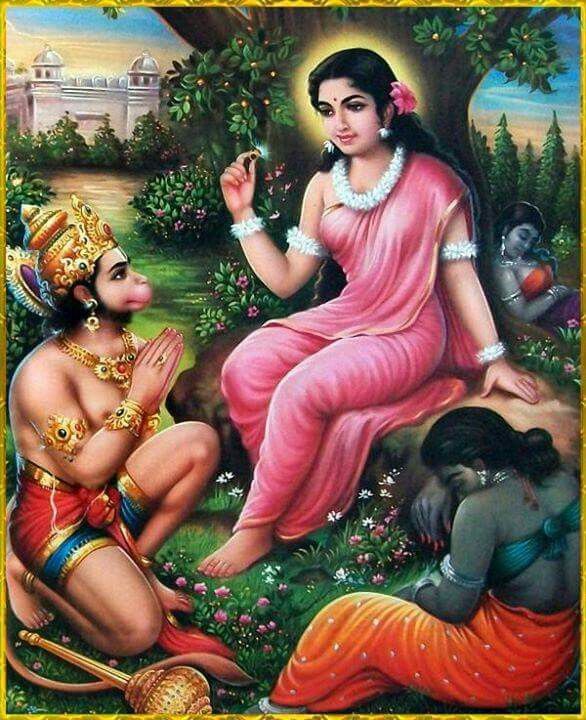
Hanuman reveals himself, presents Rama’s ring as proof of his identity, and offers to carry Sita back. She refuses: it must be Rama who comes for her, she says — not because she cannot save herself, but because Ravana’s insult is to Rama’s honour and must be answered by Rama. This is a point often misread as passivity; it is, in the text, an act of understood dharma.
Hanuman then deliberately allows himself to be captured, is brought before Ravana, and delivers Rama’s ultimatum: return Sita and live. Ravana refuses. Hanuman’s tail is wrapped in cloth and set on fire. He breaks free and burns Lanka to the ground — sparing only the Ashoka Grove where Sita sits. He leaps back across the ocean with the news.
Yuddha Kanda — The War for Lanka
The Yuddha Kanda is the epic’s great climax — a war narrative comparable in grandeur to Homer’s Iliad, but filtered through a moral framework that is distinctly Indian.
Rama’s army of Vanaras builds a bridge across the ocean to Lanka — the Rama Setu (also called Adam’s Bridge), whose remnants, some believe, can still be seen between India and Sri Lanka. The demon king’s wise brother, Vibhishana, defects to Rama’s side after failing to counsel Ravana toward reason — a moment of moral clarity at significant personal cost.
The war is vast. Its most dramatic episodes include:
- Lakshmana’s near-death: Struck by Ravana’s son Indrajit’s brahmastra (the Shakti weapon), Lakshmana falls unconscious. Hanuman flies to the Himalayas for the life-restoring herb Sanjeevani and — unable to identify it quickly — uproots the entire mountain and carries it back. Lakshmana is revived.
- The killing of Kumbhakarna: Ravana’s giant brother, who sleeps for months at a time, is awakened to fight and killed by Rama.
- Indrajit’s defeat: Ravana’s brilliant, nearly invincible son — who defeated even the god Indra in battle — is finally killed by Lakshmana.
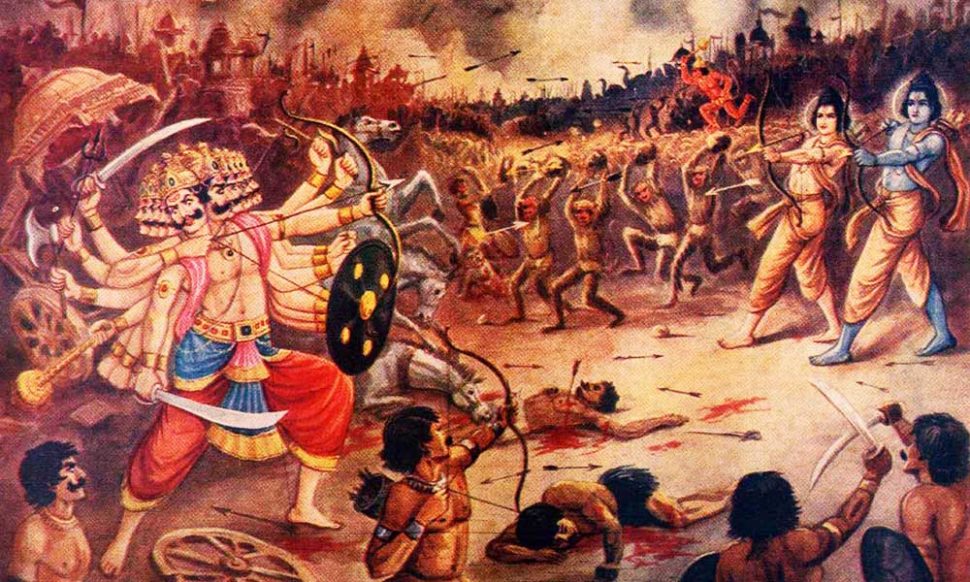
- The duel of Rama and Ravana: After a prolonged, escalating battle in which Rama repeatedly decapitates Ravana only to watch new heads grow back, Vibhishana reveals that the source of Ravana’s immortality is a vessel of nectar in his navel. Rama, wielding the Brahmastra — the divine weapon given to him by the sage Agastya — fires it straight and true. Ravana falls.
Ravana’s death is written with a poet’s ambivalence. He is the epic’s villain, certainly — but Valmiki gives him size. The world is diminished by his passing. Rama himself, after the battle, orders that Ravana be cremated with full royal honours.
Sita is freed. But Rama’s first words to her, formally, in the presence of the assembled armies, are devastating: he tells her that, having lived in another man’s house, she must prove her purity. Sita requests that a fire be lit. She walks into it. The fire god Agni emerges carrying her, testifying to her absolute purity. Rama explains that he always knew she was pure — the trial was required for the world’s understanding, not his own. The explanation has divided readers for millennia.
Uttara Kanda — The Sorrow That Follows
The Uttara Kanda is the Ramayana’s most contested book — likely a later addition, and the most painful to read.
Rama and Sita return to Ayodhya after fourteen years. Bharata joyfully surrenders the throne. Rama is crowned king in a ceremony of universal rejoicing — the Rama Rajya (Rama’s reign) becomes a Sanskrit byword for ideal governance: a kingdom of justice, abundance, and peace.
But a washerman’s gossip reaches Rama’s court: the common people, it is said, whisper about the queen who lived in Ravana’s palace. Rama, the maryada purushottama (the ideal man of righteous limits), confronted with the burden of a king’s reputation over a husband’s devotion, makes the choice that has haunted the Ramayana’s readers ever since: he exiles the pregnant Sita to the forest — alone, without warning, without explanation — on the orders of his charioteer Lakshmana, who does not even tell her why until the forest is already around her.
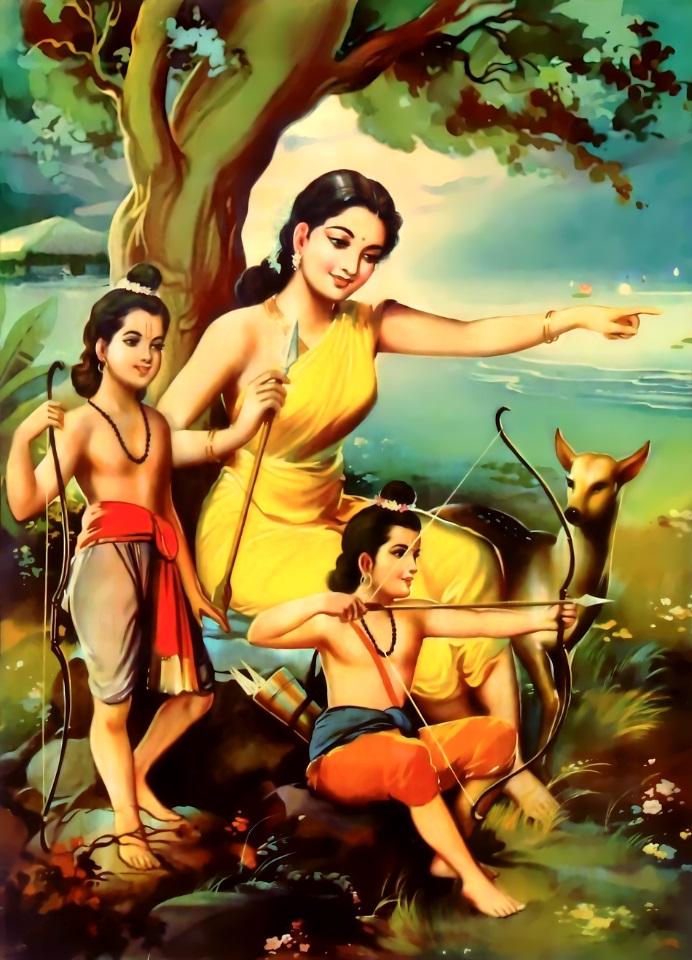
Sita takes refuge in Valmiki’s ashram and gives birth to Lava and Kusha. Years later, the twins wander to Ayodhya and sing the Ramayana in Rama’s court — the story of their own parents’ love and loss. Rama recognises them and summons Sita. She comes — and is asked to perform one final oath of purity before the assembly. It is too much. Sita calls upon her mother, the earth, to receive her if she has always been true. The earth opens. Sita descends. She does not return.
Rama lives for many years more, reigning as a just king and despairing as a bereft husband. In the end, he walks into the river Sarayu and ascends to heaven, resuming his divine identity as Vishnu.
The Characters of the Ramayana: A Complete Guide
Rama — The Ideal Man
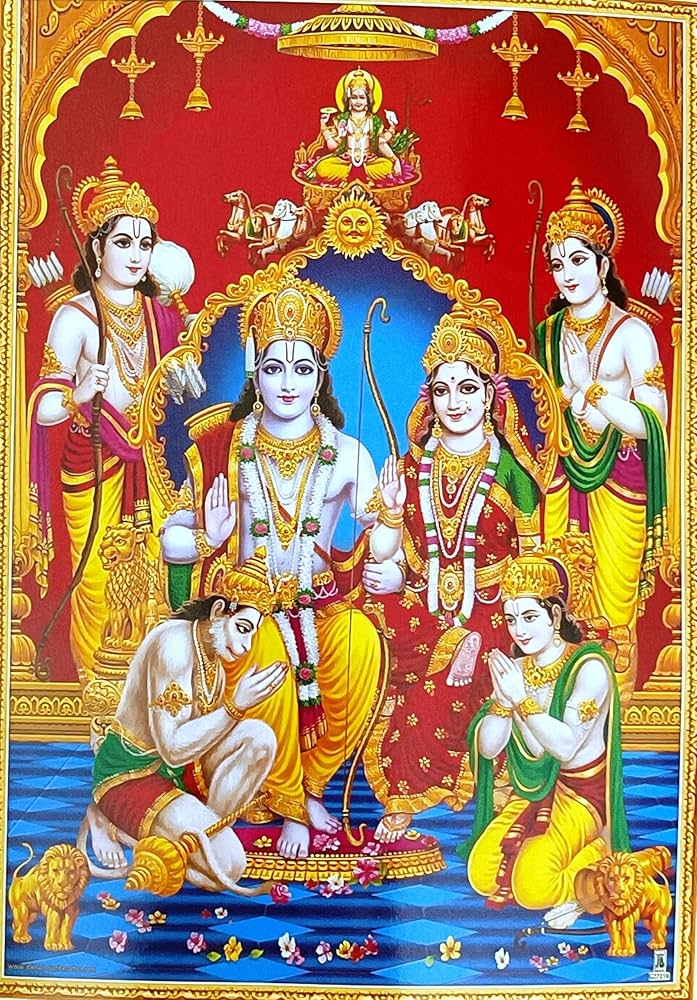
Rama (Rāma) is the Ramayana’s hero and its moral compass. He is described as the maryada purushottama — “the supreme man of righteous limits,” or “the ideal man who respects all boundaries.” He is not a warrior-hero in the mould of Achilles, defined by superhuman force; he is a moral hero, defined by the discipline he exercises over himself. He keeps every promise, honours every obligation, and subordinates personal desire to public duty — even, in the Uttara Kanda, at enormous personal cost.
Rama is also, in the devotional tradition of Vaishnavism, the seventh avatar of Vishnu — a god who takes human form to defeat the demon Ravana, who has obtained a boon that only a human (not gods or demons) can kill him. This divine dimension adds a layer of cosmic significance to Rama’s human choices.
Sita — The Earth’s Daughter
Sita (Sītā, meaning “furrow”) is among the most complex female characters in world literature — and one of the most debated. Born of the earth, she is associated throughout the epic with purity, fidelity, and endurance. She is deeply educated, philosophically articulate, and repeatedly demonstrates more courage than the narrative gives her credit for.
Sita is not passive in the Ramayana: she argues with Rama (successfully) for the right to accompany him into exile; she maintains her own identity and dignity throughout her captivity in Lanka, refusing Ravana’s advances with eloquent contempt; and her final return to the earth is understood in the devotional tradition not as defeat but as sovereign choice — the earth’s daughter returning to her mother on her own terms, refusing to submit to one more test.
Lakshmana — The Perfect Brother
Lakshmana is Rama’s younger brother and the epic’s model of seva (devoted service). He embodies a kind of love that is not romantic but absolute: he leaves his own wife Urmila sleeping in Ayodhya for fourteen years, choosing to be at his brother’s side every waking moment. He is also the Ramayana’s emotional thermostat — where Rama is composed, Lakshmana is fierce; where Rama accepts, Lakshmana protests. His fury at Kaikeyi, at Sita’s captors, at injustice in all its forms is the reader’s own fury given a character.
Hanuman — The Devoted Servant
If Rama is the ideal king and Sita the ideal of enduring virtue, Hanuman is the ideal devotee — and for most of the epic’s popular tradition, its most beloved figure. He is the son of the wind god Vayu, possessed of unlimited strength, and capable of changing his size at will. Yet he is most celebrated not for his strength but for his love.
Hanuman’s famous declaration — “Where there is Rama, there is Dharma; where there is Dharma, there I am” — is the Ramayana’s devotional heart. He represents the idea that the highest form of strength is the strength that submits itself entirely to righteous service. He is worshipped across South Asia as a protector, an exemplar of celibacy (brahmacharya), and an embodiment of devotion (bhakti).
Ravana — The Great Antagonist
Ravana is the Ramayana’s villain — and one of its most humanly drawn characters. The ten heads symbolise his mastery of the four Vedas and six shastras — he is the greatest scholar of his age. He is a poet, a musician (he composed the Shiva Tandava Stotram, still widely chanted today), and a supremely gifted ruler. Lanka under his reign is a city of gold, wealth, and power.
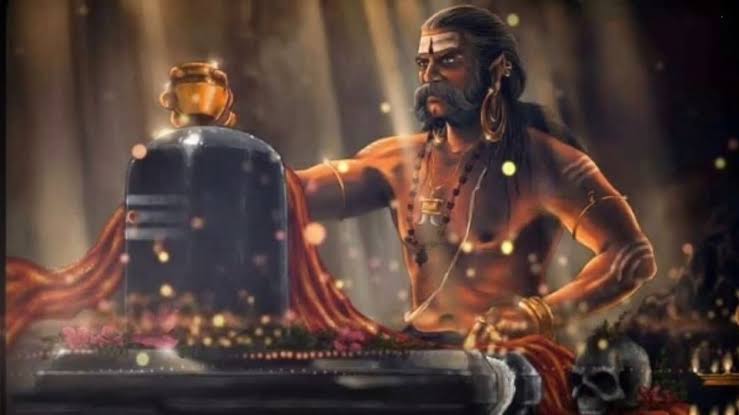
His flaw is not ignorance but ahankara — pride, ego, the inability to hear counsel that contradicts his desire. His own brother Vibhishana, his wife Mandodari, his court advisors — all plead with him to return Sita. He cannot. Knowing it will cost him everything, he chooses desire over dharma. He is the Ramayana’s portrait of what extraordinary gifts look like when pride consumes them.
Bharata — The Reluctant King
Bharata is the Ramayana’s quiet hero — the character whose greatness lies precisely in what he refuses. When he returns to find his mother has engineered Rama’s exile and his own coronation, he rejects the throne with such vehemence that he is unable to speak from grief. He lives for fourteen years as a regent and an ascetic, wearing the bark garments of a forest exile, keeping Rama’s sandals on the throne as the kingdom’s true ruler. His love for his brother is, in its own way, as extraordinary as Hanuman’s devotion — enacted not through heroic deeds but through the daily choice to honour righteous order over personal advantage.
The Major Themes of the Ramayana
1. Dharma — The Righteous Path
If the Mahabharata asks what is dharma when dharma is ambiguous?, the Ramayana asks what is the cost of living dharma absolutely? Rama never deviates from dharma. He never takes the easier path. And the Ramayana does not pretend this devotion to righteous limits is painless — it costs Rama his wife twice. The epic’s unflinching acknowledgment that dharmic living is not the same as comfortable living is one of its most enduring and challenging messages.
2. Ideal Relationships — The Web of Duties
The Ramayana is a meditation on ideal relationships in the Hindu understanding: the ideal son (Rama, who goes into exile without complaint to honour his father’s word), the ideal wife (Sita, who follows her husband into the forest), the ideal brother (both Lakshmana and Bharata in their different ways), the ideal servant (Hanuman), and the ideal king (Rama Rajya). These ideals have shaped South Asian notions of filial duty, marital fidelity, and political leadership for millennia.
3. The Power of Devotion — Bhakti
The Ramayana is the foundational text of the bhakti (devotional) tradition within Hinduism — the path to the divine through love and surrender. Hanuman’s love for Rama is its supreme expression: a devotion that asks nothing for itself, that finds meaning entirely in service, and that makes the devotee capable of anything. The enormous bhakti tradition around Rama — particularly after Tulsidas’s Ramcharitmanas in the sixteenth century — has made the Ramayana’s devotional dimension its most living aspect in popular practice.
4. The Nature of Evil
Ravana is not evil in the way that simple antagonists are evil. He is a great man who chooses wrongly. The Ramayana suggests that true evil is not born of ignorance but of pride — of the refusal to check desire with discipline, to hear truth when it conflicts with what one wants. This is a nuanced moral psychology that distinguishes the Ramayana from many heroic narratives: the enemy is not monstrous — he is human, gifted, and undone by a failing that is recognisably human.
5. Exile and Return
The arc of loss, endurance, and restoration is the Ramayana’s emotional spine. Exile — from home, from self, from love — is the condition the epic puts its characters through in order to show what they are made of. The forest is not merely a setting; it is a crucible. Rama, Sita, and Lakshmana who return to Ayodhya are not the same people who left it. They are what their fourteen years made them.
The Ramayana’s Influence on World Culture
The Ramayana’s cultural reach across Asia is extraordinary — arguably unmatched by any other literary work in scope.
In South Asia
The Ramayana exists in dozens of regional versions — each a creative reinterpretation, not merely a translation. The most beloved of these is Tulsidas’s Ramcharitmanas (c. 1574), composed in the Awadhi dialect of Hindi. Written in a language accessible to ordinary people rather than Sanskrit scholars, the Ramcharitmanas democratised the Ramayana’s devotional tradition and remains the central religious text of hundreds of millions of North Indians today. Kamban’s Iramavataram in Tamil (c. 12th century CE) is an equally celebrated reinterpretation for South India. Krittibas Ojha’s Bengali Ramayana, Ezhuthachan’s Malayalam version, and regional tellings in Kannada, Telugu, Odia, Marathi, and Assamese have given the epic continuous life in every corner of the subcontinent.
In Southeast Asia
The Ramayana’s influence across Southeast Asia is so profound that it constitutes a shared cultural substrate across vastly different nations. The Ramakien in Thailand, the Kakawin Ramayana in Java (Indonesia), the Reamker in Cambodia, and the Hikayat Seri Rama in Malaysia are all living cultural traditions — performed in classical dance, court theatre, shadow puppetry (wayang), and temple sculpture. The great bas-reliefs at Angkor Wat in Cambodia depict the Ramayana war scenes at monumental scale; in Bali, the Kecak dance performs Hanuman’s journey every night to this day.
In Western Literature and Thought
Western engagement with the Ramayana intensified from the nineteenth century onward. Ralph Waldo Emerson wrote admiringly of it; the German Romantic philosopher Friedrich Schlegel called it a work of “infinite beauty.” In the twentieth century, novelists and playwrights including R.K. Narayan (The Ramayana, 1972, an elegant condensation), Devdutt Pattanaik, and Ashok Banker (whose multivolume retelling began in 2003) have brought the epic to global English-language audiences.
In Modern India
The Ramayana’s political and cultural presence in modern India is immense and contested. B.R. Chopra’s television serial of the Mahabharata was followed by Ramanand Sagar’s Ramayan (1987–1988), which drew television audiences of over 100 million viewers per episode at its peak — a figure that has never been surpassed in Indian broadcasting history. Streets emptied on Sunday mornings when the show aired. The epic continues to animate political language, festival culture (including the nationwide burning of Ravana effigies on Dussehra), pilgrimage culture, and artistic life across India.
The Ramayana vs. the Mahabharata: Key Differences
| Ramayana | Mahabharata | |
|---|---|---|
| Length | ~24,000 verses | ~100,000 verses |
| Author | Valmiki (Ādi Kavi) | Vyasa |
| Genre | Kāvya (literary poem) + Itihāsa | Itihāsa (history) + Dharmaśāstra |
| Central conflict | Abduction and rescue | Dynastic war over succession |
| Moral framework | Clearer dharma / adharma division | Profound moral ambiguity |
| Hero archetype | Ideal king, ideal son, ideal husband | Complex, flawed, humanly relatable heroes |
| Tone | More lyrical, devotional | More philosophical, epic-encyclopaedic |
| Central philosophical text | Yoga Vasishtha (thematically linked) | Bhagavad Gita (embedded) |
| Defining relationship | Devotion (Hanuman to Rama) | Dharmic duty (Arjuna and Krishna) |
How to Read the Ramayana: A Guide for New Readers
Start with a Literary Translation
Valmiki’s Ramayana translated by Robert P. Goldman and Sally J. Sutherland Goldman (Princeton University Press, multiple volumes) is the scholarly gold standard in English — rigorous, beautifully annotated, and deeply faithful to Valmiki’s poetry. For a one-volume introduction, R.K. Narayan’s retelling (Penguin, 1972) is an accessible, elegant starting point.
Read the Sundara Kanda First
Many scholars and practitioners recommend beginning with the Sundara Kanda — the fifth book, centred on Hanuman’s flight to Lanka — as an entry point. It is self-contained, emotionally captivating, and gives an immediate sense of the epic’s tone and its greatest character. It is also the section most commonly recited in devotional settings, so reading it gives you entry into a living tradition.
Explore a Regional Version
One of the Ramayana’s greatest gifts to readers is its multiplicity. Tulsidas’s Ramcharitmanas exists in excellent English translations (by A.C. Bose and others). Reading one major regional retelling alongside Valmiki reveals how the epic has been a living tradition of creative engagement, not a fixed, unchanging text.
Engage with the Debates
The Ramayana is most richly read not as a text to agree with but as a text to think with. The killing of Vali, the fire-ordeal of Sita, and the exile in the Uttara Kanda are among the most discussed moral questions in Sanskrit literature. The epic raises them; it does not definitively answer them. Engaging with those debates — through commentaries, academic essays, and retellings written from different perspectives (such as Volga’s The Liberation of Sita in Telugu) — is part of the full Ramayana experience.
Frequently Asked Questions About the Ramayana
What is the Ramayana about? The Ramayana tells the story of Prince Rama of Ayodhya — his exile to the forest, the abduction of his wife Sita by the demon king Ravana, and the war he wages to win her back. More broadly, it is a meditation on dharma (righteous duty), ideal relationships, devotion, and the cost of living according to one’s principles.
Who wrote the Ramayana? The Ramayana is traditionally attributed to the sage Valmiki, called the Ādi Kavi (first poet) of Sanskrit literature. It is believed to have been composed between 500 and 100 BCE, though the story it preserves is likely far older.
How long is the Ramayana? The Ramayana contains approximately 24,000 verses (shlokas) divided into seven books (kandas). It is considerably shorter than the Mahabharata (which contains roughly 100,000 verses) but is often described as more poetically unified and lyrically concentrated.
What is the significance of Hanuman in the Ramayana? Hanuman is Rama’s greatest devotee and the Ramayana’s most beloved character. He is the son of the wind god Vayu, possessed of immense strength, and the central figure of the Sundara Kanda. He represents the ideal of bhakti (devotional love) — the idea that devoted service to righteousness is the highest human capacity. He is worshipped across South and Southeast Asia as a deity of strength, protection, and devotion.
Is the Ramayana true? Is it historical? The Ramayana belongs to the genre of itihāsa — which the tradition considers historical — and millions of Hindus regard it as a literal account of events that took place in the Treta Yuga (a previous cosmic age). For scholars, it is a literary-mythological text that may preserve cultural memories of an earlier era but cannot be verified as historical in the modern sense. The city of Ayodhya in Uttar Pradesh is widely accepted as the Rama’s legendary birthplace and is one of India’s most significant pilgrimage destinations. The debate between mythological and historical readings of the Ramayana is ongoing and deeply felt.
Why the Ramayana Endures
The Ramayana has endured because it does what only the greatest literature does: it gives language to experiences that otherwise remain inarticulate. The grief of a parent who loses a child. The love of a brother who will not leave your side. The pride of a man who knows he is wrong but cannot stop. The dignity of a woman who has been wronged by the person who should have protected her most. The devotion of a servant whose love is total and unconditional.
These are not ancient feelings. They are the feelings of this morning, this year, this life.
The Ramayana’s genius is that it takes these feelings and places them inside a story of such beauty, such narrative architecture, and such philosophical seriousness that the feelings become comprehensible — not resolved, not answered, but held in a form large enough to contain them.
Rama walks into the forest so that his father’s promise can be kept. Sita walks into the forest to be with her husband. Lakshmana walks into the forest because he cannot imagine being anywhere else. Hanuman leaps across the ocean because nothing is impossible for a being whose love has no limit.
This is why, more than two thousand years after Valmiki sat by the river and heard the cranes crying, the Ramayana is still being sung.
References for further reading:
- Introduction to the Mahabharata — The World’s Longest Epic
- The 18 Parvas of the Mahabharata Explained
- Who Is Hanuman? The Complete Character Study
- The Seven Kandas of the Ramayana Explained
- Ramayana vs. Mahabharata: A Complete Comparison
- Tulsidas and the Ramcharitmanas: The People’s Ramayana