
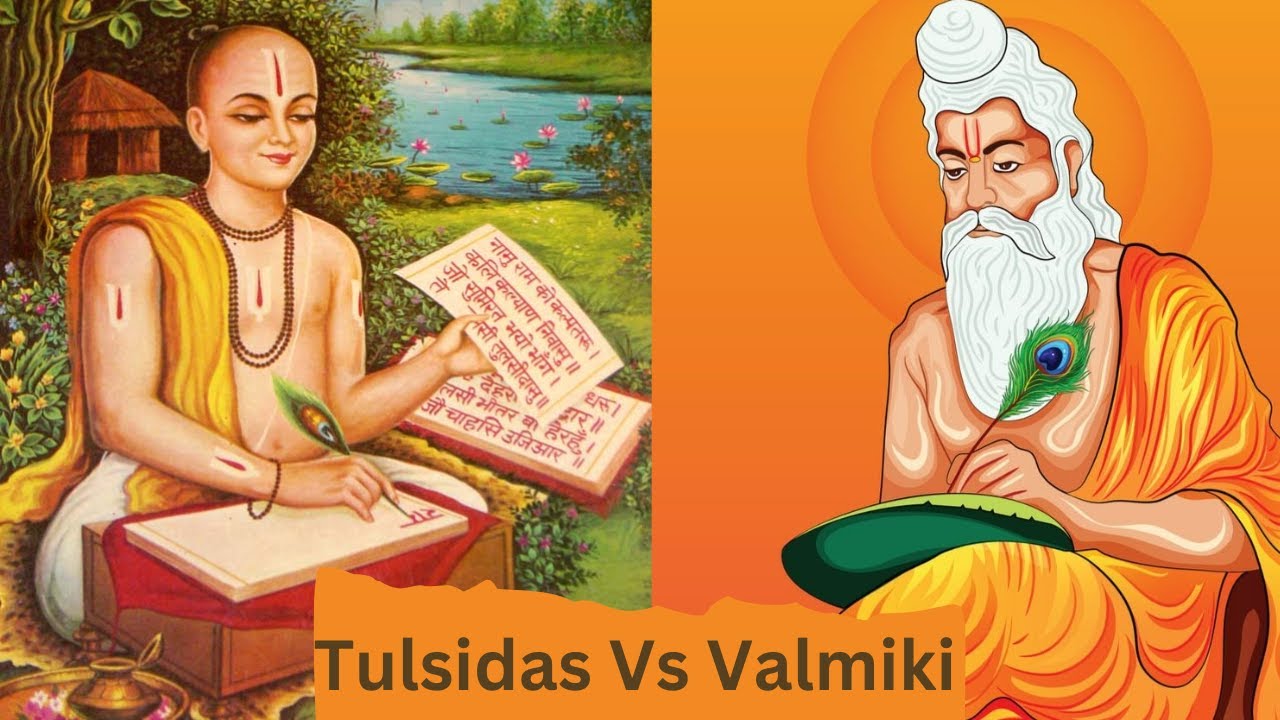
Estimated reading time: 18 minutes
When most Indians say “the Ramayana,” they may mean two entirely different books — and not know it.
Ask a scholar of Sanskrit: they will point to Valmiki’s Valmiki Ramayana, the Ādi Kāvya, the first poem, composed in classical Sanskrit somewhere between 500 and 100 BCE. Ask a devotee in Varanasi, Ayodhya, or any village of the Hindi-speaking heartland: they will almost certainly mean Tulsidas’s Ramcharitmanas, composed in Awadhi Hindi in the sixteenth century CE and sung, recited, and wept over in homes and temples across North India every single day.
These are not the same book. They tell the same story — the exile of Rama, the abduction of Sita, the war against Ravana, the return to Ayodhya — but they tell it differently: in different languages, for different audiences, with different emphases, different characters, different theology, and at times, meaningfully different moral frameworks.
Understanding the differences between these two Ramayanas is not an academic exercise. It is essential to understanding the Ramayana itself — a text that has never been a single, fixed thing but a living tradition of retellings, each shaped by its poet, its era, and its vision of the divine. And it illuminates one of the most important questions in the study of world literature: what happens when a story is retold across fifteen hundred years?
This post offers a comprehensive comparison of the Valmiki Ramayana and the Tulsidas Ramcharitmanas — covering language, theology, characterisation, key narrative differences, and their respective cultural legacies — so that you can read both with fuller understanding.
The Two Texts at a Glance
Before diving into differences, here is a quick orientation:
| Valmiki Ramayana | Tulsidas Ramcharitmanas | |
|---|---|---|
| Author | Maharshi Valmiki | Goswami Tulsidas |
| Language | Sanskrit | Awadhi (a dialect of Hindi) |
| Period of composition | c. 500–100 BCE | c. 1574–1576 CE |
| Length | ~24,000 verses (shlokas) in 7 kandas | ~10,902 chaupais and dohas in 7 kandas |
| Verse form | Shloka (anushtubh metre) | Chaupai (four-footed verse) + Doha (couplet) |
| Primary theological framework | Dharmic human ideal; later Vaishnava | Vaishnava Bhakti (Ram-bhakti tradition) |
| Intended audience | Educated, Sanskrit-literate | Mass popular devotional audience |
| Rama’s nature | Primarily human (maryada purushottama) | Primarily divine (Supreme Brahman in human form) |
| Cultural dominance | Scholarly, pan-Asian, scriptural | Devotional heartland of North India |
| Most beloved section | Sundara Kanda (Hanuman’s journey) | Bal Kanda and Sundara Kanda |
The Authors: Who Were Valmiki and Tulsidas?
Valmiki — The First Poet
As covered in detail in our introduction to the Ramayana, Valmiki is the Ādi Kavi — the first poet of Sanskrit literature — and his composition of the Ramayana is inseparable from the legend of how poetry itself was born. Stricken by grief at the sight of a hunter killing a mating crane, Valmiki spontaneously uttered a verse of sorrow in perfect metrical form — the first shloka — and was thereafter commanded by the god Brahma to compose the story of Rama.
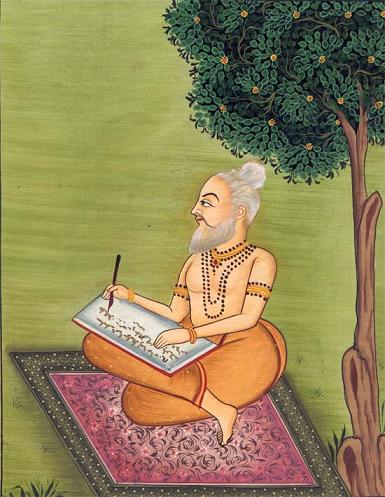
Valmiki composes from the perspective of a witnessing sage — a man of the world who has become a man of the forest, who has seen human violence and human love, and who tells Rama’s story with a poet’s clear-eyed attention to both its beauty and its pain. He is not a devotee of Rama in the bhakti sense. He is the story’s first recorder — present within it (Sita takes refuge in his ashram; Lava and Kusha are raised there) but maintaining, for the most part, the emotional distance of a great artist.
Valmiki’s Rama is primarily a human hero — an ideal man (maryada purushottama) who does not always know he is divine, who suffers fully and humanly, and whose godhood is a theological layer added to the story rather than its constant emotional texture.
Tulsidas — The Devoted Poet
Goswami Tulsidas (c. 1532–1623 CE) is one of the greatest poets of the Hindi literary tradition and one of the towering figures of the bhakti movement that reshaped devotional Hinduism from the twelfth to the seventeenth centuries. Born in a Brahmin family in the Banda district of what is now Uttar Pradesh, Tulsidas spent much of his life in Varanasi and Ayodhya, and tradition holds that he had a direct vision of Rama and Hanuman.
His masterwork, the Ramcharitmanas (“the lake of the acts of Rama”), was composed between approximately 1574 and 1576 CE — a period of extraordinary productivity during which Tulsidas worked in the bhakti tradition’s democratic impulse: bringing the story of the divine Rama to ordinary people in their own spoken language, rather than the Sanskrit of the scholarly elite.
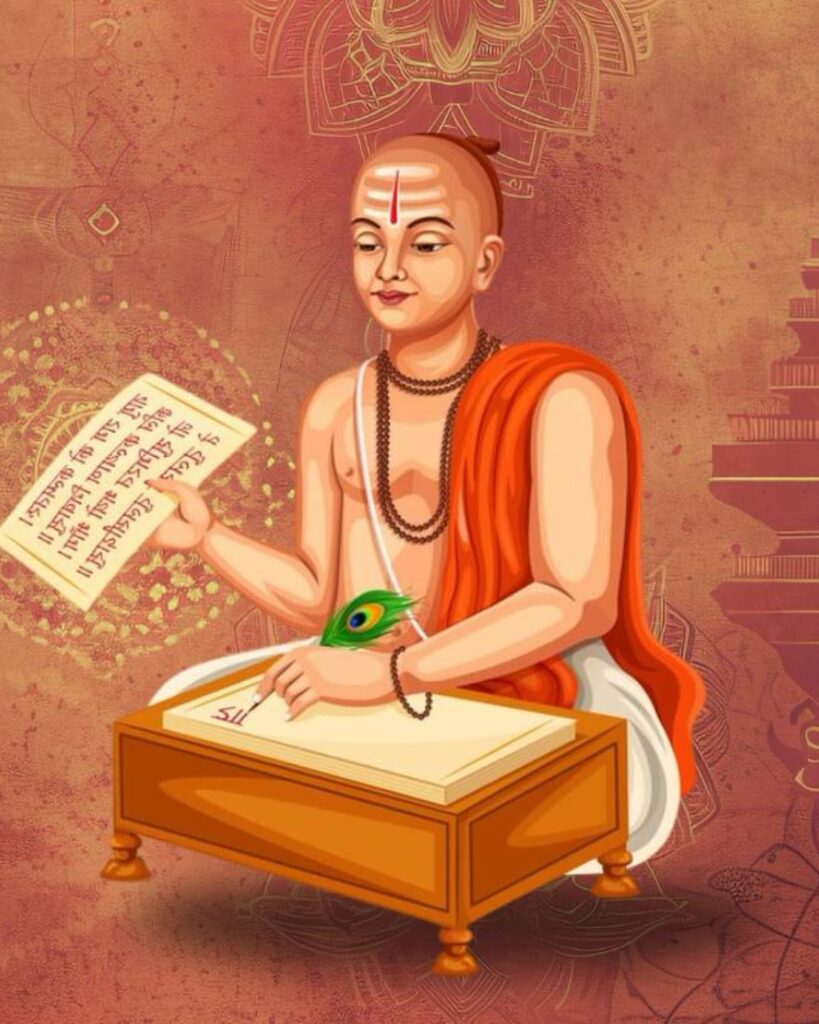
Tulsidas is not a detached artistic witness to the story of Rama. He is its most ardent devotee. His Ramcharitmanas begins with extended invocations of Rama as the supreme deity — as Brahman, the absolute — and the devotional intensity never leaves the text. Where Valmiki observed, Tulsidas worshipped.
His other major works — the Vinaya Patrika, the Hanuman Chalisa (the 40-verse hymn to Hanuman recited daily by hundreds of millions), and the Kavitavali — confirm a poet whose entire creative life was a sustained act of bhakti.
Language and Accessibility: Sanskrit vs. Awadhi
This is perhaps the most fundamental difference between the two texts, with the most sweeping cultural consequences.
Valmiki’s Sanskrit
The Valmiki Ramayana is composed in classical Sanskrit — specifically in the anushtubh or shloka metre, a form Valmiki is credited with inventing. Sanskrit in Valmiki’s era was already a prestige language — the language of the Vedas, of philosophical discourse, of royal courts and scholarly monasteries. By 500 BCE, it was increasingly a language of the educated and priestly classes rather than the vernacular of ordinary life.
Valmiki’s Sanskrit is also notably beautiful — lyrical, rich in compound words, and deployed with a poet’s ear for rhythm and imagery. Scholars describe it as more accessible than the compressed technicality of later Sanskrit poetry, but it is undeniably the work of a literary sophisticate writing for a sophisticated audience.
The consequence of this is that the Valmiki Ramayana, throughout most of its history, has been primarily a scholar’s and priest’s text — recited by trained pandits, studied in gurukulas, and translated into regional languages for broader audiences. The common person’s relationship with the Valmiki Ramayana has typically been mediated through performance, oral tradition, and those regional translations — not direct reading.
Tulsidas’s Awadhi
The Ramcharitmanas is composed in Awadhi — a dialect of Hindi spoken in the region of Awadh (Uttar Pradesh), the same linguistic territory as Ayodhya itself. In the sixteenth century, Awadhi was the spoken language of millions of ordinary people across North India. It was also the language in which Kabir preached and in which the great poet Malik Muhammad Jayasi composed the Padmavat — a bhakti and Sufi tradition of vernacular devotional poetry was already alive when Tulsidas wrote.
Tulsidas’s verse form is equally democratising. The chaupai (a four-footed verse of 16 syllables per line) and the doha (a rhyming couplet) that structure the Ramcharitmanas are oral forms designed to be sung, memorised, and recited without written text. The metre is rhythmic, catchily repetitive, and carries its meaning on the sound of the words as much as in their semantic content.
The result is that the Ramcharitmanas became the people’s Ramayana of North India in a way the Valmiki text never could. Illiterate devotees memorised it. Women recited it in the kitchen. Itinerant kathakar (storytellers) performed it in village squares. The tradition of Ramkatha — public narration of the Ramcharitmanas over nine consecutive days — remains alive across the Hindi belt today. The Manas (as it is affectionately called) is not just a literary classic; it is a living liturgical text.
Theology: Human Ideal vs. Supreme Divinity
This is the deepest difference between the two texts — and the one with the most far-reaching implications for how characters are portrayed and how the story is felt.
Valmiki’s Rama: The Maryada Purushottama
In the Valmiki Ramayana, Rama is introduced and maintained, for most of the epic’s central books (Kandas 2–6), as a human being — the most exemplary human being possible, but a human being nonetheless. He does not know, for most of the story’s dramatic action, that he is Vishnu incarnate. He experiences doubt, fear, grief, and fury as fully human emotions. When Sita is abducted, he weeps. When Lakshmana is struck down in battle, he despairs. When he cannot identify the herb Sanjeevani, he threatens to destroy the ocean.
The first book (Bala Kanda) and the last (Uttara Kanda) — both considered later additions by scholars — frame Rama as an avatar of Vishnu and are theologically explicit about his divinity. But the five central books, which most scholars regard as the epic’s original core, operate primarily on a human register. Rama is the ideal man: the son who keeps his father’s word at ruinous personal cost, the husband who cannot abandon the search for his wife, the king who subordinates private love to public duty.
This makes the Valmiki Ramayana‘s moral dilemmas sharper and more painful. Rama’s fire-ordeal of Sita and his exile of the pregnant queen in the Uttara Kanda are not divine decisions — they are human failures, or at least human choices made at enormous human cost, which the text does not fully defend. The reader is left to struggle with them.
Tulsidas’s Rama: Brahman Made Flesh
In the Ramcharitmanas, Rama’s divinity is not a later layer — it is the text’s first premise and its constant devotional atmosphere. Tulsidas draws on the Vaishnava theological tradition — specifically on the Bhagavata Purana and the teachings of the Ramanandi sampradaya — to present Rama as Parabrahman (the Supreme Absolute) who has taken human form out of divine leela (play, cosmic drama) and compassion for his devotees.
This changes everything about how events feel. When Tulsidas’s Rama weeps for Sita in the forest, it is the divine weeping — a performance of human emotion for the benefit of the devotee, not an actual loss of divine composure. When he asks forest creatures where Sita is, it is cosmic leela, not genuine ignorance. The gods watching from the heavens are witnesses to a divine drama being enacted for their edification.
This theological difference explains why Tulsidas’s Ramcharitmanas generates a completely different emotional register in its readers. The devotee does not primarily wrestle with Rama’s choices as moral dilemmas — they worship Rama’s perfection while emotionally experiencing the leela of his apparent suffering. The experience is devotional, not analytical. The text wants you to surrender to Rama, not interrogate him.
The theological implications extend to Sita as well: in the Ramcharitmanas, Tulsidas introduces the concept of the Chhaya Sita (shadow Sita) — a phantom copy of Sita who is abducted by Ravana, while the real Sita is protected in divine fire. This means that in Tulsidas’s telling, Ravana never actually touches Sita, the fire ordeal is a restoration of the real Sita (emerging from the fire) rather than a test of purity, and many of the moral difficulties of Valmiki’s ending simply do not arise. Tulsidas’s text protects Sita — and Rama — from certain kinds of moral complexity that Valmiki’s text leaves unresolved.
Key Narrative Differences: A Scene-by-Scene Comparison
1. The Chhaya Sita (Shadow Sita)
Valmiki: Ravana abducts the real, physical Sita. She lives in Lanka under Ravana’s power for many months, sustained by her fidelity and her certainty in Rama. After the war, Rama asks her to undergo the fire ordeal (agni pariksha) to prove her purity to the assembled world. She walks into the fire; Agni emerges carrying her and testifies to her purity. Rama says he always knew she was pure — the trial was for the world’s understanding. The explanation is offered but remains morally unsettled.
Tulsidas: Before Ravana’s abduction, Rama — knowing what is about to happen — asks Sita to enter a divine fire temporarily, creating a Chhaya Sita (an illusory double) in her place. The shadow Sita is what Ravana abducts. After the war, when Sita emerges from the fire during the “ordeal,” she is actually the real Sita returning — not a woman being tested but a goddess being restored. This theological innovation removes the moral anguish of the fire ordeal entirely, replacing a morally painful test with a devotionally satisfying reunion.
This is one of the most significant narrative divergences between the two texts — and one of the most revealing about each text’s priorities. Valmiki puts Sita through genuine suffering and leaves the moral accounting incomplete. Tulsidas protects her from suffering and provides theological resolution.
2. The Uttara Kanda: Sita’s Exile
Valmiki: The Uttara Kanda — the seventh and final book, likely a later addition — narrates Sita’s exile in full. After their return to Ayodhya, Rama hears that ordinary citizens gossip about a queen who lived in another man’s house. Unable to silence public doubt as king, he exiles the pregnant Sita to the forest without warning, sending her with Lakshmana who does not even tell her the reason until they are deep in the wilderness. She lives in Valmiki’s ashram, gives birth to Lava and Kusha, and ultimately returns to the earth her mother. Rama spends the rest of his reign in personal grief and political isolation. This ending is devastating, and Valmiki does not soften it.
Tulsidas: The Ramcharitmanas ends with Rama’s coronation and the celebration of Rama Rajya. Tulsidas does not include the Uttara Kanda’s narrative of Sita’s exile. The Manas closes on triumph, devotional joy, and the perfection of Rama’s kingdom. This choice is both theological (the perfect divine king cannot be seen abandoning his wife) and devotional (the text’s primary purpose is to inspire bhakti, not moral anguish). The difficult questions the Uttara Kanda raises are simply not raised.
This is perhaps the most consequential narrative choice Tulsidas makes. By ending where he does, he gives North Indian popular culture a Ramayana that ends in joy — and shields Rama from the profound moral criticism that Valmiki’s Uttara Kanda has always generated.
3. The Killing of Vali
Valmiki: When Rama kills Vali — Sugriva’s brother and the usurper of his throne — he does so by shooting an arrow from behind a tree while Vali fights Sugriva in open combat. Vali, dying, confronts Rama directly: “Why did you kill me in secret? I would have served you loyally. You are a Kshatriya — you have violated the code of honourable warfare.” Rama’s response — that Vali was a sinner who had taken his brother’s wife, and that as king of the forest Rama had the right to punish him as he chose — is thoughtful but notably unsatisfying. Valmiki presents this episode without resolution: the moral discomfort is part of the text.
Tulsidas: In the Ramcharitmanas, Tulsidas acknowledges the difficulty of the Vali episode but handles it through the lens of divine authority. The emphasis falls on Vali’s own acknowledgment of Rama’s greatness as he dies — the dying warrior’s vision of Rama as the supreme lord becomes his liberation (moksha). The dying Vali is transformed from a moral challenger into a devotee. The theological frame of bhakti absorbs the moral problem: even death at Rama’s hands is a gift.
4. Hanuman’s Character
Valmiki: Hanuman in the Valmiki Ramayana is brilliant, eloquent, strategically vital, and physically extraordinary. He is characterised with great literary sophistication: when he arrives in Lanka, Valmiki describes him thinking through multiple approaches to making contact with Sita — too large will frighten her, too small risks being unrecognised. He chooses carefully. He is a great minister and a great warrior, and his devotion to Rama is total. But in Valmiki, Hanuman is primarily a heroic agent — an indispensable ally.
Tulsidas: In the Ramcharitmanas, Hanuman is elevated from heroic ally to theological ideal. He becomes the supreme bhakta — the perfect devotee — whose love for Rama is the text’s model for how the reader should relate to the divine. Tulsidas’s Hanuman is the hero of the devotional imagination: not merely someone who helps Rama, but someone whose love for Rama is the most complete expression of human potential. Tulsidas’s Hanuman Chalisa — composed separately but inseparable from the Manas tradition — is the clearest expression of this: a forty-verse hymn to Hanuman that is probably the most widely recited religious text in India today.
5. The Role of Kaikeyi
Valmiki: Queen Kaikeyi is a more rounded and, at moments, sympathetic figure in Valmiki’s telling. Her love for Rama in earlier life is genuine — she was his favourite mother, the one he ran to as a child. Her transformation by Manthara’s scheming is a psychological unravelling, and Valmiki traces it with attention to her inner conflict. Her eventual remorse is present in the text.
Tulsidas: In the Ramcharitmanas, Kaikeyi’s betrayal is reframed by the theological conviction that Rama’s exile was divinely intended — a necessary precondition for Ravana’s defeat. Kaikeyi becomes, in a sense, an instrument of divine will rather than a free moral agent making a catastrophic choice. Her actions are not exonerated, but they are absorbed into a providential framework. This theological reframing is characteristic of Tulsidas’s approach throughout: human moral failures become episodes in a larger divine drama.
6. Sita’s Voice and Agency
Valmiki: Sita in the Valmiki Ramayana is highly articulate, philosophically engaged, and at times sharply critical. In the Aranya Kanda, she has a significant exchange with Lakshmana in which she delivers what amounts to a severe moral judgment on men who mix virtue with violence. After the fire ordeal, her dignity — both before entering the fire and after emerging from it — is quietly devastating. She asks for no more than what she is owed, and she receives less. Valmiki gives Sita a voice that the text does not always honour.
Tulsidas: Sita in the Ramcharitmanas is more clearly positioned within the pativrata (devoted-wife) ideal of medieval Hindu social thought. Her obedience, her patience, and her fidelity are foregrounded, and her independent voice is notably quieter than in Valmiki. This is one of the most-discussed differences between the two texts among feminist scholars and literary critics — and it reflects the different social contexts in which they were written. Valmiki, writing in an earlier era, had fewer conventions to maintain; Tulsidas, writing in sixteenth-century North India, worked within the social theology of his time.
Structure and Poetry: Aesthetic Differences
The Shloka vs. the Chaupai-Doha
The formal difference between the two texts is not merely technical — it shapes the emotional and cognitive experience of reading or hearing each work.
Valmiki’s shloka (anushtubh metre) is a flowing two-line verse form with a natural pause at the fourth syllable of each line. It has a quality of measured, authoritative narration — a voice that advances the story with clarity and deliberate beauty. Sanskrit shlokas can carry complex syntax, embedded stories, and philosophical argument within their compact form. The effect is of a text that is both precise and expansive.
Tulsidas’s chaupai-doha structure is designed for oral performance and communal recitation. The chaupai’s four-beat rhythm carries the narrative forward with energy and momentum; the doha’s concluding couplet functions like a musical cadence — a moment of summary, reflection, or devotional intensity that allows the singer and listener to breathe. The effect is of a text built for breath and body as much as mind — a text that wants to be sung, and that sounds different aloud than it reads on the page.
Register and Tone
Valmiki’s register is that of great literary epic — elevated, formal, and wielded with consistent artistic intention. His similes are celebrated: the moon compared to a swan, battle noise compared to a breaking dam, Sita’s grief compared to a lamp in the wind. These are images crafted by a poet who knew he was making art.
Tulsidas’s register shifts more fluidly, moving between lyrical devotion, philosophical discourse, narrative drive, and folk idiom. There are passages of the Ramcharitmanas that are deliberately simple — almost childlike in their directness — and passages of extraordinary poetic complexity. The Manas is a text with multiple emotional registers because its audience had multiple emotional needs: it had to serve the scholar and the illiterate farmer with equal spiritual nourishment.
The Uttara Kanda Question: Tulsidas’s Most Important Editorial Choice
The absence of the Uttara Kanda in Tulsidas’s Ramcharitmanas deserves extended attention — because it is probably the single most consequential editorial decision in the Ramayana’s long history of retellings.
The Uttara Kanda of Valmiki contains the events most troubling to a devotional reading of Rama: Sita’s exile on grounds of public rumour; the final fire ordeal and its implicit demand for repeated proof of purity; and Sita’s return to the earth — an ending that is not a reunion but a withdrawal, a departure made in sorrow and sovereign dignity. The Uttara Kanda is the Ramayana’s acknowledgment that even ideal men make choices that cause irreversible harm to those they love.
Tulsidas ends the Ramcharitmanas at Rama’s coronation — the moment of Ram Rajya, the ideal kingdom restored. His seventh kanda (Uttara Kanda) exists but focuses on Kakabhushundi’s discourse on Rama Bhakti and cosmic time, not on Sita’s exile.
The effect of this choice on North Indian cultural memory is difficult to overstate. For the hundreds of millions of people whose primary knowledge of the Ramayana comes through the Ramcharitmanas — through Ramkatha, through Ramlila performances, through Ramanand Sagar’s television adaptation, which was itself primarily based on the Manas — Sita’s exile is not part of the Ramayana. The story ends in celebration.
This has produced one of the most interesting cultural divergences in Indian literary history: scholars, feminists, and readers of Valmiki’s full text engage with a Ramayana in which Sita is exiled and returns to the earth, while the popular devotional tradition, shaped primarily by Tulsidas, carries a Ramayana that ends in joy. When literary critics raise the Uttara Kanda as an ethical problem in Rama’s characterisation, they are often speaking a language the Manas tradition does not recognise — because that tradition’s Ramayana ends before the problem arises.
Cultural Legacy: How Each Text Shaped Its World
The Valmiki Ramayana’s Cultural Sphere
The Valmiki Ramayana has been the source text for virtually every Ramayana tradition in Asia. The dozens of regional versions of the Ramayana that exist — Kamban’s Tamil Iramavataram, Krittibas’s Bengali Ramayana, the Javanese Kakawin Ramayana, Thailand’s Ramakien, Cambodia’s Reamker — are all, at varying degrees of remove, derived from or shaped by Valmiki’s telling. Its cultural influence is horizontal, spanning languages and nations.
Its direct devotional life is somewhat more limited: it is recited and performed by trained priests, studied in Sanskrit academies, and revered as scripture. The Sundara Kanda of Valmiki is regularly recited as a complete independent text for religious merit. Scholars consider the Valmiki Ramayana the authoritative ur-text — the Ramayana against which all others are measured.
The Valmiki Ramayana has also been the primary text for modern literary and critical re-engagements: Volga’s The Liberation of Sita (Telugu), Irawati Karve’s essays, Devdutt Pattanaik’s interpretations, and the numerous scholarly works by Michael Pollock, Sheldon Pollock, and other Indologists work from Valmiki’s text as their foundation.
The Ramcharitmanas’s Cultural Sphere
The Ramcharitmanas is, by almost any measure, the most widely read, recited, and performed literary work in the Hindi language — and one of the most devotionally influential texts in the world. Its cultural dominance in North India is extraordinary:
Ramkatha: The tradition of public nine-day recitation of the Manas, performed by professional kathakars (reciters) to audiences of thousands, is alive across the Hindi belt. Morari Bapu’s Ramkatha events have been attended by hundreds of thousands of people; his recitations have been broadcast on television and streamed online to audiences in the millions.
Ramlila: The theatrical performance of the Ramayana story — particularly the ten-day festival culminating in Dussehra (the burning of Ravana’s effigy) — draws on the Ramcharitmanas as its primary text. The Ramlila of Ramnagar (near Varanasi), a UNESCO Intangible Cultural Heritage, is performed by hundreds of actors over thirty days in a production of extraordinary scale.
The Hanuman Chalisa: Tulsidas’s forty-verse hymn to Hanuman — composed separately from the Manas but intimately connected to it — is probably the most recited devotional text in India. It is sung in vehicles, played in shops, memorised by children, and recited as daily prayer by hundreds of millions of people. Its cultural penetration is total.
Television: Ramanand Sagar’s Ramayan (1987–1988) — which drew up to 100 million viewers per episode and caused streets to empty on Sunday mornings — was based primarily on the Ramcharitmanas. It brought Tulsidas’s vision of Rama to the generation that would come of age in modern India, cementing the Manas‘s dominance in popular consciousness.
Tulsidas in Context: The Bhakti Movement and Why It Mattered
To understand Tulsidas’s departures from Valmiki, you must understand the Bhakti movement — the devotional revolution that swept through Indian religious life from roughly the twelfth to the seventeenth centuries.
The Bhakti movement was, among other things, a democratising force: a challenge to the caste-based gatekeeping of religious experience and Sanskrit learning. Bhakti poets — Kabir, Mirabai, Surdas, Raidas, Tukaram, Namdev — composed in vernacular languages, sang to mixed-caste audiences, and argued that direct devotional experience of the divine was available to anyone, regardless of birth, literacy, or ritual purity.
Tulsidas was shaped by this tradition while also being, in some ways, more conservative than its most radical voices. He maintained respect for caste hierarchy and Brahmin learning in ways that Kabir, for example, did not. But his compositional choice — to write the Ramcharitmanas in Awadhi rather than Sanskrit, to make it singable by ordinary people, to centre devotion over ritual — was deeply bhakti in impulse.
The Ramcharitmanas is the Bhakti movement’s greatest gift to the story of Rama: a text in which the path to Rama is love, not learning; surrender, not Sanskrit; devotion, not performance. Tulsidas’s Hanuman is the model not because he is strong but because he loves. His Bharata is the model not because he is politically astute but because he refuses to usurp what belongs to his brother. Character is devotion; devotion is character.
Which Ramayana Should You Read First?
This is the question every new reader of the Ramayana eventually asks — and there is no single answer, because the two texts serve genuinely different purposes.
Read Valmiki first if:
- You want the ur-text — the original that all others respond to
- You are interested in the Ramayana as world literature and literary history
- You want to engage with the moral complexity of the story, including its difficult episodes
- You are approaching the text academically or comparatively
- You are interested in Sita as a fully drawn character and want to encounter the Uttara Kanda
Read the Ramcharitmanas first if:
- You want to understand the Ramayana as a living devotional tradition in North India
- You want to understand why ordinary Indians love this story the way they do
- You are drawn to bhakti — to devotion as a spiritual path
- You want the text that has most directly shaped popular Hindu religious practice
- You want a Ramayana that can be sung — that sounds like music
Ideally, read both — because the richest understanding of what the Ramayana is comes from seeing it refracted through both lenses: Valmiki’s literary humanism and Tulsidas’s devotional theology. Together they show you the full range of what the story has meant across two thousand years.
Other Major Ramayanas: Widening the Lens
No comparison of Valmiki and Tulsidas is complete without acknowledging that the Ramayana tradition is far wider than either text. Some other significant retellings worth knowing:
- Kamban’s Iramavataram (Tamil, c. 12th century CE): The great South Indian Ramayana, composed with an independent poetic vision that diverges significantly from Valmiki in characterisation, theology, and narrative detail. Kamban’s Ravana is arguably the most psychologically compelling in the tradition.
- Krittibas Ojha’s Krittivasi Ramayan (Bengali, c. 15th century CE): The beloved Bengali Ramayana, notable for its warmth and its domestication of the epic’s themes into Bengali cultural life.
- Ezhuthachan’s Adhyatma Ramayanam (Malayalam, c. 16th century CE): The foundational text of Malayalam literature, explicitly devotional and drawing on the Adhyatma Ramayana (a Sanskrit text distinct from Valmiki).
- Volga’s The Liberation of Sita (Telugu, 2016): A landmark modern feminist retelling that gives Sita, Surpanakha, Ahalya, and other women of the Ramayana the perspectives the classical text withholds.
Each of these retellings is, in part, a conversation with Valmiki — a creative response to the first poem that says: this is what you saw, and here is what I see.
Frequently Asked Questions
What is the main difference between Valmiki Ramayana and Tulsidas Ramcharitmanas? The most fundamental differences are theological and linguistic. Valmiki’s Sanskrit epic presents Rama primarily as an ideal human being (maryada purushottama) and engages with moral complexity unflinchingly. Tulsidas’s Awadhi Ramcharitmanas presents Rama as the Supreme Deity (Parabrahman) incarnate, frames the story as divine leela, and prioritises devotional experience over moral interrogation. Tulsidas also omits the Uttara Kanda‘s narrative of Sita’s exile, ending the story at Rama’s coronation.
His devotional output went well beyond the Ramcharitmanas. Two shorter Hanuman compositions attributed to him are still recited daily across North India: the forty verses of the Hanuman Chalisa, with its meaning in English, and the eight stanzas of the Sankatmochan Hanuman Ashtak.
Which is older — Valmiki’s Ramayana or Tulsidas’s Ramcharitmanas? Valmiki’s Ramayana is far older, composed between approximately 500 and 100 BCE. Tulsidas composed the Ramcharitmanas roughly fifteen to sixteen hundred years later, in approximately 1574–1576 CE.
What language is the Ramcharitmanas written in? The Ramcharitmanas is written in Awadhi, a dialect of Hindi spoken in the Awadh region of Uttar Pradesh, India. This was the vernacular language of North Indian common people in the sixteenth century — as opposed to Valmiki’s classical Sanskrit.
Why didn’t Tulsidas include Sita’s exile in the Ramcharitmanas? Tulsidas’s omission of the Uttara Kanda‘s account of Sita’s exile reflects his devotional-theological framework: for Tulsidas, Rama is the perfect, divine king, and the story’s purpose is to inspire bhakti (devotion). The Uttara Kanda raises moral questions about Rama’s treatment of Sita that conflict with the text’s devotional intent. Tulsidas chose to end with the coronation and Rama Rajya — the ideal kingdom in its perfection.
Which Ramayana is more popular in India today? In North India, the Ramcharitmanas of Tulsidas is overwhelmingly more influential in popular devotional culture — it shapes Ramkatha recitations, Ramlila performances, temple liturgy, and daily prayer. The Valmiki Ramayana is more prominent in scholarly, pan-regional, and South Indian contexts, and is the primary text for comparative literary study.
Two Visions of the Same Sacred Story
Valmiki and Tulsidas are not rivals. They are two of the greatest minds in the Indian literary tradition, separated by fifteen centuries, each doing something the other could not have done.
Valmiki gave the Ramayana its first form — in the language of gods and scholars, with the clear eyes of a great artist who loved the story enough to leave its hardest questions unanswered. He gave us the story of a man becoming worthy of the divine he already was, without always knowing it.
Tulsidas gave the Ramayana to the people — in the language of the river, the field, and the kitchen; in verses you can sing while grinding grain or walking home at dusk; with the devotional conviction that the divine Rama wants your love, not just your respect, and that no learning is required to offer it.
Together, their two Ramayanas cover the full range of what the story has meant: literary monument and living prayer; moral examination and devotional surrender; ancient source and eternal renewal.
To know one is to know the Ramayana partly. To know both is to begin to understand why this story has never stopped being told.
References for further reading:
- Introduction to the Ramayana — Story, Characters, and Meaning
- The Seven Kandas of the Ramayana Explained
- Who Is Hanuman? Character, Symbolism, and Significance
- The Bhakti Movement in India — History, Poets, and Legacy
- Introduction to the Mahabharata — The World’s Longest Epic
- Ramayana Across Asia — Regional Versions and Their Differences