
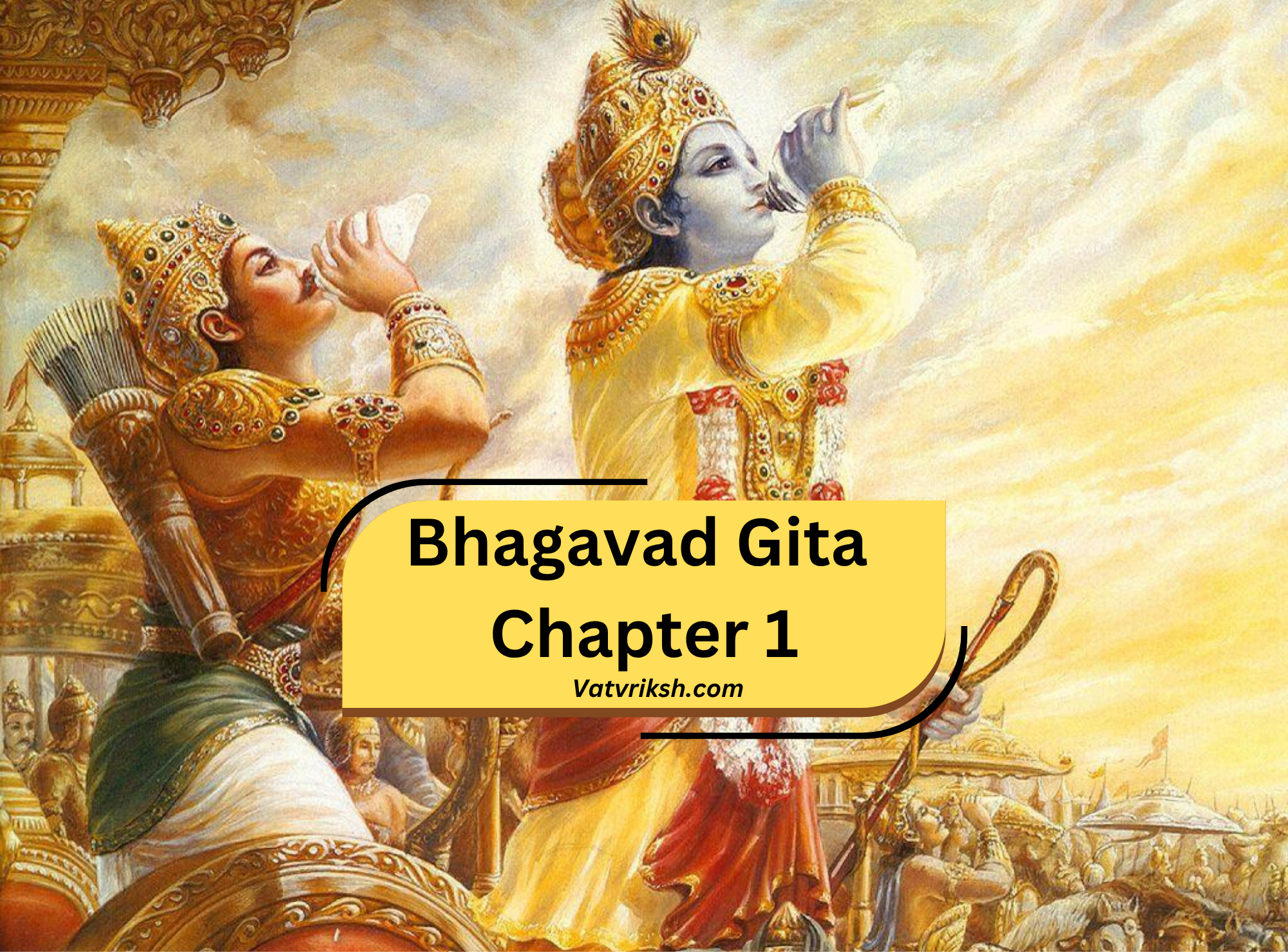
An in-depth exploration of the Kurukshetra crisis that gave birth to one of humanity’s greatest spiritual dialogues
Table of Contents
- Why Chapter 1 Is the Most Human Chapter of the Gita
- What Is Bhagavad Gita Chapter 1 About? — A Complete Overview
- The Setting: Kurukshetra and the Two Armies
- Verse-by-Verse Summary of Bhagavad Gita Chapter 1
- Arjuna’s Vishada — A Spiritual Depression or Moral Awakening?
- Key Characters Introduced in Chapter 1
- The Symbolism Hidden in Chapter 1’s Battlefield
- Spiritual Lessons from Chapter 1 for Modern Life
- Frequently Asked Questions About Bhagavad Gita Chapter 1
- Conclusion: How Chapter 1 Sets the Stage for Liberation
Why Chapter 1 Is the Most Human Chapter of the Gita
Most sacred texts begin with grandeur — cosmic declarations, divine proclamations, or the unfolding of supernatural events. The Bhagavad Gita begins differently. It begins with a man falling apart.
Chapter 1 of the Bhagavad Gita, titled Arjuna Vishada Yoga (the Yoga of Arjuna’s Despondency), opens not with revelation but with grief. A warrior of legendary skill, standing in his golden chariot at the centre of the greatest war in Vedic history, drops his bow and collapses in tears. He is unable to fight. He is unable to speak with clarity. He is, in every way that matters, completely lost.
This opening scene is why the Bhagavad Gita remains one of the most psychologically profound spiritual texts ever written. Before Lord Krishna speaks a single word of wisdom, the Gita allows us to sit fully inside human suffering. It validates the crisis. It does not rush past the confusion, the sorrow, the ethical paralysis.
If you have ever faced a moment where every choice seemed wrong, where duty and love pulled you in opposite directions, where the weight of responsibility crushed the very will to act — you have stood exactly where Arjuna stood on the plains of Kurukshetra.
Understanding Bhagavad Gita Chapter 1 in detail is not just an academic exercise. It is an act of self-recognition. Let us walk through it, verse by verse, meaning by meaning.
What Is Bhagavad Gita Chapter 1 About? — A Complete Overview
Bhagavad Gita Chapter 1 consists of 47 verses and is narrated primarily through two voices: Sanjaya, the divine narrator who describes the scene to the blind king Dhritarashtra, and Arjuna, the Pandava prince who faces the impossible choice.
The chapter establishes the physical and emotional context for the entire Gita. It takes place on the battlefield of Kurukshetra, where the Pandava and Kaurava armies have gathered for a war that will determine the future of Bharatavarsha (ancient India).
The central event of Chapter 1 is Arjuna’s request to Lord Krishna — his charioteer and friend — to drive the chariot between the two armies so he can see who he must fight. When he sees uncles, teachers, cousins, grandfathers, and beloved friends arrayed on the opposing side, his resolve dissolves. He is overcome by grief, compassion, and confusion. He articulates his doubts with remarkable philosophical depth, raising questions about duty, sin, familial bonds, social consequences, and the meaning of victory.
This emotional and philosophical crisis is called Arjuna Vishada — and the fact that the Gita calls it a Yoga is itself deeply significant. The word Vishada means grief or despondency, but the text does not frame this suffering as weakness. By naming it a Yoga — a path — the Gita suggests that the very act of confronting one’s deepest crisis with honesty is the first step on the road to spiritual awakening.
Primary long-tail themes explored in Chapter 1:
- What triggers Arjuna’s grief in the Bhagavad Gita
- The moral dilemma of duty versus compassion in the Gita
- Why Arjuna refused to fight at Kurukshetra
- The meaning of Arjuna Vishada Yoga
- Spiritual lessons from Arjuna’s collapse
The Setting: Kurukshetra and the Two Armies
To understand Chapter 1 fully, we must first understand the battlefield itself.
Kurukshetra — located in the modern-day Haryana state of India — was an ancient sacred land. Its very name carries religious significance: Kuru refers to the ancestral king of the dynasty, and Kshetra means field. But Kurukshetra was more than a plot of land. It was a dharmakshetra — a field of righteousness — a place where truth was traditionally tested.
The Mahabharata war was not a sudden conflict. It was the culmination of decades of injustice, political intrigue, exile, and failed diplomacy. The Kauravas, led by the arrogant Duryodhana, had denied the Pandavas their rightful kingdom, humiliated Draupadi in the royal court, and refused every peaceful solution. Lord Krishna himself had gone as a peace envoy and been rebuffed.
By the time both armies stand facing each other on the morning of the war, the conflict is not simply about land. It represents the ultimate confrontation between dharma and adharma — righteousness and unrighteousness.
The first few verses of Chapter 1 describe both armies in vivid detail. The Kauravas are described first — their generals, their battle formations, the sound of their conches. Then the Pandavas respond, their conches sounding with such force that “the earth and sky reverberated.” This symmetry is intentional. Both sides are formidable. Both sides include great warriors who have lived honourable lives. This is precisely what makes the coming war so agonizing.
Dhritarashtra’s opening question — “What did my sons and the sons of Pandu do when they assembled on the holy field of Kurukshetra, eager for battle?” — immediately establishes a bias. He calls Kurukshetra dharmakshetra but refers to the warriors as mamakah (mine) and Pandavah (the Pandavas), subtly acknowledging the separation of right and wrong even as he asks the question.
Verse-by-Verse Summary of Bhagavad Gita Chapter 1
Rather than a mechanical translation, here is a thematic and spiritually contextualised walkthrough of the chapter’s key movements:
Verses 1–11: The Kaurava Perspective
The chapter opens with Dhritarashtra asking Sanjaya to describe what is happening at Kurukshetra. Sanjaya’s narration begins with Duryodhana approaching his teacher Drona and cataloguing the great warriors on both sides — a rhetorical move designed to assess the odds and stoke confidence.
Duryodhana lists the great Pandava generals — Dhrishtadyumna, Virata, Drupada, Draupadi’s sons, Abhimanyu — and then turns his attention to his own side: Bhishma, Karna, Kripa, Drona himself, and many others. He reassures Drona that their forces are sufficient. Yet even in this opening bravado, scholars note an undercurrent of anxiety. Duryodhana needs to convince not just Drona but himself.
The Kauravas sound their conches, drums, and battle instruments, filling the sky with a terrifying uproar.
Verses 12–19: The Pandava Response
Lord Krishna and Arjuna respond by sounding their divine conches. Krishna’s conch is called Panchajanya, Arjuna’s is Devadatta — names that carry cosmic and mythological weight. The Pandava generals follow with their own conches: Bhima, Yudhishthira, Nakula, Sahadeva, and others.
The sound, says the Gita, “burst asunder the hearts of Dhritarashtra’s sons” — a psychologically charged image. At the literal level, it is a description of the awesome noise of battle preparation. Spiritually, it suggests that the Kauravas already sense their defeat, that the cause of adharma trembles before dharmic resolve.
Verses 20–23: Arjuna Surveys the Battlefield
Then comes the pivotal moment. Arjuna tells Krishna to drive the chariot to the centre, between the two armies, so that he may clearly see “those who stand here eager to fight, with whom I must contend in this great battle.”
This is an act of courage, not cowardice. Arjuna wants to look. He does not turn away from the battle — not yet. He positions himself to face the full reality of what is about to happen. Adi Shankaracharya and other commentators note that this act of clear-eyed examination, this desire to see the truth before acting, is already a mark of an inquiring mind.
Verses 24–47: Arjuna’s Grief
Krishna drives the chariot forward, and Arjuna sees them — Bhishma the grandsire, Drona his teacher, uncles, cousins, sons, grandsons, fathers-in-law, dear friends. The people he loves most in the world. The people who shaped him.
His reaction is immediate and physical. His limbs quiver. His mouth dries. His body trembles and his hair stands on end. The Gandiva bow slips from his fingers. His skin burns. He is unable to stand. His mind reels.
Then he begins to speak. And what he says across the remaining verses of Chapter 1 is remarkable for its philosophical and moral depth. Arjuna does not simply say “I cannot kill them because they are my relatives.” He raises a cascading argument:
On the futility of victory: What happiness can come from killing our kinsmen? he asks. What pleasure is in kingdom or enjoyment when those for whose sake we desire them stand arrayed to be killed?
On sin and consequence: Arjuna argues that killing teachers, grandfathers, and kinsmen — even those who may be greedy — will bring upon the victors an ocean of sin.
On social order: In a remarkable sociological argument (whatever its historical context), Arjuna warns that the destruction of the family will corrupt the women of the household and through them destroy the continuity of the clan’s sacred traditions. The collapse of kula dharma — family duty — will throw society into disorder.
On the afterlife: He says that both the living sinners who prosecute this war and the dead who fall in it will suffer — that the slayers of the family end up in hellish conditions, losing the ancient merit of the ancestors.
By the end of the chapter, Arjuna has placed his bow and arrows aside, sunk down in his chariot, and is consumed by sorrow. The 47th verse ends with two words in Sanskrit that have echoed through Indian philosophy for millennia: vishannah idam — “deeply distressed, he sat thus.”
The teacher has not yet spoken. The student has not yet asked. But the Gita has begun.
Arjuna’s Vishada — A Spiritual Depression or Moral Awakening?
This is one of the most debated questions in the philosophical interpretation of the Bhagavad Gita.
On the surface, Arjuna appears to be experiencing what we might today call a psychological breakdown — an acute stress response, a crisis of conscience, or what modern therapists might identify as situational depression. The symptoms described in Chapter 1 are precise and clinically recognisable: trembling limbs, dry mouth, burning skin, grief, inability to stand, loss of grip, mental confusion. These are the symptoms of overwhelming anxiety.
Many traditional commentators, however, argue that Arjuna’s grief is not a weakness but a necessary spiritual crisis — a prerequisite for receiving divine wisdom. Sri Aurobindo called it the “soul’s anguish of transition.” Swami Vivekananda noted that the chapter is proof that true spiritual inquiry begins only when the ordinary props of ego-driven motivation collapse.
The word Vishada is sometimes translated as “dejection” or “despondency,” but its Sanskrit root also carries the sense of melting or dissolution. What dissolves in Chapter 1 is Arjuna’s confidence in the framework of values he has lived by all his life. Warrior duty, clan loyalty, social honour — all of it suddenly seems insufficient when he must choose between them and love.
Adi Shankaracharya, the great Advaita philosopher, offered an interpretation that has shaped Vedantic understanding of this chapter for over a thousand years: he saw Arjuna’s crisis as the archetypal human predicament — the conflict between the empirical self (which is bound to relationships, fear, and desire) and the higher Self (which is eternal and free). The entire Gita, from Chapter 2 onward, is Krishna’s extended answer to a question that only Chapter 1’s devastation makes possible.
For the modern seeker, the spiritual lesson of Arjuna’s Vishada is both consoling and challenging: your crisis is your curriculum. The moment your old certainties fail, when the map no longer matches the territory, when doing the right thing and doing the good thing seem impossible to reconcile — that moment of collapse is not a detour from the spiritual path. It is the path.
Key Characters Introduced in Chapter 1
Dhritarashtra — The blind king of Hastinapura and father of the Kauravas. His blindness is both physical and metaphorical: he has always known that his sons were in the wrong but has never had the moral courage to correct them. His opening question sets the narrative frame.
Sanjaya — The faithful charioteer and minister to Dhritarashtra, blessed by the sage Vyasa with the divine gift of divya drishti (celestial sight) to witness and narrate the Kurukshetra war. In Chapter 1 he functions as the story’s witness.
Duryodhana — The eldest Kaurava prince and primary antagonist of the Mahabharata. He represents the ego’s refusal to surrender what it believes is rightfully its own, even in the face of overwhelming dharmic evidence to the contrary.
Dronacharya — The military teacher of both the Pandavas and Kauravas. One of the most heart-wrenching aspects of Arjuna’s crisis is the sight of his beloved teacher on the opposing side.
Bhishma — The grand patriarch of the Kuru dynasty, a man of almost inconceivable virtue and power who nonetheless fights for the Kaurava side due to a binding oath. His presence is the single most painful sight for Arjuna.
Arjuna — The third Pandava, son of Indra, and the greatest archer in the known world. Chapter 1 reveals the depth of his humanity — not his weakness. His questions are not the excuses of a coward but the genuine anguish of a man who thinks deeply and loves truly.
Lord Krishna — Present in Chapter 1 only as Arjuna’s charioteer and silent witness. He says almost nothing. He watches. He listens. He waits. This restraint is itself a teaching. Wisdom cannot be given to a mind that is not yet ready to receive it.
The Symbolism Hidden in Chapter 1’s Battlefield
The Bhagavad Gita has always been read at multiple levels simultaneously — as history, as allegory, and as spiritual metaphor. Chapter 1 is rich with symbolism that rewards careful reflection.
The chariot itself is one of the Gita’s most enduring symbols. In the Katha Upanishad, the human body is compared to a chariot: the Self is the passenger, the intellect is the charioteer, the mind is the reins, and the senses are the horses. When Krishna takes the reins of Arjuna’s chariot, the image is unmistakable — the divine intelligence guiding the human soul through the battlefield of life.
Kurukshetra as the inner battlefield is the interpretation most deeply embedded in Vedantic and yogic traditions. The external war, on this reading, is a mirror of the war that rages constantly within every human being — between ego and soul, between selfish desire and dharmic action, between the pull of attachment and the call of truth.
The two armies can be understood as the forces within the psyche: the samskaras (habitual tendencies) and ego-desires that hold us back (Kauravas) facing the dharmic impulses, higher values, and spiritual yearnings that seek to liberate us (Pandavas).
Arjuna’s bow, the Gandiva, slipping from his fingers is a symbol of the collapse of will — of the moment when the instrument of our power becomes useless because we no longer know why we are using it. This is the spiritual crisis of meaninglessness, familiar to anyone who has worked hard all their life only to arrive at a destination and discover it feels hollow.
The conches sounding — each warrior’s conch named — suggests the uniqueness of each soul’s call. Every soul has a dharma, a specific vibration it is meant to sound in the world. The war is not just about territory; it is about whether each soul will fulfil its specific, unrepeatable purpose.
Spiritual Lessons from Chapter 1 for Modern Life
The Bhagavad Gita was composed thousands of years ago, but the questions Arjuna raises in Chapter 1 have never felt more urgent. Here are the enduring spiritual teachings that Chapter 1 quietly offers:
1. Acknowledge your crisis honestly. Arjuna does not pretend to be fine. He does not push through with toxic stoicism. He says, clearly and with full vulnerability, that he is overwhelmed, grief-stricken, and confused. The Gita honours this honesty by making it the starting point of transformation. Pretending to have answers we do not have is not strength — it is the delay of real growth.
2. Seek the right teacher at the right moment. Arjuna does not turn to the army’s generals, nor to his brothers, nor to the priests. He turns to Krishna — who represents not just a divine friend, but the indwelling wisdom that is always available to us when we stop filling the silence with our own noise. Modern life is full of advice but short on wisdom. Chapter 1 asks: who is your Krishna? Whose counsel cuts through the noise and speaks to the truth?
3. Every conflict has two armies — look carefully at both. Arjuna’s insistence on seeing both sides before acting is a model for ethical reasoning. Modern decisions — in business, relationships, politics — are rarely as simple as good versus evil. There are always Bhishmas on both sides: great, honourable people supporting positions we disagree with. True dharmic action requires the humility to look clearly at the full picture before choosing.
4. The collapse of certainty is an opening. When Arjuna’s established worldview — “I am a warrior; warriors fight; fighting is my duty” — fails to provide guidance, a space opens for a deeper teaching. In meditation traditions this is called beginner’s mind. In the Gita, it is the fertile ground upon which all 18 chapters of divine wisdom are sown. Your confusion may not be a problem. It may be the first honest moment you have had in years.
5. Attachment to outcomes poisons action. Arjuna’s grief is, at its core, a grief rooted in attachment — to loved ones, to their survival, to the world remaining as he knows it. He cannot imagine acting without certainty about consequences. The entire Gita will answer this paralysis. Chapter 1 simply and powerfully diagnoses it. What in your own life are you unable to act on because you cannot control the outcome?
6. Dharma is always contextual and never easy. One of the most profound contributions of Chapter 1 is its refusal to make Arjuna’s choice simple. Both sides of the argument he makes are morally valid. Killing is bad. Allowing injustice to triumph is also bad. Being caught between two genuine moral obligations is not a sign of weakness — it is the lived experience of being a conscious human being in a complex world. The Gita does not pretend otherwise. Neither should we.
FAQs About Bhagavad Gita Chapter 1
How many verses are in Bhagavad Gita Chapter 1? Chapter 1, Arjuna Vishada Yoga, contains 47 verses. It is one of the shorter chapters of the Gita but establishes the entire psychological and philosophical framework for all 18 chapters.
Why is Chapter 1 called Arjuna Vishada Yoga? The term Vishada means grief or despondency, and Yoga means a path or method. By calling Arjuna’s grief a Yoga, the Gita elevates suffering — when honestly confronted — to the level of a spiritual practice. Grief that awakens us to deeper questions is itself transformative.
Does Krishna speak in Bhagavad Gita Chapter 1? Krishna speaks only one brief verse in Chapter 1 (verse 21), in which he responds to Arjuna’s request to position the chariot between the armies. His extended teachings begin in Chapter 2. Chapter 1 belongs entirely to the setting up of Arjuna’s crisis.
What is the main message of Bhagavad Gita Chapter 1? The main message is that the beginning of wisdom is the honest acknowledgment of one’s confusion. Arjuna’s willingness to stop and say “I do not know what is right here” is the most courageous thing he does. Chapter 1 validates human vulnerability as the gateway to divine teaching.
Is Arjuna’s grief in Chapter 1 a sign of weakness? Traditional commentators are largely unified in saying no. Sri Aurobindo, Swami Vivekananda, Adi Shankaracharya, and many others interpret Arjuna’s grief not as cowardice but as the natural response of a deeply sensitive and morally aware person facing an impossible situation. The Gita does not mock his tears — it transforms them.
What is the significance of Kurukshetra in Chapter 1? Kurukshetra is both a historical battlefield and a symbol of the inner battlefield of the human mind and heart. The Gita begins by calling it dharmakshetra — the field of righteousness — signalling that everything that happens there, including Arjuna’s crisis, belongs to the sphere of dharma, of righteous inquiry.
How is Bhagavad Gita Chapter 1 relevant today? Chapter 1’s themes of moral paralysis, the conflict between personal loyalty and larger duty, and the collapse of conventional certainty are profoundly relevant to contemporary life. Whether facing a difficult professional choice, a painful relationship decision, or a crisis of meaning, the Arjuna moment is universally human.
What should a first-time reader focus on in Chapter 1? Focus on Arjuna’s questions more than his grief. He is not simply sad — he is asking some of the most sophisticated ethical questions in world literature: What constitutes a good life? What makes an action right? Can good outcomes justify terrible means? These questions are the seed of everything the Gita will bloom into.
How Chapter 1 Sets the Stage for Liberation
The Bhagavad Gita does not begin in heaven. It begins on a battlefield. It does not begin with God speaking — it begins with a man weeping. This is not an accident of narrative structure. It is the Gita’s first and most fundamental teaching: wisdom is born in crisis.
Chapter 1, Arjuna Vishada Yoga, serves four essential functions in the architecture of the Gita as a whole:
It humanises the seeker. By showing us a great warrior in complete collapse, the Gita gives every ordinary person permission to approach this text as their own story. You do not need to be noble or fearless or certain to begin the spiritual path. You need only to be honest about where you are.
It frames the question. Every great answer requires a great question. Before Krishna can teach about the nature of the Self, about karma and dharma, about devotion and liberation, Arjuna must ask — deeply, genuinely, from the place of real need — “What should I do?” Chapter 1 makes that question unavoidable.
It establishes the complexity of dharma. The Gita does not deal in simple morality. Chapter 1 immediately places us in a situation where conventional moral rules fail. Both action and inaction seem sinful. This complexity is not a bug in the Gita’s spiritual system — it is the feature that makes the teaching powerful. Real life is complicated. The Gita respects that.
It points to the need for a higher perspective. All of Arjuna’s reasoning in Chapter 1 is conducted from within the framework of a finite, embodied, emotionally entangled human being. It is perfectly logical within its own terms. And it is completely insufficient. Chapter 1 thus quietly establishes the necessity of a higher wisdom than the human intellect alone can provide — a wisdom that Krishna will begin to offer in Chapter 2.
When you read Chapter 1 of the Bhagavad Gita slowly and with an open heart, you are not reading ancient history. You are reading a mirror. The questions Arjuna asks in the 47 verses of this chapter are questions you have asked — perhaps not on a battlefield, but in the silences between choices, in the hours before sleep, in the moments when life demands more of you than you know how to give.
The Gita’s answer to those questions begins in Chapter 2. But the journey — the real, irreversible journey toward truth — begins here, in the dust of Kurukshetra, with a great warrior’s tears.
Tat tvam asi. That thou art.
This article is part of our ongoing Bhagavad Gita series on Vatvriksh. Explore other chapters, Sanskrit terms, and deeper spiritual commentaries in our Hindu Wisdom section.