
The Ramayana does not ask to be rushed. Across seven books — seven kandas — it takes Rama from a palace nursery in Ayodhya to forest exile, across a roaring ocean to a golden city, through the fires of war and the quieter fires of peacetime grief, and finally to the river that carries him home. Each Ramayana kanda is a world unto itself: a distinct emotional register, a different landscape, a different test of every person who passes through it.
If the Mahabharata is an encyclopedia of the human condition, the Ramayana is a poem — and its seven-part structure has the arc and economy of a great poem: an opening full of promise, a rupture at the heart, a journey into the unknown, a climax of war and reunion, and an ending that refuses easy comfort.
Understanding the seven kandas is essential to understanding the Ramayana — not just what happens, but why the story is shaped the way it is, what each book contributes to the whole, and why certain kandas (the Sundara Kanda above all) have become devotional texts in their own right, recited independently for blessings, healing, and the grace of the divine.
This guide covers all seven kandas in depth: what happens in each book, which characters define it, what themes it explores, and why — together — these seven books form one of the most enduring and beloved narratives in human history.
Why “Kanda”? The Word and Its Meaning
The Sanskrit word kanda (also spelled canto in some translations) means a section, a chapter, or — most literally — the joint of a sugarcane stalk: the natural node between one segment and the next. The word implies organic division: not arbitrary cuts but natural breaks in a living thing, where one section ends and another begins with its own integrity.
This is exactly how the seven kandas function. Each carries a distinctive setting (palace, forest, mountain, ocean, island, battlefield, homeland), a distinctive emotional register (hope, grief, wandering, alliance, devotion, war, sorrow), and a distinctive central question. They are not interchangeable or shuffleable. The Ramayana could not have its Kishkindha Kanda before its Aranya Kanda, or its Sundara Kanda after its Yuddha Kanda. The sequence is both narratively and spiritually intentional.
The seven kandas are:
- Bala Kanda — The Book of Youth
- Ayodhya Kanda — The Book of Ayodhya
- Aranya Kanda — The Book of the Forest
- Kishkindha Kanda — The Book of Kishkindha
- Sundara Kanda — The Beautiful Book
- Yuddha Kanda — The Book of War (also called Lanka Kanda)
- Uttara Kanda — The Concluding Book
1. Bala Kanda — Youth phase of Ramayana
Sanskrit meaning: Bāla = child, youth, young one Setting: Ayodhya; the forests of the sages; Mithila Approximate length: ~77 sargas (chapters), ~2,344 shlokas Central question: Who is Rama — and what world is he born into?
What Happens
The Bala Kanda is the Ramayana’s overture — the section that establishes the world before the story proper begins. It opens, unusually, with the sage Narada visiting Valmiki, who asks him a profound question: “Is there a man alive today who is truly virtuous — who possesses beauty, courage, gratitude, truth, and the capacity to bring joy to all beings?” Narada answers with a single name: Rama. And so the story begins with its conclusion already known — a brilliant narrative gesture that tells us the Ramayana’s suspense is never about what happens but always about what it costs and what it means.
The kanda establishes the kingdom of Kosala and its magnificent capital Ayodhya — a city of extraordinary beauty on the banks of the Sarayu river, governed by the aged and beloved King Dasharatha of the Solar Dynasty. Dasharatha is prosperous, powerful, and beloved — but without a son to carry the dynasty forward. His grief becomes the trigger for the kanda’s first major event.
Performing the Putrakameshti Yagna — a sacred fire sacrifice conducted by the sage Rishyashringa — Dasharatha receives a divine vessel of payasam (sacred kheer) from the fire god Agni. He distributes it among his three queens: Kaushalya, Kaikeyi, and Sumitra. In due course, four sons are born: Rama to Kaushalya, Bharata to Kaikeyi, and the twins Lakshmana and Shatrughna to Sumitra.
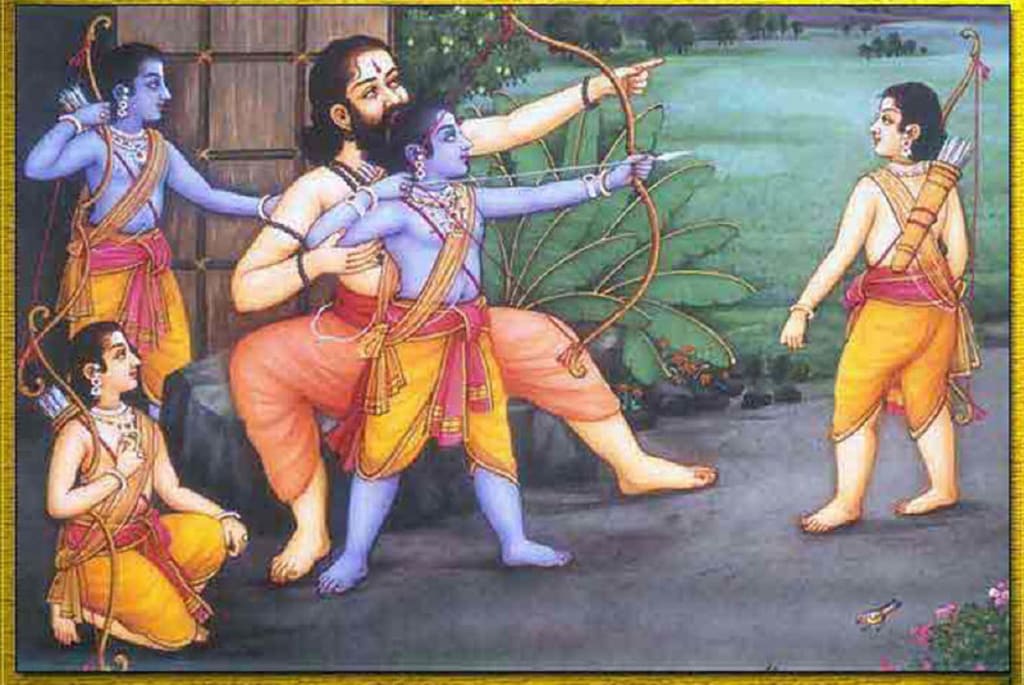
The kanda then describes the princes’ boyhoods in vivid, compressed strokes: their play, their early education, their natural gifts. The centrepiece of their youth is when the sage Vishwamitra arrives at Dasharatha’s court requesting that Rama — still a teenager — be sent to protect his forest ashram from demonic disturbances. Dasharatha is horrified and offers his own armies. Vishwamitra gently, immovably insists: it must be Rama.
What follows is Rama’s first campaign — and first self-revelation. He kills the demoness Tataka, destroys the demons Subahu and Maricha (the latter fleeing, to reappear fatefully in the Aranya Kanda), and receives from Vishwamitra a treasury of divine weapons and sacred knowledge. The sage then takes the brothers to Mithila — the kingdom of the philosopher-king Janaka — for a great ceremony.
Janaka has a daughter: Sita, found as an infant in a furrow of the earth as he plowed his field, a child of the earth goddess herself. For any man who wishes to marry her, Janaka has set one condition: string the divine Shiva Dhanush — a bow so ancient and massive that five thousand men struggle to carry it and hundreds of kings have failed even to lift. Rama steps forward, lifts the bow with one hand, strings it — and in drawing back the string, snaps it in two with a crack of thunder that shakes the earth.
The marriage of Rama and Sita is celebrated. The brothers marry as well — Lakshmana to Urmila, Bharata to Mandavi, Shatrughna to Shrutakirti. The Bala Kanda closes in completeness: a royal family united, a kingdom at peace, a destiny not yet begun.
Why It Matters
The Bala Kanda establishes everything the Ramayana will be. Its portrait of Ayodhya — serene, ordered, just — is the paradise the story will spend six more books trying to return to. The marriage of Rama and Sita at the close of this kanda is the epic’s still centre: the moment of completeness before the rupture. Everything before it is promise. Everything after it is recovery.
Crucially, the kanda contains the entire Ramayana in miniature — a brief summary told by Narada to Valmiki at the very opening. This signals immediately that the story is known before it is told. The Ramayana does not trade in suspense about outcomes. It trades in the depth of experience along the way.
2. Ayodhya Kanda — Ramayana
Sanskrit meaning: Ayodhyā = the unconquerable (the city’s name) Setting: The royal city of Ayodhya; the bank of the Ganga; the forest of Chitrakoot Approximate length: ~119 sargas, ~4,248 shlokas (the longest kanda) Central question: What does it mean to keep a promise — and what does it cost?
What Happens
The Ayodhya Kanda is the Ramayana’s great domestic tragedy — and by sheer verse count, its longest book. It takes the world the Bala Kanda built and breaks it open with a single night’s conversation between a queen and her maid.
Dasharatha, sensing his age, decides to crown Rama as Yuvaraja (crown prince). The entire city of Ayodhya rejoices. On the eve of the coronation, Manthara — the hunchbacked maid and confidante of Queen Kaikeyi — arrives at the queen’s chambers with poison dressed as counsel. She points out that a Rama on the throne means Kaushalya’s influence will eclipse Kaikeyi’s; that Bharata, away at his maternal uncle’s home, will return to find himself a servant in his own father’s palace.
Kaikeyi, genuinely devoted to Rama, is at first unmoved — until Manthara invokes pride, self-preservation, and the future of her son’s line. Slowly, terribly, she is turned. She enters the Kopa Bhavana — the anger chamber — and waits for Dasharatha. When he arrives and discovers her state, he offers her anything. She invokes the two boons he granted her years earlier on a battlefield where she saved his life. First boon: crown Bharata king. Second boon: exile Rama to the forest in the garments of an ascetic for fourteen years.
What follows is one of the most emotionally detailed sequences in world literature. Dasharatha collapses in anguish. He pleads through the night. Kaikeyi is unmovable. Rama is summoned at dawn. When he is told, his response defines the entire arc of his character: he accepts, completely, without grievance. He will go. He will not allow his father to become a man whose word failed.
Sita refuses every argument to stay behind. Her words — “Wherever you go, Rama, those very forests become Ayodhya for me” — are among the Ramayana’s most celebrated lines. She goes.
Lakshmana, fierce in love for his brother, will not stay. He goes too.
The departure from Ayodhya is the Ramayana’s emotional nadir. Citizens follow the exiles weeping until sleep overtakes them and Rama slips away in the night, unable to witness their grief any longer. Dasharatha dies within days — of heartbreak and the unbearable weight of a promise kept at the cost of everything worth keeping.
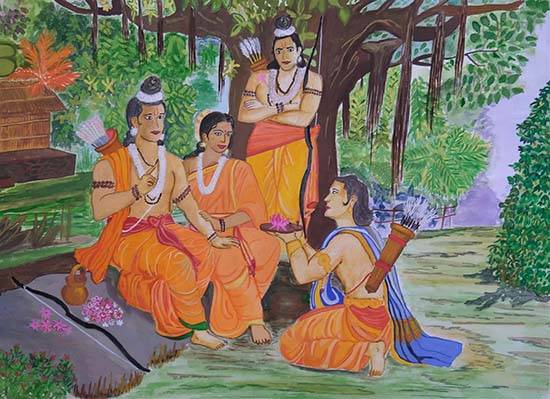
Bharata, returning to find his father dead and his mother’s catastrophic ambition laid bare, is devastated and furious. He marches to the forest to beg Rama to return. Rama refuses: the promise must be honoured in full. Bharata, accepting this with equal conviction, takes Rama’s sandals, places them on the throne, and lives in bark garments at the edge of Ayodhya — refusing to enter the city — as regent in his absent brother’s name.
Why It Matters
The Ayodhya Kanda is the Ramayana’s thesis statement: dharma is not convenient, and the people who live it most fully often suffer most for it. Rama, Sita, Lakshmana, Bharata, and Dasharatha each demonstrate a different dimension of this truth. Every one of them loses something irreplaceable. Not one of them chooses the easy path.
It is also the Ramayana’s most purely domestic kanda — its drama plays out in rooms and conversations and partings, not battles. It is the section that makes readers understand, viscerally, what is at stake in every sword-stroke of the Yuddha Kanda. Without the Ayodhya Kanda’s intimacy, the war that follows would have no emotional roots.
3. Aranya Kanda — The Book of the Forest
Sanskrit meaning: Araṇya = forest, wilderness Setting: The Dandaka Forest and its hermitages; the edges of the Deccan plateau Approximate length: ~75 sargas, ~2,973 shlokas Central question: What lurks at the boundary of the ordered world — and what happens when you step past it?
What Happens
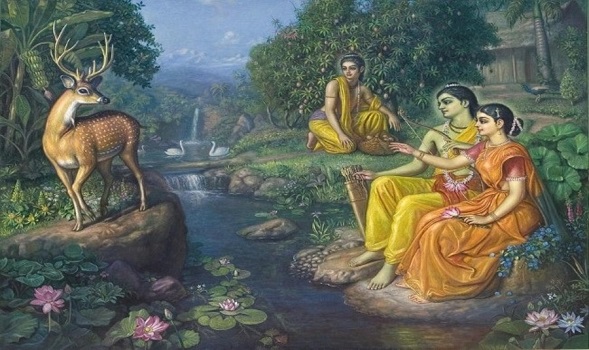
The Aranya Kanda is the Ramayana’s wilderness years — and in the wilderness, things that were safe in the palace become vulnerable. Rama, Sita, and Lakshmana move through the great Dandaka Forest, visiting sages, protecting hermitages from demonic disturbances, and living with the simplicity of ascetics. The forest is simultaneously beautiful and dangerous — a liminal space where the dharmic world of Ayodhya and the chaotic world of the rakshasas (demons) meet.
The pivotal encounter begins with Shurpanakha — the demoness sister of Ravana — who encounters Rama and is immediately, obsessively smitten. When Rama gently redirects her toward Lakshmana, who responds with sharp humour, she attacks Sita in jealousy. Lakshmana cuts off her nose and ears.
This single act sets everything that follows in motion. Shurpanakha flies to Lanka with two irresistible lures for her brother Ravana: wounded pride and a description of Sita’s beauty so vivid it ignites the demon king’s desire. Ravana devises his plan: he summons Maricha — the demon Rama had repelled in his boyhood — and commands him to take the form of a golden deer to lure Rama away from Sita.
The golden deer appears. Sita is transfixed by its beauty and begs Rama to capture it. Rama, despite misgiving, goes in pursuit. As Maricha dies, he cries out in Rama’s voice — “Lakshmana! Help me!” — and Sita, in her anguish, forces Lakshmana to go to his brother’s aid over his strong protest. Before leaving, Lakshmana draws the famous Lakshmana Rekha — a protective circle around their cottage — and warns Sita not to cross it for any reason.
Ravana arrives disguised as a wandering Brahmin mendicant begging alms. Sita, honouring the sacred obligation of hospitality to a holy man, steps across the line to offer him food. In that instant, Ravana seizes her and carries her away in his flying chariot.
The ancient vulture king Jatayu — lifelong companion of Dasharatha — sees the abduction and attacks Ravana with magnificent, hopeless courage. He is old; Ravana cuts his wings. Jatayu falls but keeps himself alive long enough to tell Rama which direction the chariot flew — the Ramayana’s most poignant act of loyalty.
Rama returns to find Sita gone. He searches the forest calling her name. He asks the trees. He asks the river. He weeps. It is the only moment in the Ramayana’s central books where the composed prince is utterly undone — and Valmiki gives it full, unhurried weight.
Why It Matters
The Aranya Kanda is the Ramayana’s hinge — the moment its entire geometry changes. Before it, the epic is about loss and exile. After it, it is about recovery and war. The abduction of Sita converts domestic tragedy into heroic epic.
It is also the kanda of the Lakshmana Rekha — one of the most resonant images in all of Indian literature. That protective line, drawn by devoted love and crossed out of dharmic obligation to a stranger, speaks to the impossible tension between safety and duty, between protection and the rules of civilised conduct that make protection worth having. Every Indian child learns this image. Most carry it for life.
4. Kishkindha Kanda — The Book of Kishkindha
Sanskrit meaning: Named after the Vanara (monkey) kingdom of Kishkindha Setting: The forests and mountains of the Deccan south; the monkey kingdom Approximate length: ~67 sargas, ~2,444 shlokas Central question: Who will stand with you when you have lost everything — and what do you owe them in return?
What Happens
Having found the dying Jatayu and learned Sita was taken southward, Rama and Lakshmana travel into unfamiliar terrain — deeper into the subcontinent, moving away from everything they know. They are not just exiles now but seekers, journeying into a world without maps and without allies.
In the forests near Rishyamukha mountain, they meet their most important ally. Sugriva — exiled king of the Vanaras — lives in hiding from his monstrous elder brother Vali, who has usurped his throne, taken his wife Ruma, and sworn to kill him on sight. With Sugriva is his devoted minister and the Ramayana’s greatest figure: Hanuman.
Hanuman approaches the brothers in disguise, assesses them with perceptive intelligence, and carries them on his shoulders to meet Sugriva. An alliance is sealed: Rama will kill Vali and restore Sugriva’s kingdom; Sugriva will deploy his vast armies to find Sita.
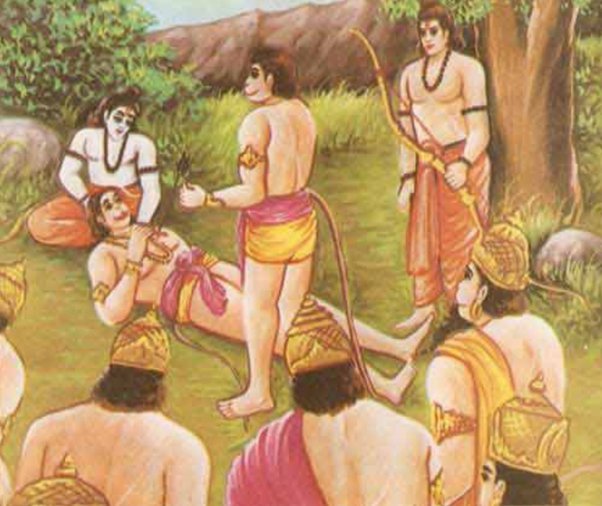
The killing of Vali is the kanda’s most morally debated episode. Vali holds a divine boon — any opponent who faces him directly in single combat automatically loses half their strength to him, making him nearly invincible. Rama kills him from behind a tree, shooting an arrow while Vali fights Sugriva. Vali falls and confronts Rama dying: “You call yourself righteous. Would a righteous man kill another from hiding, without challenge?” Rama’s response — that Vali was a sinner who had taken his brother’s wife, and that Rama as the land’s sovereign had authority to punish him — is dignified but does not fully satisfy. Valmiki presents the exchange without resolution, leaving the moral discomfort deliberately on the page.
Sugriva, restored to his throne, settles into feasting and delay as the monsoon arrives. Lakshmana, furious, reminds him of the debt with forceful persuasion. Sugriva then deploys the great Vanara generals — Angada, Jambavan, Nila, Nala — in all four directions to search for Sita. Of all the Vanaras, only Hanuman is identified as capable of crossing the great ocean to Lanka. He is given Rama’s ring to carry as proof of identity to Sita.
Why It Matters
The Kishkindha Kanda is the Ramayana’s alliance book — a kanda about how help is found and what it costs. It introduces Hanuman as a character of the highest moral and physical gifts, though his full greatness is reserved for the next book. It shows Rama as a political actor as well as a moral ideal — making bargains in an imperfect world, living the dharma of a king who must use what alliances are available.
The despatching of Vanara search parties in all four directions is also the epic’s most striking acknowledgment of its own geography: Sita is somewhere in the world’s vastness, and finding her requires the entire scope of the known earth. The Kishkindha Kanda gives the Ramayana its scale.
5. Sundara Kanda — The Beautiful Book
Sanskrit meaning: Sundara = beautiful, lovely, auspicious Setting: The ocean crossing; the golden city of Lanka; the Ashoka Grove Approximate length: ~68 sargas, ~2,885 shlokas Central question: What can love accomplish that armies cannot?
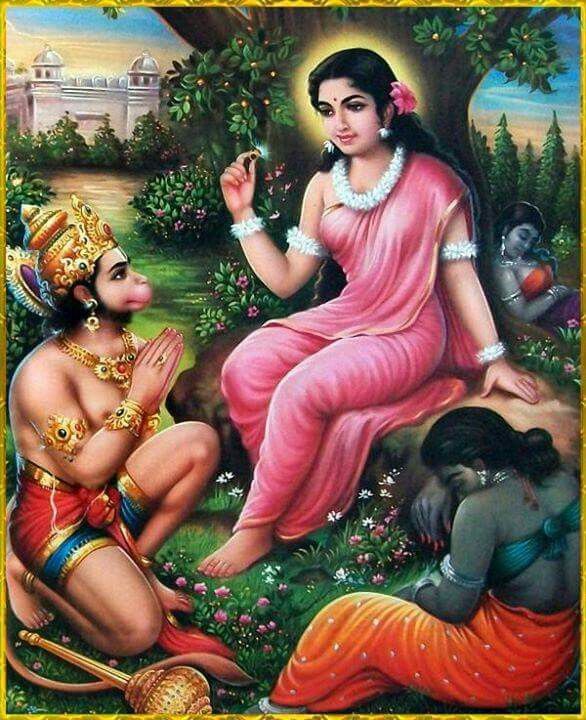
What Happens
The Sundara Kanda is the Ramayana’s most celebrated book — recited independently as a complete devotional text, prescribed for grief, difficulty, and spiritual seeking; chanted at dawn in temples; completed in nine-day marathon sessions (Sundara Kanda Parayana) for blessings across the full range of human need. More than any other section of the Ramayana, this is the book the tradition has decided is the living heart of the story.
Its name is traditionally said to refer to Hanuman — whose beauty is understood not physically but spiritually: the beauty of perfect devotion made visible. Hanuman in the Sundara Kanda is not primarily a warrior; he is love in action — and the book demonstrates, over sixty-eight chapters, that love in action can accomplish what armies cannot.
The kanda opens with one of world literature’s most electrifying images. Hanuman stands on the southern shore, surveys the ocean between him and Lanka, remembers his divine heritage as the son of the wind god Vayu, expands to mountainous size — and leaps. A single bound across the sea.
The crossing is dramatised at length. The sea-demoness Surasa opens her mouth to swallow him; he shrinks to the size of a thumb, darts in and out, and salutes her as he passes (she was testing him). The shadow-demon Simhika drags at his reflection; he kills her. He reaches the shores of Lanka as a golden city blazes on the horizon — a city of such beauty and power that even Hanuman pauses in wonder before reducing himself to the size of a cat and slipping past the city’s guards.
His search of Lanka is meticulous and almost novelistic in texture: he moves through Ravana’s palace, the magnificent women’s quarters, the great hall where Ravana sleeps enormous amid his wives — and does not find Sita. The absence is harrowing. He sits in the garden and confronts the possibility that she is already dead. Then he finds the Ashoka Grove — and within it, beneath a tree, in soiled garments, surrounded by demoness guards, refusing food, sustained by nothing but her own indestructible fidelity and absolute certainty in Rama: Sita.
The meeting between Hanuman and Sita is one of the great emotional encounters in world literature. He approaches with utmost care — too sudden an appearance would terrify her. He presents Rama’s ring. She does not believe. She slowly, guardedly does. He offers to carry her back to Rama on his shoulders. She refuses: it must be Rama who comes for her. The insult to his honour was real; it must be answered by him. This is not passivity — it is the clarity of a woman who understands exactly what the situation requires of each person within it.
Sita gives Hanuman a message for Rama: a small private story about the day a crow pecked her in the forest and Rama, half asleep, marked it with a blade of grass as punishment — a memory no one but Rama could verify. In the economy of devotion, this tiny token outweighs any army.
Then Hanuman allows himself to be captured. He is brought before Ravana in full magnificent court and delivers Rama’s ultimatum with composure and eloquence that stuns the assembly. Ravana orders his tail set on fire. Hanuman, through divine power, allows the flame but prevents the burning — then breaks free, grows to vast size, and burns Lanka to the ground, leaping from rooftop to rooftop, lighting the golden city like a torch. He spares only the Ashoka Grove where Sita sits.
He leaps back across the ocean. He lands among the Vanaras with the news that changes everything: Sita has been found.
Why It Matters
The Sundara Kanda is the Ramayana’s spiritual summit. Everything the epic has been building toward — the question of whether love can survive loss, whether righteousness can withstand power, whether one devoted soul can matter against an empire — is answered here. Yes. Yes. Yes.
Hanuman’s journey is structurally the Ramayana in miniature: departure, obstacles, discovery, message delivered, return with hope renewed. He completes in one kanda what the whole epic takes seven to accomplish. This is why the Sundara Kanda can be read independently and still feel complete.
Its extraordinary devotional life — the Sundara Kanda Parayana, the dawn recitations, the grandmothers who have memorised it entire — is not superstition. It is the tradition’s correct understanding that this kanda is the purest expression of bhakti anywhere in the Ramayana. To read it is not just to follow a story. It is to be, for the duration of the reading, in the presence of perfect devotion.
6. Yuddha Kanda — The Book of Ramayana War
Sanskrit meaning: Yuddha = war, battle (also called Lanka Kanda) Setting: The ocean crossing; the battlefield before Lanka; the city itself Approximate length: ~128 sargas, ~5,682 shlokas Central question: What is the true cost of restoring what was wrongfully taken?
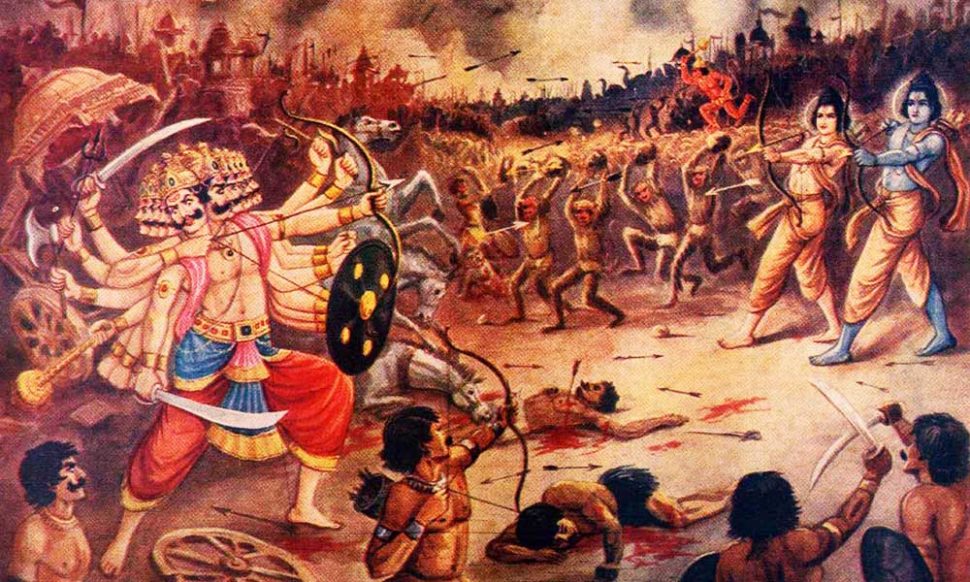
What Happens
The Yuddha Kanda from Ramayana is great war — and like all great literary wars, it is as concerned with what the fighting costs as with who wins.
The kanda opens with the building of the bridge. The Vanara engineers Nala and Nila — sons of the divine architect Vishwakarma — lead the construction of Rama Setu (called Adam’s Bridge in modern geography), the stone causeway across the ocean to Lanka. Squirrels carry pebbles and are stroked by Rama’s grateful hand; the image of the smallest creature contributing to the largest purpose is one of the Ramayana’s most beloved.
Before the battle begins, Vibhishana — Ravana’s younger brother, a man of genuine dharmic conviction who has tried and failed to counsel Ravana toward reason — defects to Rama’s side. Sugriva and others counsel distrust. Rama accepts him: “I do not turn away anyone who comes to me seeking shelter.” Vibhishana becomes the war’s essential insider — it is he who eventually reveals that Ravana’s immortality rests on a vessel of nectar stored in his navel.
The war is vast. Rama’s army of Vanaras fights Ravana’s demon legions across eighteen days of battle. The kanda’s most gripping episodes:
The fall of Lakshmana: Ravana’s brilliant son Indrajit — who defeated the king of heaven Indra himself — strikes Lakshmana with the Brahmastra weapon, and the prince falls unconscious. The army halts in collective terror. The physician Sushena prescribes the herb Sanjeevani, found only in the Himalayas. Hanuman flies north, cannot identify the specific herb in darkness, and in magnificent impatience uproots the entire mountain and carries it back. Lakshmana is revived. The army’s roar of relief shakes the heavens.
Kumbhakarna: Ravana wakes his giant brother Kumbhakarna — who sleeps for half the year — to fight. Kumbhakarna had already told Ravana the abduction was wrong. But he will not abandon his brother. He fights with devastating force and is finally killed by Rama in a prolonged battle. His death carries an elegiac weight: a good man destroyed by an inescapable loyalty.
The death of Indrajit: Lakshmana finally kills Indrajit in a duel of extraordinary ferocity — but not before Indrajit creates an illusion of Sita and appears to behead her before Rama’s horrified army. (Sita is unharmed; it is a weapon of deception.) Indrajit’s death is the war’s turning point. Ravana, hearing of his beloved son’s fall, descends to the battlefield himself.
Rama and Ravana: The final confrontation is fought at cosmic scale, with divine weapons, as the gods watch from the sky in silence. Rama repeatedly cuts off Ravana’s heads; each grows back. On Vibhishana’s counsel, Rama fires the Brahmastra — the supreme weapon crafted by Brahma himself — at Ravana’s chest. The demon king falls. The war ends. Ravana is cremated with full royal honours: “With death, all enmities end.”
The fire ordeal: Sita is brought before Rama. His formal words to her in the public assembly — that having lived in another man’s house she must prove her purity — are among the most contested lines in all of Sanskrit literature. Sita, with complete composure, requests a fire to be lit. She steps into the flames. Agni himself rises from the fire, carrying her, testifying to her absolute purity. Rama receives her. He says he always knew — the ordeal was for the world’s understanding, not his own. The gods shower flowers from heaven.
Why It Matters
The Yuddha Kanda is the Ramayana’s narrative fulfilment. But Valmiki is too honest to make it purely triumphant. The deaths of Kumbhakarna and Indrajit — both written with genuine feeling for the wrong side — prevent the victory from feeling clean. The fire ordeal’s moral complexity, left unresolved in Valmiki’s telling, is the kanda’s final act of honesty: the war was just, the victory was real, and something was still broken.
The Yuddha Kanda is also the kanda that earns the Sundara Kanda its emotional power in retrospect. The war vindicates Hanuman’s leap. Every soldier who crossed Rama Setu, every stone placed by a squirrel, every Vanara general who fell on that battlefield — all of it was set in motion by one monkey’s love and one morning’s decision to leap.
7. Uttara Kanda — The Concluding Book
Sanskrit meaning: Uttara = later, subsequent, concluding Setting: Ayodhya; Valmiki’s forest ashram; the banks of the Sarayu Approximate length: ~111 sargas, ~3,289 shlokas Central question: What survives after everything — and at what cost does a king hold his world together?
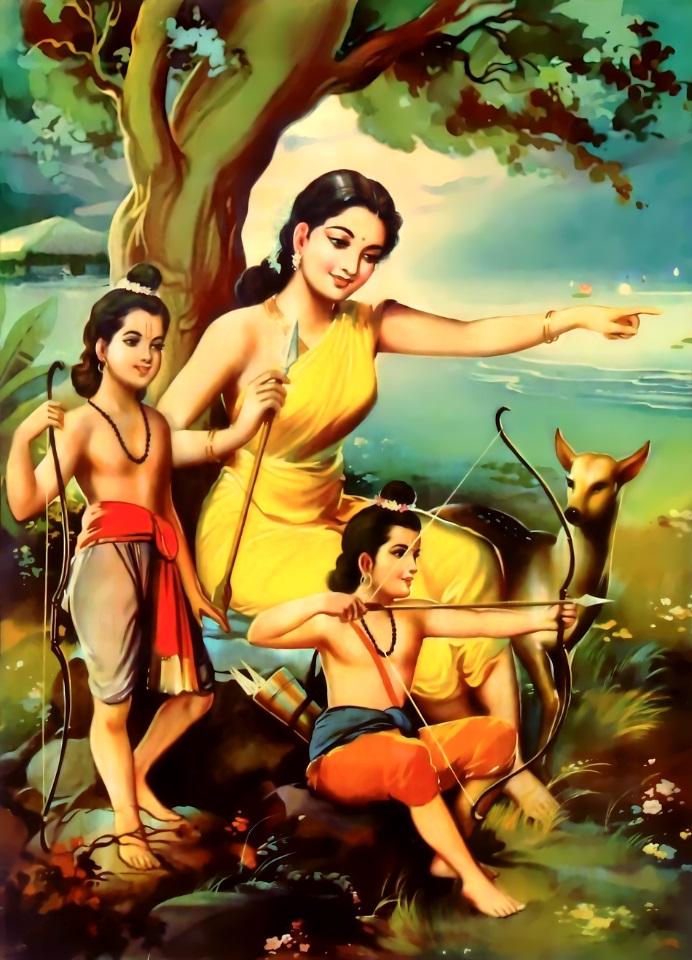
What Happens
The Uttara Kanda in Ramayana is the most contested and most painful book. Most scholars consider it a later addition to the original core of five central kandas — its language and theology differ noticeably from the earlier books. Yet it has been part of the Ramayana tradition for at least two millennia. To read the Ramayana without the Uttara Kanda is to read a story with its hardest truth removed.
The kanda opens with retrospective narratives — back-stories of Ravana’s lineage, his obtaining of divine boons, and the full history of the demon clan. These sections provide context the war books did not need and read clearly as later additions, useful to scholars and to the tradition but not part of the original poem’s urgency.
The central and shattering episode is the exile of Sita. Rama and Sita are reigning in Ayodhya. The kingdom is prosperous; the people content. But Rama’s intelligence reports carry disturbing news: ordinary citizens gossip. A washerman, it is said, has declared he is not like a king — meaning a king who took back a wife who lived in another man’s house. The gossip is of uncertain origin and doubtful credibility. Rama does not investigate. He does not confront it. He does not defend Sita publicly.
He sends for Lakshmana and gives him a royal command: take Sita — pregnant with twin sons — to the forest near Valmiki’s ashram on the pretext of a visit, and leave her there. He does not tell her himself. He does not explain. Lakshmana, horrified and unable to refuse his brother and king, obeys. He does not tell Sita the reason until the forest is already around her and the chariot has turned back toward the city.
Sita does not collapse. She does not accuse. She asks, quietly, that Valmiki’s ashram be nearby. She enters the forest. She gives birth to Lava and Kusha — two sons of extraordinary gifts.
Years pass. Rama performs the Ashvamedha Yagna (the great horse sacrifice of sovereignty). The sacred horse, wandering freely as ritual requires, reaches Valmiki’s forest ashram. Lava and Kusha — who do not yet know who they are — capture it. The Vanara generals come to reclaim it and are defeated. Rama’s greatest warriors come and are defeated by these two boys of unknown origin. Finally Rama himself comes — and sees, in their faces, something that hits him with the force of recognition.
Valmiki brings the boys to Rama’s court and reveals their identity. Sita is summoned. She comes — dignified, self-possessed, the earth’s daughter who has been through everything and is still entirely herself. The assembly waits. And then, once again, she is asked to prove herself before a public gathering.
It is too much. This time, Sita does not enter fire. She calls upon the earth: “If I have been true to Rama in thought, word, and deed — if I have known no man but Rama — let my mother receive me.” The earth opens. The earth goddess rises, receives her daughter in her arms with all honour, and descends. The ground closes. Sita does not return.
Rama lives for a long age afterward — just, effective, and irreparably bereft. He keeps a golden image of Sita beside him at every ritual that requires a wife’s presence. Eventually, the god of death arrives. Rama walks into the Sarayu river and, entering its waters, is received back into his divine form as Vishnu, ascending to heaven.
Why It Matters
The Uttara Kanda is the Ramayana’s refusal of the easy ending — and its greatest act of literary honesty. It insists that the ideal king and the ideal husband are not always the same person, that public duty and private love can pull in genuinely opposite directions, and that even the most righteous human life leaves behind sorrow it could not prevent.
Rama’s choice is not defended in the text. It is witnessed. The reader is left to sit with it.
Sita’s return to the earth is the Ramayana’s most profound final image — not a defeat but a sovereign act, a departure made entirely on her own terms, a woman who has been asked once too often to prove what was never in question, choosing to answer to the earth that bore her rather than to one more assembly’s judgment. It does not feel like failure. It feels like the earth’s daughter coming home.
The Uttara Kanda is why the Ramayana is not a fairy tale. The demon is defeated, the wife is recovered, the prince is crowned, the kingdom is just — and still, the ending is sorrow. Valmiki, the first poet, seems to have understood something only the most courageous literature understands: life does not resolve. It concludes. And the story we tell about it is all the immortality any of us get.
How the Seven Ramayana Kandas Work as One Whole
Reading all seven kandas together reveals an arc of extraordinary structural intelligence:
| Kanda | Setting | Emotional Register | Central Movement |
|---|---|---|---|
| Bala Kanda | Palace & Mithila | Hope, arrival, promise | Gain: Identity, marriage, divine purpose |
| Ayodhya Kanda | City & forest edge | Rupture, grief, acceptance | Loss: Kingdom, father, home |
| Aranya Kanda | Wilderness | Wandering, encounter, catastrophe | Loss: Sita, safety, direction |
| Kishkindha Kanda | Southern forests | Alliance, delay, mobilisation | Gain: Hanuman, the army, direction |
| Sundara Kanda | Ocean & Lanka | Devotion, discovery, fire | Gain: Sita found, hope restored |
| Yuddha Kanda | Battlefield Lanka | War, sacrifice, recovery | Gain: Sita returned, Ravana defeated |
| Uttara Kanda | Kingdom & forest | Reign, loss, departure | Loss: Sita again, completeness, Rama himself |
The arc moves from promise to rupture to recovery to final, irreversible loss — an oscillation that mirrors the structure of a human life, where no achievement is permanent and no loss is truly final until the last one. The Ramayana is a poem about impermanence written in the only form that survives it: the story itself.
The Sundara Kanda as Independent Text
Of all seven kandas, the Sundara Kanda holds the most remarkable independent devotional life — and understanding why illuminates the Ramayana’s entire tradition.
The kanda is regularly recited as a complete text in its own right. The practice of Sundara Kanda Parayana — reading or chanting the entire kanda over nine consecutive days, or over a single extended sitting — is found across Hindu households and is prescribed for everything from examination success to illness recovery to relief from sorrow. The Sundara Kanda is believed to carry particular shakti (divine power), and even those who have not read any other part of the Ramayana may know this kanda well.
The reason is theological but also literary. The Sundara Kanda is the one kanda in which the Ramayana’s deepest theme — devotion as the supreme human capacity — is made completely concrete, enacted before our eyes in real time by a single character. Hanuman does not merely talk about devotion. He leaps the ocean. He walks through fire. He carries a mountain. He does all of this not through divine mandate but through love freely given. Every human being who recites the Sundara Kanda is, for the duration of that recitation, standing in Hanuman’s light.
Which Ramayana Kanda Should You Read First?
For new readers approaching the Ramayana in sections, here is practical guidance shaped by what each kanda does best:
Start with the Sundara Kanda — it is the most complete, the most devotionally alive, and the most emotionally self-contained of the seven. It gives you Hanuman, which means it gives you the Ramayana’s beating heart. If you read it aloud, even better.
Then read the Ayodhya Kanda — for the domestic drama that establishes every emotional stake of the larger story. The exile of Rama is the Ramayana’s true origin point; everything else flows from it.
Then read the Aranya and Yuddha Kandas for the complete arc from abduction to war — the narrative spine of the epic as most readers know it.
Read the Bala Kanda for context and origin, and the beautiful marriage of Rama and Sita that gives the loss in the Aranya Kanda its full weight.
Read the Uttara Kanda last, and deliberately — when you are ready for the Ramayana’s most difficult honesty. It is not comfortable reading. But it is the book that elevates the Ramayana from a great adventure story to a great work of literature.
FAQs on the Seven Kandas of Ramayana
How many kandas are in the Ramayana? The Valmiki Ramayana is divided into seven kandas: Bala Kanda, Ayodhya Kanda, Aranya Kanda, Kishkindha Kanda, Sundara Kanda, Yuddha Kanda (also called Lanka Kanda), and Uttara Kanda.
Which is the longest kanda in the Ramayana? The Ayodhya Kanda is the longest by shloka count at approximately 4,248 shlokas, though some recensions place the Yuddha Kanda as slightly longer. Together they form the Ramayana’s two heaviest sections — the domestic catastrophe and its martial resolution.
Why is the Sundara Kanda called the Beautiful Book? The name refers to Hanuman, whose sundara (beauty) is understood as the radiance of perfect, selfless devotion. The book is also tonally the most lyrical and emotionally complete section of the Ramayana — it has a full arc within itself, and its outcome (Sita found; hope restored) gives it a quality of grace that the war books, for all their power, do not possess.
Is the Uttara Kanda part of the original Ramayana? Most scholars consider both the Uttara Kanda and the Bala Kanda later additions to the original five-kanda core (Kandas 2–6). The Uttara Kanda’s language and tone differ from the central books, and its narrative raises difficulties not present in the earlier text. However, it has been part of the living Ramayana tradition for at least two millennia and is inseparable from the epic as it is known today.
What is the significance of seven kandas? While seven does not carry the same explicit numerological symbolism in the Ramayana as 18 does in the Mahabharata, its seven-part structure mirrors the seven stages of a complete human arc — from birth through purpose, rupture, seeking, devotion, resolution, and transcendence. The seven kandas together trace not just a hero’s journey but an entire human life in its fullness.
Which kanda of the Ramayana contains Hanuman’s story? Hanuman is introduced in the Kishkindha Kanda and reaches his fullest expression in the Sundara Kanda, which is almost entirely devoted to his journey to Lanka and back. He also plays a vital role in the Yuddha Kanda, particularly in the episode where he carries the Dronagiri mountain to revive Lakshmana.
Seven Journeys, One Story – Ramayana
The Ramayana’s seven kandas are seven different answers to the same question: What does it mean to live rightly in a world that will take everything from you?
The Bala Kanda answers: it means being born into purpose and beauty. The Ayodhya Kanda answers: it means going into the forest anyway, when your word demands it. The Aranya Kanda answers: it means accepting that even the most righteous life is not immune to catastrophe. The Kishkindha Kanda answers: it means finding the allies the world provides, even imperfect ones, and honouring the cost of their help. The Sundara Kanda answers: it means that love alone can cross the uncrossable. The Yuddha Kanda answers: it means fighting the necessary war without pretending it leaves you whole. And the Uttara Kanda answers, quietly, at the end: it means that even the best among us makes choices that break what they love most — and that the story continues, sung by their own children, in the ashram of the poet who watched everything and wrote it down so none of it would be lost.
Seven books. One story. Over two thousand years of telling. And it is not finished yet.
Reference for Further Reading:
- Who Is Hanuman? Character, Symbolism, and Devotional Significance
- Sundara Kanda: Why Hindus Recite It for Blessings and Healing
- Introduction to the Mahabharata — The World’s Longest Epic
- The 18 Parvas of the Mahabharata Explained