
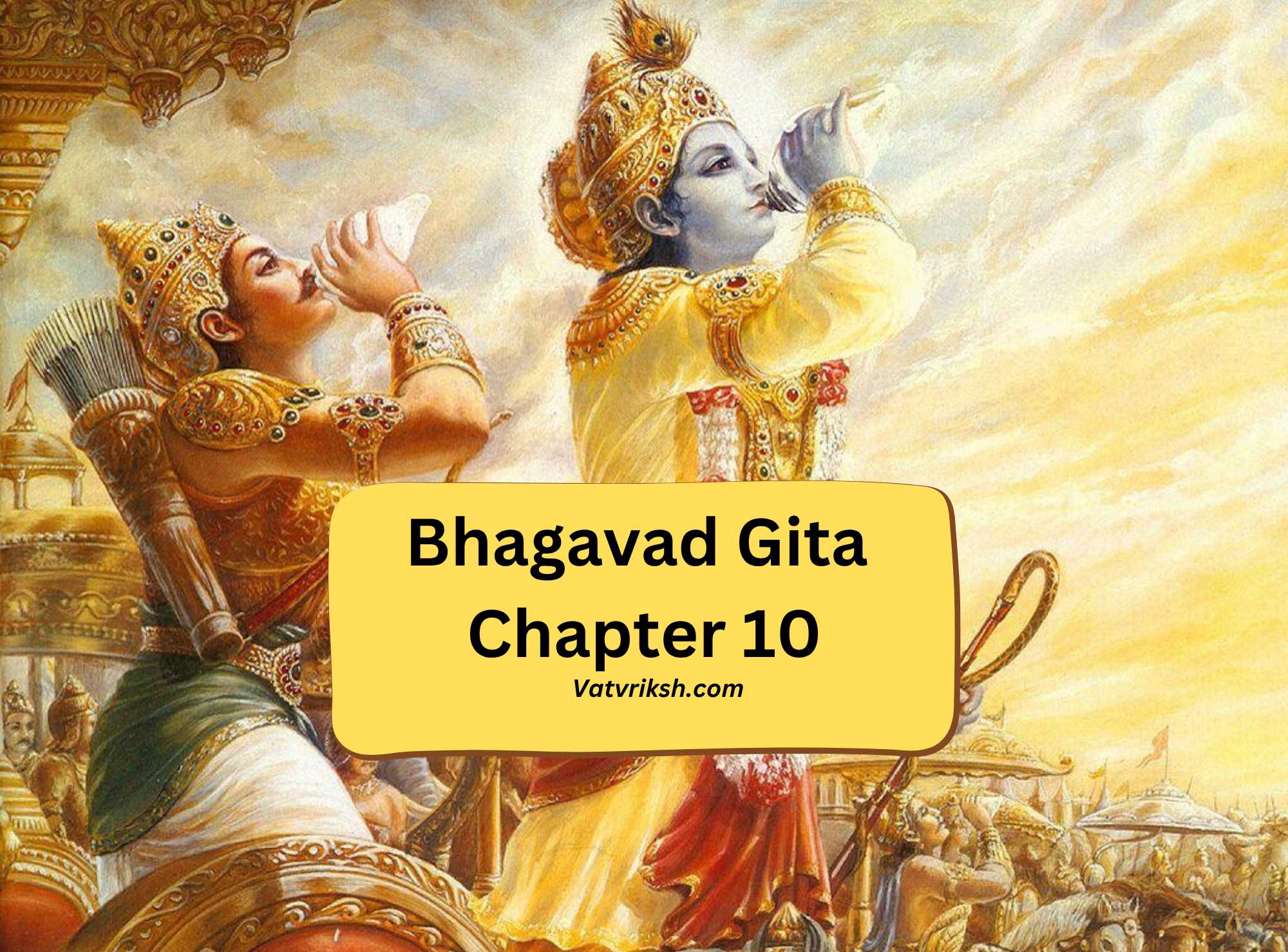
Try, for a moment, to name the single most magnificent thing you know — the tallest mountain, the most brilliant mind, the most powerful force of nature, the most beautiful sound. Now imagine being told that all of these, and countless things like them, are not separate wonders scattered across the world, but individual glimpses of one underlying, radiant presence. This is the invitation Krishna extends to Arjuna in Chapter 10 of the Bhagavad Gita — a chapter often described as a hymn of divine grandeur, and one of the most poetically rich sections of the entire text.
Having revealed, in Chapter 9, the intimate, accessible nature of devotion, Krishna now turns to something different in tone: a sweeping, almost overwhelming catalogue of his own manifestations throughout creation. Chapter 10, known as Vibhuti Yoga — “The Yoga of Divine Glories” or “The Yoga of Manifestations” — sets the stage for the Gita’s most awe-inspiring moment, the cosmic vision of Chapter 11, by first cultivating in Arjuna a deepened sense of wonder.
Krishna Speaks Again of His Own Glory
Chapter 10 opens with Krishna telling Arjuna, once more, that he will speak for Arjuna’s benefit, since Arjuna delights in hearing him. Krishna notes that neither the gods nor the great sages fully know his origin, since he is, in truth, the source of all the gods and great sages themselves.
He adds a significant teaching here: one who knows him as unborn, without beginning, and as the great Lord of all the worlds, is freed from delusion among mortals and released from all wrongdoing. This sets up the chapter’s central purpose — not simply to list impressive facts, but to cultivate a genuine recognition of the divine source underlying all forms of greatness in the world.
The Story Narrative
The Qualities That Flow From Krishna
Krishna begins by listing a series of inner qualities that arise from him: intelligence, knowledge, freedom from delusion, patience, truthfulness, self-control, calmness, pleasure and pain, birth and death, fear and fearlessness, non-violence, equanimity, contentment, austerity, charity, fame, and disrepute — this diverse range of qualities in living beings, Krishna says, arises from him alone.
This opening list is notable for its honesty: it includes not just the qualities we might consider purely positive (truthfulness, contentment, fearlessness) but also more difficult experiences (pain, fear, disrepute). Krishna is establishing, from the outset, that his presence is not confined to what is conventionally pleasant, but underlies the full range of human experience.
Arjuna’s Sincere Request
Arjuna responds to Krishna’s teaching with evident sincerity and humility. He tells Krishna directly that he now regards him as the supreme Brahman, the supreme abode, the supreme purifier, the eternal divine person, the first among the gods, unborn, and the greatest Lord — a truth confirmed, Arjuna says, by great sages such as Narada, Asita, Devala, and Vyasa, and now spoken by Krishna himself.
Arjuna adds that he believes everything Krishna has told him, acknowledging that neither the gods nor the demons fully comprehend Krishna’s true manifestation. Then Arjuna makes his request — one that drives the remainder of the chapter: he asks Krishna to describe, in full detail, his own divine glories (vibhuti) by which he pervades and sustains all these worlds, since Arjuna, though he has heard much, still cannot fully grasp the extent of Krishna’s power and presence.
He adds a beautiful, humble line here: tell me again and again, he asks, of your glory, for I am never satisfied hearing this life-giving nectar.
Why It Matters: Arjuna’s request models an important spiritual disposition — genuine wonder and a desire to keep learning, rather than assuming that a single explanation exhausts a truth this vast. This openness sets the tone for the extraordinary catalogue that follows.
Krishna’s Catalogue of Divine Manifestations
Krishna responds warmly, acknowledging that his divine manifestations are indeed without end, but that he will describe the chief among them for Arjuna’s sake. What follows is one of the most vivid, poetically structured passages in the entire Gita — a sweeping list in which Krishna identifies himself with the very best, the most essential, or the most representative example within one category after another.
He describes himself as the self seated in the heart of all beings, and as the beginning, middle, and end of all beings. Among the celestial deities (adityas), he is Vishnu; among luminaries, the radiant sun; among the storm deities (maruts), he is Marichi; among the constellations, the moon.
Among the Vedas, he is the Sama Veda; among the celestial beings, he is Indra; among the senses, he is the mind; among living beings, he is consciousness itself. Among the fierce deities (rudras), he is Shiva; among wealth-bestowing spirits, he is Kubera; among elemental forces, he is fire; among mountains, he is Meru.
Among priestly sages, he identifies himself as Brihaspati; among military commanders, Skanda; among bodies of water, the ocean. Among the great sages, he is Bhrigu; among sacred utterances, the single syllable Om; among forms of spiritual practice, the silent repetition of sacred names (japa); among immovable things, the Himalayas.
Among trees, he is the sacred fig (ashvattha); among divine sages, Narada; among heavenly musicians (gandharvas), Chitraratha; among the perfected sages, Kapila. Among horses, he identifies himself with Uchchaihshravas, born of the churning of the cosmic ocean of nectar; among elephants, Airavata; among human beings, the king.
Among weapons, he is the thunderbolt; among cows, the wish-fulfilling cow Kamadhenu; among the causes of procreation, he is Kandarpa, the god of love; among serpents, he is Vasuki. Among the divine serpent-kings (nagas), he is Ananta; among aquatic beings, Varuna; among ancestral spirits, Aryaman; among enforcers of law and order, Yama, the lord of death and justice.
Among the demonic clans, he is Prahlada; among things that measure or calculate, time itself; among wild animals, the lion; among birds, Garuda. Among purifiers, he is the wind; among wielders of weapons, Rama; among fish, the shark; among rivers, the Ganges.
Among all forms of creation, he is the beginning, middle, and end; among branches of knowledge, the knowledge of the individual self (adhyatma vidya); among methods of debate, the correct conclusion. Among the letters of the alphabet, he is the letter A; among compound word forms, the dual compound; he is imperishable time itself, and the sustainer facing in every direction.
He is all-devouring death, and also the origin of all that is yet to come into being; among feminine qualities, he identifies himself as fame, prosperity, speech, memory, intelligence, steadfastness, and patience. Among the Vedic hymns, he is the great chant of the Sama Veda; among meters, the Gayatri; among months, Margashirsha; among seasons, the flower-bearing spring.
He is gambling among the fraudulent, the splendor of the splendid, the victory of the victorious, the determination of the resolute, and the goodness of the good. Among the descendants of Vrishni, he is Krishna himself (speaking here in the third person of his own lineage); among the sons of Pandu, he is Arjuna; among sages, Vyasa; among poets and thinkers, Ushanas.
He is the rod of those who punish, the strategy of those who seek victory, the silence of secrets, and the wisdom of the wise. He is the very seed of all existence, and there is nothing, whether moving or unmoving, that could exist without him.
The Impossibility of Complete Enumeration
Krishna closes this extraordinary catalogue with an important clarification: there is no end to his divine manifestations, and what he has spoken is only a brief indication of their extent. Whatever being possesses glory, brilliance, or power, Krishna says, know that to have sprung from just a fraction of his own splendor.
He then offers a concluding teaching that reframes the entire purpose of the preceding catalogue: what use, he asks, is such extensive knowledge to Arjuna? He himself, Krishna says, remains established, sustaining this entire universe with merely a single fragment of his own being.
Why It Matters: This closing move is crucial to understanding the chapter correctly. The extensive list is not meant to be memorized as a catalogue of trivia, nor is it meant to imply that Krishna’s true nature can be fully captured through enumeration. Instead, the list functions as a spiritual exercise — training the mind to recognize the sacred within excellence, greatness, and representative qualities wherever they appear, while gesturing toward a reality that ultimately exceeds any list, however extensive.
Deeper Philosophical Meaning
Chapter 10 serves a specific and important function within the Gita’s overall structure, and its philosophical significance can be understood on a few levels.
Training perception, not just providing information: Rather than offering a systematic philosophical argument, Chapter 10 offers a contemplative practice — inviting the reader to look at the world and recognize the divine specifically within its finest, most excellent, most representative expressions. This is a distinctive form of spiritual pedagogy: shaping how a person sees, rather than simply what they know.
Immanence within diversity: By identifying himself with the best example within dozens of different categories — rivers, mountains, seasons, animals, human roles, forms of knowledge — Krishna presents a vision of the divine that pervades the tremendous diversity of the created world without being reducible to any single element within it.
Preparing for the cosmic vision to come: Chapter 10 functions as a deliberate build-up toward the extraordinary vision of Krishna’s universal form that Arjuna requests and receives in Chapter 11. The wonder cultivated here — Arjuna’s genuine hunger to keep hearing more — sets the emotional and spiritual stage for that even more overwhelming revelation.
What This Chapter Means for Life Today
Excellence, wherever we encounter it, can point toward something larger than itself. Chapter 10’s method — recognizing the sacred specifically within the finest examples of any category — offers a practical spiritual exercise adaptable to modern life: noticing what is most excellent, skillful, or beautiful in ordinary experience, and allowing that recognition to cultivate a broader sense of wonder and gratitude, rather than viewing accomplishment purely in terms of personal comparison or competition.
A restless curiosity toward truth is itself a healthy spiritual disposition. Arjuna’s repeated request — “tell me again and again” — models a valuable orientation toward learning and understanding generally: genuine intellectual and spiritual humility recognizes that important truths are rarely exhausted by a single explanation, and remains open to continued exploration rather than assuming premature completeness.
No list, however extensive, fully captures reality — and that’s a reason for humility, not despair. Krishna’s closing acknowledgment that his manifestations have no end, and that the catalogue offered is only a brief indication, models healthy epistemic humility: even extensive knowledge and description inevitably fall short of the full reality being described, a useful reminder in any field of study or understanding.
Greatness in any form deserves the same underlying respect. By identifying with excellence across an enormous range of categories — from rivers to warriors to letters of the alphabet — Krishna’s teaching implicitly resists narrow hierarchies that value only certain forms of achievement or greatness, suggesting instead that genuine excellence, wherever it appears, reflects the same underlying source.
Frequently Asked Questions
What is the main teaching of Bhagavad Gita Chapter 10? Chapter 10 presents Krishna’s catalogue of divine manifestations (vibhuti), in which he identifies himself with the finest or most representative example within numerous categories of existence, teaching Arjuna to recognize the divine within excellence and greatness throughout the created world.
What does “Vibhuti Yoga” mean? Vibhuti Yoga translates roughly as “the yoga of divine glories” or “the yoga of manifestations,” referring to the chapter’s central theme of Krishna describing his own presence within the most excellent examples across many categories of creation.
Why does Krishna list so many different examples in Chapter 10? The extensive catalogue is meant as a contemplative exercise rather than a literal or complete inventory — it trains the reader to recognize the divine within excellence and greatness wherever it is found, while Krishna himself clarifies that the list represents only a small indication of his boundless manifestations.
How does Chapter 10 relate to Chapter 11? Chapter 10 builds anticipation and wonder in Arjuna through its description of Krishna’s manifestations, directly setting the stage for Arjuna’s request, at the start of Chapter 11, to witness Krishna’s complete universal form.
Does Chapter 10 say Krishna’s manifestations are limited to what is listed? No. Krishna explicitly states that his divine manifestations have no end, and that what he has described is only a brief indication, since he sustains the entire universe with merely a fraction of his own being.
How many verses are in Bhagavad Gita Chapter 10? Chapter 10 contains 42 verses, and it is celebrated for its poetic, almost hymn-like structure as it moves through dozens of categories of created existence.
Chapter 10 invites us to look at the world differently — not as a collection of separate, unrelated wonders, but as countless expressions of a single, radiant source, glimpsed most clearly wherever excellence, beauty, or power appears at its finest. Arjuna’s hunger to hear more, again and again, mirrors the very wonder this chapter hopes to awaken in every reader.