
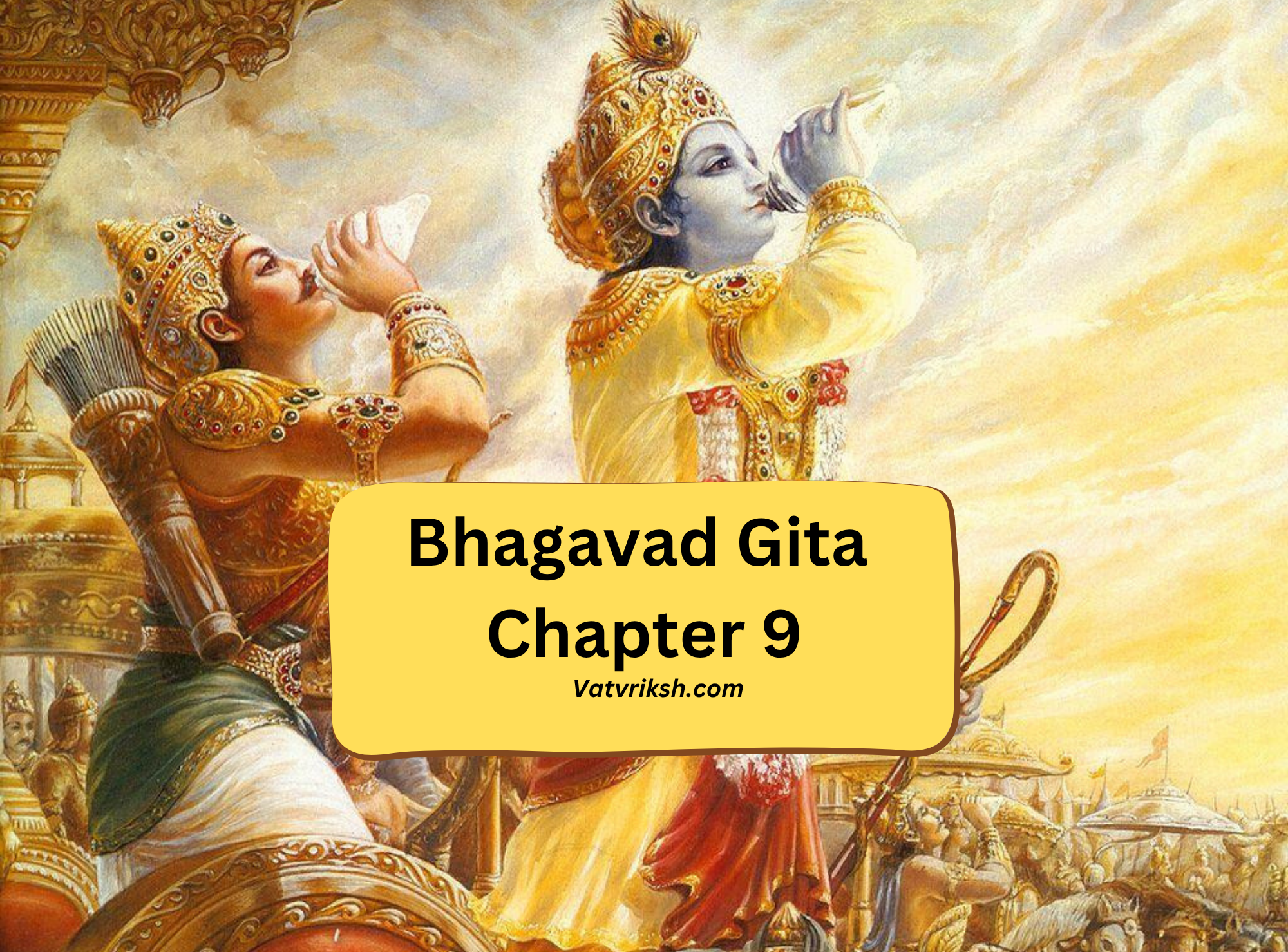
Some teachings are held back until a student has proven ready for them — not out of secrecy for its own sake, but because certain truths only make sense once the ground has been properly prepared. By the time we reach Chapter 9 of the Bhagavad Gita, Krishna has spent eight chapters carefully building that ground: the eternal self, selfless action, meditation, the nature of Brahman, the mystery of death. Now, he tells Arjuna, he is ready to reveal something even deeper — a teaching he calls the most secret of all secrets.
Chapter 9, known as Raja Vidya Raja Guhya Yoga — “The Yoga of Royal Knowledge and Royal Secret” — is widely regarded as one of the most beloved and quoted chapters in the entire Bhagavad Gita. It combines profound metaphysics with an unusually warm, personal, devotional tone, and it closes with one of the most inclusive and comforting promises found anywhere in Hindu scripture.
A Teaching Called “Royal” and “Secret”
Krishna opens Chapter 9 by telling Arjuna, who is free from any trace of envy or ill will, that he will now reveal the most profound secret — a combination of direct knowledge (jnana) and its realized, experiential counterpart (vijnana), knowing which Arjuna shall be freed from all inauspiciousness.
He describes this teaching as the raja vidya (the king, or sovereign, of all knowledge) and the raja guhya (the king, or sovereign, of all secrets) — supremely purifying, directly perceivable through experience, entirely in accordance with righteousness (dharma), very easy to practice, and imperishable in its results.
This framing matters. Krishna isn’t describing an obscure or difficult teaching reserved for a select few ascetics. He explicitly calls it easy to practice and immediately perceivable — setting up a chapter that will, in fact, close with one of the most accessible and universally addressed teachings in the entire text.
The Story Narrative
The Unmanifest Krishna Pervading All Things
Krishna begins his teaching with a striking metaphysical claim: this entire universe is pervaded by him in his unmanifest form; all beings exist within him, yet — and this is the subtle part — he does not exist within them in the ordinary sense one might assume.
He goes further, saying that beings do not actually dwell within him either, in a simplistic sense. This is his divine mystery (aishvarya yoga): though he is the sustainer of all beings and does not literally dwell within them, his very self brings forth and sustains all beings, much as the vast wind, moving everywhere, is said to rest within the space of the sky.
This paradoxical-sounding teaching is attempting to describe something genuinely difficult to express in ordinary language: a reality that is simultaneously the source and sustainer of everything, while remaining, in its essential nature, untouched and unentangled by the changes and limitations of the created world it sustains.
The Cycle of Cosmic Creation and Dissolution
Krishna describes the recurring cycle of cosmic manifestation: at the end of a cosmic age, all beings return into his material nature (prakriti); and at the beginning of the next age, he sends them forth again. Presiding over his own material nature, he brings forth this entire multitude of beings, again and again, driven by the inherent force of that nature itself — and he adds an important clarification: these actions do not bind him, since he remains as one seated apart, unattached to these very actions.
This teaching reinforces a theme carried over from earlier chapters (particularly Chapter 4’s discussion of action that does not bind): even the vast, continuous work of cosmic creation does not create attachment or bondage for the one who acts from a place of complete non-attachment and mastery.
The Deluded and the Great-Souled
Krishna then draws a sharp contrast between two very different responses to his true nature. Deluded people, he says, disregard him when he assumes a human-like form, not recognizing his higher nature as the great Lord of all beings. Their hopes, actions, and knowledge are described as being in vain, their discrimination lost, as they partake of a deceptive, demonic, and delusive nature.
By contrast, great souls (mahatmas), possessing a divine nature, worship him single-mindedly, knowing him as the imperishable source of all beings. Constantly glorifying him, striving with firm resolve, bowing before him with devotion, they worship him with unwavering focus, ever united with him in this understanding.
This passage introduces a recurring pattern that continues through the rest of the chapter: rather than condemning those who fail to recognize the divine, Krishna primarily describes the natural, almost inevitable consequences of different orientations — some leading toward confusion and lost discernment, others toward clarity, devotion, and peace.
Different Forms of Worship, All Directed Toward Him
Krishna then describes various additional ways people approach him — some worship him through the sacrifice of knowledge (jnana yajna), recognizing his oneness; others worship him as manifold, perceiving him in his many different forms. He describes himself as the ritual (kratu), the sacrifice (yajna), the offering to ancestors (svadha), the medicinal herb, the sacred hymn (mantra), the clarified butter (ghee), the fire, and the very act of offering.
He describes himself, further, as the father of this universe, the mother, the supporter, the grandfather, the object of knowledge, the purifier, the sacred syllable Om, and the sacred verses of the Rig, Sama, and Yajur Vedas. He is the goal, the sustainer, the lord, the witness, the abode, the refuge, the friend, the origin, the dissolution, the foundation, the treasure-house, and the imperishable seed of all things.
This extended, almost hymn-like passage functions as an expansion of similar material introduced in Chapter 7, reinforcing the idea that Krishna’s presence isn’t confined to any single ritual object or practice, but underlies the entire structure of Vedic worship and cosmic order itself.
The Fruits of Ritual Worship Are Temporary
Krishna offers an important, somewhat cautionary teaching here: those who worship other deities according to Vedic ritual, seeking the fruits of action, quickly obtain rewards in this world — but he adds a crucial qualifier: this is a world governed by the results of action (karma), and such rewards, however real, are inherently temporary.
He notes that worshippers of the celestial deities go to those deities, while worshippers of ancestors go to the ancestors; worshippers of lesser spirits go to those spirits — but those who worship him, Krishna says, come to him directly. This distinction matters within the chapter’s broader argument: ritual worship focused primarily on specific, limited outcomes yields limited, temporary results, while devotion directed toward the ultimate, imperishable reality yields a correspondingly complete and lasting result.
The Simplicity of True Devotion
Here Krishna offers one of the most tender and widely loved verses in the entire Bhagavad Gita: whoever offers him a leaf, a flower, a fruit, or even water, with devotion, he accepts that offering of love from the pure-hearted devotee who presents it with genuine devotion.
This single teaching carries enormous weight within the devotional (bhakti) tradition that grows out of the Gita. It strips away any requirement for elaborate ritual, costly offerings, or specialized knowledge, insisting instead that sincere devotion — expressed through even the simplest, most humble gesture — is genuinely sufficient. Krishna is not describing a minimum threshold grudgingly accepted; he is describing what he considers the essential heart of true worship.
Krishna extends this teaching further: whatever you do, whatever you eat, whatever you offer in sacrifice, whatever you give, whatever austerity you practice — do it as an offering to him. In this way, he says, you shall be freed from the bondage of action, whether its results are good or bad, and you shall come to him, united through the yoga of renunciation.
Why It Matters: This teaching universalizes spiritual practice in a remarkable way. It suggests that virtually any ordinary daily activity — eating, working, giving, exercising discipline — can become a genuine spiritual offering, provided it is undertaken with the right inner orientation, rather than requiring withdrawal into exclusively religious or ritual contexts.
Equal Toward All Beings, Yet Dear to the Devoted
Krishna clarifies an important point about his own nature here: he is equal toward all beings, showing no favor and no hatred toward anyone — yet those who worship him with devotion dwell within him, and he, in turn, dwells within them, in a special and reciprocal way.
He adds a remarkable teaching that closes the chapter with striking generosity: even a person of the most sinful conduct, if they worship him with exclusive, undivided devotion, should be regarded as righteous, because they have resolved rightly. Such a person, Krishna says, soon becomes righteous in nature and attains lasting peace — and Krishna states directly that his devotee never perishes.
He extends this promise explicitly and inclusively: those who take refuge in him — even those born of what the social conventions of the era considered a lower or inferior birth, including women, merchants, and laborers — attain the supreme goal. How much more so, he adds, holy scholars and devoted, saintly kings.
The Final Invitation
Krishna closes the chapter with a warm, personal invitation, delivered in some of the Gita’s most quoted lines: fix your mind on him, become devoted to him, offer sacrifice to him, bow down to him; having thus disciplined yourself, with him as the supreme goal, you shall surely come to him.
Deeper Philosophical Meaning
Chapter 9 accomplishes something distinctive within the Gita’s overall structure: it takes the sophisticated metaphysics developed in Chapter 7 and translates it into an intensely personal, accessible devotional invitation.
Divine immanence without entanglement: The teaching that all beings exist within Krishna, while he does not exist within them in an ordinary sense, describes a relationship between the divine and the created world that is intimate without being limiting — the source remains free even while sustaining everything that depends upon it.
The universalizing of spiritual practice: By teaching that ordinary daily actions — eating, giving, practicing discipline — can become genuine offerings when performed with the right inner orientation, Krishna dissolves any strict boundary between “religious” and “ordinary” activity.
Radical accessibility of devotion: The chapter’s most famous verse — accepting even a leaf, flower, fruit, or water offered with love — alongside its explicit inclusion of those excluded by the social hierarchies of the era, establishes devotion (bhakti) as a path genuinely available to absolutely anyone, regardless of social position, ritual knowledge, or material resources.
What This Chapter Means for Life Today
Sincerity matters more than scale or polish. The teaching that Krishna accepts even the humblest offering — a single leaf or a cup of water — made with genuine devotion, pushes back against a common modern assumption that meaningful spiritual or ethical action requires grand gestures. A small, sincere act often carries as much genuine weight as an elaborate one.
Ordinary activities can carry deeper meaning. Krishna’s instruction to offer “whatever you do, whatever you eat” as a form of dedication suggests a practical, everyday spirituality — one that doesn’t require retreating from work, family, or daily responsibilities, but instead invites a shift in the inner orientation brought to those very activities.
No one is excluded from meaningful growth or belonging. The chapter’s explicit statement that people of any background — including those historically marginalized by social hierarchies — can attain the highest spiritual goal offers a message of radical inclusion that remains deeply relevant to contemporary conversations about dignity, access, and belonging.
Genuine change is possible, regardless of one’s past. Krishna’s teaching that even someone of deeply flawed conduct, upon turning toward sincere devotion, should be regarded as righteous and will steadily grow into that righteousness offers a compassionate, growth-oriented view of moral transformation — one that emphasizes the direction a person is moving rather than permanently fixing them by their past.
Frequently Asked Questions
What is the main teaching of Bhagavad Gita Chapter 9? Chapter 9 reveals what Krishna calls the most secret and sovereign knowledge: that sincere devotion, expressed through even the simplest offerings and ordinary daily actions, leads directly to union with the divine, and that this path is available to absolutely everyone.
Why is Chapter 9 called “Raja Vidya Raja Guhya Yoga”? The title means “the yoga of royal knowledge and royal secret,” reflecting Krishna’s description of this teaching as the sovereign, most excellent form of both knowledge and confidential wisdom — supremely purifying and, notably, very easy to practice.
What does Krishna mean by accepting “a leaf, a flower, a fruit, or water”? This famous verse teaches that Krishna accepts any offering made with genuine devotion, regardless of its material value, emphasizing that sincerity of heart matters far more than the elaborateness or cost of religious ritual or practice.
Does Bhagavad Gita Chapter 9 say devotion is available to everyone? Yes. Krishna explicitly states that people of any background, including groups marginalized by the social conventions of the era, can attain the highest spiritual goal through sincere devotion and refuge in him.
What happens to a person of poor conduct who turns to devotion, according to this chapter? Krishna teaches that even a person of very sinful conduct, upon worshipping him with exclusive devotion, should be regarded as righteous because of their sincere resolve, and will soon become righteous in nature, attaining lasting peace.
How many verses are in Bhagavad Gita Chapter 9? Chapter 9 contains 34 verses and is widely regarded, alongside Chapters 12 and 15, as one of the Gita’s most beloved devotional chapters.
Chapter 9 offers something genuinely rare in religious literature: a teaching described as the most secret and exalted of all knowledge, which turns out to be strikingly simple, warm, and available to absolutely anyone willing to offer their sincerity. Krishna’s closing invitation — fix your mind on me, and you shall surely come to me — remains one of the most personally inviting lines in the entire Bhagavad Gita.