
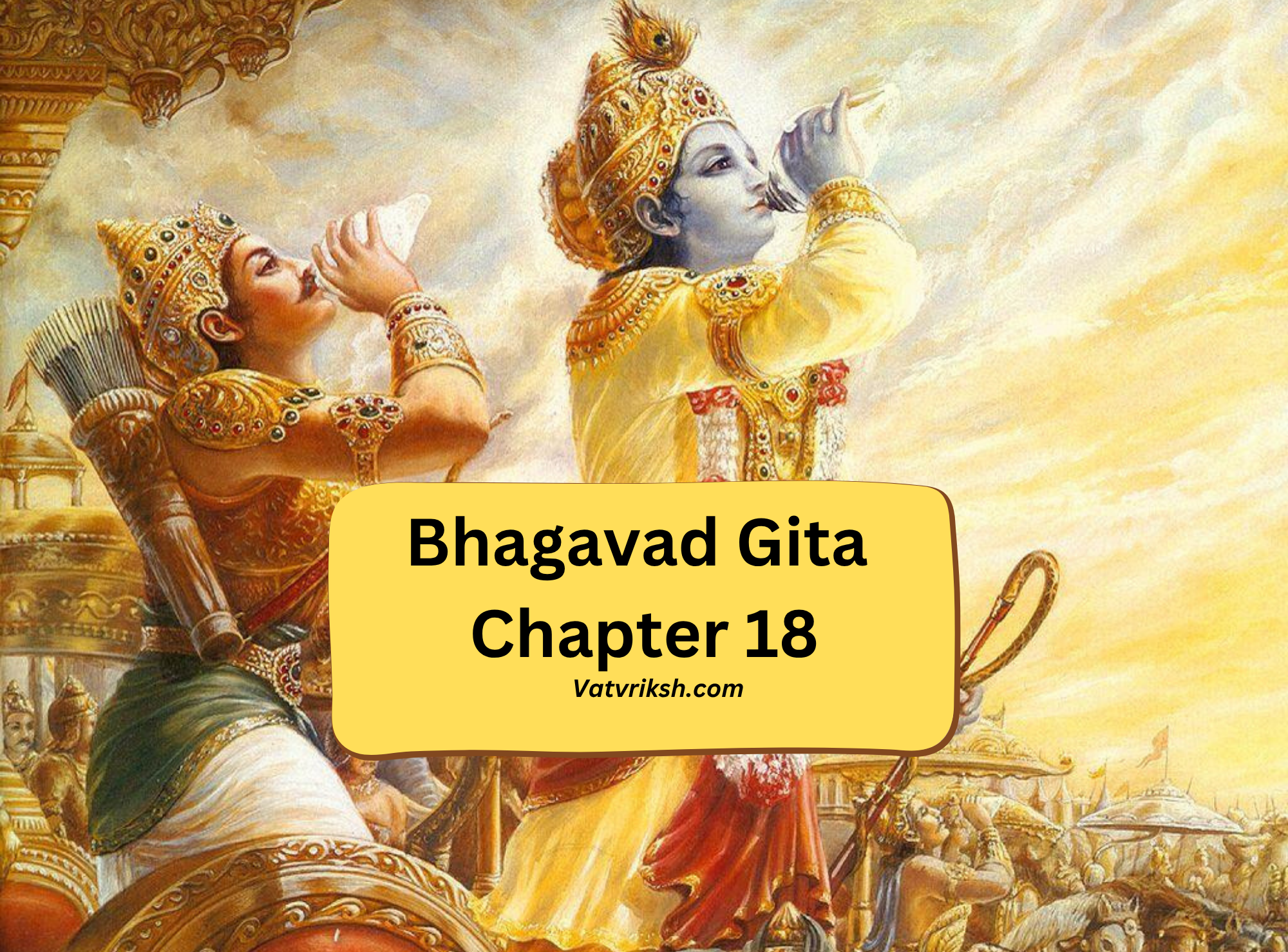
Every great teaching eventually has to answer one final question: now that you’ve heard all of this, what will you actually do? Seventeen chapters of philosophy, cosmology, psychology, and devotion have led Arjuna to this point — and Chapter 18 of the Bhagavad Gita, the longest chapter in the entire text, exists to bring every thread of that teaching together into a single, complete whole, before Arjuna finally, definitively responds.
Chapter 18, titled Moksha Sanyasa Yoga — “The Yoga of Liberation Through Renunciation” — is the grand synthesis of the Bhagavad Gita. Krishna revisits nearly every major theme introduced across the previous seventeen chapters — action and renunciation, the three gunas, duty, devotion, and the nature of true freedom — weaving them into a final, comprehensive teaching before releasing Arjuna to make his own choice. It is a fitting, deeply satisfying close to one of the world’s great spiritual texts.
One Last Clarifying Question
Arjuna opens the final chapter with a question that returns to a theme first raised back in Chapter 5: he wishes to understand, separately and in truth, the essential nature of renunciation (sannyasa) and the essential nature of relinquishment (tyaga) — two closely related terms that had been used somewhat interchangeably in earlier parts of the dialogue.
This question gives Krishna the opportunity, in this final chapter, to offer his most precise and comprehensive statement yet on a theme that has run throughout the entire text: what does it truly mean to act, and to renounce, in a manner that leads to liberation?
The Story Narrative
Defining Renunciation and Relinquishment
Krishna begins with careful definitions. The wise, he explains, understand renunciation (sannyasa) as the giving up of actions performed out of personal desire; relinquishment (tyaga), by contrast, is understood by the discerning as the giving up of attachment to the fruits of all actions.
Some philosophers, Krishna notes, hold that action itself, being inherently flawed, should be abandoned entirely, like a fault to be avoided; others hold that actions of sacrifice, charity, and austerity should never be abandoned. Krishna then offers his own definitive judgment on this matter, which he asks Arjuna to hear clearly: relinquishment, he says, is declared to be of three kinds.
The Threefold Nature of Relinquishment
Applying the familiar framework of the three gunas one final time, Krishna explains that actions of sacrifice, charity, and austerity should not be abandoned; they should indeed be performed, since sacrifice, charity, and austerity are purifying even for the wise. But even these should be performed, Krishna clarifies, by relinquishing attachment to their results — this, he says, is his own final, definitive judgment on the matter.
He explains that abandoning a prescribed duty out of mere confusion is declared to be tamasic relinquishment. Abandoning action out of fear of physical hardship, believing it to be simply troublesome, is described as rajasic relinquishment — and such relinquishment, Krishna notes, does not yield the true fruit of genuine renunciation.
But performing a prescribed duty simply because it ought to be performed, while relinquishing attachment and the desire for personal reward — this, Krishna says, is considered sattvic relinquishment.
Why It Matters: This threefold analysis brings remarkable clarity to a theme that has run throughout the entire Gita since Chapter 3: not all forms of “giving up” action are equal. Avoiding duty out of confusion or fear of discomfort is not genuine spiritual renunciation at all — it is simply avoidance, dressed in spiritual language. True relinquishment, as Krishna defines it here, involves continuing to act rightly while releasing the anxious grip on personal outcome and reward.
The Five Factors Behind Every Action
Krishna then offers a detailed account of the causal factors involved in any action, drawing on the philosophical framework of Sankhya. Five factors, he explains, contribute to the accomplishment of all action: the physical basis (the body), the individual agent, the various instruments of perception and action, the diverse forms of effort involved, and finally, divine providence or destiny (daiva) as the fifth factor.
Whatever action a person undertakes, through body, speech, or mind, whether right or wrong, Krishna explains, these five factors are its true causes. This being so, Krishna notes, one who perceives the true self alone as the sole doer, due to imperfect understanding, does not see correctly.
He adds an important clarifying point: one whose nature is free from the sense of individual ego, and whose understanding is not entangled or attached, even if such a person were to kill all these people, does not truly kill, nor is bound by the action. This teaching returns, in its final and most complete form, to the metaphysical foundation Krishna first offered back in Chapter 2 regarding the eternal, unchanging nature of the true self.
The Threefold Nature of Knowledge, Action, and the Doer
Krishna continues applying the threefold framework of the gunas across several further dimensions of experience, offering one final, comprehensive survey before the chapter’s practical conclusion.
Knowledge that perceives a single, undivided reality present within all the diversity of separate beings, undivided within the divided, is described as sattvic knowledge. Knowledge that perceives various distinct beings as entirely separate in nature, failing to perceive their underlying unity, is described as rajasic knowledge. And knowledge that clings, without genuine reason, to a single narrow object as though it were the entirety of reality, trivial and lacking true understanding, is described as tamasic knowledge.
Krishna then describes the threefold nature of action itself: prescribed action, performed without attachment, without craving or aversion, by one free from the desire for personal reward, is described as sattvic. Action performed with great effort by one seeking to satisfy personal desire, or performed with excessive egotism, is described as rajasic. And action undertaken out of delusion, without regard for consequence, loss, injury to others, or one’s own genuine capacity, is described as tamasic.
He then describes the threefold nature of the doer (karta) themselves: one who is free from attachment, free from egotistic speech, endowed with steadiness and enthusiasm, unaffected by success or failure, is described as a sattvic doer. One who is passionate, seeking the fruits of action, greedy, harmful to others, impure, and easily moved by joy and sorrow, is described as a rajasic doer. And one who is undisciplined, vulgar, stubborn, deceitful, malicious, lazy, despondent, and given to procrastination, is described as a tamasic doer.
Why It Matters: This extended, systematic survey across knowledge, action, and the character of the doer offers a comprehensive, integrated final review of the entire threefold framework introduced back in Chapter 14, now applied with remarkable specificity to virtually every dimension of how a person perceives reality, acts within it, and carries themselves as an agent in the world.
The Threefold Nature of Intellect, Steadiness, and Happiness
Krishna continues this systematic final survey with the threefold nature of intellect (buddhi) and steadfast resolve (dhriti). Intellect that correctly understands right action and wrong action, what should and should not be done, fear and fearlessness, and bondage and liberation, is described as sattvic intellect. Intellect that incorrectly discerns right and wrong, and what should and should not be done, is described as rajasic. And intellect that, enveloped in darkness, perceives wrong as right and views all things in a reversed, distorted manner, is described as tamasic.
Similarly, steadfastness that, through unwavering practice, sustains the functions of mind, life-force, and senses, is described as sattvic steadfastness. Steadfastness that clings, with attachment, to duty, pleasure, and wealth out of desire for their fruits, is described as rajasic. And steadfastness through which one of little understanding fails to abandon sleep, fear, grief, despondency, and arrogance, is described as tamasic.
Finally, Krishna describes the threefold nature of happiness itself. Happiness that seems, at first, like poison, but in the end proves like nectar — arising from the serene clarity of one’s own understanding — is described as sattvic happiness. Happiness arising from the contact of the senses with their objects, seeming at first like nectar, but proving in the end like poison, is described as rajasic happiness. And happiness that deludes the self both at its beginning and its end, arising from sleep, laziness, and negligence, is described as tamasic happiness.
Why It Matters: The teaching on the threefold nature of happiness is especially valuable and psychologically astute — the observation that genuinely worthwhile happiness (sattvic) often requires an initially uncomfortable investment of effort before yielding lasting satisfaction, while shallow, immediately gratifying happiness (rajasic) frequently produces regret or diminishing returns, offers a timeless and immediately relatable insight into the true nature of lasting fulfillment.
Duty According to Nature: The Four Social Orders
Krishna then addresses a specific and, for modern readers, often challenging section of the text: the duties (svadharma) associated with the four traditional social classes (varnas) of the era — Brahmins, Kshatriyas, Vaishyas, and Shudras — describing these duties as arising from the particular qualities (gunas) inherent in each person’s own nature.
He describes the natural duties of Brahmins as including serenity, self-control, austerity, purity, patience, uprightness, knowledge, realization, and faith. The natural duties of Kshatriyas include heroism, vigor, steadfastness, skillfulness, not fleeing from battle, generosity, and leadership. The natural duties of Vaishyas include agriculture, cattle-rearing, and trade, while the natural duty of Shudras consists of service.
Krishna then offers an important clarifying principle here, one that resonates well beyond its original social context: a person attains perfection by devotion to their own natural duty. He explains that one who worships the source from which all beings arise, and by whom this entire universe is pervaded, through the performance of their own proper duty, attains perfection.
He adds a genuinely striking and reassuring teaching: one’s own duty, even if imperfectly performed, is better than another’s duty well performed; performing the action prescribed by one’s own nature, a person does not incur sin. Therefore, Krishna concludes, one should not abandon a duty arising from one’s own nature, even if it involves some inherent flaw, since all undertakings are covered by some degree of imperfection, just as fire is covered by smoke.
Why It Matters: While the specific historical framework of the four varnas reflects the social structure of the era in which the Gita was composed, the underlying principle Krishna offers here carries broader, more universal application: sincere, dedicated commitment to one’s own genuine calling and responsibilities — even performed imperfectly — is described as more valuable than abandoning that calling in pursuit of something that seems, from the outside, more impressive or prestigious but doesn’t authentically reflect one’s own true nature and capacities.
The Path to Perfection and Beyond: Devotion as the Final Teaching
Krishna then describes the path by which a person, established in their own proper duty, attains the supreme perfection of realizing Brahman. He offers a detailed description of the disciplined, purified mind — controlled in intellect and senses, free from attachment to sense objects, free from excessive desire and aversion, dwelling in solitude, moderate in eating, controlled in speech, body, and mind, ever absorbed in meditation, and free from egotism, force, arrogance, desire, anger, and possessiveness.
Such a person, peaceful and free from the sense of “mine,” is described as fit for realizing Brahman. Having realized Brahman, with a serene self, neither grieving nor desiring, regarding all beings with equanimity, such a person attains supreme devotion (para bhakti) to Krishna. And through this devotion, Krishna explains, one comes to know him in truth, in essence, exactly as he is — and having known him in this way, one immediately enters into him.
Krishna then offers his final, comprehensive instruction, one that gathers together the entire teaching of the Gita into a single, practical directive: performing all actions, always taking refuge in Krishna, one attains, through his grace, the eternal, imperishable abode.
He adds a beautiful, warmly personal closing invitation: surrendering all forms of duty, take refuge in Krishna alone; he will liberate Arjuna from all sin — do not grieve.
Why It Matters: This closing teaching, one of the most quoted verses in the entire Gita, offers a remarkable culmination to the text’s long philosophical and devotional journey. After seventeen chapters of intricate teaching on action, knowledge, meditation, and the gunas, Krishna’s final practical instruction is disarmingly simple and personal: surrender, with sincere faith, and trust in his grace. It is a fitting synthesis of the Gita’s philosophical depth and its devotional warmth.
Krishna’s Final Charge to Arjuna
Krishna offers a final, direct charge to Arjuna: this teaching should not be spoken to one who lacks austerity, who lacks devotion, who has no desire to hear it, or who speaks ill of Krishna. But whoever shares this supreme secret teaching among his devotees, offering him the highest devotion, shall undoubtedly come to Krishna — Krishna declares that no one among humanity performs an action more dear to him than this act of sharing, nor will anyone on earth be more beloved to him.
He adds that one who studies this sacred dialogue between himself and Arjuna is considered, by Krishna, to have worshipped him through the sacrifice of knowledge — and even one who simply listens to this teaching with faith and without resentment, Krishna says, becomes liberated, attaining the fortunate worlds of those who have performed virtuous deeds.
Arjuna’s Response: The Dialogue Concludes
Krishna then asks Arjuna directly: has this been heard with a focused and attentive mind? Has the delusion born of ignorance now been dispelled?
Arjuna’s response closes the entire Bhagavad Gita, and it carries genuine emotional weight after the long journey the two have traveled together across these eighteen chapters. Arjuna declares that his delusion has been destroyed, and that he has regained his memory and understanding through Krishna’s grace. He now stands firm, his doubts dispelled, ready to act according to Krishna’s word.
Sanjaya, the narrator who has relayed this entire extraordinary dialogue to the blind king Dhritarashtra, closes the text with his own reflection: wherever Krishna, the Lord of yoga, and Arjuna, the wielder of the bow, are found together, there, Sanjaya declares, will surely be found prosperity, victory, welfare, and steadfast righteousness — his own firm conviction, he says, upon having witnessed and relayed this wondrous, hair-raising dialogue between the two.
Deeper Philosophical Meaning
Chapter 18, as the culminating chapter of the entire Bhagavad Gita, achieves something genuinely remarkable: it doesn’t simply add new teaching, but weaves together nearly every major theme from the preceding seventeen chapters into a single, integrated whole.
A comprehensive final synthesis: By systematically revisiting the threefold nature of relinquishment, knowledge, action, the doer, intellect, steadfastness, and happiness, Chapter 18 offers a genuinely comprehensive review of the gunas framework first introduced in Chapter 14, demonstrating its application across virtually every dimension of human experience.
Duty and devotion as complementary, not competing, paths: The chapter’s teaching on svadharma (one’s own proper duty) and its subsequent turn toward supreme devotion as the ultimate path to liberation demonstrates, in its final form, the Gita’s characteristic integration of ethical action and heartfelt surrender — neither one replacing the other, but each supporting and completing the other.
Grace as the final word: Krishna’s closing instruction — surrender all duties and take refuge in him alone, and he will liberate Arjuna from all sin — represents a significant theological culmination, suggesting that beyond even the most careful ethical and philosophical effort, ultimate liberation is finally made possible through devotion and divine grace.
What This Chapter Means for Life Today
True fulfillment often requires an initial investment of discomfort. Chapter 18’s teaching on sattvic happiness — resembling poison at first, but nectar in the end — offers a timeless corrective to the pursuit of instant gratification, reminding modern readers that lasting satisfaction frequently requires patience and short-term difficulty, while immediately pleasurable choices often carry hidden long-term costs.
Authentic commitment to your own path outperforms imitation of someone else’s. Krishna’s teaching that one’s own duty, even performed imperfectly, surpasses another’s duty performed well, offers valuable modern guidance against the common temptation to abandon one’s authentic calling in pursuit of paths that look more impressive from the outside but don’t genuinely fit one’s own nature and capacities.
Real avoidance is not the same as genuine letting go. The chapter’s careful distinction between abandoning duty out of fear or confusion (a false, unproductive form of relinquishment) and performing duty sincerely while releasing attachment to outcome (true relinquishment) remains a genuinely useful distinction for modern readers tempted to disguise avoidance or procrastination as spiritual detachment.
Sometimes the wisest response to overwhelming complexity is simple, sincere trust. After eighteen chapters of intricate philosophical, psychological, and metaphysical teaching, the Gita’s final practical instruction is strikingly simple: surrender with sincere faith. This offers a valuable reminder that genuine wisdom often circles back, in the end, toward simplicity and trust, rather than accumulating endless complexity.
Frequently Asked Questions
What is the main teaching of Bhagavad Gita Chapter 18? Chapter 18 synthesizes the Gita’s major themes — action, renunciation, the three gunas, duty, and devotion — into a comprehensive final teaching, culminating in Krishna’s instruction to surrender all duties and take refuge in him alone, after which Arjuna resolves to fight.
What is the difference between sannyasa and tyaga in Bhagavad Gita Chapter 18? Sannyasa (renunciation) refers to giving up actions performed from personal desire, while tyaga (relinquishment) refers to giving up attachment to the fruits of action while continuing to perform one’s proper duty — Krishna favors tyaga as the genuinely valuable form of “giving up.”
What are the five factors behind every action, according to this chapter? Krishna identifies the physical body, the individual agent, the various instruments of perception and action, the diverse forms of effort, and divine providence (daiva) as the five factors contributing to the accomplishment of any action.
What does Krishna mean by “surrender all duties and take refuge in me alone”? This famous closing teaching, sometimes called the Gita’s final and most complete instruction, invites the sincere devotee to trust fully in Krishna’s grace as the ultimate source of liberation, following a lifetime of committed, non-attached ethical action and devotion.
How does the Bhagavad Gita end? The Gita ends with Arjuna declaring that his delusion has been dispelled and that he stands ready to act according to Krishna’s teaching, followed by Sanjaya’s closing reflection that wherever Krishna and Arjuna are found together, prosperity, victory, and righteousness are certain to follow.
How many verses are in Bhagavad Gita Chapter 18? Chapter 18 contains 78 verses, making it by far the longest chapter in the Bhagavad Gita, reflecting its role as the text’s comprehensive concluding synthesis.
With Chapter 18, the eighteen-chapter journey of the Bhagavad Gita comes to its close — from Arjuna’s grief-stricken collapse on the battlefield of Kurukshetra to his final, resolute readiness to act. Across these eighteen chapters, Krishna’s teaching has moved through metaphysics, ethics, meditation, cosmic vision, and devotion, always circling back to the same essential invitation: to act with sincerity, to release attachment to outcome, and to trust in something greater than the anxious, grasping self. As Sanjaya’s closing words remind us, wherever this understanding and this devotion are found together, welfare and steadfast righteousness are sure to follow.
This concludes our complete chapter-by-chapter journey through the Bhagavad Gita. We hope this series has offered a genuine companion for your own study of this timeless text — one to return to, as Arjuna did, again and again.