
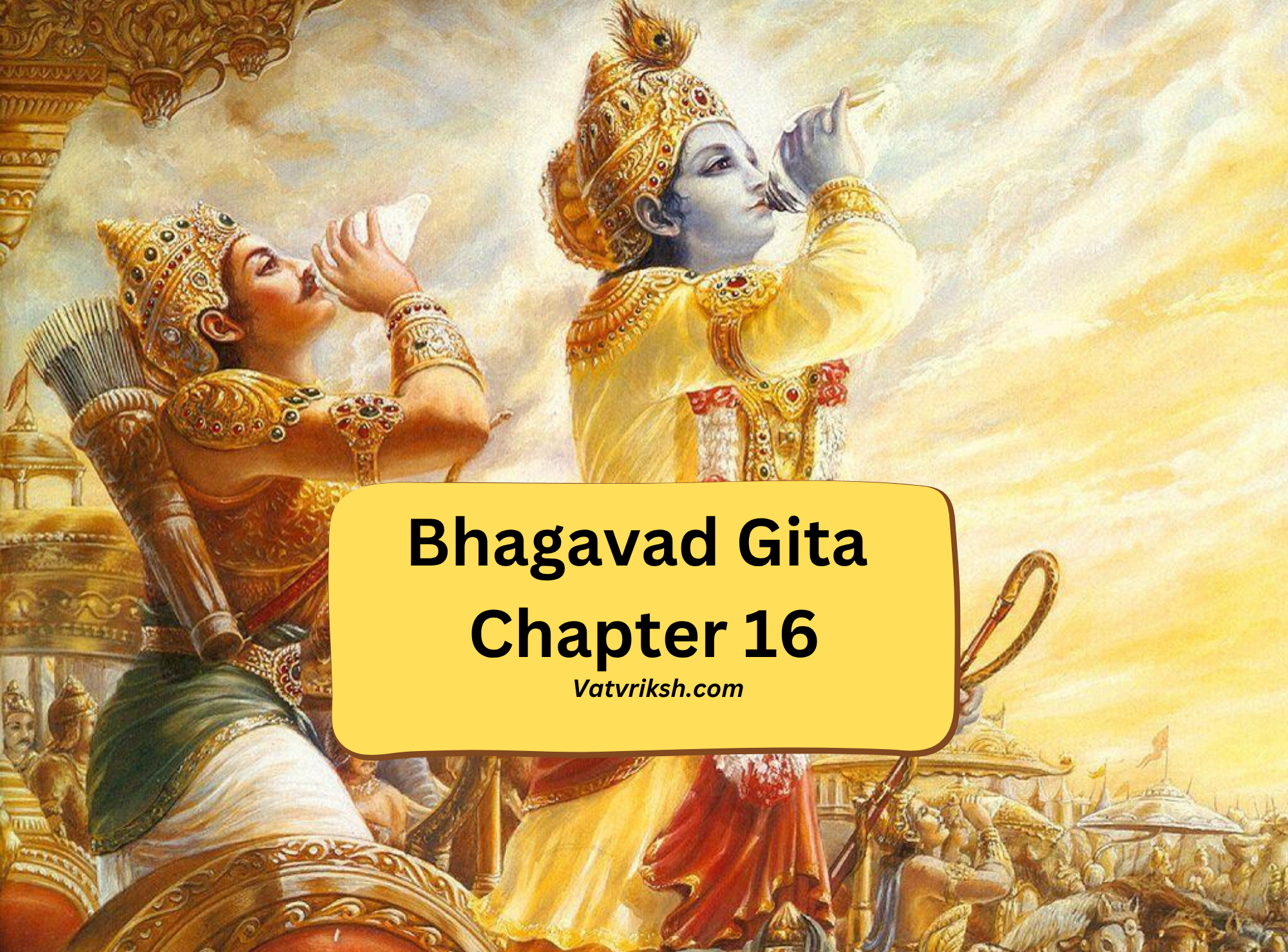
Most of us like to think of good and evil as things that happen “out there” — in other people, in villains, in clearly identifiable wrongdoing. But the Bhagavad Gita takes a more searching, more personal approach to this question. Rather than describing external forces of good and evil, Chapter 16 of the Bhagavad Gita turns the lens inward, offering a detailed portrait of two fundamentally different orientations of character that exist as real possibilities within every human being — and asking each of us, implicitly, which direction we are currently moving toward.
Having spent Chapter 15 describing the cosmic tree and the Supreme Person underlying all existence, Krishna now shifts to a more directly ethical register. Chapter 16, titled Daivasura Sampad Vibhaga Yoga — “The Yoga of the Distinction Between Divine and Demonic Natures” — offers one of the Gita’s most practically useful chapters for everyday self-examination, laying out, in remarkably specific detail, the qualities that define these two contrasting paths.
A Direct, Practical Teaching
Chapter 16 doesn’t open with a philosophical puzzle or a question from Arjuna, as many previous chapters have. Instead, Krishna begins directly, offering an extended teaching without preamble — perhaps reflecting the practical urgency of the subject matter. This is a chapter meant to be applied immediately, offering clear, actionable criteria for self-examination rather than abstract metaphysical speculation.
The Story Narrative
The Qualities of the Divine Nature
Krishna begins with an extensive list of qualities that mark what he calls the divine nature (daivi sampad) — the inheritance or endowment leading toward liberation and spiritual flourishing. This list functions almost as a comprehensive ethical curriculum, echoing and expanding on similar lists found in earlier chapters such as Chapter 12’s description of the beloved devotee and Chapter 13’s qualities of true knowledge.
He lists: fearlessness, purity of mind and heart, steadfastness in the cultivation of knowledge and meditation, charity, self-control, sacrifice, study of scripture, austerity, and uprightness.
He continues: non-violence, truthfulness, freedom from anger, renunciation, peacefulness, freedom from slander, compassion toward all beings, freedom from covetousness, gentleness, modesty, and steadiness.
Krishna adds further qualities: vigor, patience, fortitude, purity, freedom from malice, and freedom from excessive pride. These qualities, Krishna concludes, belong to one born with a divine inheritance.
Why It Matters: This list is notable for combining what might be called “hard” virtues (fearlessness, vigor, fortitude) with “soft” virtues (compassion, gentleness, modesty) in a single, integrated vision of character. The divine nature, as Krishna describes it, isn’t purely gentle passivity, nor purely bold assertiveness — it combines both strength and tenderness into a complete, well-rounded picture of ethical maturity.
The Qualities of the Demonic Nature
Krishna then turns to the opposite orientation — what he calls the demonic nature (asuri sampad). Hypocrisy, arrogance, excessive pride, anger, harshness, and ignorance, he explains, belong to one born with this demonic inheritance.
He clarifies an important point here: the divine inheritance is said to lead toward liberation, while the demonic inheritance is said to lead toward continued bondage. He reassures Arjuna directly at this point: do not grieve, he says, for you, Arjuna, are born with the divine inheritance.
Why It Matters: This brief but significant reassurance to Arjuna is worth pausing on. Even in the midst of laying out this stark ethical contrast, Krishna doesn’t leave Arjuna wondering anxiously which category he belongs to — he offers direct, personal encouragement, modeling a teaching approach that combines honest ethical instruction with genuine reassurance and support.
A Detailed Portrait of the Demonic Mindset
Krishna then offers an extended, detailed psychological portrait of the demonic mindset — considerably more detailed, in fact, than his description of the divine nature, almost as though this portrait is meant to serve as a cautionary mirror for genuine self-examination.
He describes people of demonic nature as not knowing what action to undertake and what action to avoid; neither purity, nor good conduct, nor truthfulness is found within them. Such people, Krishna says, claim that the world is without truth, without a moral foundation, and without a governing divine principle — believing instead that the world arises purely through the union of male and female driven by desire, and nothing more, with no other cause behind it.
Holding to this view, Krishna continues, these people of diminished understanding, engaging in harsh and destructive actions, arise as enemies of the world, working toward its destruction. Filled with insatiable desire, possessed by hypocrisy, pride, and arrogance, holding to wrong understanding through delusion, they act with impure resolve.
He describes them as consumed by immeasurable anxiety that persists until the moment of death, regarding the gratification of desire as their highest aim, convinced that this alone constitutes the whole of existence. Bound by hundreds of ties of hope and expectation, given over entirely to desire and anger, they strive to accumulate wealth by unjust means, in order to satisfy their own cravings.
Krishna paints a vivid picture of the internal monologue of such a person: “This I have gained today; this desire I shall next fulfill; this wealth is already mine, and this further wealth shall also become mine.” “I have destroyed this enemy, and I shall destroy others also; I am the lord, I am the enjoyer, I am accomplished, powerful, and happy.” “I am wealthy, and born into a noble family; who else is equal to me? I shall perform sacrifice, I shall give charity, I shall rejoice” — deluded by ignorance in this way, Krishna says, such people continue in their confusion.
Carried away by numerous distracting thoughts, entangled in a web of delusion, excessively attached to the gratification of desire, they fall into a foul, impure state of existence. Self-conceited, stubborn, filled with the pride and intoxication of wealth, they perform sacrifices in name only, without genuine sincerity or adherence to proper principle, purely for the sake of ostentation.
Given over to ego, force, arrogance, desire, and anger, such people, Krishna explains, resent and envy Krishna’s own presence dwelling within their own bodies and within the bodies of others.
Why It Matters: This extended, unsparing psychological portrait serves an important pedagogical function within the chapter — rather than offering abstract condemnation, it maps out, with almost clinical precision, the specific internal experience of ego-driven delusion: the self-congratulatory internal monologue, the endless cycle of craving and satisfaction, the hostility toward anything that challenges one’s own sense of self-importance. By naming these patterns so specifically, the teaching offers genuine material for honest self-examination.
The Consequences and the Threefold Gate to Ruin
Krishna describes the fate of those governed by this demonic orientation: hateful, cruel, and among the most degraded of people, Krishna casts such individuals repeatedly into demonic wombs across various births in this world of transmigration. Falling into demonic wombs life after life, deluded, such people fail to reach him at all, and descend instead into an ever-lower condition.
He then offers what may be the chapter’s single most practically useful teaching — a compact, memorable identification of the root causes of this downward spiral. There are three gates leading to the ruin and downfall of the self, Krishna explains: desire (kama), anger (krodha), and greed (lobha). Therefore, he instructs, one should abandon these three.
This teaching directly echoes and reinforces the psychological analysis offered back in Chapter 3, where Krishna identified desire and anger, born of the rajas guna, as the great enemies obscuring true understanding. Here, greed is added as a third closely related force, together forming a compact, memorable framework for identifying the specific inner tendencies most responsible for spiritual and ethical decline.
Why It Matters: This threefold framework — desire, anger, and greed as the “three gates to self-destruction” — offers an exceptionally practical tool for ongoing self-examination, distilling a complex psychological portrait into three specific, recognizable patterns that a person can genuinely watch for and work to address in their own daily experience.
Scripture as the Standard for Right Conduct
The chapter closes with Krishna offering practical guidance on how one should determine right action going forward. One who abandons the guidance of scripture (shastra), Krishna explains, acting instead purely according to the impulses of personal desire, does not attain perfection, happiness, or the highest goal.
Therefore, Krishna instructs Arjuna, scripture should serve as the authoritative standard in determining what should and should not be done; understanding what is enjoined by the rules laid out in scripture, one should perform action accordingly in this world.
Why It Matters: This closing instruction offers a practical safeguard against the very self-delusion described throughout the chapter’s portrait of the demonic mindset — recognizing that unchecked personal impulse and desire, left entirely to its own judgment, is precisely the pattern that leads toward the destructive spiral Krishna has just described. External guidance, whether from scripture, established ethical tradition, or trusted teachers, provides a genuine check against the distortions of self-serving rationalization.
Deeper Philosophical Meaning
Chapter 16’s central contribution lies in its detailed, practically applicable psychology of ethical character, offered as a direct tool for ongoing self-examination.
Character as a genuine, recognizable orientation: By describing the divine and demonic natures through such specific, observable qualities and behaviors, Krishna offers a framework considerably more useful for honest self-assessment than a purely abstract discussion of good and evil in the abstract.
The psychology of self-delusion: The detailed portrait of the demonic mindset’s internal monologue — the self-congratulation, the endless craving, the hostility toward anything that challenges one’s self-image — offers a remarkably specific psychological analysis of how ego-driven delusion actually operates from the inside, rather than simply condemning it from the outside.
A compact, actionable framework: The identification of desire, anger, and greed as the three gates to self-destruction distills the chapter’s extensive analysis into a genuinely practical, memorable tool — one a person can actually apply in the midst of daily decision-making, rather than needing to hold an entire elaborate ethical system in mind at all times.
What This Chapter Means for Life Today
Honest self-examination requires specific, recognizable criteria, not just vague good intentions. Chapter 16’s detailed lists of divine and demonic qualities offer something genuinely useful for modern self-reflection: concrete, observable patterns to check against, rather than a vague sense of wanting to “be a good person” without any specific benchmark for assessing actual progress.
Watch for the specific internal monologue of ego and entitlement. Krishna’s vivid rendering of the demonic mindset’s self-talk — “I am accomplished, powerful, and happy,” “who else is equal to me?” — offers a genuinely recognizable pattern worth watching for in oneself: the moments when success or status begins generating a subtle, self-congratulatory superiority rather than gratitude or humility.
Three specific patterns deserve particular vigilance. The compact teaching on desire, anger, and greed as the “three gates to ruin” offers an exceptionally practical, memorable checklist for modern self-monitoring — three specific tendencies worth noticing and addressing directly, rather than attempting to manage character growth through vague, unfocused effort.
External standards protect against self-serving rationalization. Krishna’s instruction to rely on established guidance rather than pure personal impulse speaks to a genuinely modern concern: how easily unchecked personal reasoning can rationalize almost any behavior when left entirely to its own judgment, and the real protective value of accountability to standards, communities, or trusted guidance beyond ourselves.
Frequently Asked Questions
What is the main teaching of Bhagavad Gita Chapter 16? Chapter 16 contrasts the divine nature (daivi sampad), marked by qualities like fearlessness, compassion, and self-control, with the demonic nature (asuri sampad), marked by hypocrisy, arrogance, and unchecked desire, offering a detailed framework for ethical self-examination.
What are the three gates to self-destruction in Bhagavad Gita Chapter 16? Krishna identifies desire (kama), anger (krodha), and greed (lobha) as the three gates leading to the ruin of the self, instructing that these three tendencies should be deliberately abandoned or overcome.
What qualities does Krishna list as part of the divine nature? Krishna lists fearlessness, purity, self-control, compassion, truthfulness, freedom from anger, gentleness, patience, and modesty, among many other qualities, as belonging to one born with a divine inheritance leading toward liberation.
Does Chapter 16 say some people are permanently demonic by nature? The chapter describes demonic tendencies as an orientation that leads to repeated rebirth into difficult circumstances if left unaddressed, but the broader teaching of the Gita, including Chapter 9’s promise that even those of flawed conduct can be transformed through sincere devotion, suggests this orientation is not necessarily fixed or unchangeable.
Why does Krishna reassure Arjuna directly in this chapter? After introducing the stark contrast between divine and demonic natures, Krishna reassures Arjuna that he is born with the divine inheritance, offering personal encouragement alongside the broader ethical teaching, rather than leaving Arjuna in anxious uncertainty about his own character.
How many verses are in Bhagavad Gita Chapter 16? Chapter 16 contains 24 verses, and it is notable for its unusually specific and psychologically detailed portrait of both virtuous and destructive patterns of character.
Chapter 16 asks each reader to look honestly inward, offering not vague moral platitudes but a specific, recognizable map of the patterns that lead toward flourishing and the patterns that lead toward ruin. Its most memorable teaching — the three gates of desire, anger, and greed — remains a genuinely practical tool for anyone sincerely committed to ongoing self-examination and growth.