
A few years ago, a friend going through a brutal stretch — layoff, breakup, the whole unraveling — told me she’d started reading the Bhagavad Gita on her lunch breaks. Not because she was suddenly devout. She just needed something that had already sat with hard questions for a couple thousand years and come out the other side with actual answers, not just sympathy.
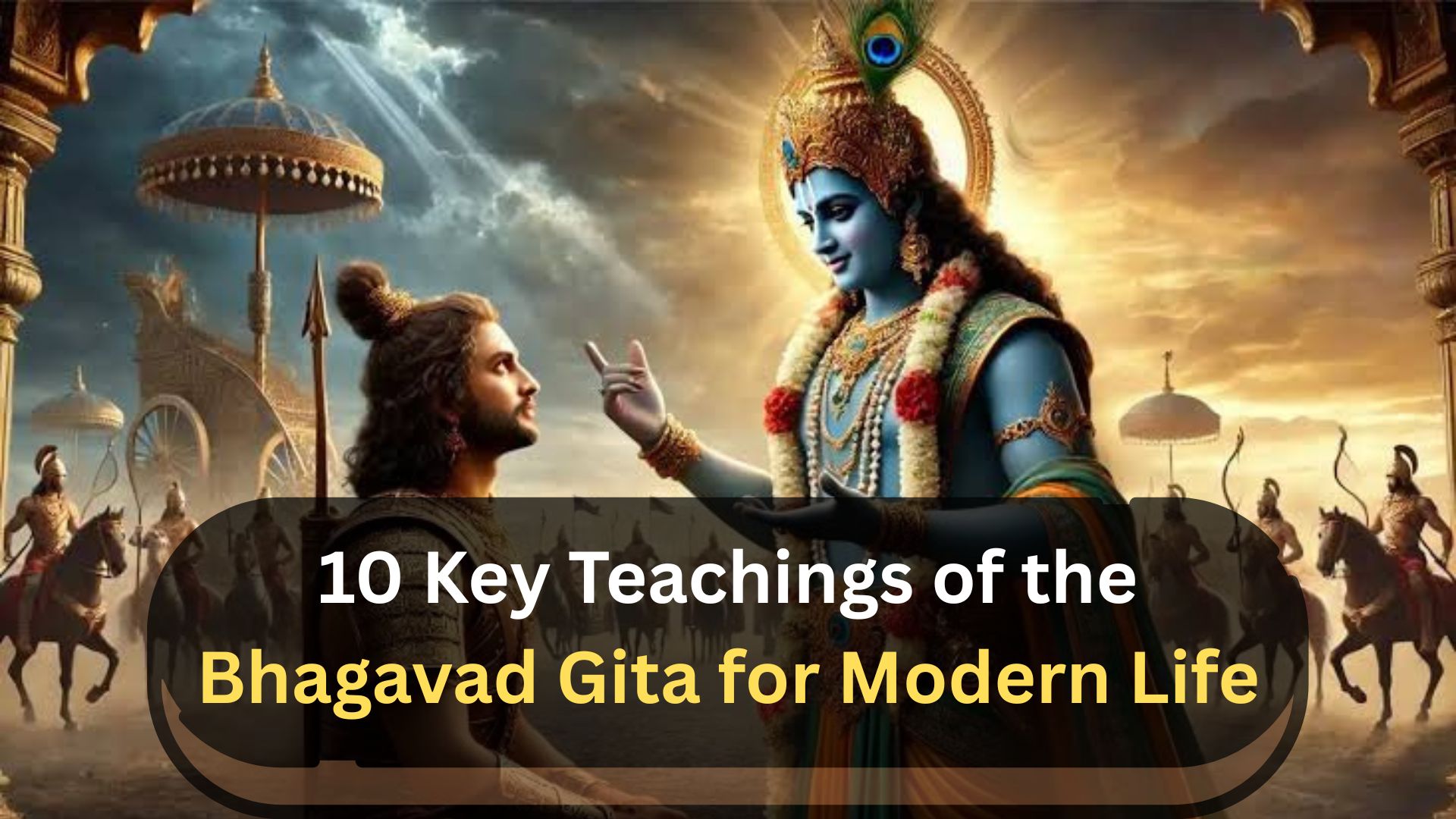
That’s the thing about the Gita. It wasn’t written as a self-help book, and yet it keeps getting read like one, generation after generation, because the questions at its center never really go out of style. How do I act when every option feels wrong? How do I stop being ruled by outcomes I can’t control? What do I do with grief, with fear, with the gap between who I am and who I want to be? Arjuna asks Krishna these questions on a battlefield 5,000 years ago. We ask them in traffic, in hospital waiting rooms, at 2 a.m. when the ceiling won’t stop being interesting.
Here are ten teachings from across the Gita’s eighteen chapters that have aged, if anything, better than most modern advice.
1. You Have a Right to Your Effort, Not to the Outcome
This is the line everyone quotes, and for good reason. In Chapter 2, Krishna tells Arjuna he has a right to his actions but never to their fruits — meaning: give something everything you’ve got, then let go of your grip on how it turns out.
I used to think this sounded like an excuse not to care. It’s the opposite. Krishna isn’t telling Arjuna to be indifferent about the battle; he’s telling him to stop white-knuckling the result so hard that his hands shake too much to actually fight well. Anyone who’s choked during a presentation because they wanted it too badly knows exactly what he’s talking about. The anxious grip on the outcome is often the very thing that ruins the outcome.
2. The Restless Mind Isn’t a Personal Failure
In Chapter 6, after Krishna has just finished describing this beautifully still, lamp-in-a-windless-room kind of meditative mind, Arjuna basically says: that sounds impossible. The mind is restless, turbulent, and about as easy to hold as the wind.
I find this one of the most human moments in any scripture I’ve ever read. Krishna doesn’t correct him. He agrees — yes, the mind is hard to control — and then says it can be done anyway, through practice and non-attachment, not through some special gift Arjuna lacks. If you’ve ever sat down to meditate and spent the whole time making grocery lists in your head, you are in excellent company. The restlessness isn’t the problem. Giving up because of it is.
3. Detachment Doesn’t Mean Withdrawal
There’s a persistent idea that spiritual peace requires checking out — quitting the job, leaving the noise, retreating somewhere quiet. The Gita pushes back on this directly. In Chapter 5, Krishna compares the wise person to a lotus leaf resting on water: fully in contact with it, never soaked by it.
This distinction has mattered more to me than almost anything else in the text. You don’t have to escape your responsibilities to find some peace with them. The goal isn’t fewer obligations; it’s a different relationship to the ones you already have.
4. Real Renunciation Happens in the Mind, Not in Your Circumstances
Related to the above, but worth its own entry: Krishna is unusually blunt about this in Chapter 5, saying that a person who has merely stopped doing things, while their mind still craves and clings, hasn’t actually renounced anything at all. He calls this a kind of self-deception.
This lands differently once you notice how often we do exactly this — deleting the app while still thinking about it constantly, leaving the situation while still replaying it every night. The Gita’s position is unambiguous: the letting go has to happen internally, or the external change doesn’t count for much.
5. Whatever You Habitually Think About, You Become
Chapter 8 contains one of the more sobering ideas in the whole text — that whatever a person dwells on at the moment of death, they tend to move toward, because that’s simply the direction their mind has already been trained to go across a lifetime.
Set aside, for a moment, whatever you believe about death specifically. The underlying claim is really about habit, and it’s borne out constantly in ordinary experience. What you rehearse in your head — worry, gratitude, resentment, curiosity — isn’t neutral. It’s building the mental grooves you’ll default to under pressure. The Gita is arguing, essentially, that character is just attention, repeated.
6. Desire, Anger, and Greed Are the Three Things Worth Watching
Chapter 16 offers what might be the most quotable piece of practical psychology anywhere in the text: three gates lead to the ruin of a person — kama (desire), krodha (anger), and lobha (greed) — and the instruction is simply to watch for these and let them go.
I like this list because it’s short enough to actually remember in the moment. Most of us don’t need forty rules for living well. We need two or three honest checkpoints we can run through when we’re about to do something we’ll regret. Am I about to act from craving? From anger? From grasping for more than I need? That’s a genuinely useful three-question filter for a Tuesday afternoon.
7. Even the Smallest Sincere Offering Counts
One of the warmest verses in the entire Gita comes in Chapter 9, where Krishna says he accepts even a leaf, a flower, a piece of fruit, or a little water, so long as it’s offered with real devotion.
There’s something quietly radical about this, especially set against a tradition with such elaborate ritual traditions around it. It says, in effect: the extravagance was never the point. I think about this one whenever I’m tempted to believe that a gesture doesn’t matter because it’s small — a short message checking in on someone, an unglamorous errand run out of love. Scale was never really the measure. Sincerity was.
8. Different People Reasonably Need Different Starting Points
Chapter 12 is short — only twenty verses — but it contains something I wish more spiritual and self-improvement writing included: a graded ladder of practice. If you can’t hold your mind steady in meditation, Krishna says, try disciplined practice instead. Can’t manage that either? Then work with devotion. Still struggling? Then simply let go of your attachment to results, and that alone is enough to start from.
No single rung is treated as failure. This matters because so much modern advice about self-improvement is delivered as an all-or-nothing standard — meditate for an hour daily or don’t bother, journal every morning or you’re not really committed. The Gita’s approach is kinder and, frankly, more realistic: meet yourself at your actual current capacity, and move from there.
9. Equanimity Toward Praise and Blame Is a Skill, Not a Personality Type
Across several chapters — the sthitaprajna portrait in Chapter 2, the description of the ideal devotee in Chapter 12, the transcender of the gunas in Chapter 14 — the Gita keeps circling back to a person who meets praise and blame, gain and loss, honor and insult, with roughly the same composure.
This used to strike me as an impossibly high bar, something reserved for saints. I’ve come to read it more as direction than destination. Every time you notice a harsh comment landing a little less hard than it used to, or a compliment inflating you a little less, that’s the practice actually working. It’s a dial, not a switch, and the Gita seems fully aware of that — it never once suggests this happens overnight.
10. Sincere Effort Is Never Wasted
My favorite teaching in the whole text, and maybe the most quietly reassuring passage in any scripture I know, comes near the end of Chapter 6. Arjuna asks what happens to someone who sincerely takes up a spiritual practice but falls short — does all that effort just evaporate?
Krishna’s answer, more or less: no one who does good ever comes to a bad end. The effort carries forward. It picks back up, life after life, from wherever it left off.
You don’t need to believe literally in reincarnation for this to land. Read it as a statement about unfinished projects, abandoned habits, relapsed intentions, the half-written book in your drawer. The Gita’s position is that none of it disappears. It compounds, even through the failures, even through the false starts. That’s a genuinely different way to relate to your own setbacks than the story most of us tell ourselves by default.
Why These Teachings Still Work
None of this requires you to accept every cosmological claim in the Bhagavad Gita to find it useful — plenty of readers who aren’t practicing Hindus still return to this text precisely because its psychology holds up independent of its metaphysics. What Krishna is really doing, across all eighteen chapters, is diagnosing the specific inner habits that make people miserable — grasping at outcomes, avoiding responsibility, dwelling on grievance, mistaking withdrawal for peace — and offering, patiently, chapter after chapter, a different way to hold all of it.
Arjuna starts the Gita on the floor of his chariot, weapon dropped, unable to move. He ends it ready to stand and act. Most of us aren’t choosing between armies. But the shape of that movement — from paralysis to clear, grounded action — is one nearly everyone eventually needs to make, more than once, in an ordinary life.
Frequently Asked Questions
What is the central message of the Bhagavad Gita?
At its core, the Gita teaches that a person can act fully and skillfully in the world while remaining inwardly free from anxious attachment to results — achieved through some combination of selfless action, meditation, knowledge, and devotion, depending on a person’s temperament.
Can you benefit from the Bhagavad Gita without being Hindu?
Yes. Many readers outside the Hindu tradition, including those with no particular religious affiliation, find genuine practical and psychological value in the Gita’s teachings on detachment, duty, and equanimity, independent of its specific theological framework.
What is the most famous verse in the Bhagavad Gita?
Chapter 2’s teaching that one has a right to action but never to the fruits of that action is probably the most widely quoted verse, though Chapter 11’s “I am Time, the destroyer of worlds” and Chapter 9’s line about accepting even a leaf or a flower are close behind.
Is the Bhagavad Gita only about the battle at Kurukshetra?
No. While the dialogue is set on a battlefield, the vast majority of the text addresses universal questions about duty, the nature of the self, meditation, ethics, and devotion that extend well beyond the specific military context of the story.
How long does it take to read the Bhagavad Gita?
The text itself, at roughly 700 verses across eighteen chapters, can be read in a few sittings, though most readers find that returning to individual chapters slowly, over time, yields far more than reading it once straight through.
If you’re new to the Gita and want to go deeper than a summary list, our chapter-by-chapter series walks through all eighteen chapters in full detail, verse by verse, in the same accessible style.