
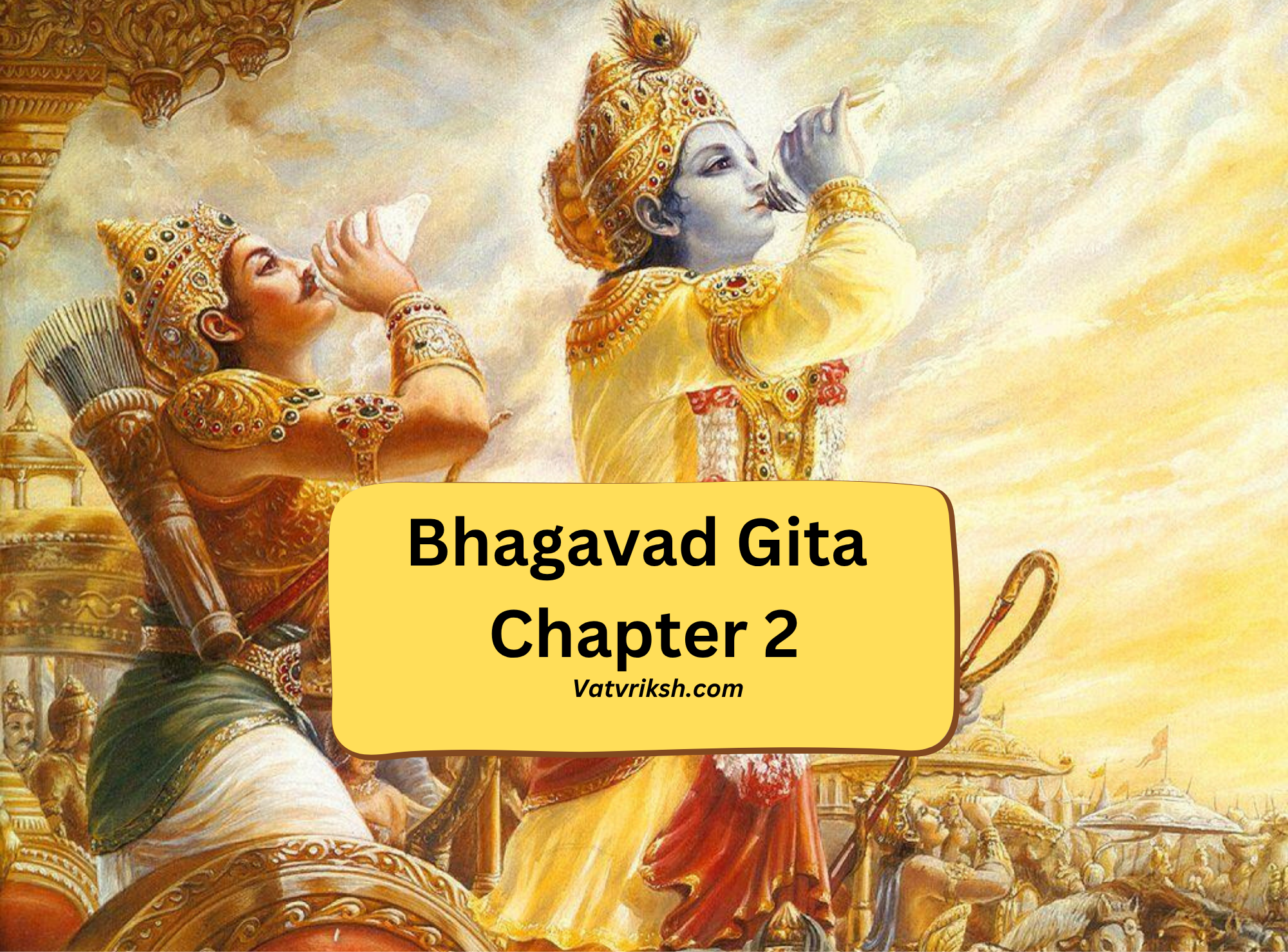
Picture the scene. Two armies stand ready on the field of Kurukshetra, conch shells still echoing across the plain, and the greatest warrior of his generation has just let his bow slip from his hands. Arjuna, who has faced down kings and demons without flinching, sits down in his chariot and weeps. It is one of the most human moments in all of Indian scripture — a hero paralyzed not by fear of death, but by grief, confusion, and moral anguish over what he is about to do.
This is where Chapter 2 of the Bhagavad Gita begins. If Chapter 1 sets the stage — Arjuna surveying the battlefield, seeing his teachers, cousins, and grandfather arrayed against him — then Chapter 2 is where the real teaching begins. It is often considered the true starting point of the Gita’s philosophy, and for good reason: nearly every major idea developed across the remaining sixteen chapters is introduced here in seed form. If you only read one chapter of the Bhagavad Gita in your life, teachers of the tradition will often point you here.
This chapter is called Sankhya Yoga, sometimes translated as “The Yoga of Knowledge” or “The Path of Analytical Understanding.” It marks the moment Krishna stops comforting his grieving friend and starts teaching him — firmly, philosophically, and with a clarity that has echoed across 2,500 years.
Where Chapter 2 Picks Up
Chapter 1 ends with Arjuna collapsing into despair. He tells Krishna he will not fight — killing his own kinsmen for a kingdom feels meaningless to him, even sinful. He’d rather be killed unarmed than raise a weapon against his family.
Chapter 2 opens with Krishna’s response to this crisis, and it is not what we might expect. Krishna does not immediately console Arjuna or validate his grief. Instead, he does something almost startling: he gently rebukes him.
Sanjaya, the narrator relaying this entire conversation to the blind king Dhritarashtra, describes Arjuna as overwhelmed with karpanya (a Sanskrit word meaning pitiable weakness or faint-heartedness) and vishada (sorrow or despondency — in fact, this chapter is sometimes referred to as containing “Arjuna Vishada Yoga,” the Yoga of Arjuna’s Despondency, in some chapter-naming traditions). Krishna’s first words to him are pointed: how has this weakness come over you at this critical hour? It is unworthy of you, he says. It will not lead to heaven, but to disgrace.
This opening exchange sets up the entire chapter’s purpose: Arjuna is not suffering from too little compassion, but from confusion about what compassion, duty, and the self actually are. Krishna’s teaching in this chapter is designed to clear that confusion at its root.
The Story Narrative
Arjuna’s Crisis Deepens
Arjuna doesn’t back down immediately. He pushes back at Krishna, essentially asking: how can I possibly fight Bhishma and Drona — my grandfather and my teacher — with arrows, when I should be honoring them? He says he would rather live as a beggar than enjoy a kingdom soaked in the blood of elders he reveres. He describes being overcome by karpanya-dosha (the fault of pitiable weakness), his very nature bewildered about what is right (dharma) and what is wrong.
Then comes a small but pivotal moment: Arjuna says plainly, “I am your disciple. Teach me, for I have taken refuge in you.” This is the turning point of the entire Gita. Arjuna moves from being a grieving friend to being a student. Krishna, in turn, shifts from companion to guru.
The Immortality of the Self
Krishna’s first major teaching addresses the root of Arjuna’s grief: the fear of causing death. Krishna’s response is metaphysical, not tactical. He tells Arjuna that the wise do not grieve for the living or the dead, because the true self — the atman — never dies.
This is the philosophical heart of the chapter. Krishna explains that:
- The body is temporary, subject to birth, growth, and decay — like childhood, youth, and old age passing within a single lifetime.
- The atman, the eternal self or soul, is never born and never dies. It is not slain when the body is slain.
- Weapons cannot cut it, fire cannot burn it, water cannot wet it, wind cannot dry it. It is eternal, unchanging, and all-pervading.
Krishna uses one of the Gita’s most famous images here: just as a person casts off worn-out clothes and puts on new ones, the soul casts off worn-out bodies and takes on new ones. This is the philosophical foundation for the Hindu understanding of reincarnation — not as a strange add-on belief, but as a direct consequence of the soul’s eternal nature.
Why It Matters: This teaching isn’t Krishna offering a technical loophole to make killing acceptable. It’s a complete reframing of what death even is. If the essential self cannot be destroyed, then grief rooted purely in the fear of causing death is grief based on a misunderstanding. This doesn’t mean life is trivial — the Gita never says that — but it relocates the tragedy of war away from the body and toward the moral quality of one’s actions.
The Argument from Duty: Arjuna’s Dharma as a Warrior
Having addressed the metaphysical objection, Krishna turns to a more practical argument. Even setting aside the eternal nature of the soul, Krishna says, look at your svadharma — your own specific duty given your nature and role in life. Arjuna was born into the kshatriya (warrior/ruling) class, whose sacred duty is to protect righteousness, uphold justice, and fight when a righteous war is necessary. For a warrior, Krishna says, there is nothing more auspicious than a righteous battle.
Krishna adds a pointed warning here, one that resonates far beyond the battlefield: if Arjuna refuses this righteous duty out of fear or false compassion, he will incur sin by abandoning his dharma, and he will lose his honor — which for a man of his standing, Krishna says, is worse than death itself. Other warriors will think he fled out of fear, and this dishonor will follow him forever.
This section can be uncomfortable for modern readers if taken as a simple endorsement of violence. It’s important to read it in context: Krishna is not glorifying war for its own sake. He is addressing a specific, tragic situation in which a just war has already been declared after every diplomatic effort failed, and Arjuna’s refusal to act is driven not by principled nonviolence but by personal grief and attachment. The deeper teaching, developed further in later chapters, is about acting from duty and clarity rather than raw emotion — not about violence being good.
Equanimity in Action: Treating Pleasure and Pain Alike
Krishna then introduces a concept that will recur throughout the Gita: samatva, or equanimity — evenness of mind in the face of opposites. He tells Arjuna to treat pleasure and pain, gain and loss, victory and defeat, as the same, and to fight with this equanimity. Acting this way, Krishna says, one does not incur sin.
This is the first appearance of the Gita’s central ethical innovation: the idea that the moral quality of an action lies less in its external outcome and more in the inner state — free or unfree, attached or detached — from which it is performed.
Buddhi Yoga and Nishkama Karma
Here the chapter turns toward what many consider its most influential teaching: Buddhi Yoga, the yoga of the intellect or discernment, and its practical expression, Nishkama Karma — selfless action, or action without attachment to the fruits of that action.
Krishna tells Arjuna that he has been given a teaching of knowledge (Sankhya), and now he will explain the yoga of action (Buddhi Yoga), by practicing which one can free oneself from the bondage of karma. The essential instruction is deceptively simple and endlessly deep:
You have a right to perform your prescribed duties, but you are never entitled to the fruits of your actions. Never consider yourself the cause of the results of your activities, and never be attached to not doing your duty.
This is arguably the single most quoted teaching in the entire Bhagavad Gita. It does not counsel passivity or indifference to outcomes — Krishna is explicit elsewhere that action, done well, matters. What it counsels is releasing the anxious, grasping attachment to specific results, which Krishna identifies as the true source of human suffering and confused action. A person who acts with excellence and sincerity, but without being enslaved to outcomes, acts from freedom rather than compulsion.
Krishna draws a sharp distinction here between people who perform rituals and actions purely for personal reward — described somewhat critically as those attached to the flowery words of scripture who believe there is nothing beyond heaven and enjoyment — and the wise person of steady intellect (sthitaprajna), who acts from a settled, non-attached understanding.
Sthitaprajna: A Person of Steady Wisdom
The final major section of Chapter 2 is one of the most beloved in the entire text: Arjuna, having listened, asks Krishna a direct question — what are the marks of a person whose wisdom is steady (sthitaprajna)? How does such a person speak, sit, walk?
Krishna’s answer is a portrait of spiritual maturity that has inspired readers across traditions for centuries:
- A person of steady wisdom gives up all desires that arise in the mind and finds contentment in the self, by the self.
- Such a person is undisturbed in sorrow, free from longing in pleasure, and free from attachment, fear, and anger.
- They are like a tortoise that can withdraw its limbs — able to withdraw the senses from their objects at will.
- Even though the senses may still perceive objects, the taste or craving for them fades in one who has experienced the higher reality of the self.
- Such a person moves through the world of sense objects with disciplined senses, free from attraction and aversion, and attains peace.
Krishna warns that this discipline isn’t easy — dwelling on sense objects creates attachment, attachment breeds desire, desire breeds anger when frustrated, anger clouds judgment, and clouded judgment destroys discernment, leading finally to ruin. This chain of psychological cause and effect is one of the Gita’s sharpest pieces of practical psychology, describing exactly how small attachments spiral into destructive decisions.
The chapter closes with Krishna describing the peace such a person attains — a peace compared to the ocean, which remains still and undisturbed even as rivers constantly pour into it. This is Brahmi sthiti, the state of being established in the ultimate reality, and Krishna says that one who attains it even at the hour of death passes beyond all delusion into the highest liberation.
Deeper Philosophical Meaning
Chapter 2 works on two levels simultaneously, and understanding both is key to appreciating why it holds such a central place in the Gita.
On one level, it is Krishna’s direct response to a specific crisis: convincing a grieving warrior to fulfill his duty in a particular battle. Read only this way, the chapter can feel narrowly tied to its historical and cultural context.
On the deeper level, Chapter 2 is laying out the Gita’s entire philosophical architecture in miniature:
- Sankhya philosophy — the discernment between the eternal self (purusha/atman) and the changing material nature (prakriti), including the body and mind.
- Karma Yoga — acting according to duty while relinquishing attachment to outcomes, which becomes the Gita’s central practical teaching, elaborated fully in Chapter 3.
- The ideal of the sthitaprajna — a psychological and spiritual portrait of liberation that anticipates the descriptions of the enlightened devotee given later in Chapters 12 and 14.
- The problem of action itself — how can one act in the world without becoming bound by the consequences and attachments that action creates? This question, posed here, drives much of the rest of the text.
In this sense, Chapter 2 functions almost like a table of contents written in philosophical prose — everything that follows is an expansion of a seed planted here.
What This Chapter Means for Life Today
You don’t need to be facing a literal battlefield to recognize Arjuna’s crisis. Most of us have stood at some version of that moment — paralyzed between competing obligations, overwhelmed by a decision where every option seems to carry some cost, uncertain whether our hesitation is wisdom or simply fear dressed up as principle.
A few of Chapter 2’s teachings translate directly into modern life:
Detachment from outcomes reduces suffering, not effort. The teaching of Nishkama Karma is often misunderstood as an argument for not caring. It’s closer to the opposite: it argues for putting your full sincerity into your effort while releasing the anxious grip on results you cannot fully control — a distinction that resonates with modern ideas about performance under pressure, whether in sport, creative work, or difficult decisions.
Emotional overwhelm can distort our sense of duty. Arjuna’s grief was genuine, but Krishna suggests it was clouding his judgment about what was actually right, rather than clarifying it. This is a useful, if uncomfortable, question to sit with in our own lives: is my hesitation coming from ethical clarity, or from fear and attachment disguised as ethics?
Equanimity is a practiced state, not a personality trait. The sthitaprajna is not described as someone born calm, but as someone who has trained the mind to meet gain and loss, praise and blame, without being thrown off balance. This reframes emotional steadiness as a discipline available to anyone willing to work at it, rather than a fixed trait some people simply have.
Impermanence can be a source of freedom, not just fear. Krishna’s teaching on the eternal soul isn’t primarily about proving reincarnation — it’s an invitation to loosen the grip of fear that keeps us from acting rightly.
Frequently Asked Questions
What is the main teaching of Bhagavad Gita Chapter 2? Chapter 2 introduces the Gita’s core philosophy: the eternal nature of the soul (atman), the importance of fulfilling one’s duty (dharma) with equanimity, and the practice of acting without attachment to results (Nishkama Karma). It also describes the ideal of the sthitaprajna, a person of steady, liberated wisdom.
Why is Chapter 2 called Sankhya Yoga? It draws its name from Sankhya philosophy, one of the six classical schools of Indian thought, which emphasizes discerning between the eternal self and changing material nature. Krishna uses this framework to explain why grief over death is based on a misunderstanding of the self’s true nature.
What does “you have a right to your actions, not to the fruits of your actions” mean? This central verse teaches that we should perform our duties with full sincerity and effort, but without an anxious attachment to specific outcomes, since results depend on many factors beyond our control. It is considered the foundational statement of Karma Yoga in the Gita.
Who is the sthitaprajna in the Bhagavad Gita? The sthitaprajna, or “person of steady wisdom,” is Krishna’s portrait of spiritual maturity: someone free from craving, undisturbed by sorrow or pleasure, whose senses are disciplined, and who has found contentment within the self rather than in external things.
Is Chapter 2 telling Arjuna that killing is acceptable? Chapter 2 addresses Arjuna’s specific situation as a warrior in an already-declared, righteous conflict, urging him to act from duty and clarity rather than from grief-driven paralysis. It should be read in the context of the Gita’s broader teaching on selfless, dutiful action, not as a general endorsement of violence.
How long is Bhagavad Gita Chapter 2? Chapter 2 contains 72 verses, making it one of the longer chapters in the Gita and, by most measures, its philosophical foundation.
Chapter 2 is where the Bhagavad Gita stops being a story about a reluctant warrior and becomes a living philosophical text — one that has been read, debated, and drawn upon by householders, renunciates, freedom fighters, and philosophers alike for over two millennia. Arjuna’s crisis of duty may have unfolded on an ancient battlefield, but the questions Krishna answers here — how do I act rightly amid grief and uncertainty, and how do I find steadiness within myself — remain as immediate today as they were then.