
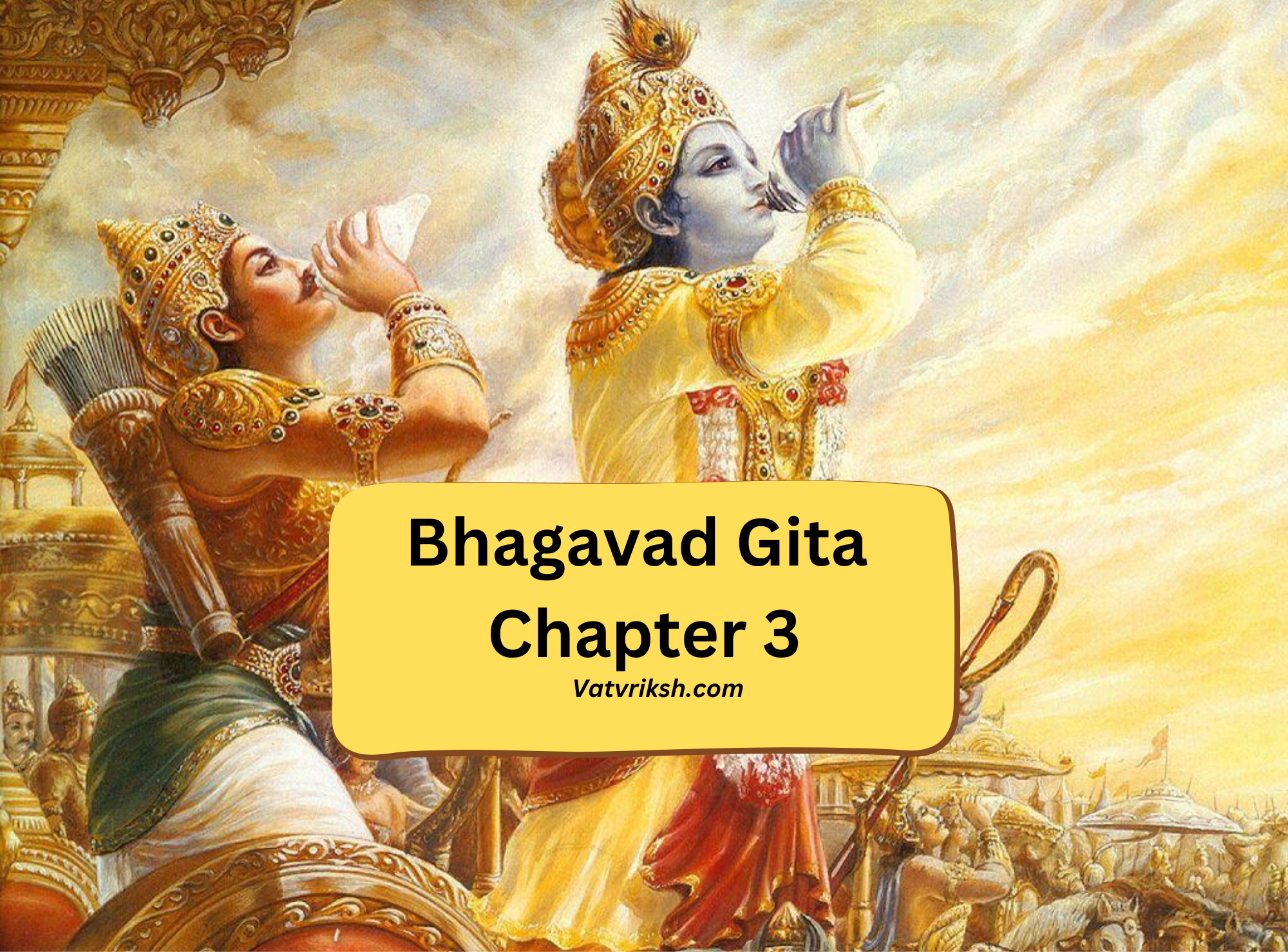
Imagine being told two things that sound like they contradict each other: that knowledge is superior to action, and that you must act. This is exactly the puzzle Arjuna finds himself in as Chapter 3 of the Bhagavad Gita opens — and it’s a puzzle many of us still quietly wrestle with today. If wisdom and inner stillness are the goal, why not simply renounce the world and meditate? Why bother with the messy, consequence-laden business of doing anything at all?
Chapter 3 of the Bhagavad Gita, known as Karma Yoga, is Krishna’s answer to this very question. Having spent Chapter 2 introducing the eternal nature of the soul and the ideal of the steady-minded sthitaprajna, Krishna now turns to something intensely practical: how should a person actually live and act in the world? The answer he gives here is one of the most influential ethical teachings in Indian philosophy, and it speaks directly to anyone who has ever felt torn between the desire for peace and the demands of daily responsibility.
Arjuna’s Confusion
Chapter 3 opens with Arjuna genuinely puzzled. He tells Krishna that if Krishna considers knowledge (jnana) superior to action (karma), then why is he urging Arjuna into this terrible battle? Arjuna feels Krishna’s teaching is pulling him in two directions at once, and he asks for one clear path, not a confusing mixture of ideas.
This is a completely reasonable question, and it’s one worth pausing on. In Arjuna’s time, as in ours, there was a real tension between two spiritual approaches: the path of renunciation, where one withdraws from action to pursue contemplative knowledge, and the path of engaged action in the world. Arjuna wants Krishna to pick one. Krishna’s response in this chapter is that, properly understood, both paths lead to the same liberation — but for almost everyone, the path of disciplined, selfless action is the wiser and more accessible route.
The Story Narrative
Two Paths, One Goal
Krishna begins by explaining that from ancient times, he has taught a twofold path in this world: Jnana Yoga, the path of knowledge for those inclined to contemplation, and Karma Yoga, the path of selfless action for those inclined to active life. He is clear that neither path is superior in its ultimate destination — both lead to the same liberation. But he adds an important practical caution: one cannot achieve freedom from action simply by abstaining from action, nor does mere physical renunciation of activity constitute true renunciation.
This point deserves emphasis because it’s easy to misunderstand. Krishna isn’t saying action is merely a lesser, second-tier path for people who can’t handle “real” spirituality. He’s saying that inaction itself is impossible for embodied beings, and that pretending otherwise is a kind of self-deception.
No One Can Truly Remain Actionless
Krishna makes a striking observation here: no one can remain without action even for a moment, because everyone is compelled to act by the gunas — the three fundamental qualities of material nature (sattva, rajas, and tamas — purity/clarity, passion/activity, and inertia/dullness) that underlie all of nature, including the body and mind. Even the simple acts of breathing, digesting, and the movement of the senses are actions we cannot fully suspend.
He goes further, criticizing a specific kind of hypocrisy: a person who restrains the organs of action outwardly while the mind continues to dwell on sense objects is called a mithyachara, one of deluded conduct or a hypocrite. This is a sharp psychological insight — outward renunciation without inner transformation accomplishes very little, and can even be a subtler form of self-delusion than honest engagement with the world.
Why It Matters: This teaching directly dismantles a tempting spiritual shortcut: the idea that we can escape moral complexity simply by withdrawing from the world. Krishna insists that the real spiritual work happens in the quality of our engagement with action, not in physically avoiding it.
The Superior Path: Acting Without Attachment
Having established that action is unavoidable, Krishna makes his central claim: it is far better to perform one’s prescribed duty (svadharma), even imperfectly, than to abstain from action altogether. He tells Arjuna to perform necessary action, because action is indeed superior to inaction, and even the maintenance of one’s own body would be impossible through inaction alone.
The key qualifier Krishna adds — the hinge on which this entire chapter turns — is this: action should be performed as yajna, or sacrifice, free from attachment. He explains that the world is bound by action except when it is performed as a sacred offering; therefore, Arjuna should act without attachment, for the sake of sacrifice alone.
This idea of yajna deserves unpacking. In the Vedic tradition, yajna referred to ritual sacrifice — offerings made to sustain cosmic and social order. Krishna broadens this idea dramatically: any action performed with the right spirit, offered without selfish grasping, becomes a form of yajna. Cooking a meal, doing one’s job, raising a family, fighting a righteous battle — all of these can become sacred acts if performed selflessly, rather than merely for personal gain.
The Cosmic Cycle of Sacrifice and Sustenance
Krishna places this teaching in a larger cosmic frame. He explains a cycle: from food, beings come into existence; from rain, food is produced; from sacrifice, rain arises; and sacrifice itself arises from action. He concludes that Brahman (the ultimate reality) is present in the very process of action, and that one who does not help turn this cycle of sacrifice and sustenance forward — who lives only for personal senses and enjoyment — lives in vain, described bluntly as living a sinful life.
While this cosmology may feel unfamiliar to modern readers, its underlying message is universal and enduring: we are part of an interconnected web of giving and receiving, and a life oriented purely around personal consumption, disconnected from any form of contribution, is a hollow one.
The Example of the Self-Realized and the Danger of Confusing Others
Krishna then addresses an important question: what about someone who has already realized the self and is satisfied within? Does such a person still need to act? Krishna acknowledges that such a self-realized soul has no personal necessity to perform action, since they have nothing left to gain and nothing to lose by acting or not acting.
But — and this is a crucial ethical point — even such a person should continue to act, for the sake of loka-sangraha, the welfare and guidance of the world. Krishna points to himself as an example: even he, with nothing to attain and nothing unattained, continues to engage in action, because if he did not, others would follow his example and abandon their own duties, causing confusion and the ruin of social order.
Why It Matters: This is one of the Gita’s most quietly radical teachings. It says that even enlightened action isn’t purely a private, individual matter — those with wisdom and influence bear a responsibility to model right conduct for others, because human beings naturally imitate what they see respected figures doing. It’s a teaching about leadership and example as much as personal liberation.
Desire and Anger: The Real Enemy
Toward the close of the chapter, Arjuna asks a pointed question that many readers of the Gita have quietly wondered themselves: even a person who does not wish to sin seems driven to it, as if by some force. What compels a person toward wrongdoing?
Krishna’s answer is direct: it is kama — desire — and its close companion krodha — anger — born from the rajas guna (the quality of passion and restlessness). He calls this desire the great devourer and the great sinner, comparing it to fire covered by smoke, a mirror covered by dust, or an embryo covered by the womb — something that obscures true knowledge and wisdom, wrapping itself around discernment like an insatiable fire.
Krishna locates desire’s seat in the senses, the mind, and the intellect, explaining that through these it deludes the embodied soul by veiling true knowledge. His prescribed remedy is to first discipline the senses, then use a steady, discerning intellect to master the mind, and through the mind, to subdue this powerful enemy of desire. He closes the chapter with a striking image: just as the intellect is subtler than the senses and the mind, and the self subtler than the intellect, one should use knowledge of this hierarchy to conquer desire, that persistent enemy so difficult to overcome.
Deeper Philosophical Meaning
Chapter 3’s teaching can be understood as unfolding across three interconnected layers:
Metaphysical: Action is woven into the very structure of existence through the gunas; true inaction is not possible for an embodied being, and pretending otherwise leads to self-deception rather than liberation.
Ethical: The moral center of gravity shifts from outcomes to intention and attachment. An action performed as selfless offering (yajna), without craving for personal reward, does not bind the soul in the way that action performed from selfish desire does. This refines and extends the teaching of Nishkama Karma introduced in Chapter 2.
Social: Even the enlightened have a duty to act for the sake of loka-sangraha — the maintenance of social and cosmic order — because human beings learn by example. This connects personal liberation to social responsibility in a way that resists a purely individualistic reading of spiritual life.
Together, these layers form what many consider the Gita’s most original philosophical contribution: the idea that liberation does not require withdrawal from the world, but rather a transformed relationship to action itself.
What This Chapter Means for Life Today
Chapter 3 speaks with surprising directness to modern struggles around work, purpose, and burnout.
You can’t opt out of responsibility by simply disengaging. Many of us fantasize, in moments of stress, about simply withdrawing from our obligations — quitting the job, avoiding the difficult conversation, checking out entirely. Krishna’s teaching suggests that disengagement without inner transformation rarely brings the peace we imagine; the discontent often follows us, since the mind that clings to sense objects remains restless even in withdrawal.
Reframing work as offering changes its emotional weight. The idea of yajna — action performed as sacred offering rather than as a transaction for personal gain — offers a genuinely useful mental shift for modern work life. A task done purely to extract a reward (a promotion, praise, income) carries a different emotional charge than the same task done with care, as a form of contribution. Neither erases the practical need for compensation, but the inner orientation changes how the work is experienced.
Leaders and role models carry extra responsibility. The principle of loka-sangraha resonates strongly today, in an age of parents, managers, teachers, and public figures whose choices are watched and often unconsciously imitated by others. Krishna’s insight — that those with visibility and influence should act with special care, because others will follow their example — remains a sound piece of ethical leadership advice.
Desire and anger, left unchecked, cloud judgment before we notice. The chapter’s closing image — desire as fire wrapped in smoke, obscuring wisdom — describes a psychological pattern many people recognize: how craving quietly narrows our perspective long before we consciously register being upset or unbalanced. Krishna’s remedy — building the discipline to observe desire through a steady intellect rather than being swept along by it — remains a practical, non-dogmatic piece of guidance for emotional self-regulation.
Frequently Asked Questions
What is the main teaching of Bhagavad Gita Chapter 3? Chapter 3 teaches Karma Yoga, the path of selfless action. It explains that true renunciation is not the physical abandonment of action, which is impossible for embodied beings, but performing necessary duties without attachment to personal reward, offered in the spirit of sacrifice (yajna).
What does Karma Yoga mean? Karma Yoga literally means “the yoga (path/discipline) of action.” It refers to performing one’s duties with full sincerity and skill while relinquishing attachment to the outcomes, so that action becomes a vehicle for spiritual growth rather than a source of bondage.
Why does Krishna say action is better than inaction? Krishna argues that complete inaction is impossible for any embodied being, since the body and mind are constantly active due to the three gunas. Attempting to suppress outward action while the mind still craves sense objects creates hypocrisy rather than freedom, so engaged, selfless action is the wiser path.
What is loka-sangraha in the Bhagavad Gita? Loka-sangraha means “the welfare or maintenance of the world.” Krishna teaches that even self-realized individuals with nothing personal to gain from action should continue to act responsibly, since others learn and follow by observing their example.
What does Krishna identify as the root cause of sinful action? Krishna identifies desire (kama) and anger (krodha), arising from the rajas guna, as the forces that drive people toward wrongdoing even against their better judgment, describing desire as an insatiable fire that clouds true knowledge.
How many verses are in Bhagavad Gita Chapter 3? Chapter 3 contains 43 verses, making it a relatively focused chapter compared to the longer Chapter 2, while introducing some of the Gita’s most quoted and practically applied teachings.
Chapter 3 answers a question that has followed spiritual seekers for millennia: must we choose between engaging with the world and finding inner peace? Krishna’s response — that selfless, disciplined action can itself become a path to liberation — remains one of the Gita’s most quietly transformative teachings, offering a way to live fully in the world without being enslaved by it.