
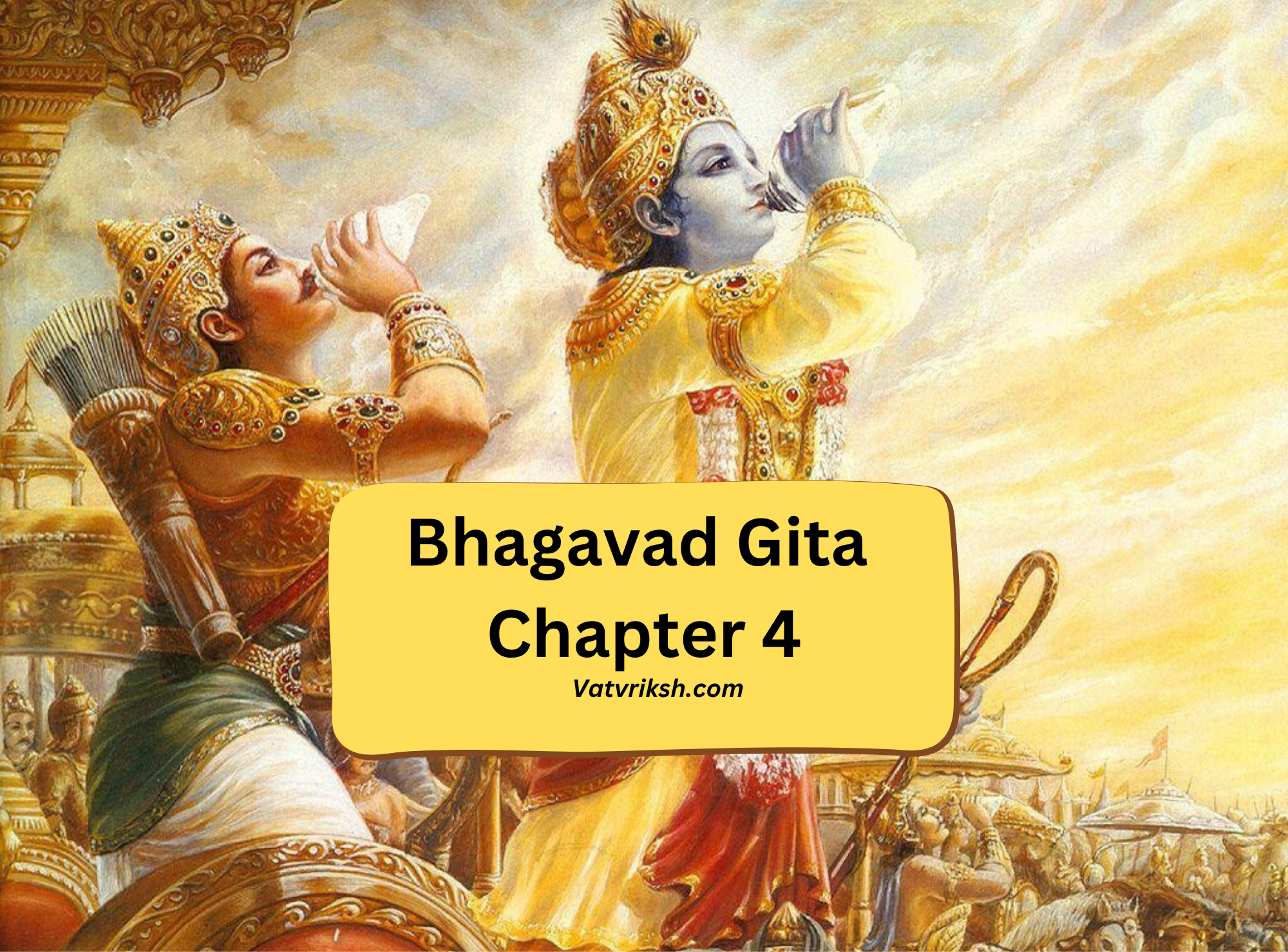
Imagine sitting with a trusted teacher, someone you’ve known your whole life as a friend, a cousin, a charioteer — and having them suddenly reveal that they’ve existed since before time began, quietly guiding the course of the universe across countless ages. This is precisely the moment that opens Chapter 4 of the Bhagavad Gita. Just when Arjuna thought he understood the shape of his crisis — a battle, a family, a difficult duty — Krishna widens the frame entirely, revealing dimensions of reality that stretch far beyond the battlefield of Kurukshetra.
Chapter 4, known as Jnana Karma Sanyasa Yoga — “The Yoga of Knowledge and the Renunciation of Action” — marks a pivotal shift in the Gita’s teaching. Having spent Chapter 3 establishing that selfless action (Karma Yoga) is the wiser path for most people, Krishna now reveals something Arjuna did not expect: that this very teaching is ancient, that he himself has taught it across ages, and that he periodically incarnates in the world to restore righteousness. This chapter is where the Gita’s philosophy and its theology begin to fuse — where practical ethics meets the deep mystery of the divine.
A Startling Revelation
Chapter 3 closes with Krishna’s guidance on mastering desire through disciplined intellect. Chapter 4 opens with something unexpected: Krishna tells Arjuna that this very yoga — the imperishable teaching of selfless action he has just described — was originally taught by Krishna to the sun-god Vivasvan, who passed it to Manu, who passed it to Ikshvaku, and so it was handed down through royal sages across generations, until, over great stretches of time, this yoga was lost to the world.
Arjuna, understandably confused, asks the obvious question: Vivasvan was born long ago, and you, Krishna, were born recently — how am I to understand that you taught him this at the beginning of time?
Krishna’s answer to this question opens one of the most theologically significant sections in the entire Gita.
The Story Narrative
Many Births, One Unchanging Self
Krishna explains that both he and Arjuna have passed through many births. The difference, he says, is that Arjuna does not remember his, while Krishna remembers all of his own. This single line carries enormous weight: Krishna is stating plainly that he is not merely a gifted teacher or a skilled warrior-prince, but a being whose awareness transcends the limitations of ordinary embodied existence.
He goes further, describing himself as unborn and imperishable in his true nature, and as the Lord of all beings — yet he still takes birth through his own maya (divine creative power, often translated as illusion or the force that manifests the material world) by controlling his own nature, or prakriti.
The Doctrine of Avatara: Why the Divine Descends
This leads to what is perhaps the most famous declaration in Chapter 4, one frequently quoted even outside devotional or scholarly circles:
Whenever there is a decline of righteousness (dharma) and a rise of unrighteousness (adharma), O Arjuna, I manifest myself.
Krishna explains that he takes birth age after age for the protection of the virtuous, the destruction of the wicked, and the re-establishment of dharma. This is the doctrinal foundation for the concept of avatara — literally “descent” — the idea that the divine periodically incarnates in the world in a tangible form to restore moral and cosmic balance. This single teaching underlies much of later Hindu devotional theology, including the traditional accounts of Vishnu’s ten avatars, from Matsya to Kalki.
Why It Matters: This teaching offers something quietly reassuring underneath its cosmic scale: it suggests that periods of moral decline and confusion are not permanent or final, but part of a larger, self-correcting rhythm. It reframes the battlefield Arjuna faces not as random chaos, but as part of exactly this kind of necessary restoration.
Divine Action Without Being Bound By It
Krishna then makes a subtler point: one who truly understands the divine nature of his birth and his actions is not born again after leaving the body, but attains to Krishna himself. Many seekers of the past, Krishna says, freed from attachment, fear, and anger, absorbed in him and purified by the fire of knowledge, have attained his very being.
He adds that he responds to all beings according to how they approach him — “in whatever way people surrender to me, I reciprocate accordingly” — a statement often read as an early articulation of religious universality within the text: different paths of sincere seeking are honored, not merely tolerated.
Action That Does Not Bind: Krishna’s Own Example
Returning to the practical theme of Karma Yoga, Krishna makes an important observation about himself: he has no unfulfilled duty in the three worlds, nothing to attain that has not already been attained, and yet he continues to engage in action. He offers this as confirmation of the loka-sangraha principle from Chapter 3 — even without personal necessity, right action continues, both to sustain the world and to set an example others will follow.
He states that the wise, knowing this truth, act without attachment, just as their ancestors did in the pursuit of liberation. This section reinforces that Krishna’s revelation of his divine nature is not a departure from the practical teaching of the earlier chapters — it deepens and grounds it.
What Is Action? What Is Inaction? The Puzzle of Karma
Krishna then turns to a question he says even the wise find puzzling: what exactly is action, and what is inaction? He tells Arjuna he will explain this, so that by knowing it, Arjuna may be freed from inauspicious results.
His answer introduces some of the chapter’s subtlest ideas: one must understand not just action (karma), but also wrong action (vikarma) and inaction (akarma), because the true nature of action is profound and difficult to understand.
Krishna praises the person who can see inaction within action and action within inaction — a person of this discernment, he says, is wise among all people, established in yoga, and has accomplished all that needs to be accomplished. This paradoxical-sounding teaching points to an experiential truth rather than a logical puzzle: a person acting from ego, craving, and attachment is, in a subtle sense, more bound and reactive (less truly “acting” from freedom) than a person who performs vigorous outward action from a place of inner stillness and non-attachment.
Krishna describes such a liberated person as one whose actions are entirely free from selfish desire and craving, whose actions have been burned up in the fire of knowledge — someone the wise call a pandita, a truly learned person, regardless of how much conventional activity they undertake.
Renouncing Attachment, Not Action Itself
Krishna clarifies something important here, one that resolves the apparent tension from the opening of Chapter 3: giving up attachment to the fruits of action, ever content, independent of external supports, such a person, though fully engaged in action, does nothing at all in the binding sense. Free from expectation, with mind and self under control, having given up all sense of possessiveness, performing action only with the body, such a person incurs no sin.
Content with whatever comes unsought, beyond the pairs of opposites (dvandva — such as pleasure and pain, honor and dishonor), free from envy, equal-minded in success and failure — such a person is not bound even while acting.
The Many Forms of Sacrifice
The chapter’s closing section returns to and dramatically expands the concept of yajna (sacrifice/offering) introduced in Chapter 3. Krishna describes an entire spectrum of practices that can be understood as forms of sacrifice: offerings to gods, offerings of the self into the fire of Brahman, the practice of restraint and self-control, offerings of wealth, austerity, yogic practice, systematic study of scripture, and the cultivation of knowledge itself. Even the regulation of the breath (pranayama) and the disciplining of the senses are described here as legitimate forms of yajna.
Krishna’s underlying point is expansive and inclusive: sacrifice is not limited to ritual fire ceremonies. Any disciplined, sincere, self-transcending practice — performed with the right understanding — participates in this same sacred principle.
He then delivers what many consider the philosophical high point of the chapter: superior to any sacrifice of material things is the sacrifice of knowledge (jnana yajna), because all action, without exception, culminates and finds completion in knowledge. This is why, Krishna tells Arjuna, he should seek this knowledge through humble approach to those who have realized the truth, through inquiry, and through service — such realized teachers, having true insight, will impart this knowledge.
The Power of Knowledge to Dissolve Doubt and Sin
The chapter closes with some of the Gita’s most encouraging and often-quoted verses. Krishna declares that just as a blazing fire reduces wood to ashes, the fire of knowledge reduces all past actions to ashes. There is nothing in this world as purifying as knowledge, he says, and one who has attained perfection through the discipline of yoga discovers this truth within themselves, in time.
But Krishna is careful to add a caution here too: one who lacks faith and is full of doubt is destroyed; for the doubting soul, there is neither this world, nor the world beyond, nor happiness. He urges Arjuna to cut through this doubt with the sword of knowledge, take refuge in the practice of yoga, and rise to fight — closing the chapter by circling back, once more, to the immediate crisis Arjuna faces.
Deeper Philosophical Meaning
Chapter 4 accomplishes something structurally important within the Gita: it lifts the entire conversation from a practical ethical dilemma into a theological and metaphysical register, without ever abandoning the practical thread.
Three layers of meaning stand out:
Theological: The doctrine of avatara, introduced here for the first time in the text, establishes Krishna’s teaching authority as originating from a timeless, divine source rather than merely personal opinion or clever argument. This becomes the theological backbone for the devotional (bhakti) teachings that will emerge more fully in later chapters.
Epistemological: The chapter’s meditation on the true nature of action and inaction (karma, vikarma, akarma) sharpens the ethical teaching of Chapter 3 by locating the essence of bondage not in outward activity itself, but in the presence or absence of ego-driven attachment.
Practical/Spiritual: The vast catalogue of sacrifices, culminating in the elevation of knowledge as the highest offering, universalizes the path of yajna — suggesting that virtually any disciplined, sincere human endeavor can become a vehicle for spiritual growth, provided it is undertaken with the right inner orientation.
What This Chapter Means for Life Today
Chapter 4’s teachings, despite their cosmic scale, land with real practicality in modern life.
Difficult periods often carry the seeds of necessary correction. Krishna’s teaching on avatara — that the divine responds precisely when righteousness declines — offers a way of holding difficult, chaotic periods (whether personal, social, or historical) with more patience: not passive resignation, but a trust that imbalance tends to call forth its own correction over time, often through the sincere efforts of those willing to act rightly within it.
Busy, engaged people are not disqualified from inner peace. The teaching that one can be “fully engaged in action” while, in the deeper sense, “doing nothing at all” pushes back against the common modern assumption that peace requires escaping obligations. It suggests instead that the quality of inner attachment — not the quantity of outward activity — determines whether action is binding or liberating.
Learning happens through humility, inquiry, and relationship, not just information-gathering. Krishna’s instruction to seek knowledge through humble approach, sincere questioning, and service to those who have genuine insight remains a strikingly relevant model in an age of easy information access but often shallow understanding. It suggests real wisdom is transmitted through relationship and sincere effort, not simply consumed.
Doubt, left unexamined, is more corrosive than wrong belief. Krishna’s warning about the doubting mind — destroyed, without peace in this world or beyond — speaks to a very modern form of paralysis: endless second-guessing that prevents any committed action or growth. The remedy offered isn’t blind faith, but cultivated knowledge and disciplined practice strong enough to resolve doubt rather than merely suppress it.
Frequently Asked Questions
What is the main teaching of Bhagavad Gita Chapter 4? Chapter 4 reveals Krishna’s divine nature and the doctrine of avatara — his periodic incarnation to restore dharma — while deepening the teaching of Karma Yoga through a nuanced exploration of action, inaction, and the purifying power of knowledge.
What is an avatar according to Bhagavad Gita Chapter 4? An avatar (avatara) refers to a divine incarnation. Krishna explains that whenever righteousness declines and unrighteousness rises, he manifests in a bodily form to protect the virtuous, destroy the wicked, and restore dharma, appearing age after age throughout history.
What does Krishna mean by “action within inaction and inaction within action”? This teaching distinguishes outward activity from inner bondage. A person acting from ego and craving remains inwardly bound (a kind of subtle “inaction” in the sense of spiritual stagnation), while a person acting without attachment, even amid vigorous activity, is inwardly free — “inaction” within action.
What is jnana yajna, or the sacrifice of knowledge? Jnana yajna is the offering of knowledge, which Krishna describes as superior to any material sacrifice, since all actions ultimately find their completion and purpose in true understanding. It represents the culmination of the various forms of sacrifice described throughout the chapter.
How should one seek spiritual knowledge according to this chapter? Krishna advises approaching those who have realized the truth with humility, sincere inquiry, and service, since such teachers, having genuine insight, are able to impart real knowledge to a sincere seeker.
How many verses are in Bhagavad Gita Chapter 4? Chapter 4 contains 42 verses, and it is notable for introducing the Gita’s foundational teaching on divine incarnation alongside its continued development of Karma Yoga.
Chapter 4 marks the moment the Bhagavad Gita reveals its full scope — not simply a manual for right action, but a teaching rooted in the timeless, self-renewing nature of the divine itself. Krishna’s revelation here doesn’t replace the practical wisdom of selfless action; it grounds that wisdom in something vast enough to make sense of Arjuna’s crisis, and perhaps our own, as part of a much larger, ongoing act of restoration.