
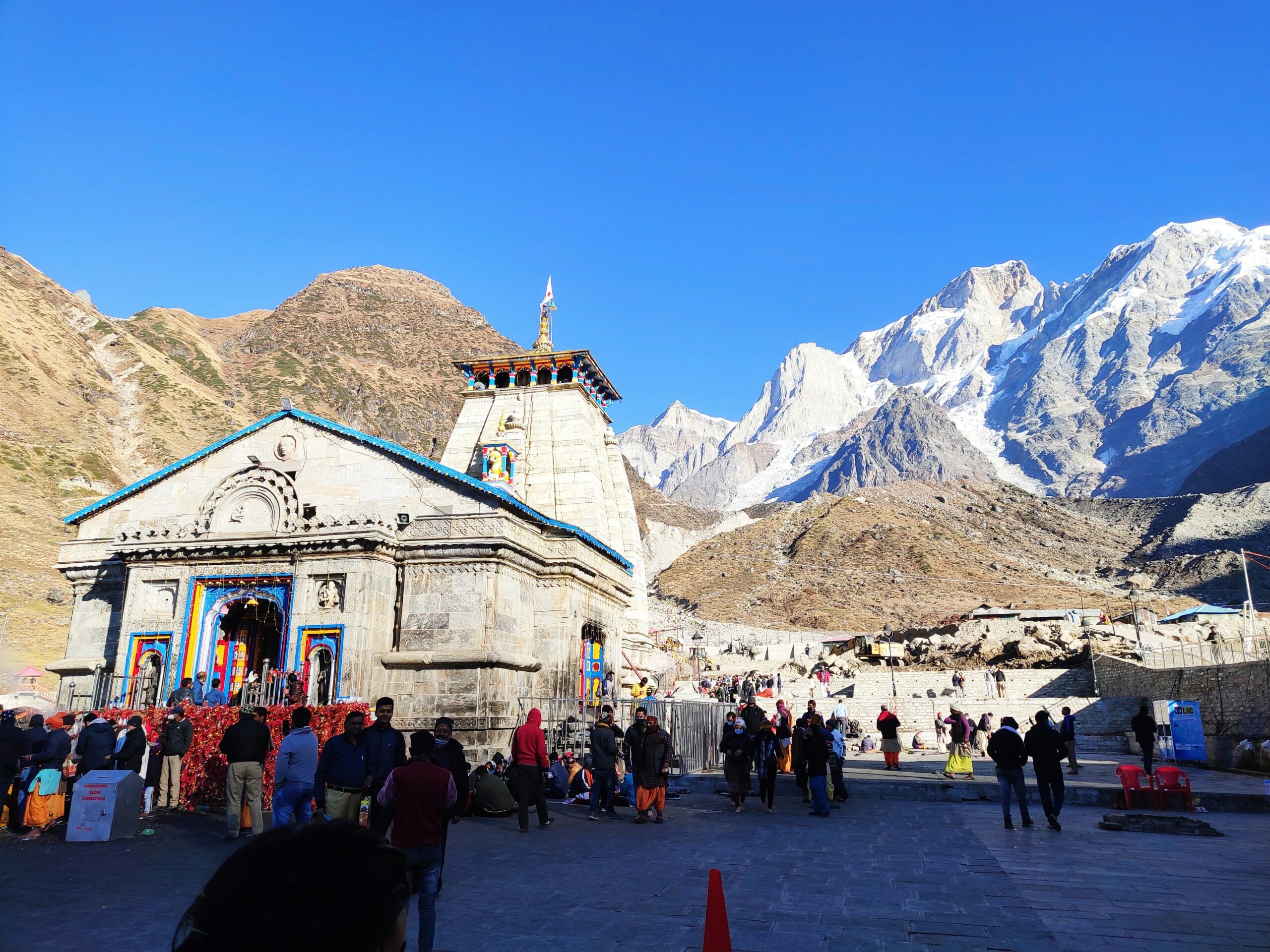
At a quarter past four in the morning, nobody at Kedarnath is talking. The cold does that. You have been standing in a queue on a stone path for an hour, breath clouding, the Mandakini roaring somewhere below in the dark, and the mountains behind the temple are only a deeper shade of black against the sky. Then the doors open, and the line moves, and you are pushed forward into a small dim chamber that smells of ghee and wet stone and crushed marigold.
And what you see is not a face. There is no sculpted Shiva here, no trident-bearing figure with a cobra at his throat. There is a rough, three-sided mass of rock rising from the floor, slick with milk and water and the touch of ten thousand hands. People put their foreheads against it and say nothing at all.
That is Kedarnath. Of the twelve Jyotirlingas — the twelve shrines where Shiva is believed to have manifested as a pillar of light rather than as an image carved by human hands — this one sits highest, at 3,583 metres, in a bowl of snow at the head of a Himalayan valley that is simply uninhabitable for half the year. For six months the shrine is open. For the other six it is sealed, buried, abandoned to the weather, while the deity is carried down the mountain to be worshipped somewhere warmer.
Why Kedarnath Matters: Three Pilgrimages in One Shrine
Most temples belong to one circuit. Kedarnath belongs to three, which is part of why it looms so large in the Hindu imagination.
It is, first, a Jyotirlinga — one of the twelve most sacred Shiva shrines in the subcontinent, and the northernmost and highest of them. The word joins jyoti (light, radiance) and linga (the aniconic form in which Shiva is worshipped). The theology behind the Jyotirlinga tradition is worth sitting with: these are sites where the divine is said to have shown itself as formless light, which is precisely why the object of worship at Kedarnath is unshaped stone. You are not looking at a representation of God. You are standing in front of something the tradition says God became.
It is, second, one of the four shrines of the Chota Char Dham, the Uttarakhand pilgrimage circuit of Yamunotri, Gangotri, Kedarnath and Badrinath. Pilgrims traditionally travel them in that order, moving from the sources of two rivers to the seats of Shiva and Vishnu — a geography that reads almost like a theological argument about where India’s water, and its gods, come from.
And it is, third, the first of the Panch Kedar, five high Shiva temples in Garhwal that together are said to hold the pieces of a single divine body. That story is the one people tell on the trek.
The Legend: A Bull, a Wrestler, and a Body Scattered Across the Garhwal Hills
The Pandavas have won the Mahabharata war, and winning has ruined them. They have killed cousins, teachers, elders — kinsmen whose blood, in the moral physics of the epic, does not simply wash off. So they go looking for Shiva, hoping he will absolve them.
Shiva does not want to be found. He takes the form of a bull and hides among the cattle of the Garhwal hills. Bhima — the strong one, the wrestler, the brother who solves things with his hands — recognises the bull and grabs it by the tail and hind legs. The bull does not fight him. It sinks into the earth.
And then it reappears, in pieces, across five sites. The hump surfaces at Kedarnath. The arms at Tungnath (3,680 m). The face at Rudranath (3,559 m). The navel and stomach at Madhyamaheshwar (3,490 m). The hair at Kalpeshwar (2,200 m), the only one of the five reachable in winter. Together they are the Panch Kedar, and pilgrims who walk all five are, in a sense, reassembling a god.
A note on sources, because this matters. This legend is woven into the Mahabharata’s broader tradition and is told at length in regional Sanskrit and Garhwali material, including the Kedarkhanda section associated with the Skanda Purana, a text generally dated by scholars to roughly the 7th–10th centuries. You will see the story confidently cited to a single chapter and verse on temple signboards and travel sites; the honest position is that it belongs to a living regional Puranic and oral tradition rather than to one neatly datable source. The Skanda Purana does contain some of the earliest surviving textual references to Kedara as a sacred site, which is a different and better-documented claim.
The temple’s founding is similarly uncertain. Tradition credits Adi Shankaracharya, the 8th-century Advaita philosopher, with reviving Kedarnath along with Badrinath and the other Himalayan shrines, and holds that he attained mahasamadhi here; a samadhi monument stands just behind the temple, rebuilt and reconsecrated in recent years after the 2013 floods. Historians are more cautious about the attribution than tradition is. What is reasonably clear is that by the 12th century Kedarnath was already an established pilgrimage centre of considerable prominence — a destination, not a discovery.
The Rock That Saved the Temple
In June 2013, a catastrophic cloudburst and glacial flood tore through the Kedarnath valley. Thousands died across Uttarakhand. The settlement around the temple was largely destroyed — guesthouses, shops, the stone paths, the people on them.
The temple itself survived. A vast boulder had come down with the debris and lodged against its rear wall, splitting the torrent around the structure like a breakwater. Pilgrims now call it Bhim Shila — Bhima’s rock — and it is garlanded and worshipped where it sits. You will hear it described as a miracle and you will hear it described as geology, and the striking thing about Kedarnath is how many people there seem comfortable holding both descriptions at once.
The Temple Itself: What You Are Actually Looking At
Kedarnath is not an ornate temple. There are no soaring gopurams, no dense friezes of dancing figures. It is a compact stone structure in the heavy, squat Himalayan idiom — massive interlocked grey slabs built to survive snow-load and seismic shock, which is exactly what it has done for several centuries.
Inside, the sanctum holds the three-sided lingam, with a pedestal recorded at roughly 3.6 metres in both height and circumference. In the mandapa outside the sanctum are images of the Pandavas, Krishna, Draupadi, Nandi and the guardians — the cast of the founding story, standing around the thing the story was told to explain. A Nandi statue sits outside the main door.
The plainness is the point. At 3,583 metres, with the Kedarnath peak rising behind it and a glacier at the valley head, the architecture does not need to generate awe. The site does that. The building’s job is to survive.
Planning a Kedarnath Yatra: A Practical Guide
This section carries the ordinary caveat that applies to all Himalayan pilgrimage: arrangements change season to season, sometimes week to week, and the authority is the Badri-Kedar Temple Committee (BKTC) and the Uttarakhand administration, not a blog post. Verify before you book.
Opening and Closing Dates
The shrine opens on or around Akshaya Tritiya in spring and closes on Bhai Dooj, two days after Diwali. For 2026, the opening was officially announced on Maha Shivaratri and the portals opened on 22 April 2026.
The closing date is the one to watch if you are reading this in autumn. By convention it is formally announced on Vijayadashami, shortly before the end of the season, and it tracks Bhai Dooj — which for 2026 falls on either 10 or 11 November depending on which panchang you follow, since the relevant tithi straddles the two days. Treat the second week of November 2026 as the closing window and confirm the exact date with BKTC rather than with any travel site, including the ones quoting a single confident figure.
When the doors close, the deity does not stay. The portable utsava murti is carried in procession down to the Omkareshwar Temple at Ukhimath, Kedarnath’s winter seat, and worshipped there through the snow months. If you cannot make the trek, Ukhimath in December is a real and much-overlooked way to have darshan of Kedarnath’s deity.
How to Reach Kedarnath
The road approach is from Haridwar or Rishikesh, roughly 220–250 km of mountain driving via Devprayag, Rudraprayag and Guptkashi. Nearest railheads are Haridwar and Rishikesh; nearest airport is Jolly Grant, Dehradun.
Private vehicles are generally stopped at Sonprayag, where you park and take a shared shuttle the last five kilometres to Gaurikund. From Gaurikund the temple is reached only on foot, by pony, by palki (a carried chair), or by helicopter.
The trek is commonly given as 16 km from Gaurikund, taking six to eight hours at an unhurried pace, via Jungle Chatti, Bhimbali and Linchauli. You will also see 17 km, 18 km and 19 km quoted, and all of these have been accurate at different times: the route was substantially realigned after 2013 and has been modified since. Plan for a long, steep day rather than a precise number.
Helicopter shuttles operate from three helipads — Sersi (Sitapur), Phata and Guptkashi — with Guptkashi the furthest and most expensive and Sersi the closest and cheapest. Tickets are sold only through the official IRCTC heliyatra portal, and this is a genuinely important detail: Kedarnath helicopter fraud is a recurring problem, and agents offering guaranteed seats outside that portal should be treated with suspicion.
Registration is mandatory and free. Char Dham Yatra registration is done through the Uttarakhand government’s tourist-care portal, with ID upload and a QR-coded slip that is checked at Sonprayag and Gaurikund. Do it before you leave home.
Darshan Timings
Timings shift with the season and with crowd management, so take these as the usual pattern rather than a fixed schedule. The temple generally opens around 4 am for Mangala Aarti and the morning abhishek, with general darshan from roughly 6 or 7 am. There is typically an afternoon closure, often around 3 pm to 5 pm, for bhog and the dressing of the deity. Evening darshan resumes in the late afternoon, with Sandhya Aarti around dusk and Shayan Aarti — the putting-to-rest — before the doors close for the night, usually somewhere between 8.30 and 9 pm.
Sparsh darshan, where devotees may physically touch the lingam, is permitted at the committee’s discretion and is often restricted to morning hours or suspended entirely during peak crowding. Do not build your trip around it. Special and personalised pujas are booked through BKTC for a fee; ordinary darshan is free.
Dress Code and What the Altitude Will Do to You
There is no ornate dress code — modest clothing is the expectation, and nobody will object to the heavy woollens you will desperately need. Even in June, mornings at Kedarnath are near freezing. Bring layers, a waterproof shell, a cap, gloves and broken-in shoes with real grip.
The altitude deserves more respect than it usually gets. 3,583 metres is high enough for acute mountain sickness in unacclimatised visitors, and the standard advice applies: spend a night at Guptkashi or Sonprayag before ascending if you can, walk slowly, hydrate, and come down if you develop a persistent headache, nausea or breathlessness at rest. Helicopter passengers are at particular risk because they go from low altitude to 3,583 metres in minutes with no acclimatisation at all. If you have a heart or lung condition, this is a conversation to have with your doctor and not with a travel agent.
Best Time to Go
Late April to mid-June, and mid-September to the November closing, are the windows most pilgrims prefer. BKTC itself identifies July to mid-September — the monsoon — as the period of heaviest rain and highest landslide risk, and the 2013 disaster happened in June. Autumn offers the clearest mountain views and thinner crowds; it also offers serious cold.
What Devotees Come Here to Ask For
Kedarnath is not primarily a wish-fulfilment shrine, and that distinguishes it from a great many Indian temples. People do not mainly come here for a job, a child, a marriage.
They come, overwhelmingly, for two things. The first is release — from guilt, from karmic weight, from the accumulated residue of a life lived imperfectly. The Pandava story is a story about exactly this: people who did a terrible thing for arguably good reasons and could not stop feeling the terribleness. That is a recognisable human condition, and Kedarnath has been absorbing it for a very long time.
The second is a kind of readiness for death. Shiva at Kedarnath is Shiva the destroyer and the dissolver, the one who ends things, and older pilgrims in particular come in a spirit of putting their affairs in order. The exertion is not incidental to this. You arrive at the shrine emptied out, legs shaking, lungs burning, with nothing left to perform.
Nearby Sites Worth Your Time
Most pilgrims pass through the Kedar valley in a rush. A day or two more buys you a great deal.
Ukhimath (Omkareshwar Temple) — the winter seat, and the only place to have darshan of Kedarnath’s deity when the high shrine is shut. Guptkashi — where Shiva, in the legend, first went into hiding; the Vishwanath temple here is modest and quiet. Triyuginarayan — believed to be the site of Shiva and Parvati’s wedding, with a fire said to have burned continuously since. Vasuki Tal — a high glacial lake above Kedarnath, a demanding day hike for the acclimatised and fit. Tungnath and Chandrashila — the second Panch Kedar, with one of the finest short ridge walks in the Himalaya above it. And, for those with time, the rest of the Panch Kedar circuit, which very few pilgrims complete and which is, by common account, the most beautiful pilgrimage in Garhwal.
Why Kedarnath Still Matters
It would be easy to read Kedarnath as a survival — a shrine that persists because tradition is stubborn. I think something more interesting is going on.
Almost every other devotional object in Hinduism gives you something to look at. Kedarnath refuses. It hands you a rough stone in a cold room and asks you to find God in it. That is a genuinely demanding theology, and the fact that millions of ordinary, unphilosophical people climb sixteen kilometres to practise it is remarkable. The Jyotirlinga tradition is Advaita made physical: the divine as light and formlessness, not as personality.
And there is the seasonality, which no air-conditioned temple can offer. Kedarnath is unavailable for half of every year. You cannot have it on demand. You go when the mountain permits and not when you feel like it, and the deity itself migrates downhill with everyone else when the snow comes. In a culture of permanent access — of everything open, always, instantly — a God who is seasonally unreachable is a strange and clarifying idea.
The practical takeaway is smaller and more usable than any of that. Kedarnath is one of the few pilgrimages where the journey is unmistakably part of the rite. You cannot shortcut it into a photograph. Six to eight hours of uphill walking does something to a person that arriving by car does not, and if you are planning this trip, resist the temptation to make it easy. Walk it if your body will let you.
Frequently Asked Questions
Which Jyotirlinga is Kedarnath?
Kedarnath is one of the twelve Jyotirlingas and the highest of them, at 3,583 metres in Rudraprayag district, Uttarakhand. It is also one of the four Chota Char Dham shrines and the first of the five Panch Kedar temples.
Why does Kedarnath temple close for six months?
Snow. At 3,583 metres the valley becomes inaccessible and uninhabitable through winter — heavy snowfall, blocked paths, no services. The shrine closes on Bhai Dooj, two days after Diwali, and the deity is carried down to the Omkareshwar Temple at Ukhimath, where worship continues through the winter until the portals reopen around Akshaya Tritiya.
How difficult is the Kedarnath trek?
It is a sustained uphill walk of around 16 km from Gaurikund, usually six to eight hours, gaining roughly 1,600 metres. It is not technical and it requires no climbing skill, but it is genuinely strenuous and it is at altitude. Ponies, palkis and porters are available at Gaurikund, and helicopters fly from three nearby helipads. Reasonably fit walkers who pace themselves manage it comfortably; people who arrive unacclimatised and rush do not.
Is registration compulsory for Kedarnath?
Yes. Char Dham Yatra registration through the Uttarakhand government’s tourist-care portal is mandatory and free, requires ID upload, and produces a QR-coded slip that is checked en route at Sonprayag and Gaurikund. Register before travelling; on-the-spot verification exists but adds delay.
What are Kedarnath temple darshan timings?
Broadly, the temple opens around 4 am for Mangala Aarti and morning abhishek, general darshan runs from about 6 am, there is usually an afternoon closure in the region of 3 pm to 5 pm, and evening darshan continues through Sandhya and Shayan Aarti until roughly 8.30–9 pm. These shift with season and crowd management, so confirm locally.
Can you visit Kedarnath without trekking?
Yes — by helicopter from Sersi, Phata or Guptkashi, booked only through the official IRCTC heliyatra portal, or by pony or palki from Gaurikund. Be aware that flying straight to 3,583 metres carries a real risk of altitude sickness precisely because it skips acclimatisation.
What is Bhim Shila at Kedarnath?
Bhim Shila is the large boulder that lodged behind the temple during the June 2013 Kedarnath floods and diverted the floodwater around the structure, which is widely credited with the temple’s survival. It stands behind the shrine and is now itself venerated.
A Closing Thought
Walk out of the sanctum and turn around, and you will see the thing the architecture was never trying to compete with: a wall of snow and rock going straight up, indifferent, enormous, older than every story told about it.
People have been climbing here for at least a thousand years to put their foreheads against a piece of stone in a freezing room. They have come carrying grief and guilt and old age and ordinary unresolved life, and they have gone back down lighter. Whatever else Kedarnath is, it is proof that human beings will walk a very long way uphill for something they cannot photograph.
Continue Exploring
- Kashi and Its Significance for Hinduism — the other great Shiva city, and another Jyotirlinga
- Pandavas: The Rightful Heirs of the Kuru Kingdom — the five brothers whose search for Shiva founded the Panch Kedar
- Shiva Trilogy: Key Highlights and Takeaways
- Parashurama: The Eternal Warrior Sage of Sanatan Dharma
- What the Bhagavad Gita Teaches Us About Death