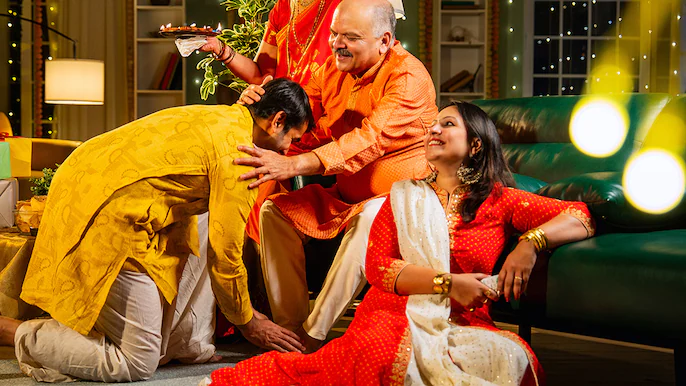
It happens at the door, before anyone has taken their shoes off properly. A grandmother arrives from Pune, or a nephew lands from Toronto, and there is a half-second of negotiation nobody plans: the younger one bends, the older one is already reaching out, and a hand lands on the top of a head. Sometimes the elder catches the younger halfway and pulls them up into a hug instead, muttering that it is not necessary. Nobody has said a word yet. A great deal has already been communicated.
Then there is the other version, the one that happens in airports: a twelve-year-old raised in New Jersey, visiting India for the second time in her life, watching her cousins fold at the waist in front of a great-uncle and having no idea what she is supposed to do with her hands.
This small gesture is one of the most widely practised rituals in Indian life and one of the least explained. Most people who do it every week have never been told why. So here is the why — what the texts actually say, what the gesture is built out of, how it is done, where the popular explanations go wrong, and what to make of it now.
What Charan Sparsh Actually Is
Charan sparsh is a compound of two plain Sanskrit words: charan, feet, and sparsh, touch. It is one member of a much larger family of respectful gestures that the tradition groups under the word pranama — from pra, meaning forward, and anama, bending — literally, bending forward.
The older and more formal Sanskrit term for the act of salutation is abhivadana. When you read classical texts on conduct, that is the word you will meet, and it covers a good deal more than the physical movement. The eleventh-century commentator Medhatithi, glossing the Manusmriti, is explicit that abhivadana is not just the bow or the formula of words — it extends to addressing people respectfully in general, speaking pleasantly to elders, and actually attending to them. The gesture is the visible tip of something that is meant to be a habit.
That distinction is worth holding on to, because it answers the most common objection to the custom before it is raised. A person who touches an aunt’s feet at a wedding and does not call her for two years has performed the gesture and missed the practice entirely. The tradition knew this.
Why Feet? The Logic of the Lowest Point
To a newcomer the choice of body part seems arbitrary at best and unhygienic at worst. It is neither. It is the most deliberate part of the design.
The feet are the lowest point of the body and the part in contact with the ground, with dust, with everything we are taught to keep away from the clean and the sacred. To voluntarily lower your head — the highest point, the seat of the thinking, judging, self-defending mind — to that level is a precise piece of physical theatre. It is not possible to perform it while feeling superior. The body makes an argument the mind would prefer to avoid.
And the gesture is not an Indian social invention that later got a religious coat of paint. It runs the other way. Feet are where Hindu worship has always begun.
Consider the shodasha upachara, the sixteen-step sequence of temple and household worship. The deity is meditated upon, invoked, offered a seat — and the fourth step, before anything else is given, is padya: water poured to wash the feet, with mantras. Only after that come water for the hands, water to drink, the bath, the clothes, the sandal paste, the flowers, the lamp, the food. The whole sequence is the protocol for receiving an honoured guest in an Indian home, applied to God. You wash a guest’s feet first because they have travelled to reach you.
The imagery runs right through the tradition. Water that has washed the deity’s feet is charanamrit — foot-nectar — and devotees drink it. In Vaishnava cosmology the Ganga herself is Vishnupadi, issuing from Vishnu’s foot. Lakshmi is depicted at Vishnu’s feet, not as a subordinate but because that is where devotion situates itself. When a disciple formally accepts a teacher, the ceremony is pada puja, worship of the feet. In temple sculpture across India, the single most common posture of devotion is a figure bent at the feet of the divine.
So when you touch an elder’s feet, you are not inventing a social courtesy. You are borrowing the vocabulary of worship and pointing it at a person — which is itself the claim being made. Something worth revering is present in them.
What the Texts Say
The Manusmriti and the Four Things That Increase
The single most quoted verse on this subject is Manusmriti 2.121:
abhivadanashilasya nityam vriddhopasevinah | chatvari tasya vardhante ayur dharmo yasho balam ||
For one who is in the habit of saluting, and who constantly serves elders, four things increase: ayus (long life), dharma (merit, right conduct), yashas (good name) and balam (strength).
Notice what the verse does not promise. It does not say the elder grants these four things as a reward. It says they increase in the person who has made this a habit — nityam, constantly. This is a claim about character formation, not about transactions. Medhatithi, commenting on it, reads dharma here as the tree that bears its fruit in the next world.
A word about the source. The Manusmriti is a dharmashastra — a treatise on law and conduct, compiled over time, prescriptive rather than descriptive, and a text that modern Hindus read selectively and often critically, particularly where it legislates on caste and on women. Citing 2.121 does not require endorsing the whole work, and this article is not doing so. It is quoted here because it is the oldest clear statement of the custom and because its reasoning is interesting.
Yudhishthira at Kurukshetra
The most striking instance in the epics comes in the Bhishma Parva of the Mahabharata, in the hour before the war begins.
Yudhishthira takes off his armour, puts down his weapon, climbs down from his chariot, and walks across the open ground towards the enemy army on foot with his palms joined. He goes to Bhishma — his grand-uncle, now commanding the army assembled to destroy him — and, in Kisari Mohan Ganguli’s translation, seizes his feet with both hands. Then he says, in effect: I salute you. We are going to fight you. Give me your permission, and your blessing.
He repeats it with Drona, with Kripa, with Shalya. Krishna, explaining the custom afterwards, says that one who pays respects in the proper manner to his teachers and elders before fighting those who are his superiors is assured of victory.
Read that scene slowly, because it demolishes the idea that touching feet is submission. Yudhishthira does not yield a thing. He is about to try to kill these men and he says so to their faces. What the gesture establishes is that the conflict is real and the relationship is also real, and that he refuses to let the first one cancel the second. Very few societies have a ritual for that.
Bharata and a Pair of Sandals
The Ramayana pushes the logic further than any other text. In the Ayodhya Kanda, Bharata — offered a kingdom he never wanted — carries Rama’s sandals on his head to Nandigrama and sets them on the throne. He crowns the sandals. He holds the royal parasol over them, reports every state matter to them before acting, wears bark and matted hair himself, and rules for fourteen years as a regent serving a pair of shoes.
It is an extravagant image and it makes a sober point. In this tradition the feet, and even what touches the feet, can stand in for the whole person and their authority. When a Hindu bows to a guru’s sandals or to the footprint symbols you see carved at temple entrances, that is the grammar being used.
The Different Forms of Pranama
Charan sparsh is one option on a graded scale, and classical sources enumerate the levels — though their lists do not perfectly agree with each other, so treat the following as the common scheme rather than the only one.
- Namaskara — palms joined, raised towards the forehead, standing or seated. The everyday greeting, offered to anyone.
- Abhinandana — bending forward with folded hands held at the chest.
- Charanasparsha — bending and touching the feet. The standard form for parents, grandparents, teachers and elders.
- Panchanga pranama — five limbs to the ground: in the usual listing, knees, chest, chin, temple and forehead.
- Shashthanga — six points: toes, knees, hands, chin, nose and temple.
- Ashtanga pranama — eight parts touching the ground, a full prostration, traditionally reserved for the divine, for a guru, or for a sannyasi.
- Dandavat — from danda, a staff: lying flat and straight as a stick, forehead down.
The grading is the useful part. The tradition does not ask for the same gesture for everybody. A full prostration to a colleague would be as inappropriate as a casual wave to your grandmother.
How It Is Actually Done
For anyone who has never been shown, the practical version is simple.
Bend from the waist, or go down on one or both knees if the person is seated and you are close family. Touch their feet with your hands — the fuller traditional form touches both feet, with the right hand crossing to the right foot and the left to the left, the arms crossed. Say something: pranam, or namaskaram, or in many families simply the relationship word. Then rise.
The elder’s part is not optional and is often forgotten in descriptions of the custom. They place a hand on or above your head and bless you. The classical reply is ayushman bhava — may you be long-lived — often with saumya, gentle one, attached; in ordinary homes it is more likely to be khush raho, sukhi raho, jiyo, or a long affectionate mumble that includes marks, a job and marriage. The gesture is a two-part exchange. Without the blessing it is incomplete.
There is also a formal Vedic version worth knowing about even if you never use it, because it reveals the thinking. In the brahminical abhivadaye formula, the younger person holds their palms open near the ears and introduces themselves by lineage before saluting: abhivadaye, followed by their gotra (clan), the three founding rishis of their pravara, the sutra whose ritual procedures their family follows, the branch of the Veda they study, and only then their own name — aham asmi bho, this is who I am, sir. The elder answers ayushman bhava saumya.
Read that order again. You announce four generations of context before you announce yourself. The self arrives last and smallest. Whether or not anyone in your family still recites it, that is the posture the whole custom is built around.
One Gesture, Many Names
India is not one culture with one etiquette, and this custom varies as much as everything else does.
In Punjabi and Sikh families the act is pairi pauna — falling at the feet — taught to children early and strongly associated with seeking blessings. Across the Hindi belt you will hear charan sparsh and paer chhoona, and the phrase paay lagoon or pailagan survives in several regions as a spoken greeting that no longer always involves the physical act. Bengali families say pronam. In Tamil, Malayalam and Telugu households namaskaram commonly refers to the full bending salutation rather than only to joined palms, and the deep form offered to elders at festivals and weddings is unmistakable.
The occasions vary too. In some families it is daily, on leaving the house and on returning. In others it is reserved for festivals, weddings, departures, exam days and the start of anything important. In parts of South India the formal prostration to parents at festivals is a set piece of the day; in parts of the north, daily touching of a mother’s feet is ordinary. There is no single correct frequency, and visitors should take their cue from the household they are in rather than from an article.
Nor is the custom exclusively Hindu in practice. Touching the feet of parents and teachers is common in Sikh, Jain and Buddhist families, and in many Indian Muslim and Christian households the equivalent gestures of respect to elders carry much of the same weight. It is as much a subcontinental grammar of respect as a religious rite.
When It Is Not Done
A few boundaries that regular practitioners know and newcomers do not.
It flows upward, not sideways. You touch the feet of those senior in age, relationship or spiritual standing — not peers, not juniors. Offering it to someone your own age reads as either a joke or an embarrassment.
Elders frequently decline it. A grandmother catching your elbow and saying it is not necessary is not rejecting you; many elders are uncomfortable receiving it, especially from adults, and especially in public. Accept the refusal gracefully.
Communities differ on who may receive it from whom — practice varies considerably around in-laws, around women receiving it from men, and around whether a younger person of higher religious standing receives it from an older relative. Some families have firm rules and some have none. When unsure, the safe move is namaskara with joined palms, which is never wrong.
And hygiene has its say. In temples and homes you remove footwear anyway; you do not reach for the feet of someone in shoes, or of someone who is eating, or in a context where it would physically interrupt them.
About the Science Claims
If you search for this custom you will quickly meet a confident explanation: the fingertips and the toes are nerve endings that complete an energy circuit; touching the feet transfers a current of positive energy from elder to younger; the posture increases blood flow to the brain; it is measurable.
It is worth being straight about this, because readers of this blog deserve better than a comfortable answer. There is no established scientific evidence for an energy transfer between bodies through the fingers and feet, no measured circuit, and no study demonstrating the specific benefits those posts describe. The claims are modern additions, written mostly in the last few decades, usually by people hoping to defend the custom in the only vocabulary they thought would be respected.
The custom does not need them. What is actually defensible is more interesting anyway. A small, repeated, physical act of deference to the people who raised you is a well-formed habit: it is public, it is unambiguous, it costs nothing, it takes two seconds, and it does not depend on anyone feeling the right emotion at the time. Rituals of this kind are among the sturdier things a family can own, precisely because they work on days when nobody is in the mood. That is the claim the Manusmriti was making, in its own idiom, when it said four things increase in the person who does it habitually. It is a claim about what repetition does to a character, and it does not require a nerve ending.
Why This Matters Today
Three things make this worth thinking about rather than simply inheriting.
It is a working antidote to a flattened world. Much of modern life trains us to treat everyone as a peer and every interaction as an exchange between equals with claims to press. There are real gains in that. There is also a loss, and the loss shows up as a generation that has no physical vocabulary for reverence at all — nothing to do with the body when it encounters someone genuinely older, wiser or more accomplished. Charan sparsh is a two-second lesson in a hierarchy that is not about power. You are not lower than your grandmother. You simply came after her, and she carried things so that you would not have to.
It is unusually useful when relationships are strained. This is the lesson of Yudhishthira at Kurukshetra and it is the most practical thing in this article. The gesture does not require you to agree, to have forgiven, or to pretend. It asserts one narrow thing: you are my elder and that fact stands regardless of what lies between us. Families in conflict often have nothing left to say to each other and could still do this. It keeps a door from locking.
It needs consent to stay alive. Any custom about deference can go wrong, and this one has, wherever it has been used to demand submission rather than to offer respect — particularly from young wives, and in any setting where it marked some people as permanently lower than others. A child dragged forward to touch the feet of a relative they are frightened of is learning something, but not reverence. The custom is strongest when nobody is compelled: when children see adults they admire doing it willingly, and when elders receiving it are visibly glad rather than entitled.
For parents raising children outside India, that is the whole practical answer. Explaining the energy circuit will not survive contact with a sceptical ten-year-old. Telling her that in our family we do this because it is how we say you came before me and I know what that cost, and then letting her watch you do it to your own mother, generally will. Offer the words along with the gesture. A child who knows what she is saying is far more likely to keep saying it.
Frequently Asked Questions
Why do Indians touch the feet of elders?
To express respect, to seek blessings, and — in the logic the tradition itself gives — to form a habit of humility. The feet are the lowest part of the body, so lowering your head to them is a deliberate inversion of ego. The gesture borrows directly from worship, where washing the deity’s feet is the fourth step of the sixteen-step puja sequence, before any other offering is made.
Whose feet should you touch, and whose should you not?
Traditionally parents, grandparents, elder relatives, teachers and gurus, and in many families priests and sannyasis. Not peers and not juniors. Practice around in-laws and across genders differs by community, so follow the household you are in. When in doubt, joined palms and a namaskara are always appropriate.
What do you say while touching someone’s feet?
Commonly pranam, namaskaram, or a regional phrase such as pairi pauna or paay lagoon. The elder replies with a blessing — classically ayushman bhava, may you live long, and in everyday speech something like khush raho or sukhi raho. The blessing is part of the ritual, not an optional extra.
Is there a scientific reason for touching feet?
Not in the way the popular posts claim. The widely shared explanations about nerve endings completing an energy circuit, or energy flowing from elder to younger, are modern additions with no established evidence behind them. What stands up is simpler: a short, repeated, physical ritual of respect is an effective way to maintain a relationship, which is roughly what the classical texts asserted in their own language.
Which scripture mentions touching the feet of elders?
The clearest classical statement is Manusmriti 2.121, which says four things increase in one who habitually salutes and serves elders: long life, merit, good name and strength. The epics show the practice in action — Yudhishthira seizing Bhishma’s feet before the Kurukshetra war in the Bhishma Parva of the Mahabharata, and Bharata enthroning Rama’s sandals in the Ayodhya Kanda of the Ramayana.
Do you have to touch feet, or is a namaste enough?
A namaskara with joined palms is a complete and respectful greeting in its own right, and it is the correct form for most people you meet. Charan sparsh is the deeper form reserved for those closest and most senior to you. Nobody is obliged to perform it, and many elders actively prefer that you do not. Forced reverence is not reverence.
Why do people touch the feet of statues and photographs?
Because in this tradition the feet, and even objects that have touched the feet, can represent the whole person. Bharata ruling Ayodhya through Rama’s sandals is the extreme case; the carved footprints at temple thresholds and the garlanded photograph of a late grandparent in the family shrine work the same way.
A Closing Thought
What makes this gesture durable is how little it asks. No words you have to mean, no money, no occasion, no belief required. Two seconds and a bend at the waist.
And yet nobody who has done it in front of a parent they are angry with would call it nothing. The body goes down, the hand comes to rest on your head, and something gets said that the two of you could not have managed out loud.
Continue Exploring
- The Meaning of Namaste — the other gesture almost nobody translates
- Why We Eat With the Right Hand — another everyday rule with a reason underneath it
- Indian Wedding Rituals Explained — where charan sparsh sits inside the ceremony
- Female Saints of India — seven women at whose feet kings and scholars bowed
- Introduction to the Ramayana: Story, Characters and Meaning — including Bharata and the fourteen-year regency
- Yudhishthir: The Embodiment of Dharma and Righteousness
- Bhishma: The Immortal Warrior of the Mahabharata — the elder whose feet Yudhishthira held
- Dronacharya: The Legendary Guru of the Mahabharata — on the teacher-student bond
- The Concept of Dharma in the Bhagavad Gita