
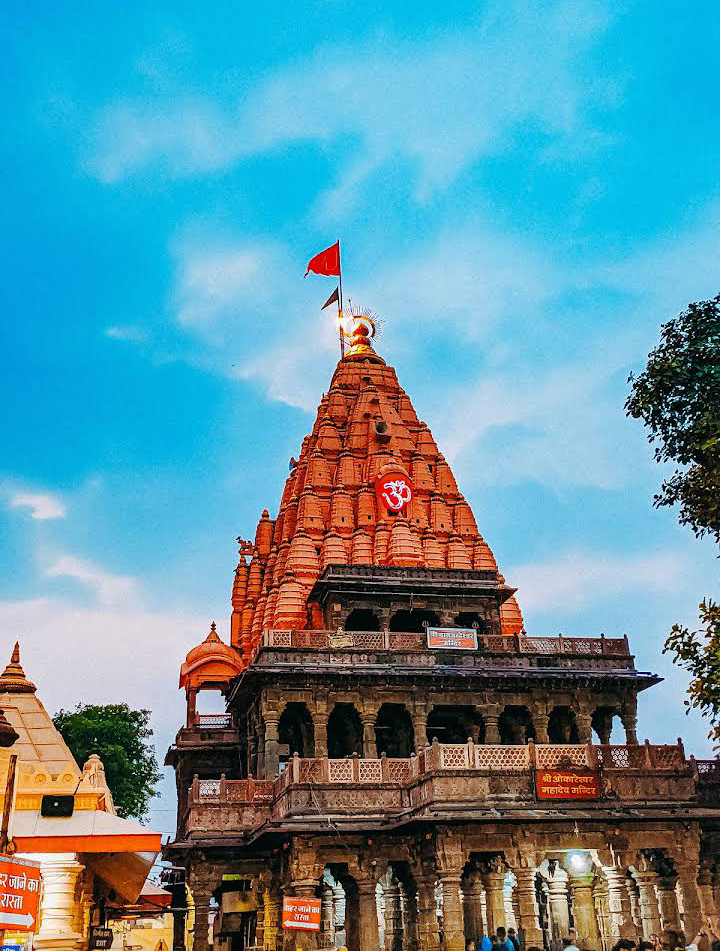
At four in the morning the queue outside the Mahakaleshwar temple in Ujjain is already long, and almost nobody in it is talking. Men in dhotis, women in sarees, no phones — phones are not allowed past the gate at all. The air smells of wet stone and camphor. Then the doors of the underground sanctum open, and the priests begin the one ritual performed nowhere else on earth: they take handfuls of sacred ash and press it over the whole surface of the Jyotirlinga until the stone is grey-white, and the Bhasma Aarti has begun.
Ash. Not milk, not flowers, not sandal paste first — ash. It is a startling thing to watch, and it tells you immediately what kind of shrine you have come to. Of the twelve Jyotirlingas, this is the one that does not pretend death is somewhere else.
Ujjain sits on the Malwa plateau in Madhya Pradesh, about 53 kilometres from Indore, and has been a city of consequence for some two and a half thousand years: capital of the Avanti kingdom, a viceroy’s seat under Ashoka, and — in the reckoning of classical Indian astronomy — the place the prime meridian runs through. The temple at its heart is where Shiva is worshipped as Mahakala: maha, great, and kala, which means both time and death.
Why Mahakaleshwar Is Unlike the Other Eleven
The twelve Jyotirlingas are the shrines where Shiva is held to have manifested not as an image but as a column of light. Mahakaleshwar comes third in the order of the Dwadasa Jyotirlinga Stotram, after Somnath and Mallikarjuna, and immediately before Omkareshwar. The stotram’s line for it is short and geographical:
उज्जयिन्यां महाकालं ओंकारममलेश्वरम्
Ujjayinyām Mahākālam-Omkāram-Amaleśvaram
“At Ujjayini resides the Mahakala; at Omkara is found the Amaleshwara.”
Two features set this shrine apart, both stated by the Ujjain district administration’s own page as well as by scholarly sources. First, the lingam is dakshinamukhi — south-facing — described as unique to Mahakaleshwar among the twelve and upheld by the tantric shivnetra tradition. South is Yama’s direction in Hindu cosmology, and devotional interpretation reads the orientation as Shiva facing death down rather than turning away from it; that gloss is tradition rather than text, though the orientation itself is a documented fact.
Second, the lingam is held to be swayambhu, self-manifested — understood to derive its shakti from within itself rather than receiving power through the consecration rite that establishes most images. There is an unusual liturgical consequence too: here, alone among the shrines, prasada offered to the deity is held to be re-offerable.
A Confusion Worth Clearing Up
You will frequently read that Mahakaleshwar is also one of the eighteen Maha Shakti Peethas. This looks like a conflation of two separate claims the city holds. Ujjain does have a Shakti Peetha — two shrines are in fact identified with one. Gadkalika temple on Bhairavparvat is named as the Avanti or Mahakali Peetha, where Sati’s upper lip fell; Harsiddhi temple, about 600 metres from Mahakaleshwar, is where her elbow fell. Mahakaleshwar itself is the Jyotirlinga. Sources genuinely differ, so the honest position is that Ujjain is a city of both a Jyotirlinga and a Shakti Peetha rather than a single shrine that is both.
The Stories, and Which Text They Come From
Two legends sit behind this shrine, and almost every retelling online merges them into one. They are in fact two adjacent chapters of the Shiva Purana, in the Koti Rudra Samhita, and they are different stories with different casts.
Chapter 16 opens in Avanti, “a beautiful city yielding liberation to all souls, a favourite of Shiva.” A virtuous Brahmin named Vedapriya lives there with four pious sons. A powerful demon king, Dushana, comes from the hill of Ratnamala and sets about destroying righteous practice, attacking the Brahmins at their worship. Shiva then rises from beneath a clay image, through a chasm he opens in the earth, in a form the text calls hideous, and destroys the demon with a sound. The verse that follows is the one the whole shrine rests on: “He became famous as Mahākāla, the slayer of the wicked and the goal of the good.” The Brahmins ask him to remain for their protection, and he does.
Chapter 17 is a different and gentler story. Ujjayini is under siege by rival kings, and its ruler, Chandrasena, is a devotee of Shiva. A young boy — the son of a cowherdess — watches the king’s worship and begins his own, using a pebble for a lingam, with complete concentration. Shiva transforms the boy’s makeshift shrine into a golden temple; the besieging kings abandon the attack. Then Hanuman appears, blesses the child, names him Shrikara, and makes a prophecy: in the eighth generation of his line a famous cowherd named Nanda will be born, and Vishnu himself will come as his son, Krishna. Both the king and the boy attain Shiva’s realm.
It is worth knowing what is not in either chapter. The widely circulated composite — a farmer’s boy called Shrikhar, a priest named Vridhi, invading kings Ripudamana and Singhaditya, and Dushana made invisible by a boon from Brahma — welds the two stories together and adds names found in neither. The boy is a cowherdess’s son, his name in the text is Shrikara, and the Dushana episode belongs to Chapter 16, where there is no Chandrasena. None of this makes the stories less beautiful. It just means they deserve to be told accurately.
A City That Keeps Time
Mahakaleshwar is not a shrine that happens to be in Ujjain. The two are the same claim.
Ujjain is one of the Sapta Puri, the seven cities the Garuda Purana names as givers of liberation — Ayodhya, Mathura, Haridwar, Kashi, Kanchi, Avantika and Dwarka. It is also one of the four Kumbh Mela sites, where drops of amrita are said to have fallen, sanctifying the Shipra river. Ujjain’s Kumbh is the Simhastha, held every twelve years when Jupiter enters Leo — Simha. The 2016 Simhastha drew something in the region of 75 million people; the next falls in 2028, though specific 2028 dates circulating online are planning-stage figures rather than officially notified ones.
And then there is the astronomy. The Surya Siddhanta places Ujjain at the intersection of the zero meridian and the Tropic of Cancer, which is why the city is sometimes called the Greenwich of India; Maharaja Jai Singh II built an observatory here in 1725, the Vedha Shala, with thirteen masonry instruments. Kalidasa, associated with the city by long tradition, refers in the Meghaduta to the Mahakala temple’s evening rituals and the music and dance performed within them. The emperor Vikramaditya, who gives his name to the Vikram Samvat era beginning in 57 BCE, belongs to Ujjain’s legend, though scholars debate how much of him is history.
So: a shrine to the lord of time, in the city that measured it. Not a coincidence anybody here would call accidental.
History: Five Centuries of Absence
In 1234–35 CE the temple complex was destroyed in Iltutmish’s raid on Ujjain, an event recorded in Minhaj-i-Siraj’s Tabaqat-i-Nasiri. The Jyotirlinga was dismantled and, by tradition, thrown into the Koti Tirtha tank beside the temple. Later attacks by the Khalji sultans are also reported, though without firm dates.
Reconstruction came in the Maratha period, and the two names you will see cited are not rivals. Ranoji Scindia, who established his seat at Ujjain in 1731, was the ruler and patron; his Diwan, Ramachandra Baba Shenvi Sukthankar, executed the work. Dating converges on the 1730s, with around 1734 most often given for completion, and Madhya Pradesh Tourism describing the present temple as built “during the fourth and fifth decades of the eighteenth century.” Treat 1734 as approximate. So the shrine spent something close to five centuries in ruins — which is worth holding in mind while standing in it.
Reading the Building
The architecture is a composite, not a single style: Bhumija, with Chalukya and Maratha elements layered over centuries of rebuilding. Descriptions of it as purely Bhumija are a simplification.
The structure has five levels, one of them underground, and the vertical stacking is the thing most worth understanding before you visit. The Mahakaleshwar lingam is in the lowest sanctum, lit by brass lamps; directly above it is a shrine to Omkareshwar Shiva; on the third level is Nagchandreshwar, which opens for worship on exactly one day of the year.
Nagchandreshwar opens on Nag Panchami, for a twenty-four-hour window from midnight to midnight, with the opening aarti performed by the Mahant of the Mahanirvani Akhada. The image inside is a rare stone sculpture dated to around 1050 CE, showing Shiva with Parvati and Ganesha seated beneath a ten-hooded serpent — unusual, since a ten-hooded serpent couch is conventionally Vishnu’s. Darshan here is sought above all by those carrying Kaal Sarp Dosh in their chart. Nag Panchami 2026 fell on 17 August; the next opening is expected on Nag Panchami in August 2027, worth confirming against a panchang if you plan around it.
Around the sanctum are images of Ganesha to the west, Parvati to the north, Kartikeya to the east and Nandi to the south, and within the premises is the Koti Tirtha tank, lined along its approach with sculptures from the older temple.
Since 2022 the approach has changed completely. The Shri Mahakal Lok corridor — phase one inaugurated on 11 October 2022, phase two in November 2023 — runs more than 900 metres around the revived Rudrasagar Lake, lined with 108 carved sandstone pillars and entered through the Nandi Dwar and Pinaki Dwar; the precinct expanded from roughly seven acres to around 116. Published figures for cost, statues and murals vary widely, so this article will not give you a single number. Nor is the project uncontroversial: in May 2023 six of the seven Saptarishi statues collapsed in high winds, prompting a political row and their replacement under the contract’s defect liability period.
The Bhasma Aarti, and the Thing Everyone Gets Wrong
The Bhasma Aarti is performed in the pre-dawn Brahma muhurta, reported as running from 4:00 to 6:00 AM, with Vedic recitation throughout. It is the reason most pilgrims come to Ujjain rather than to a Jyotirlinga closer to home.
It is also the subject of the single most repeated falsehood about the temple: that the ash applied to the lingam comes from cremation grounds. Here is where the record actually stands. Madhya Pradesh Tourism’s own page says the ash historically came from funeral pyres but now consists of ash prepared from cow dung. More decisively, the Supreme Court of India, in Sarika v. Administrator, Shri Mahakaleshwar Mandir Committee (2018), directed the temple to use only dry cow-dung ash, with pH testing before application — a conservation measure, because the offerings were eroding the stone.
So the cremation-ash association is a genuine part of this shrine’s Shaiva and tantric symbolism and may well reflect historical practice, but the ash used today is not cremation ash, and saying otherwise is both inaccurate and contrary to a court direction. The symbolism survives the correction intact: ash is what remains when everything burnable has burned, which is precisely the point being made about time.
Booking the Bhasma Aarti — Rules Changed in 2026
Most guides online are now out of date, so treat the following as a starting point and verify on the official portal, shrimahakaleshwar.com, before you travel. As reported in April 2026, the offline permit counter has been permanently closed; the 300 previously free offline permits became a paid online Tatkal quota at around ₹200 per person, opening at 8:00 AM one day ahead on a first-come basis; and the advance window was shortened from three months to one month. Registration requires photo ID and a photograph for every attendee, requests are not auto-confirmed, and you must carry the printed receipt with the original ID. Slots have been reported full months ahead.
Two warnings. Book only through the official portal — search results for “Bhasma Aarti booking” are saturated with third-party agent sites, and at least one prominent lookalike presents itself as official while listing obviously fake helpline numbers. And aim to be at the temple by around 3:00 to 3:30 AM.
The dress code for Bhasma Aarti is traditional Indian dress — a dhoti for men, a saree (some sources also permit a salwar suit) for women, with Western clothing not allowed. Shops near the temple entrance rent and sell the required clothing. The widely repeated specifics about men being bare-chested and wearing a safa appear in only one or two secondary sources and should be confirmed with the temple.
Planning a Visit
Getting there. Ujjain has no commercial airport of its own; fly to Devi Ahilyabai Holkar Airport at Indore, around 53 kilometres away by the Ujjain Division’s official figure. Ujjain Junction (station code UJN) is on the Western Railway and roughly 2 kilometres from the temple. By road, Bhopal is about 183 kilometres, Mumbai 655 and Delhi 774, with regular buses from Indore, Bhopal, Ratlam and Omkareshwar.
Timings. The temple is reported open from 4:00 AM to 11:00 PM, with six daily worship ceremonies — Bhasma Aarti before dawn, a morning naivedya aarti, a midday bhog aarti, evening pujan, the Sandhya Aarti and the Shayan Aarti at night. Published clock times for the middle and evening rituals differ between sources. These were checked in early October 2026 from secondary sources and will change — seasonally, during Shravan, on festivals, and radically during Simhastha. In the 2024 Shravan season the temple opened at 3:00 AM with the Monday Bhasma Aarti from 2:30 to 4:30 AM. Verify before you travel.
Fees. General moving darshan remains free. Fast-track or shighra darshan is reported at ₹250 per person, as is the new charge for seated darshan at the evening and night aartis. Garbhagriha jalabhishek, where available, is around ₹750 — but it is suspended through Shravan and Bhadrapada each year, with dates re-notified annually.
Phones. This one catches visitors out. Mobile phones are banned from the entire temple premises, not merely the sanctum, and must be deposited before entry. There are three deposit points: Manasrovar Bhavan, Gate No. 4 near Bada Ganpati, and Avantika Gate No. 1. The ban does not extend to the Mahakal Lok corridor outside the main temple. Photography inside is not permitted.
What you cannot do. If you have come expecting to pour panchamrit over the lingam yourself, read this first. Under Supreme Court directions of 2018 and 2020, devotees may not touch or rub the lingam, may not pour panchamrit, and may not rub curd, ghee or honey on it; only limited quantities of pure milk are accepted, and water is supplied treated by the temple. Full abhishek is performed by temple priests during the prescribed pujas. This is a court-mandated conservation regime protecting a stone worshipped for many centuries, not temple officiousness.
Practicalities. Budget four to five hours for darshan on an ordinary day, considerably more on Shravan Mondays, at Mahashivratri and during Nag Panchami. The cool, dry months from October to March are the easier season on the Malwa plateau. Laddu prasad is available, including from a vending machine installed in December 2024.
What People Come Here to Ask For
Every great shrine has a speciality, and Mahakaleshwar’s is the fear of death.
What is sought here is akaal mrityu nivaran — protection from untimely death — and, beyond that, the easing of the fear itself. The thematic companion is the Mahamrityunjaya Mantra, the great death-conquering verse, which is Rig Veda 7.59.12 and also appears in the Yajurveda:
त्र्यम्बकं यजामहे सुगन्धिं पुष्टिवर्धनम् ।
उर्वारुकमिव बन्धनान्मृत्योर्मुक्षीय मामृतात् ॥
tryambakaṃ yajāmahe sugandhiṃ puṣṭivardhanam | urvārukamiva bandhanān mṛtyor mukṣīya mā’mṛtāt ||
“We make offering to the three-eyed one, the fragrant, the increaser of prosperity. Like a ripe cucumber from its stem, may I be freed from death — not from deathlessness.”
That image deserves a moment. The verse does not ask to be spared death. It asks for a particular quality of release: the way ripe fruit comes away from the vine, with no tearing, because it is ready. A green fruit has to be pulled. That is what is being prayed against — not mortality, but the wrench.
Ujjain is also a well-known destination for astrological remediation. Kaal Sarp Dosh is addressed through Nagchandreshwar darshan; Mangal Dosh at the Mangalnath temple through a ritual called Bhaat Puja, said to be performed only there; and Rudrabhishek is widely offered by pandits across the city. One caution: almost every website advertising these is a commercial booking operation, not the temple. Arrange a ritual through the temple or a priest you have a connection to.
Where Else to Go in Ujjain
Mahakaleshwar is a day; Ujjain is three.
Harsiddhi Temple, about 600 metres away, is the Shakti Peetha where Sati’s elbow is held to have fallen, with a Sri Yantra in the sanctum and two tall deep stambhs carrying 726 lamp holders, lit together during Navratri.
Kal Bhairav Temple, in Bhairavgarh on the Shipra, is mentioned in the Avanti Khanda of the Skanda Purana and is where Ujjain’s most startling ritual survives: liquor is offered to the deity, the last remaining element of the tantric panchamakara of the Kapalika and Aghora traditions for which Ujjain was once a centre, with about a third of the bottle returned as prasad. Kal Bhairav is the city’s kotwal, its guardian — which is why the temple keys are not taken off the premises at night.
Mangalnath Temple is regarded in the Matsya Purana as the birthplace of Mars, and sits where the meridian passes. Gadkalika, on Bhairavparvat, is the Avanti Shakti Peetha, linked to Kalidasa’s receiving of divine grace. Ram Ghat, the oldest bathing ghat on the Shipra, has an evening aarti around 8:00 PM. Gopal Mandir, in the Big Market Square, holds a silver-coated marble Krishna and is the venue of Harihar Milan — the meeting of Hari and Har on Vaikunth Chaturdashi, when Mahakal hands the burden of the universe to Vishnu and departs for Kailash. Also worth your time: Sandipani Ashram, where Krishna, Balarama and Sudama are held to have studied; Chintaman Ganesh, with its swayambhu Ganesha and Paramara-period pillars; and the Vedha Shala.
If You Can Choose Your Dates
During Shravan and Bhadrapada, Mahakal goes out on Mondays in the Sawari — a palanquin procession through the city, the deity appearing each week in a different form, the police rendering a ceremonial salute, the route running from the temple’s sabha mandap through Gudri Chauraha and Bakshi Bazaar to Ram Ghat. The season’s final and largest is the Shahi Sawari, the royal procession.
Ujjain also keeps Shiv Navratri — nine days before Mahashivratri, framed as Mahakal’s wedding, with a different shringar each day, from Chandan and Sheshnag through to Shiv Tandav and Saptadhan. Mahashivratri itself brings a fair and worship through the night, with a grand midnight rite; in 2027 it is expected on 6 March.
Why a Temple of Death Is Not a Morbid Place
It would be easy to describe Mahakaleshwar as grim. It is the opposite. The pilgrims coming out of the sanctum at six in the morning look lighter than the ones going in.
Most of the strategies we use to manage the fear of dying work by looking away — we stay busy, keep the subject off the table, treat mortality as somebody else’s news. The theology of this shrine does the reverse. It puts the lingam underground and faces it south, towards Yama. It opens the day with ash, the residue of combustion, and makes that the first offering rather than the last. It worships time itself as the deity rather than as the enemy.
The effect is strangely practical: a fear faced is smaller than a fear deferred. The Mahamrityunjaya verse makes the same move, bargaining not for exemption from death but for arriving at it ripe. That is a prayer about how to live, dressed as a prayer about how to die. You do not need to be in Ujjain to take the point — but it is a very good place to be reminded of it.
Frequently Asked Questions
Why is Mahakaleshwar called a dakshinamukhi Jyotirlinga?
Because the lingam faces south, which the Ujjain district administration and other sources describe as unique among the twelve Jyotirlingas and as upheld by the tantric shivnetra tradition. South is Yama’s direction in Hindu cosmology, and devotional interpretation reads the orientation as Shiva presiding over death rather than turning from it — though that explanation is tradition rather than textual citation.
Is cremation ash used in the Mahakal Bhasma Aarti?
Not today. Madhya Pradesh Tourism states the ash historically came from funeral pyres but now consists of ash prepared from cow dung, and a 2018 Supreme Court direction requires only dry cow-dung ash with pH testing, to prevent erosion of the lingam. Temple priests describe it as prepared from cow-dung cakes with shami, peepal, palash, bel and amaltas wood.
How do I book the Bhasma Aarti at Mahakaleshwar?
Only through the official portal, shrimahakaleshwar.com. As reported in April 2026, the offline counter is permanently closed, the advance window is one month, and a paid Tatkal quota of around ₹200 per person opens at 8:00 AM the day before. You will need photo ID and a photograph for each attendee. Avoid the many third-party agent sites, and verify the rules directly, since they changed recently.
What is the dress code at the Mahakaleshwar temple?
For the Bhasma Aarti, traditional Indian dress is required — a dhoti for men and a saree (some sources also permit a salwar suit) for women, with Western clothing not permitted; clothing can be bought or rented near the entrance. Modest traditional dress is expected in the sanctum generally. Some further specifics circulating online are weakly sourced and worth confirming with the temple.
Can devotees perform abhishek on the Mahakaleshwar lingam?
Not directly. Under Supreme Court directions of 2018 and 2020, devotees may not touch or rub the lingam, pour panchamrit, or rub curd, ghee or honey on it; only limited quantities of pure milk are accepted, and water is supplied treated by the temple. Priests perform the full abhishek during the prescribed ceremonies. Paid garbhagriha jalabhishek exists when available but is suspended through Shravan and Bhadrapada.
How many days do I need in Ujjain?
One long day covers Mahakaleshwar with an unhurried darshan and the Mahakal Lok corridor. Two to three days let you add Harsiddhi, Kal Bhairav, Mangalnath, Ram Ghat, Gopal Mandir and the Vedha Shala — and, if you want it, a day trip to the Omkareshwar Jyotirlinga about 140 kilometres south.
A Note Before You Go
Timings, fees, booking rules and access at Mahakaleshwar have changed more than once in recent years, some as recently as April 2026. Everything above was checked in early October 2026, in several cases from reputable secondary sources rather than the temple’s own pages — so please confirm the details that matter to your trip against the official site before booking anything.
And when you are standing in that queue at four in the morning with your phone in a locker and nothing in your hands, the inconvenience is part of what you came for. You arrive at the lord of time with no way to check the time. That is probably the correct posture.
Continue Exploring
- Kashi and Its Significance for Hinduism
- What the Bhagavad Gita Teaches Us About Death
- The Shiva Trilogy: Key Highlights and Takeaways
- Lord Hanuman FAQs
- Parashurama: The Eternal Warrior Sage of Sanatan Dharma