
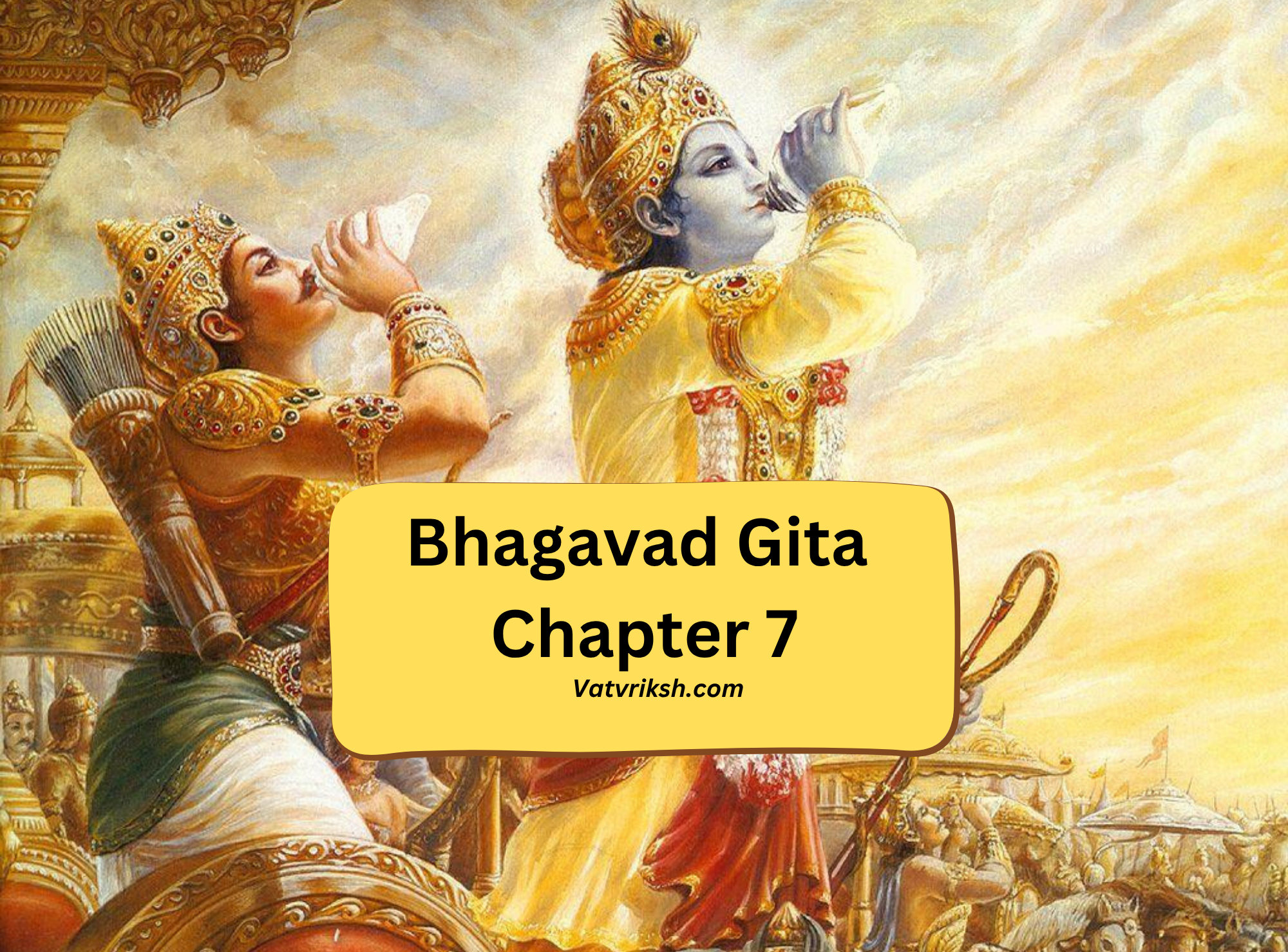
There’s a particular kind of knowledge that changes how a person sees everything, not just one part of life. Not information you memorize, but understanding that reorganizes your entire relationship to the world — to other people, to hardship, to the ground you stand on. This is the kind of knowledge Krishna promises Arjuna at the opening of Chapter 7 of the Bhagavad Gita: complete knowledge, he says, after which there remains nothing more to know.
That’s a bold claim, and Krishna makes it deliberately. Having spent the first six chapters establishing the philosophy of selfless action, the unity of renunciation and engagement, and the practical discipline of meditation, Krishna now shifts into a new phase of the teaching. Chapter 7, known as Jnana Vijnana Yoga — “The Yoga of Knowledge and Wisdom” — begins the Gita’s deeper exploration of Krishna’s own divine nature, and marks the point where the text’s devotional (bhakti) dimension starts to take clear shape.
A New Kind of Teaching Begins
The first six chapters of the Gita can be read, in some ways, as a complete unit — establishing the eternal self, selfless action, and meditative discipline. Chapter 7 opens a new section of the text, often described by commentators as beginning the Gita’s more explicitly theological and devotional teachings.
Krishna tells Arjuna directly: listen now how, with a mind attached to me, practicing yoga and taking refuge in me, you shall know me completely, without any doubt. This isn’t merely an invitation — it’s a promise of comprehensive understanding, framed as something attainable through a combination of devoted attention (bhakti) and disciplined practice (yoga).
The Story Narrative
Both the Manifest and the Knowable
Krishna begins by promising to explain both jnana (knowledge) and vijnana (realized, experiential wisdom or applied knowledge) in full, after which nothing further remains to be known in this world. This distinction between jnana and vijnana is worth pausing on: jnana often refers to theoretical or conceptual understanding, while vijnana points to direct, lived realization of that same truth — the difference between knowing about something and truly knowing it through experience.
Krishna adds a humbling observation here: among thousands of people, perhaps only one strives for perfection; and even among those who strive and succeed, perhaps only one truly knows him in essence. This isn’t meant to discourage Arjuna, but rather to underscore the rarity and preciousness of the understanding Krishna is about to share.
The Eightfold Lower Nature and the Higher Self
Krishna then describes his own nature (prakriti) as divided into two categories. His lower, or material, nature (apara prakriti) consists of eight components: earth, water, fire, air, ether (space), mind, intellect, and ego (sense of individual selfhood). This eightfold division represents, in essence, the basic building blocks of the manifest material universe, including the subtle instruments of individual perception and thought.
But beyond this lower nature, Krishna says, is another, higher nature (para prakriti) — the very life-force or consciousness by which this entire universe is sustained. All beings, Krishna explains, have their source in this higher nature; he describes himself as the origin and the dissolution of the entire universe, adding that there is nothing higher than himself, and that everything in existence is strung upon him “like clusters of gems on a thread.”
Why It Matters: This teaching offers a coherent metaphysical picture that resolves what could otherwise feel like scattered, disconnected claims across the Gita. It positions Krishna not simply as a wise teacher or even as one deity among many, but as the very ground of both matter and consciousness — the substance underlying the entire manifest and unmanifest universe.
Krishna Present in the Essential Qualities of All Things
One of the most beautiful and frequently quoted sections of Chapter 7 follows, in which Krishna describes his presence within the essential, defining qualities of ordinary things. He is the taste in water, he says, the light in the sun and moon, the sacred syllable Om in all the Vedas, the sound in ether, and the manhood in men. He is the pure fragrance in the earth, the brilliance in fire, the life in all living beings, and the austerity in ascetics.
He continues: he is the eternal seed of all beings, the intelligence of the intelligent, and the splendor of the splendid. In strong men, he is strength free from desire and attachment; and in all beings, he is desire that is not contrary to righteousness (dharma).
This passage functions almost like a devotional hymn nested within the philosophical dialogue. Rather than describing Krishna as separate from the world, looking down upon it, these verses locate the divine within the most essential, defining quality of each thing described — suggesting an intimate, immanent presence rather than a distant, external one.
The Three Gunas Originate From Him, Yet He Transcends Them
Krishna clarifies an important point here: all states of being — whether characterized by sattva (purity, clarity), rajas (passion, activity), or tamas (inertia, dullness) — originate from him, yet he himself is not contained or bound within them; rather, they exist within him.
He adds that the entire world is deluded by these three qualities born of material nature, and therefore fails to recognize him, who is imperishable and beyond these very qualities. This divine illusion (maya), composed of the three gunas, is described as extremely difficult to overcome — but Krishna adds an important qualifier: those who take refuge in him alone are able to cross beyond this illusion.
Four Kinds of People Who Turn Toward the Divine
Krishna then offers a memorable, practical classification of people who turn toward him in devotion, describing four types, all virtuous in their own way: the distressed (arta), those seeking material gain or knowledge (artharthi), the curious seeker (jijnasu), and the one established in wisdom (jnani).
Of these four, Krishna says, the wise one — who is constantly united with him in single-minded devotion — is the most excellent, because Krishna is exceedingly dear to such a person, and such a person is exceedingly dear to Krishna in return. All four types are described as noble, Krishna adds, but the wise one is regarded as Krishna’s very self, since such a person, with a firmly settled mind, has taken exclusive refuge in him as the highest goal.
Why It Matters: This teaching is notably generous and inclusive. Rather than dismissing those who turn to the divine out of personal crisis or material need as somehow less legitimate, Krishna affirms all four motivations as genuine and worthy, while pointing toward wisdom-based devotion as the most complete and mature expression of this same underlying impulse.
The Rarity of True Recognition
Krishna acknowledges something significant here: after many births, the one who is truly wise finally comes to him, recognizing that “Vasudeva” — Krishna himself — is all that exists. Such a great soul (mahatma), Krishna says, is exceedingly rare to find.
He contrasts this with those whose discernment has been carried away by various desires, who turn instead to other deities, adopting various rites and disciplines according to their own nature. Krishna adds an important, ecumenical clarification here: whatever form a devotee seeks to worship with faith, he himself makes that very faith steady and unwavering — suggesting a broad, accommodating theological stance toward the diversity of devotional practice, even while maintaining that the deepest, most complete recognition ultimately points toward himself as the singular, underlying reality behind all such worship.
Why the World Fails to Recognize the Unborn, Imperishable Self
The chapter closes with an explanation for why so many fail to recognize Krishna’s true, imperishable nature. He states that he is not manifest to everyone, being veiled by his own yoga-maya (divine creative power) — and so the deluded world fails to recognize him as unborn and imperishable.
He adds that he knows all beings — past, present, and future — but no one truly knows him in this complete sense. This is attributed to a fundamental delusion arising from desire and aversion, expressed through the pairs of opposites (dvandva) discussed in earlier chapters, which causes all beings to fall into confusion at the very moment of their birth into this world.
Krishna offers a note of hope to close the chapter, however: those whose sins have come to an end through righteous action, who are freed from the delusion of these dualities, worship him with firm resolve. Those who take refuge in him, striving for liberation from old age and death, come to know Brahman completely — including the nature of the individual self (adhyatma) and the entirety of action (karma). And those who know him along with the governing principle behind the manifest universe, the principle behind the offering of divine beings, and the principle of sacrifice itself, retain this understanding even at the critical hour of death, with minds fully absorbed in him.
Deeper Philosophical Meaning
Chapter 7 marks a significant turning point in the Gita’s structure, weaving together several major threads introduced across the previous chapters into a more unified metaphysical and devotional picture.
A comprehensive metaphysics: The distinction between Krishna’s lower nature (the eightfold material world) and higher nature (the animating consciousness sustaining that material world) provides a systematic framework for understanding how the manifest universe relates to its underlying source — bridging the philosophical material of earlier chapters with the increasingly devotional material of the chapters ahead.
Divine immanence: The description of Krishna as present within the essential quality of ordinary things — taste, light, fragrance, intelligence — reflects a theological vision in which the sacred is not confined to temples or rituals alone, but is woven into the basic fabric of everyday experience.
Inclusive theology: The teaching on the four types of devotees, along with Krishna’s acknowledgment that he strengthens the faith of those who worship other deities and forms, reflects a notably accommodating and non-exclusive theological stance — one that has shaped much of the broader Hindu tradition’s openness to diverse devotional and philosophical paths.
What This Chapter Means for Life Today
Ordinary experience can become a doorway to something larger. Krishna’s description of himself as the taste in water, the light in the sun, and the fragrance of the earth offers a way of relating to daily experience that doesn’t require dramatic mystical events — suggesting instead that a sense of the sacred can be found by paying closer, more appreciative attention to the ordinary qualities of everyday life.
All sincere motivations for seeking meaning deserve respect. The teaching on the four types of devotees — the distressed, the seeker of gain, the curious, and the wise — offers a generous, non-judgmental way of understanding why people turn to spirituality, philosophy, or faith. Whether someone arrives at a spiritual practice through crisis, ambition, curiosity, or genuine wisdom, Chapter 7 suggests each starting point is legitimate, even if they represent different stages of the same underlying journey.
Confusion and delusion are described as natural, not shameful. Krishna’s explanation that the pairs of opposites — desire and aversion — create confusion “from the very moment of birth” normalizes the difficulty of seeing clearly. This isn’t a teaching that shames people for their confusion, but one that identifies its cause and offers a path beyond it through sustained, sincere practice.
True understanding takes patience across a long arc of growth. The acknowledgment that a truly wise soul, recognizing the complete truth, is found only “after many births” resists the modern impulse toward instant transformation or quick spiritual fixes, instead framing deep understanding as the fruit of sustained effort over a much longer arc than a single moment of insight.
Frequently Asked Questions
What is the main teaching of Bhagavad Gita Chapter 7? Chapter 7 introduces Krishna’s comprehensive metaphysics, describing his lower material nature and higher conscious nature, explaining his presence within the essential qualities of ordinary things, and outlining four types of people who turn toward devotion.
What is the difference between jnana and vijnana in this chapter? Jnana generally refers to conceptual or theoretical knowledge, while vijnana refers to realized, experiential wisdom — direct, lived understanding of that same truth, rather than merely intellectual comprehension of it.
What are the eight elements of Krishna’s lower nature? Krishna describes his lower, material nature (apara prakriti) as composed of earth, water, fire, air, ether (space), mind, intellect, and ego — representing the fundamental building blocks of the manifest material universe.
Who are the four types of devotees described in Bhagavad Gita Chapter 7? Krishna describes the distressed (arta), those seeking material gain or knowledge (artharthi), the curious seeker (jijnasu), and the one established in wisdom (jnani) — all considered virtuous, with the wisdom-based devotee regarded as the most complete expression of devotion.
Why does Krishna say people fail to recognize his true nature? Krishna explains that he is veiled by his own divine creative power (yoga-maya), and that confusion arising from desire and aversion (the pairs of opposites) causes beings to fall into delusion from the very moment of their birth, obscuring recognition of his unborn, imperishable nature.
How many verses are in Bhagavad Gita Chapter 7? Chapter 7 contains 30 verses, and it marks the beginning of the Gita’s deeper exploration of Krishna’s divine nature, setting the stage for the even more expansive teachings found in Chapters 9 through 11.
Chapter 7 marks a quiet but decisive shift in the Bhagavad Gita — from a teaching primarily concerned with right action and inner discipline, to one that begins revealing the vast, intimate presence underlying all of existence. Krishna’s promise of complete knowledge at this chapter’s opening is not fulfilled all at once; it unfolds gradually, deepening with each chapter that follows, as the Gita moves toward its most awe-inspiring revelations.