For nine nights each autumn, something shifts across India. In Kolkata, entire neighbourhoods build temporary temples out of bamboo and cloth, and clay artisans in Kumartuli finish idols they began moulding in monsoon. In Ahmedabad, tens of thousands of people move in slow concentric circles until three in the morning. In Chennai, families arrange dolls on tiered wooden steps and invite the neighbours to come and look. In Varanasi, pilgrims walk a nine-temple circuit, one temple for each night.
None of these look much like each other. Yet all of them are Navratri, and all of them are doing the same thing: turning toward the Divine Mother for nine nights, and then letting her go on the tenth.
This is a guide to what those nine nights actually mean — the Sanskrit behind the name, the scripture the festival rests on, why the number nine, and why a celebration this old still holds so much energy. Whether you grew up with Navratri and never quite asked what it was for, or you are meeting it for the first time, the answer is richer than most short explanations allow.
What Navratri Means
The word is a compound of two Sanskrit terms: nava, meaning nine, and ratri, meaning night. Nine nights. The tenth day that follows is a separate observance with its own name — Vijayadashami, the tenth day of victory, more widely known as Dussehra.
The choice of nights rather than days is not incidental. In the Hindu reckoning, night is when the ordinary world quietens and the subtle becomes accessible. Devotional traditions hold that the Mother’s grace is unusually available during these nights — that practice done now carries further than practice done at other times. Whether one takes that literally or as a description of what sustained attention does to a person, the effect is the same: for nine nights, devotees give the practice more than they usually would.
There Is More Than One Navratri
Most people mean one specific festival when they say Navratri, but the Hindu calendar actually contains four:
- Sharad Navratri (also Shardiya or Maha Navratri) — in the month of Ashwin, September or October. This is the largest and the one meant when the word is used alone.
- Chaitra Navratri (also Vasant Navratri) — in spring, March or April, ending in Rama Navami.
- Two Gupt Navratris — in the months of Magha and Ashadha. Gupt means hidden; these are observed largely by tantric practitioners and serious sadhaks rather than the general public.
Sharad Navratri begins on the first day (Pratipada) of the bright fortnight of Ashwin. It arrives immediately after Pitru Paksha, the fortnight devoted to ancestors. The sequence is deliberate and worth noticing: the family settles its debt to those who came before, and only then turns to the Mother.
Navratri 2026: Dates
Sharad Navratri 2026 begins on Sunday, 11 October 2026 with Ghatasthapana and runs through Monday, 19 October. Vijayadashami (Dussehra) falls on Tuesday, 20 October 2026.
A note on the tithis this year, because 2026 is slightly unusual: the Saptami tithi stretches across both 17 and 18 October, and Ashtami and Navami overlap on 19 October, with Ashtami ending mid-morning. This means Kanya Pujan may fall on 18 or 19 October depending on your family’s tradition and your local panchang. Navratri follows lunar tithis rather than civil dates, so timings shift by city. Always confirm against a panchang calculated for where you actually are.
For the full ritual sequence — the Ghatasthapana muhurat, samagri list and daily puja — see our complete guide to celebrating Navratri at home.
The Story the Festival Rests On
The scriptural foundation of Navratri is the Devi Mahatmya — also called the Durga Saptashati or Chandi Path — a text of seven hundred verses embedded within the Markandeya Purana. It is one of the earliest surviving texts to treat the Goddess not as a consort or an aspect of a male deity, but as the supreme reality herself. That was a significant theological move, and the text has been recited during Navratri for well over a thousand years.
The Devi Mahatmya contains three episodes, and the middle one is the story most associated with these nine nights.
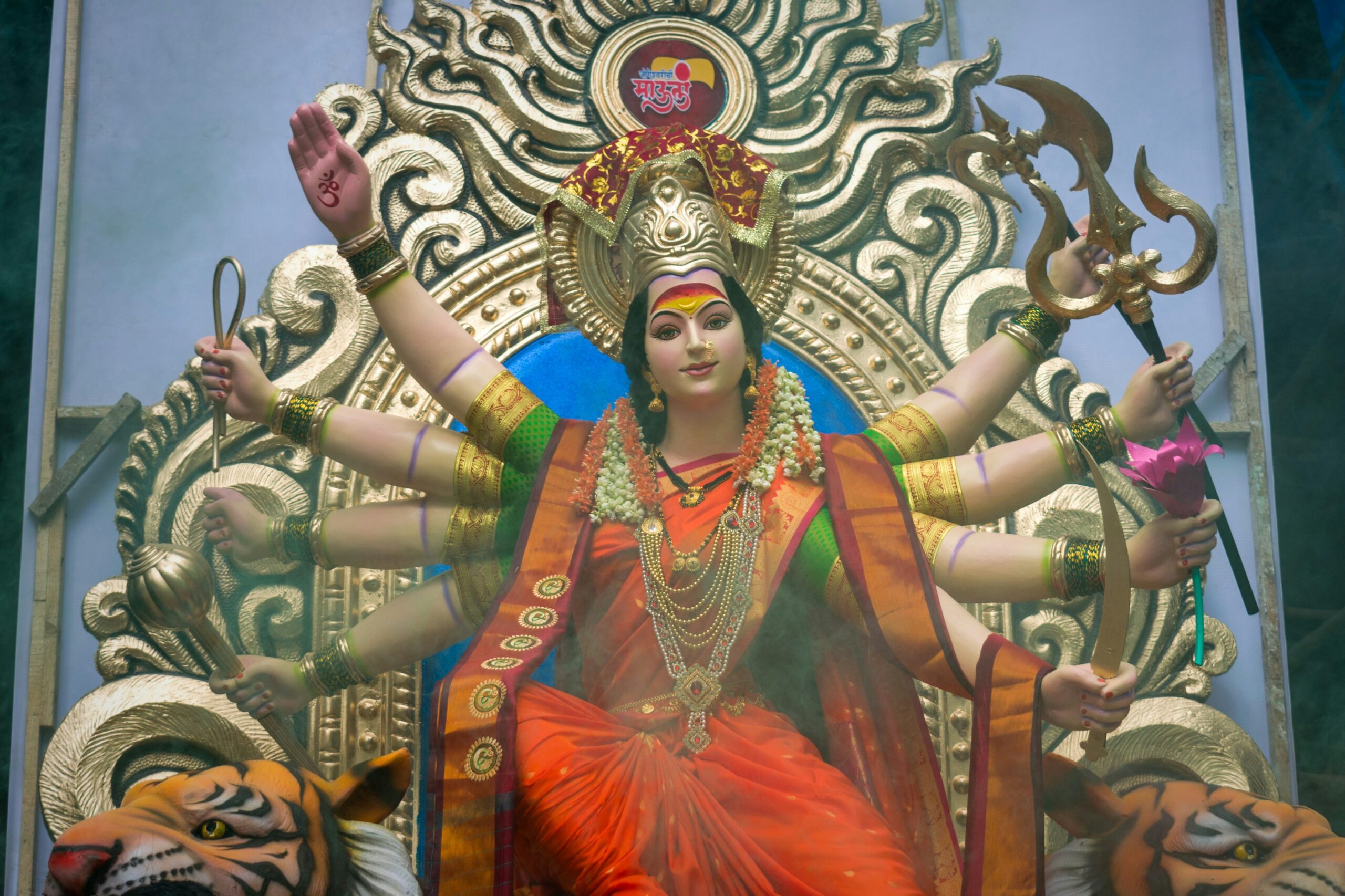
A buffalo-demon named Mahishasura had won a boon: no man and no god could kill him. Confident in the loophole, he overran the heavens and drove the gods out. Unable to defeat him themselves, and blocked by the precise terms of his own protection, the gods did something none of them could have done alone. Each released his accumulated energy — his tejas — and the combined radiance took form as a woman. Shiva’s light became her face, Vishnu’s her arms, Agni’s her eyes. Each god gave her his weapon. Himavan gave her a lion.
Mahishasura, seeing her, offered marriage. She declined. The battle that followed ran nine days and nine nights, and Mahishasura fought it by shifting shape — buffalo, then lion, then man, then elephant, then buffalo again, never holding one form long enough to be finished. On the tenth day, she pinned him mid-transformation and ended it.
The nine nights of the festival are those nine nights of battle. The tenth day is the victory.
Why Nine? The Navadurga
Each of the nine nights is dedicated to one of the Navadurga, the nine forms of the Goddess, worshipped in a fixed order:
- Shailaputri — daughter of the mountain
- Brahmacharini — the one who practises austerity
- Chandraghanta — she who wears the crescent shaped like a bell
- Kushmanda — she whose smile produced the cosmic egg
- Skandamata — mother of Skanda
- Katyayani — the warrior form, daughter of the sage Katyayana
- Kalaratri — the dark night, the fiercest form
- Mahagauri — the luminous white
- Siddhidatri — the giver of attainment
Read in sequence, these are not nine unrelated goddesses. They form an arc — from grounded strength through discipline, beauty, creative power, nurture, and ferocity, into radiance and finally completion. Many teachers map this arc onto the reader’s own interior progress across the nine nights, which is why the order is never rearranged. Each form has her own story, iconography and mantra, covered in detail in our guide to the nine forms of Durga.
The Three-Fold Reading: Durga, Lakshmi, Saraswati
A widely held traditional interpretation divides the nine nights into three sets of three, each addressed to a different aspect of the Divine Feminine.
The first three nights belong to Durga in her fierce aspect. This is the destructive phase — not destruction for its own sake, but the burning away of what obstructs: old resentments, bad habits, inherited fear. Nothing new can be built on a cluttered site.
The middle three nights belong to Lakshmi. Having cleared the ground, the devotee asks for wealth — but the tradition is careful about what kind. Lakshmi’s abundance includes patience, generosity, steadiness, and the capacity for devotion. Material prosperity is real and not disparaged, but it is one item on a longer list.
The final three nights belong to Saraswati. Purified and enriched, the devotee now seeks knowledge — not information, but jnana, the discriminating wisdom that distinguishes the real from the merely apparent. This is why the South Indian tradition places Saraswati Puja and Vidyarambham, the beginning of learning, at this end of the festival.
The logic is elegant: clear, then fill, then illuminate. It is a fair description of any serious inner work.
One Festival, Many Celebrations
India is not monolithic, and Navratri may be the clearest proof of it. The same nine nights produce genuinely different festivals in different places.
Bengal and the East: Durga Puja
In West Bengal, Assam, Odisha and Bengali communities worldwide, the last five days become Durga Puja — arguably the grandest Hindu festival anywhere. Clay idols of Durga slaying Mahishasura, flanked by Lakshmi, Saraswati, Ganesha and Kartikeya, are installed in elaborate community pandals. The most charged moment is Sandhi Puja, performed at the exact junction of Ashtami and Navami. On Vijayadashami, married women smear each other with vermilion in Sindoor Khela, and the idols are carried to the river for immersion. Kolkata’s Durga Puja was inscribed on UNESCO’s Representative List of the Intangible Cultural Heritage of Humanity in 2021.
Gujarat and the West: Garba and Dandiya
In Gujarat, the nights belong to dance. Garba is performed in concentric circles around a perforated earthen lamp — the garbo, a womb-lamp holding a flame, one of the most direct symbols of the Goddess as source. Dandiya Raas, danced in pairs with sticks, is often read as a stylised enactment of the battle with Mahishasura. Garba was added to UNESCO’s Intangible Cultural Heritage list in 2023.
The South: Golu, Ayudha Puja, Vidyarambham
In Tamil Nadu, Karnataka and Andhra Pradesh, families arrange Golu or Bommai Kolu — dolls and figurines set on an odd number of tiered steps, depicting deities, epics, and increasingly everyday life. Neighbours visit, and women and children are sent home with gifts. Ayudha Puja honours the tools of one’s livelihood: instruments, books, machinery, vehicles are cleaned, garlanded and left unused for a day. Vidyarambham, on Vijayadashami, is when small children are guided to write their first letters. Mysore Dasara, with its caparisoned elephants and illuminated palace, is the state festival of Karnataka.
The North: Ramlila and Kanya Pujan
Across North India the emphasis shifts from Durga’s victory to Rama’s. Ramlila troupes perform the Ramayana over the nine nights, culminating in the burning of towering effigies of Ravana, Meghnad and Kumbhakarna on Dussehra evening. On Ashtami or Navami, households perform Kanya Pujan — inviting nine young girls, washing their feet, feeding them, and honouring them as living forms of the Navadurga.
The Fast and What It Is For
Many devotees keep a vrat through the nine days. Practice varies widely — some fast entirely on the first and last days, some eat one sattvic meal daily, some abstain only from grains.
Where a fast is kept, ordinary rice and wheat are traditionally set aside, along with onion, garlic, and regular table salt. In their place: samak rice (barnyard millet), kuttu (buckwheat) flour, singhara (water chestnut) flour, rajgira (amaranth), and sendha namak, rock salt. Fruit, milk and yoghurt are permitted.
There is a practical reading here as well as a devotional one. Sharad Navratri sits at the seasonal hinge between monsoon and winter, a period when digestion is traditionally considered weak and the body vulnerable. A lighter, simpler diet at exactly this point is sound seasonal sense. But the deeper purpose is not dietary. Fasting removes a layer of automatic comfort, and in its absence attention becomes available for something else. That is the point.
Why Navratri Still Matters
It is easy to reduce Navratri to garba nights and new clothes. The festival will survive that reduction — it always has. But the nine nights are offering something more specific, and it is worth naming plainly.
Navratri proposes that strength is feminine. Not gentleness, not endurance, not the softer virtues a patriarchal culture is willing to concede to women — actual martial power. The gods could not defeat Mahishasura. She could. In a world still arguing about what women are capable of, a tradition that has spent centuries answering the question is worth attending to.
It proposes that transformation takes time and has stages. Nine nights, in a fixed order, clearing before filling and filling before illuminating. There is no shortcut offered anywhere in the structure. Anyone who has genuinely tried to change something in themselves recognises the shape of that.
And it proposes that the obstacle keeps changing form. Mahishasura’s real weapon was not strength but shape-shifting — he became whatever would not be defeated by the last attack. Most of what we struggle with behaves the same way. The habit that leaves returns as a different habit; the anxiety that resolves reappears wearing a new subject. The Goddess did not win by hitting harder. She won by staying present through nine nights of transformation until the form could no longer shift.
That is a strategy, not just a story.
Frequently Asked Questions
What is the significance of Navratri in Hinduism?
Navratri celebrates the Divine Feminine — Shakti — across nine nights, each dedicated to one of the nine forms of Durga. It commemorates the Goddess’s nine-night battle with the buffalo-demon Mahishasura, culminating in her victory on the tenth day. Beyond the mythology, it is understood as a structured period of inner purification: clearing obstacles, cultivating virtue, and seeking wisdom.
Why is Navratri celebrated for nine nights?
The nine nights correspond to the nine nights of Durga’s battle with Mahishasura as narrated in the Devi Mahatmya. Each night is also dedicated to one of the Navadurga, the nine forms of the Goddess, worshipped in a fixed sequence that traces a progression from grounded strength to spiritual completion.
What is the difference between Navratri and Durga Puja?
They overlap rather than compete. Navratri is the pan-Indian nine-night observance. Durga Puja is the specifically Bengali form, concentrated in the final five days, centred on community pandals, elaborate clay idols, Sandhi Puja, and immersion on Vijayadashami. A Bengali family and a Gujarati family are observing the same festival in genuinely different ways.
Can non-Hindus observe or attend Navratri?
Yes. Durga Puja pandals are open to all, and garba grounds actively welcome newcomers. Basic courtesy applies as it would at any place of worship: dress modestly, remove footwear where others do, ask before photographing the deity, and follow the lead of those around you.
What is Ghatasthapana and why does it matter?
Ghatasthapana, or Kalash Sthapana, is the ritual that opens Navratri — a water-filled pot is installed as the seat of the Goddess, usually alongside barley seeds sown in soil, which sprout over the nine days as a living sign of her presence. It must be performed during the Pratipada tithi, ideally in the morning window and avoiding Rahu Kaal. Timings vary by city.
On the tenth day, after nine nights of building and worship and attention, Bengal carries its idols to the water and lets them dissolve. The clay returns to the river it came from.
This is not an afterthought to the festival. It is the last teaching in it. The Mother is welcomed, honoured completely, and released — and the release is done with music and vermilion and open weeping, not with reluctance. What was made of earth goes back to earth. What was invoked does not need to be held onto.
Nine nights of gathering, and then the letting go. May these nine nights bring you what you need to clear, what you need to gain, and the light to see the difference.
Continue Exploring
- The Nine Forms of Durga: Navadurga Explained, Day by Day
- How to Celebrate Navratri at Home: Ghatasthapana, Puja Vidhi and Fasting
- Introduction to the Ramayana — Story, Characters, and Meaning
- Seven Kandas of the Ramayana Explained
- Why We Celebrate Holika Dahan
- Kashi and Its Significance for Hinduism