
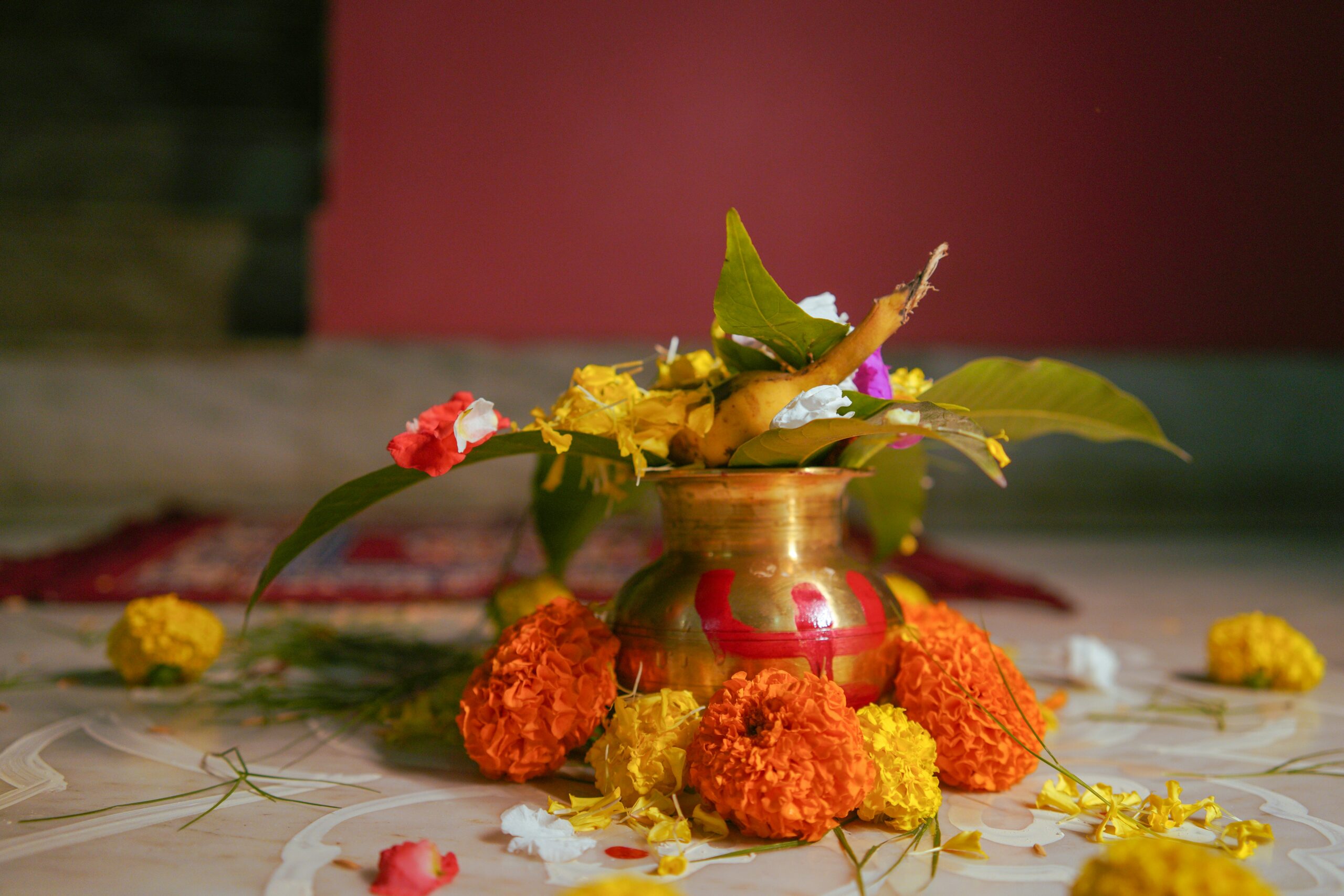
There is a particular smell to the first morning of Navratri in a house that observes it — wet earth in a clay pot, ghee warming in a lamp, marigolds that were bought the evening before and left in a bucket of water overnight. Long before anyone explains the theology to you, you know something has begun.
What often goes unexplained is the how. Plenty of us grew up watching a parent or grandparent set the kalash, and absorbed the sequence by osmosis without ever being told why the coconut faces a particular way or what the barley is for. Then you move cities, or countries, and find yourself wanting to keep the practice with nobody nearby to ask.
This guide is written for exactly that situation. It covers what to do, in what order, and — where a reason exists — why. It also deals honestly with the parts that are hard in a modern flat: no open flames allowed, no clay pots available, a puja muhurat calculated for a city eight time zones away. None of those are reasons not to observe Navratri. They are just reasons to adapt it thoughtfully.
Before You Begin: The 2026 Dates
Sharad Navratri 2026 runs from Sunday, 11 October to Monday, 19 October, with Vijayadashami on Tuesday, 20 October.
Ghatasthapana — the ritual that opens the festival — must be performed on 11 October during the Pratipada tithi. For Delhi, the morning window runs roughly 6:19 AM to 10:12 AM, with Abhijit Muhurat around 11:44 AM to 12:31 PM as the traditional fallback if the morning is missed.
One point that matters enormously and is almost never stated clearly: muhurat timings are calculated from local sunrise. If you are in New Jersey, London or Melbourne, the Delhi window is not your window. Use a panchang set to your own city. Many devotees abroad mistakenly follow IST timings and end up performing Ghatasthapana in the middle of their own night, which is precisely what the muhurat rules are designed to avoid.
A further note for 2026: the tithis are unusually arranged this year. Saptami stretches across both 17 and 18 October, and Ashtami and Navami overlap on 19 October, with Ashtami ending mid-morning. This means Kanya Pujan may fall on 18 or 19 October depending on your family’s tradition. Confirm against your local panchang rather than assuming.
Setting Up the Space
You do not need a dedicated puja room. You need a clean, quiet corner that will not be disturbed for nine days.
The traditional placement is the north-east corner of the home — the ishan kona, considered the most auspicious direction for worship. The devotee faces east or north while performing the puja. If your flat’s layout makes this impossible, a clean and undisturbed corner matters more than a compass reading.
Clean the area thoroughly before the festival begins. Many families wash the floor with water and a little rock salt, or with gangajal if they have it. Place a wooden platform — a chowki — and cover it with a fresh red or yellow cloth. Red is the colour most associated with the Goddess.
What You Will Need (Samagri)
For the Ghatasthapana itself:
- A wide clay pot or bowl for sowing barley
- Clean soil, enough to fill it
- Jau (barley seeds) — a handful
- A kalash — a pot of copper, brass, silver or clay. Avoid steel and plastic.
- Clean water, with gangajal added if available
- Five mango or ashoka leaves
- A whole coconut, husk intact
- Red cloth or a chunri to wrap the coconut
- Moli or kalava — the red-and-yellow sacred thread
- Supari (betel nut), a coin, akshat (unbroken rice grains), durva grass
- Kumkum, haldi, sandalwood paste
- Flowers — marigold and red hibiscus are traditional favourites of the Devi
- A diya, ghee or sesame oil, cotton wicks
- Incense and camphor
- Fruit and sweets for naivedyam
- An image or murti of Durga, with a chunri and simple ornaments to offer
If some of this is unavailable where you live, substitute honestly rather than skipping the ritual. A clean glass bowl instead of a clay pot, a brass tumbler instead of a proper kalash, pearl barley from a supermarket instead of jau from a temple shop — none of these invalidate anything. Sincerity is the requirement; specific vessels are conventions.
Ghatasthapana: Step by Step
Ghatasthapana (also called Kalash Sthapana) means the installing of the pot. It is the invitation — the moment the Goddess is formally asked to take up residence in the home for nine days. Everything that follows across the festival rests on it.
- Bathe and wear clean clothes before beginning. Traditionally the person performing the puja fasts until it is complete.
- Fill the clay pot with soil. Scatter the barley seeds evenly across it, cover them with a thin layer of soil, and sprinkle a little water. Do not drown them.
- Prepare the kalash. Fill it with clean water. Into the water go a supari, a coin, a few akshat grains, and durva grass. Some traditions add a few drops of gangajal, perfume, or five specific leaves.
- Tie the moli around the neck of the kalash, usually in three or five turns.
- Arrange the mango leaves around the mouth of the kalash so the tips point outward.
- Wrap the coconut in red cloth, tie it with moli, and place it on top of the leaves. The pointed end of the coconut traditionally faces upward or toward the devotee — not away.
- Place the kalash on the pot of sown barley, or beside it on the chowki.
- Install the image of Durga beside the kalash. Offer the chunri, the ornaments, flowers, kumkum and haldi.
- Light the diya and the incense.
- Take the sankalp. Hold water, rice and a flower in your right hand, state your name, your gotra if you know it, your place, the purpose of the vrat, and your intention to observe it for nine days. Then release it all into a plate.
- Invoke Ganesha first, as in all Hindu ritual, then invoke the Goddess.
- Perform the aarti and offer the naivedyam.
The whole thing takes twenty to forty minutes done unhurriedly. It should not be rushed to fit the muhurat — if you cannot start in time to finish comfortably, use the Abhijit window instead.
Why the Barley Matters
The sown barley — called khetri or jayanti in various regions — is one of the most beautiful elements in the ritual and one of the least explained.
Over the nine days it germinates. By the third or fourth day there are pale shoots; by the ninth there is a small field of green several inches high, grown inside your home while you were praying beside it. It is a living sign of the Goddess’s presence and of fertility, abundance and the continuity of life.
Water it lightly each day — a sprinkle, not a soak. Keep it out of direct sun initially. Traditionally, healthy green growth is read as an auspicious sign for the household, and thin or yellow growth as a call for more prayer. On Dashami, the shoots are offered to the Goddess and then distributed — often tucked behind the ear or into the hair, or kept in a wallet or cash box through the year.
The Akhand Jyoti — and an Honest Caveat
Many households keep an akhand jyoti, an unbroken lamp burning continuously for all nine days and nights. It is usually fed with ghee or sesame oil, placed on a small bed of rice, positioned away from drafts and curtains, and topped up before it can run low. Tradition holds that it should not be allowed to go out, and that someone should be in the house while it burns.
Here is the practical reality: in a small flat, in a building with smoke detectors, or in a household where everyone leaves for work, an unattended continuous flame is genuinely unsafe and may breach your lease or local fire regulations.
If you cannot supervise it, do not keep one. Light a diya at your morning and evening puja and extinguish it afterwards. This is a widely accepted practice and no part of the tradition holds that a devotee is obliged to risk a fire. Several families abroad use a good electric lamp for the continuous element and a real ghee diya during actual worship, which is a reasonable adaptation.
The Daily Practice Across Nine Days
Once the kalash is installed, the rhythm is straightforward and repeats each day:
- Morning: bathe, then offer fresh water, flowers, kumkum and incense. Light the diya. Water the barley. Invoke the specific form of Durga assigned to that day and recite her mantra — Om Devi Shailaputryai Namah on day one, and so on through the nine.
- Recitation: whatever you can sustain. Options range from the full Durga Saptashati (seven hundred verses, a serious undertaking) to a chapter a day, the Durga Chalisa, the Argala Stotram, or simply the day’s beeja mantra repeated on a mala.
- Evening: aarti, usually Jai Ambe Gauri, with the diya and the bell. Offer that day’s naivedyam.
A word on ambition. It is far better to commit to ten honest minutes twice a day and complete all nine days than to plan an hour of recitation, manage it for three days, and quietly abandon the rest. The vrat is a promise. Make one you can keep.
The Navratri Fast
Fasting is optional. It is not a requirement of the festival, and a household that observes Navratri fully without fasting has observed Navratri.
Where a fast is kept, practice varies enormously. The main forms, from strictest to gentlest:
- Nirjala — without even water. Rare, usually kept for a single day, and genuinely demanding.
- Phalahar — fruit, milk and water only.
- Ek bhukt — one sattvic meal a day, usually in the evening after puja.
- Grain-free — the most common form. Ordinary rice and wheat are set aside; permitted substitutes are eaten freely.
- Sattvic only — no onion, garlic, meat, eggs or alcohol, but grains permitted. Common among those who cannot fast for health or work reasons.
What Is Eaten and What Is Not
Traditionally set aside: rice, wheat, semolina, maida, lentils and most pulses, onion, garlic, and ordinary table salt.
Traditionally permitted: samak (barnyard millet), kuttu (buckwheat flour), singhara (water chestnut flour), rajgira (amaranth), sabudana, potato, sweet potato, pumpkin, bottle gourd, cucumber, tomato, all fruit, milk, yoghurt, paneer, ghee, nuts, and sendha namak (rock salt) in place of table salt.
Regional variation is real. Some communities avoid tomatoes; others permit them. Some abstain from all pulses; others allow moong. Follow your family’s practice where you have one, and pick a consistent line where you do not.
Who Should Not Fast
This deserves saying plainly, because the cultural pressure to fast can be considerable and the tradition itself is not rigid about it.
Fasting is traditionally not expected of young children, the very elderly, anyone who is unwell, women who are pregnant or nursing, or anyone whose medication or medical condition makes going without food or water risky. If you take regular medication, manage a chronic condition, or have any history of disordered eating, speak to your doctor before fasting rather than after.
The tradition offers a clear alternative in every such case: eat sattvic food, maintain the daily worship, and let the discipline take another form. Nobody’s devotion is measured on a scale.
Kanya Pujan
On Ashtami or Navami — in 2026, 18 or 19 October depending on your tradition — many households perform Kanya Pujan, also called Kanjak or Kumari Puja.
Nine young girls, traditionally between two and ten years old, are invited to the home and honoured as living embodiments of the nine forms of Durga. A young boy is often included alongside them, called the langur or bhairav, understood as the Goddess’s attendant.
The sequence: their feet are washed, a tilak is applied, a kalava is tied on the wrist, and they are fed a meal — classically puri, kala chana and sooji halwa. Gifts and a small dakshina are given. At the end, the adults touch the girls’ feet and receive their blessing.
It is worth pausing on what is actually happening in that last step. Adults kneel to children and ask them for a blessing, on the grounds that the Divine Mother is present in them. In a culture often criticised for how it treats its daughters, this ritual has been quietly making the opposite argument for centuries. It is one of the most striking things in the whole festival.
Closing the Nine Days
On Navami or Dashami, the kalash is formally dismantled. The water is sprinkled around the home and on the family; the coconut is broken and distributed as prasad; the barley shoots are offered and shared out. In households with a murti installed for the festival, it is immersed in water where that is practical, or respectfully retained.
The fast is broken after the concluding puja, traditionally with the prasad from Kanya Pujan or on Dashami itself, according to family custom.
Observing Navratri Abroad
For readers keeping this festival in a country where the infrastructure of Indian religious life is not simply outside the door, a few specific adaptations:
Timings. Use a panchang set to your own city. This is the single most common error made abroad, and it is entirely avoidable.
Materials. Barley is sold as pearl barley in most supermarkets; whole wheat grains work as a substitute. Mango leaves can be replaced with any clean, unblemished leaf if none are available — the intent is the offering of fresh growth. Marigolds are widely available as garden flowers in autumn.
Fire. Where open flames are restricted, an electric diya for the continuous element and a brief real flame during supervised puja is a sound compromise.
Community. Most cities with an Indian population run garba nights and Durga Puja pandals, often organised by a regional association rather than a temple. They are typically open to anyone and actively welcome newcomers. Search for your city’s Gujarati Samaj or Bengali Association rather than only for temples.
Children. The barley pot is a genuinely good way to involve children — they can water it daily and watch it grow, which turns an abstract observance into something they can track with their own eyes.
Why Do Any of This?
A fair question, and it deserves a better answer than tradition for its own sake.
What Navratri actually installs in a home is a nine-day structure. Something is set up in a corner on a fixed morning. It must be tended daily. Something living grows in it, slowly, at a rate you cannot hurry. On a fixed day, it ends and is dismantled.
Very little in modern life has that shape. Most of what we do is either endless or instant. A practice with a beginning, a daily obligation, visible incremental growth, and a definite end is unusual enough now to be worth something on its own terms, quite apart from what one believes.
And the daily obligation is small. Light a lamp. Sprinkle water on some seeds. Say a name. The structure does the rest — which is, more or less, the whole argument for ritual.
Frequently Asked Questions
What is Ghatasthapana and when should it be done in 2026?
Ghatasthapana is the installation of the sacred kalash that opens Navratri, inviting the Goddess into the home for nine days. In 2026 it falls on Sunday, 11 October, during the Pratipada tithi. The Delhi morning window is roughly 6:19 AM to 10:12 AM, with Abhijit Muhurat around 11:44 AM to 12:31 PM as the fallback. Timings are calculated from local sunrise, so use a panchang for your own city.
Can Navratri be observed in a small flat without a puja room?
Yes. A clean, undisturbed corner is sufficient — ideally facing north-east, but an undisturbed space matters more than the direction. A small chowki or even a covered side table works. Substitute vessels freely where traditional ones are unavailable.
What can you eat during a Navratri fast?
Commonly permitted: samak rice, kuttu flour, singhara flour, rajgira, sabudana, potato and other permitted vegetables, all fruit, milk, yoghurt, paneer, nuts, and sendha namak in place of table salt. Set aside: rice, wheat, most pulses, onion, garlic and ordinary salt. Practice varies by region and family.
Is it compulsory to keep an akhand jyoti for nine days?
No. It is a valued practice, not an obligation. If you cannot keep a flame supervised, light a diya at your morning and evening puja instead. An unattended flame in a modern flat is a genuine fire risk, and no part of the tradition requires anyone to take it.
Who performs Kanya Pujan, and on which day in 2026?
The household performs it, typically on Ashtami or Navami. Because Ashtami and Navami overlap on 19 October in 2026, it may fall on 18 or 19 October depending on your family’s tradition and local panchang. Nine girls aged roughly two to ten are honoured, fed, given gifts, and their blessing is sought.
Can Navratri be observed without fasting?
Yes, entirely. Fasting is one optional element among several. Daily puja, recitation, sattvic eating, Kanya Pujan and the nine-day discipline of attention are all complete observances in their own right.
A Closing Thought
On the tenth day the pot comes down, the water is sprinkled through the house, the coconut is broken, and the little field of barley is pulled up and shared out. The corner goes back to being a corner.
What stays is the green shoots tucked behind an ear or folded into a wallet — a few inches of grass grown in a bowl of soil over nine days of attention, carried around for the rest of the year as a reminder that something was tended and something grew.
That is the whole festival in miniature. May your nine days be steady, and may whatever you sow in them come up green.
Continue Exploring
- Significance of Navratri: The Spiritual Meaning of the Nine Nights
- The Nine Forms of Durga: Navadurga Explained, Day by Day
- Why We Celebrate Holika Dahan
- How to Chant the Vishnu Sahasranama