
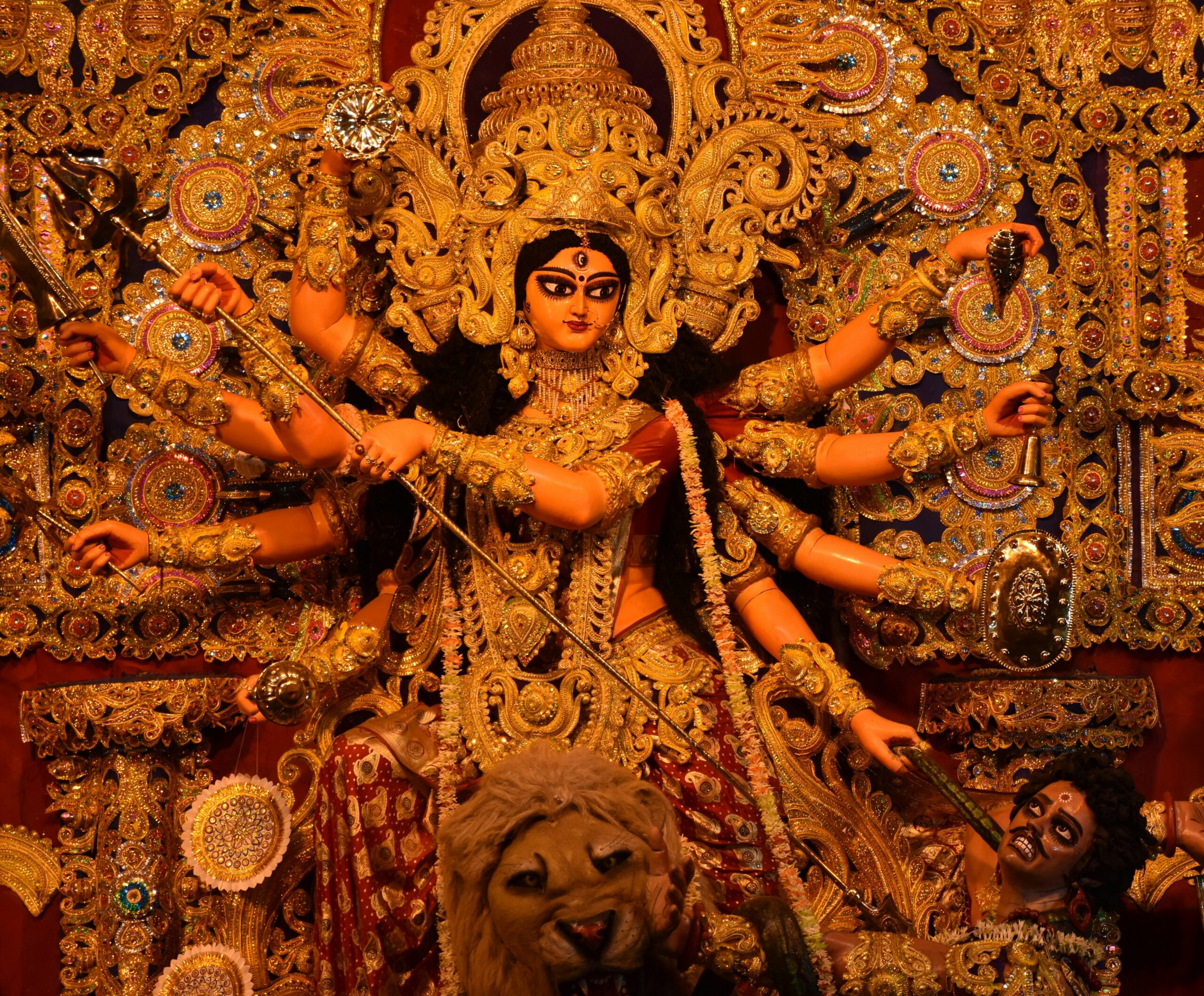
Ask most people how many forms Durga has and you will get an uncertain answer. Ask a grandmother in Varanasi and she will name nine without pausing, in order, and tell you which temple each one sits in.
The Navadurga — nine forms of the Divine Mother — are not interchangeable names for the same goddess. Each has her own story, her own iconography, her own weapon and mount, and her own night. Together they form a sequence, and the sequence is never rearranged, because the order is the teaching. It begins with a girl on a mountainside and ends with the giver of every attainment.
This guide walks through all nine, in the order they are worshipped across the nine nights of Navratri — who she is, what she holds and why, the mantra invoked, and what her form is understood to mean for the person praying.
What Navadurga Means
Nava is nine; Durga comes from the root durg, meaning a fort or something difficult to access — she is the one who is unassailable, and also the one who removes what is difficult. The nine forms are named in the Devi Kavacham, a protective hymn attached to the Devi Mahatmya (the Durga Saptashati), which is itself embedded in the Markandeya Purana.
One traditional reading treats the nine not as separate goddesses but as the life-phases of a single divine person — Parvati, from her birth in the Himalayas through her austerity, her marriage, her motherhood, her ferocity in battle, and her final radiance. Read that way, the Navadurga becomes a biography as much as a pantheon.
Navratri 2026: The Nine Days
Sharad Navratri 2026 runs from Sunday, 11 October to Monday, 19 October, with Vijayadashami on Tuesday, 20 October. The commonly followed day-and-colour sequence for this year:
- Day 1 — 11 Oct: Shailaputri, orange
- Day 2 — 12 Oct: Brahmacharini, white
- Day 3 — 13 Oct: Chandraghanta, red
- Day 4 — 14 Oct: Kushmanda, royal blue
- Day 5 — 15 Oct: Skandamata, yellow
- Day 6 — 16 Oct: Katyayani, green
- Day 7 — 17 Oct: Kalaratri, grey
- Day 8 — 18 Oct: Mahagauri, purple
- Day 9 — 19 Oct: Siddhidatri, peacock green
Two honest caveats. The nine colours are a popular convention rather than a scriptural rule — the sequence shifts with the weekday the festival opens on, and different regions follow different charts. The forms themselves are fixed; the colours are a joyful custom layered on top. Second, 2026 has an unusual tithi arrangement — Saptami spans both 17 and 18 October, and Ashtami and Navami overlap on 19 October — so day-to-date mapping can shift by a day depending on your panchang. Confirm locally.
1. Shailaputri — Daughter of the Mountain
Shaila means mountain; she is the daughter of Himavan, king of the Himalayas. This is Parvati at the beginning, reborn after her life as Sati ended in her father’s fire.
Iconography: She rides Nandi the bull, holds a trishula in her right hand and a lotus in her left, and wears a crescent moon on her forehead. The bull and the crescent are Shiva’s, worn here before the marriage that will unite them — the iconography knows where the story is going.
Meaning: Shailaputri is groundedness. Mountains do not move. Traditionally associated with the Muladhara, the root centre, she represents the stability without which nothing else can be built. It is significant that the nine nights begin here rather than with power or knowledge: first you stand somewhere solid.
Mantra: Om Devi Shailaputryai Namah
2. Brahmacharini — She Who Practises Austerity
Brahmacharini combines brahma (here meaning tapas, sacred austerity) with charini, one who practises. She is Parvati during her long penance to win Shiva — years of standing on one leg, of eating only leaves and then not even leaves, of refusing every attempt to talk her out of it.
Iconography: She walks barefoot, unadorned, carrying a japamala in her right hand and a kamandalu, a water pot, in her left. No weapon. No mount. The only form of the nine who carries nothing to fight with.
Meaning: This is the discipline that follows commitment. The story is not about suffering for its own sake — it is about a decision so complete that comfort simply stops being relevant. Anyone who has held to a practice past the point where it stopped feeling good understands what she represents.
Mantra: Om Devi Brahmacharinyai Namah
3. Chandraghanta — The Bell of the Moon
Chandra is moon, ghanta is bell. She wears a crescent moon on her forehead shaped like a bell — and a bell, in temple practice, is what announces a presence and clears the space of anything that should not be there.
Iconography: Golden-skinned, ten-armed, seated on a tiger or lion, carrying weapons in most hands and holding the remaining ones in gestures of blessing and fearlessness. Serene face, full arsenal.
Meaning: This is Parvati after the marriage — power that has arrived and settled. The combination is the point: she is at her most heavily armed and her most composed simultaneously. Chandraghanta is the answer to the assumption that strength must look like agitation.
Mantra: Om Devi Chandraghantayai Namah
4. Kushmanda — She Who Holds the Cosmic Egg
The name breaks into ku (a little), ushma (warmth), and anda (egg) — she who, with a little warmth, produced the cosmic egg. Tradition holds that when there was nothing but darkness, she smiled, and the universe came into being from that smile.
Iconography: Eight-armed, riding a lion, radiant enough that she is said to dwell within the sun and give it its light. She holds a kamandalu, bow, arrow, lotus, pot of nectar, discus, mace and japamala.
Meaning: Kushmanda is creative energy at the point of origin — and the tradition insists that creation happened through a smile rather than an effort. That is a genuinely unusual cosmology. Most creation stories involve labour, sacrifice, or struggle. This one involves delight.
Mantra: Om Devi Kushmandayai Namah
5. Skandamata — Mother of Skanda
Skanda is Kartikeya, the warrior-god born to lead the divine armies. Here the Goddess is worshipped specifically in her relationship to her child.
Iconography: Four-armed, seated on a lion, holding lotuses in two hands and the infant Skanda on her lap. She is sometimes called Padmasana, the one seated on a lotus. The child, notably, is the one who will destroy the demon Tarakasura — she holds the future warrior as a baby.
Meaning: Skandamata is protective power — strength held on behalf of someone else. Devotees traditionally note that she can be approached through the child: worship Skanda and the mother’s blessing follows. Anyone who has been fierce on behalf of a person they love rather than for themselves has stood briefly where she stands.
Mantra: Om Devi Skandamatayai Namah
6. Katyayani — The Warrior
She was born in the ashram of the sage Katyayana, who had performed austerities wishing for the Goddess as his daughter, and she took her name from him. This is the form created specifically to end Mahishasura.
Iconography: Four-armed (in some depictions ten), riding a lion, holding a sword and a lotus, with the remaining hands in blessing. Her sword is named Chandrahasa. She is golden, fierce, and unmistakably prepared for battle.
Meaning: Katyayani is righteous anger with an edge on it. She is also, in the Bhagavata tradition, the form the gopis of Vrindavan worshipped when they wished for Krishna — which places her at both ends of the emotional spectrum, presiding over warfare and longing alike. In the Devi Mahatmya narrative, the sixth night is when the battle turns.
Mantra: Om Devi Katyayanyai Namah
7. Kalaratri — The Dark Night
Kala is both time and darkness; ratri is night. The fiercest of the nine, and the most misunderstood.
Iconography: Skin dark as night, hair wild and unbound, three eyes, riding a donkey. She holds a sword and an iron hook; her other hands give blessing and remove fear. Flame issues from her breath. She is also called Shubhankari — she who does good — a name that exists precisely because devotees needed reminding.
Meaning: The terrifying appearance is directed outward, not at the devotee. Kalaratri is the form that destroys what cannot be reasoned with: entrenched fear, deep ignorance, the things that do not respond to gentler methods. Her ugliness is functional. There is a reason Hinduism did not make all its goddesses beautiful, and this is it — some work is not pretty, and the tradition declined to pretend otherwise.
Mantra: Om Devi Kalaratryai Namah
8. Mahagauri — The Luminous
Maha is great, gauri is fair or luminous. After the years of penance as Brahmacharini left her body darkened by dust and sun, Shiva is said to have bathed her in the waters of the Ganga, and her radiance returned — brighter than before.
Iconography: Luminous white, four-armed, riding a bull, holding a trishula and a damaru with two hands in blessing and fearlessness. White clothing, white ornaments; she is sometimes compared to the moon or to a conch.
Meaning: Mahagauri is what remains after the fierce night. Kalaratri destroys; Mahagauri is the peace on the other side of that destruction. The eighth night is one of the most important of Navratri — Durga Ashtami — and Kanya Pujan, the honouring of nine young girls as living forms of the Goddess, is commonly performed on this day or the next.
Mantra: Om Devi Mahagauryai Namah
9. Siddhidatri — The Giver of Attainment
Siddhi means attainment or perfection; datri is the giver. Tradition holds that Shiva himself obtained his siddhis by worshipping her, and that it was through her grace that half his body became hers — the Ardhanarishvara form, half male and half female.
Iconography: Four-armed, seated on a lotus or riding a lion, holding a mace, discus, conch and lotus. Serene, complete, sought by gods and sages alike.
Meaning: The nine nights end in fulfilment. Having grounded, disciplined, composed, created, protected, fought, destroyed and purified, the devotee arrives at attainment. That Shiva — the supreme ascetic — is said to have received his own powers from her is the tradition’s final statement on where power actually originates.
Mantra: Om Devi Siddhidatryai Namah
The Traditional Offerings
Many households offer a specific naivedyam on each night. The most widely followed sequence, which varies by family and region:
- Shailaputri — pure ghee
- Brahmacharini — sugar
- Chandraghanta — milk or kheer
- Kushmanda — malpua
- Skandamata — banana
- Katyayani — honey
- Kalaratri — jaggery
- Mahagauri — coconut
- Siddhidatri — sesame seeds
These are conventions, not commandments. An offering made with attention counts for more than the correct item offered absent-mindedly.
Reading the Nine as One Arc
Set the nine side by side and a shape appears that no single form contains.
The sequence begins with stability and ends with attainment, and the route between them runs through discipline, composure, creativity, protection, warfare, annihilation, and purification. Nothing is skipped. The creative form (Kushmanda) arrives only after the disciplined one (Brahmacharini). The peaceful form (Mahagauri) arrives only after the terrifying one (Kalaratri). Fulfilment (Siddhidatri) is last, and reaching it requires having passed through the rest.
This is why the order does not change. A tradition that wanted only to catalogue nine goddesses could list them alphabetically. This one insists on a sequence because it is describing a process — and a process has a direction.
The most demanding part of the arc, for most readers, is the seventh night. Kalaratri is not optional and cannot be reached around. Whatever it is that will not yield to patience or reason has to be met directly and destroyed, and the form that does that work is dark, wild-haired and rides a donkey. Only then does Mahagauri arrive, white and calm. The tradition puts them in that order deliberately, and refuses to let anyone have the second without the first.
Frequently Asked Questions
Who are the nine forms of Durga?
In order of worship across Navratri: Shailaputri, Brahmacharini, Chandraghanta, Kushmanda, Skandamata, Katyayani, Kalaratri, Mahagauri and Siddhidatri. They are collectively called the Navadurga and are named in the Devi Kavacham of the Durga Saptashati.
Are the Navadurga nine different goddesses?
They are understood as nine aspects or manifestations of one Goddess rather than nine independent deities. A widely held traditional reading treats them as the life-phases of Parvati, from her birth as the mountain king’s daughter through her penance, marriage, motherhood, and final completion.
Which form of Durga is the most powerful?
The tradition does not rank them, and the question slightly misses the point — each form is complete in itself and addresses a different need. Kalaratri is the fiercest in appearance and Siddhidatri the culmination of the sequence, but no form is treated as lesser. Devotees typically feel drawn to whichever one meets where they currently are.
Where can I see all nine Navadurga temples?
Varanasi is the traditional answer — the city holds temples to all nine forms, and devotees walk the circuit across the nine nights, visiting one temple each day. The Katyayani Shakti Peeth in Vrindavan is another significant destination, particularly for those in the Krishna bhakti traditions.
Do the Navratri colours have to be followed?
No. The nine colours are a widely enjoyed modern-ish convention, not a scriptural prescription, and the sequence changes each year with the weekday the festival begins on. Different regions follow different charts. If you miss a day’s colour, red or yellow are always considered dear to the Goddess.
A Closing Thought
What is most striking about the Navadurga is not that the Goddess has nine forms. It is that the tradition insisted on keeping all nine — including the ones that are difficult to look at.
It would have been easy, over centuries of retelling, to quietly let Kalaratri fade and keep the luminous forms. Plenty of traditions have done exactly that with their own difficult figures. Hinduism kept her, gave her a night of her own, and named her Shubhankari, the doer of good, so that no one would mistake her ferocity for malice.
Nine forms, in order, none of them skippable. May each night of these nine give you what it is meant to.
Continue Exploring
- Significance of Navratri: The Spiritual Meaning of the Nine Nights
- Introduction to the Ramayana — Story, Characters, and Meaning
- Kashi and Its Significance for Hinduism
- How to Chant the Vishnu Sahasranama