
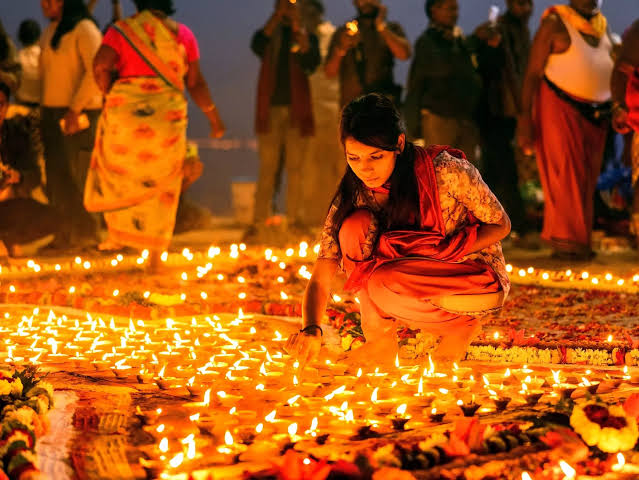
Ask five people why we celebrate Diwali and you will get five different answers, all of them correct.
A family in Lucknow will tell you about Rama coming home to Ayodhya. A family in Chennai will tell you about Krishna killing Narakasura before dawn, and will have already had their oil bath by the time the north wakes up. In Kolkata the lamps are lit for Kali, not Lakshmi, and the night is spent in front of a dark goddess with her tongue out. In Ahmedabad it is New Year’s Day. In a Jain household it is the night Mahavira left the world. In a gurdwara it is the day a Guru walked out of a Mughal fort with fifty-two prisoners holding on to his cloak.
None of these is the “real” Diwali and the others decoration. Diwali is what happens when an enormously old festival of lamps keeps getting adopted — by different regions, different sects, different religions — and each one brings a story with it. The lamps came first. The stories arrived to explain them.
This is a guide to all of them: what each legend says, which text it actually comes from, and where the honest uncertainty lies.
Diwali 2026: The Dates First
The main day of Diwali 2026 is Sunday, 8 November, the new-moon night of the month of Kartika. The days around it:
- Dhanteras — Friday, 6 November 2026
- Naraka Chaturdashi / Choti Diwali / Kali Chaudas — Saturday, 7 November 2026
- Lakshmi Puja (main Diwali) — Sunday, 8 November 2026
- Govardhan Puja / Bali Pratipada — Monday 9 or Tuesday 10 November 2026, depending on your panchang
- Bhai Dooj — Tuesday 10 or Wednesday 11 November 2026, depending on your panchang
That last disagreement is real and I would rather flag it than paper over it. Hindu festival dates follow the tithi — a lunar day that does not line up neatly with a calendar date and can begin mid-afternoon and end mid-morning. For 2026, the pratipada tithi after the new moon straddles two civil days, and reputable panchangs genuinely differ on whether Govardhan Puja falls on the 9th or the 10th and Bhai Dooj on the 10th or the 11th. The first three dates are not in dispute. For the last two, go by the panchang your family or temple follows.
Published muhurat timings carry the same caveat with more force. The Lakshmi Puja muhurat you see quoted — often an evening window of roughly an hour and a half — is almost always calculated for Delhi or another specific Indian city. If you are reading this in New Jersey, Leicester, Toronto or Melbourne, those clock times are meaningless for you: your sunset, and therefore your pradosh kaal, is on a different schedule, and in some time zones the tithi itself falls on a different calendar day. Use a panchang set to your own city, or ask your local temple what they are doing.
The Story Everyone Knows: Rama’s Return to Ayodhya
Fourteen years of exile. A wife abducted, a war fought across the sea, a demon-king killed. And then the long walk north, and a city that has been waiting.
In the version told in most of north India, the people of Ayodhya light the entire city — every doorway, every wall, every ghat on the Sarayu — so that Rama, Sita and Lakshmana arriving on a moonless night will find their way home in a river of flame. The lamps are a welcome. They are also, in the most common reading, a public declaration: that the rightful king is back, that the long wrong has been righted, that the darkness was temporary.
Here is where I have to be careful, because this is the most confidently misattributed fact in the whole festival.
The Valmiki Ramayana does describe Rama’s return and his coronation, and it describes a jubilant, decorated Ayodhya. What it does not do is name a festival. Neither, by most scholarly accounts, does Tulsidas’s Ramcharitmanas. The explicit identification of Deepavali as the anniversary of Rama’s homecoming is a later development — powerfully established in popular and regional tradition, and genuinely ancient in the sense that most things in Hinduism are ancient, but not something you can point to a verse for. You will find websites and even temple pamphlets citing chapter and verse. Treat those citations with suspicion.
This does not make the association false or unimportant. It is how a great many Hindus understand the festival, and that is a fact about Diwali whatever the textual history. It just is not the origin of a festival of lamps that was being celebrated under the name Deepotsava well before anyone wrote it down as Rama’s.
The Story Half of India Actually Tells: Krishna and Narakasura
South of the Vindhyas, Diwali is mostly not about Rama at all.
Narakasura was a demon king — in the Puranic accounts the son of Bhumi, the earth goddess, and so not straightforwardly evil by birth. He became a tyrant: he conquered the three worlds, took sixteen thousand women captive, and could not be killed, by the terms of his boon, by anyone except his own mother. Krishna rides out against him with Satyabhama driving the chariot — and Satyabhama is, in the logic of the story, an incarnation of Bhumi. The mother kills the son. Narakasura dies on the fourteenth day of the waning moon, asking as a last wish that his death be remembered not with mourning but with lamps and celebration.
This story is told in the Puranic corpus — the Bhagavata Purana and Vishnu Purana among the texts that carry the Narakasura material — and it is why in Tamil Nadu, Karnataka, Andhra Pradesh, Telangana and much of the Deccan the second day, Naraka Chaturdashi, is the main day of Deepavali. The ritual is the Ganga snanam: an oil bath before dawn, often before four in the morning, treated as a bath in the Ganga itself, washing off the demon’s blood. Firecrackers at sunrise, not at midnight. New clothes. A bitter-sweet medicinal preparation eaten first thing.
In 2026 this falls on Saturday 7 November — and worth noting, when the second and third days are close together as they are this year, north and south are celebrating on almost the same weekend, which does not always happen.
If you have ever wondered why your South Indian colleagues seemed to be done with Diwali while you were just starting, this is why. They were not early. You were.
Lakshmi, the Churning Ocean, and the Oldest Layer
The third day, and the main day across most of India, belongs to Lakshmi — goddess of wealth, fortune, abundance and beauty.
The story here is the Samudra Manthana, the churning of the cosmic ocean. Gods and demons together churn the sea using a mountain for a churning rod and a cosmic serpent for a rope, and out of it come, one after another, poison and treasures and the physician Dhanvantari holding the pot of amrita, and Lakshmi herself, rising on a lotus. The Padma Purana places Lakshmi’s emergence in this sequence, and the tradition reads the Diwali days as marking Dhanvantari’s appearance on Dhanteras — which is why Dhanteras is also observed as a day for health and for Ayurveda — and Lakshmi’s own arrival and marriage to Vishnu across the days that follow.
There is a second Lakshmi story, less often told, in which she is held captive by the demon king Bali and freed by Vishnu — which ties the festival’s wealth-goddess into the Bali legend of the fourth day.
And underneath both there is something older. Diwali is, almost certainly, a harvest festival before it is anything else. Kartika amavasya is the darkest night of the year’s turn, after the monsoon, when the kharif crop is in and the accounts of the agricultural year are settled. The Kamasutra of Vatsyayana mentions a festival called Yaksha Ratri — a night of the yakshas, the guardians of buried treasure — involving lamps and gambling. The gambling survives: playing cards on Diwali night is still, in many families, a half-joking ritual obligation. So does the accounting. Traders across India still open new ledgers at Diwali, and Lakshmi Puja in a shop is as much bookkeeping as devotion.
The earliest hard references we have point this way. Diwali appears in the Puranas — the Padma Purana and Skanda Purana, generally dated to roughly the 7th–10th centuries — and as Deepotsava, “festival of lights,” in Emperor Harsha’s 7th-century play Nagananda. Inscriptions in Sanskrit from across the subcontinent, including a 10th-century copper plate, name it. A festival of lamps marking the agricultural year’s turn, which the great devotional stories then attached themselves to: that is the most defensible history.
Bengal Lights Lamps for Kali
On the same new-moon night that most of India worships Lakshmi, Bengal, Assam, Odisha, Tripura and parts of Bihar and Jharkhand worship Kali.
This is not a minor variant. It is a completely different religious experience. Lakshmi Puja is bright, domestic, fragrant — a goddess invited into a clean house to bless it. Kali Puja is a night rite: dark, intense, tantric in its ritual grammar, with red hibiscus and offerings made after midnight, and devotees who stay awake until dawn in front of a goddess who stands on Shiva’s chest with a severed head in her hand.
Lakshmi promises you abundance. Kali promises you nothing, and asks you to love her anyway. The Bengali devotional tradition is quite clear-eyed about this: the mother is both compassionate and terrible, and you do not get to choose which one you get.
The history is comparatively recent and well documented. Kali worship in Bengal was systematised in the late medieval period — the tantric scholar Krishnananda Agamavagisha is a central figure — and Kali Puja as a large public observance was popularised in the 18th century under the patronage of Raja Krishnachandra of Nadia. It grew enormously in the 19th century, helped by the fame of Sri Ramakrishna, the Kali devotee of Dakshineswar. Barasat, north of Kolkata, now holds what is generally reckoned the largest Kali Puja in West Bengal.
Bali’s One Day a Year
The fourth day carries two different observances depending on where you are.
In Maharashtra, Gujarat, Karnataka, Andhra Pradesh and parts of the Himalayas, it is Bali Pratipada. The asura king Bali was a generous and genuinely righteous ruler who became too powerful, and Vishnu came to him as Vamana, a dwarf brahmin, asking for as much land as he could cover in three steps. Bali, who never refused a petitioner, agreed — and Vamana grew until two steps covered the universe, and Bali offered his own head for the third. Vishnu, honouring the king’s integrity, granted him a boon: one day each year he may return to earth to be among his people and be worshipped. Bali Pratipada is that day. The story appears across the Puranic corpus — the Brahma Purana, Kurma Purana and Matsya Purana all carry versions — and was evidently well known by the 2nd century BCE, since Patanjali’s Mahabhashya refers to it being performed in drama.
In Gujarat and Rajasthan the same day is Bestu Varas, the Vikram Samvat New Year. Which is worth remembering before you tell a Gujarati friend “happy Diwali” on the wrong day.
In Braj and much of the north the day is instead Govardhan Puja or Annakut: the day Krishna, a boy, persuaded the cowherds of Vrindavan to stop propitiating Indra and worship their own hill instead, and then lifted that hill on one finger for seven days to shelter them from Indra’s retaliatory storm. Temples build mountains of food — the annakut, literally “food mountain” — in front of the deity.
Two Non-Hindu Diwalis
Diwali is not only a Hindu festival, and in two traditions the night carries an entirely independent meaning.
For Jains, the new moon of Kartika is the night Mahavira, the twenty-fourth Tirthankara, attained nirvana at Pavapuri in Bihar — placed by Jain tradition in 527 BCE. On the same night his chief disciple Gautama Swami attained kevala jnana, complete knowledge. Jain texts including the Kalpasutra and Jinasena’s Harivamsa Purana carry the account. The Jain Vira Nirvana Samvat calendar begins from the day after — so Jain New Year starts where Diwali ends. Jain observance is accordingly quieter: lamps, fasting, recitation, and in many communities an emphatic avoidance of fireworks, which are hard to reconcile with ahimsa.
For Sikhs, the day is Bandi Chhor Divas, “the day of liberation of prisoners.” Guru Hargobind, the sixth Guru, was imprisoned in Gwalior Fort by the emperor Jahangir. When his release was ordered he refused to leave alone, insisting that fifty-two Rajput princes held there be freed with him; by the best-known telling, he had a cloak made with fifty-two tassels so that each could hold one and walk out behind him. Accounts place his arrival at Amritsar on Diwali, with the city illuminated to receive him, and the Harmandir Sahib is lit for Bandi Chhor Divas to this day.
The dating here is genuinely unsettled — sources variously place the release around 1611–1612 and Persian records suggest a detention somewhere between 1617 and 1619, and historians differ on the details of both the imprisonment and the Diwali coincidence. Anyone quoting one precise year without qualification is being more confident than the evidence allows.
Brothers, Sisters, and the God of Death
The fifth day, Bhai Dooj, is also called Yama Dwitiya, and the older name points to the older story.
Yama, the god of death, has a twin sister: Yamuna, the river. She invites him; he comes. She welcomes him with food and a tilak on his forehead, and death, visiting his sister, is for one day simply a brother being fed. Yama is so moved that he grants a boon — that any brother who receives his sister’s tilak on this day will be protected, and that siblings who honour each other will not fear him.
There is a second story, tied to the Krishna cycle: after killing Narakasura, Krishna goes to his sister Subhadra, who welcomes him with sweets, flowers and a tilak. That version threads the fifth day back to the second.
Regionally it is Bhai Phonta in Bengal, Bhau Beej among Marathi, Gujarati and Konkani families, Yama Dwitiya in the south, and Bhai Tika in Nepal’s Tihar. Unlike most of the legends above, these stories sit in living tradition rather than in a securely identifiable text, and it is better to say so than to invent a citation.
Why the Multiplicity Is the Point
It is tempting to try to settle this — to find the original Diwali and rank the rest as accretions. I think that instinct misreads what kind of thing Diwali is.
Here is a festival that a Jain, a Sikh, a Bengali Shakta, a Tamil Vaishnava and a Gujarati trader all celebrate on the same night, for five incompatible reasons, without any of them feeling the need to resolve the contradiction. There is no central authority that adjudicated this. It simply happened, over something like two thousand years, by accumulation.
That is an unusual capacity, and it is worth naming in a decade that is not notably good at it. The underlying grammar is shared — light against darkness, order recovered, the year turning — and on top of that everyone puts their own story, and nobody is wrong. Hinduism’s tolerance for unresolved plurality is not a bug that modernity needs to tidy up. It is the most sophisticated thing about it.
Something practical, if you want one. This Diwali, when the lamps are lit, ask the oldest person in the room which story they grew up with. Not the one from the WhatsApp forward — the one their grandmother told them, in whatever language she told it in. In a generation of diaspora families the regional specificity is the first thing to go: everyone ends up with the generic Rama-and-Ayodhya version, and the Tamil oil bath and the Gujarati new year and the Bengali night vigil quietly disappear. Those details are not trivia. They are the last thread back to a particular village, a particular dialect, a particular way of being Hindu. Ask while there is someone to ask.
Frequently Asked Questions
When is Diwali 2026?
The main day of Diwali 2026 — Lakshmi Puja, the Kartika new moon — is Sunday, 8 November 2026. Dhanteras is 6 November and Naraka Chaturdashi is 7 November. Govardhan Puja and Bhai Dooj fall on 9–10 and 10–11 November respectively, depending on which panchang you follow.
Why do we celebrate Diwali?
There is no single reason, and that is the honest answer. In most of north India it marks Rama’s return to Ayodhya; in the south, Krishna’s defeat of Narakasura; across most of India it is the night Lakshmi is worshipped; in Bengal and the east it is Kali Puja; in Maharashtra and Gujarat it includes Bali Pratipada and the Vikram Samvat New Year; Jains mark Mahavira’s nirvana and Sikhs mark Bandi Chhor Divas. Beneath all of them is a very old festival of lamps tied to the harvest and the turning of the year.
Is the Diwali story in the Ramayana?
Not by name. The Valmiki Ramayana describes Rama’s return and a rejoicing, decorated Ayodhya, but it does not name Deepavali, and most scholars say the same of Tulsidas’s Ramcharitmanas. The explicit link between Diwali and Rama’s homecoming is a later tradition, widely held and deeply felt, but not something you can cite a verse for. Be sceptical of sources that give you one.
Why is Diwali celebrated on a different day in South India?
Because the south observes Naraka Chaturdashi — the day Krishna killed Narakasura — as the main day of Deepavali, rather than the Lakshmi Puja new moon that follows it. The characteristic ritual is a pre-dawn oil bath, with firecrackers at sunrise. In 2026 it falls on Saturday 7 November, the day before the north’s main Diwali.
What is the difference between Diwali and Kali Puja?
They are on the same night but they are different observances. Most of India worships Lakshmi — a bright, domestic rite inviting abundance into the home. Bengal, Assam, Odisha, Tripura and neighbouring regions worship Kali in a night-long rite that is tantric in character, with offerings made after midnight and devotees awake until dawn.
Why do Sikhs and Jains celebrate Diwali?
For their own reasons, not as a borrowing. Jains mark the night as Mahavira’s nirvana at Pavapuri, which Jain tradition places in 527 BCE; their new year begins the following day. Sikhs mark Bandi Chhor Divas, when Guru Hargobind was released from Gwalior Fort and insisted that fifty-two imprisoned princes be freed with him, arriving at Amritsar to a city of lamps.
Can I use the Lakshmi Puja muhurat timings I found online?
Only if they were calculated for your city. Almost every muhurat published online is computed for Delhi or another Indian location, and both sunset and the tithi boundaries differ elsewhere — sometimes enough to shift the observance to a different calendar day in North America, the UK or Australia. Use a panchang set to your own coordinates, or follow your local temple.
A Closing Thought
Kartika amavasya is the darkest night of the Hindu year’s turn. No moon at all. And what the tradition decided to do with the darkest night was not to hide from it but to answer it — one clay lamp at a time, in every doorway, in a line along the wall, until a whole city is outlined in small flames that any passing wind could put out.
That is not a confident gesture. A diya is a fragile thing. But a row of them is deepavali — literally, a row of lights — and the row is the whole idea. No single lamp is adequate to the night. All of them together are.
Continue Exploring
- Dussehra (Vijayadashami): Meaning, the Two Legends, and How India Celebrates — the festival twenty days before Diwali, and the start of Rama’s journey home
- Durga and Mahishasura: The Story Behind Navratri’s Nine Nights
- Introduction to the Ramayana: Story, Characters and Meaning
- Why We Celebrate Holika Dahan — the other great fire festival, and the other demon who would not die
- Krishna: The Divine Guide of the Mahabharata