
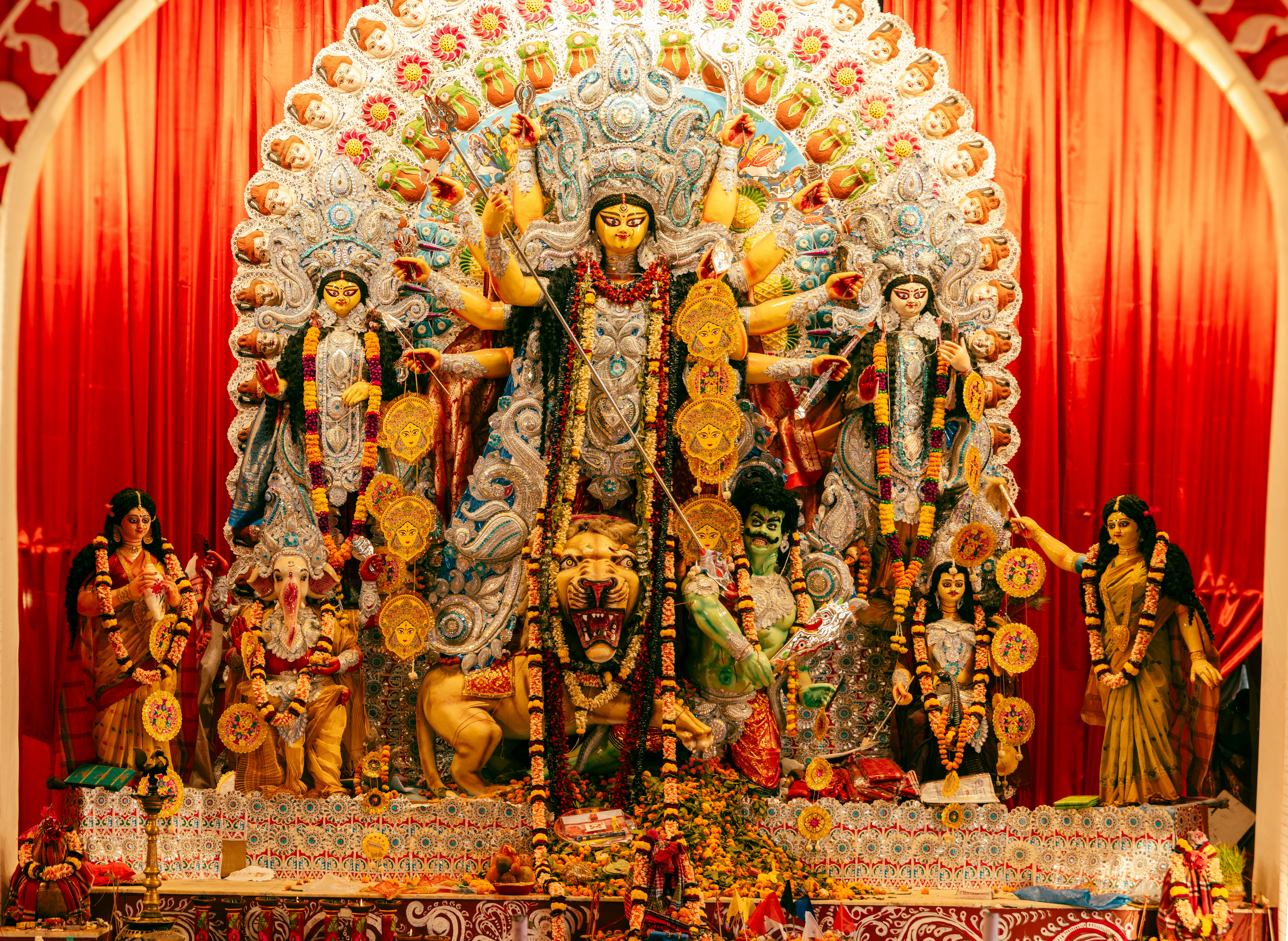
Every image of Durga you have ever seen is a freeze-frame from the same moment. Ten arms, a lion mid-leap, a trident driven downward, and beneath her a figure emerging from the body of a buffalo — caught halfway between one form and another, which is exactly where he was when she finished it.
She is called Mahishasuramardini, the crusher of the buffalo demon, and it is the single most reproduced image in Hindu art. Millions of households keep it without ever having read the story it comes from.
The story is worth reading. It is stranger and sharper than the one-line summary suggests, and it contains at least three ideas that were genuinely radical when they were written down and have not entirely lost their edge since.
Where the Story Comes From
The source is the Devi Mahatmya — the Glory of the Goddess — also known as the Durga Saptashati or the Chandi Path. It is seven hundred verses long and sits embedded within the Markandeya Purana. Scholars generally date its composition to somewhere around the fifth to sixth century CE, though it draws on material considerably older.
Its significance is hard to overstate. This is the text in which the Goddess is presented not as a consort, not as an energy belonging to a male god, but as the ultimate reality from which everything including the gods proceeds. That was a major theological claim, and the Devi Mahatmya makes it without apology.
The text has three sections, each with its own presiding form: the first tells of Madhu and Kaitabha, the second of Mahishasura, the third of Shumbha and Nishumbha. The nine nights of Navratri are the nine nights of the middle story.
Who Mahishasura Was
The Devi Mahatmya itself is brisk about his origins — it is interested in the battle, not the biography. The parentage most commonly told comes from later Puranic and regional sources, and the versions differ.
The usual account: his father was Rambha, an asura king, who fell in love with a she-buffalo — in most tellings a princess named Shyamala, cursed into that form. Mahishasura was born of that union, and it is why he could move between human and buffalo shape at will. Mahisha is Sanskrit for buffalo; asura is the class of beings set in perpetual opposition to the devas. His name is simply what he is.
That shape-shifting is not incidental colour. It becomes the whole architecture of the story.
The Boon and the Loophole
Mahishasura performed austerities of such severity that Brahma appeared before him and offered a boon.
He asked for immortality. Brahma refused — no created being may be exempt from death, and the refusal is standard across Hindu narrative. So Mahishasura reconsidered and asked instead that no man and no god should be able to kill him.
Brahma granted it.
Consider what is contained in that request. Mahishasura surveyed every category of being he thought could threaten him, listed them, and had them excluded. Women simply did not appear on the list. He did not exempt them as an oversight to be exploited later; he genuinely did not think of them as a possibility. The loophole was not a flaw in the boon. It was a flaw in his imagination.
The text is quietly merciless about this. Everything that follows is the consequence of one asura’s inability to picture a woman as dangerous.
The Conquest of Heaven
Armoured in the boon, Mahishasura made war on the devas. The war ran a hundred years and the devas lost it. Indra was driven from his throne, the gods were expelled from heaven and forced to wander the earth in human form, and Mahishasura installed himself as lord of the three worlds. Sacrifices were stopped. The order of things came apart.
The defeated gods went to Brahma, and Brahma led them to Vishnu and Shiva. And here the story does something unusual.
The Making of the Goddess
Hearing the account, Vishnu and Shiva were filled with anger — and from that anger a light issued from their faces. Seeing it, the assembled gods released their own accumulated energy, their tejas, and all of it converged into a single blazing mass.
From that mass, a woman took form.
The Devi Mahatmya describes the assembly of her body with unusual precision. Shiva’s light became her face. Yama’s became her hair. Vishnu’s became her arms, the moon’s her breasts, Indra’s her waist, Varuna’s her thighs, Brahma’s her feet. Agni gave her three eyes. She was made of every god at once, and therefore of none of them in particular.
Then they armed her. Shiva drew a trident from his own and gave it to her; Vishnu produced a discus from his; Varuna a conch; Agni a spear; Vayu a bow and two quivers of arrows; Indra a thunderbolt and a bell taken from Airavata; Yama his staff; Brahma a water pot and a rosary; Kala a sword and shield; Vishwakarma an axe and impenetrable armour. Kubera gave a cup, Samudra a garland of unfading lotuses, Himavan a lion to ride and jewels beyond counting.
Then she laughed — a laugh that shook the mountains and the oceans and made the earth tremble — and Mahishasura heard it.
It is worth pausing on the mechanics of this. She is not a goddess who arrives to help. She is made from the combined power of every god there is, because none of them individually was sufficient. Every deity in the pantheon contributes and still cannot fight the battle — they can only produce the one who can, and then step back.
The Battle
Mahishasura sent his commanders first. Chikshura came with a great army, and Chamara with the cavalry, and Udagra, Mahahanu, Asiloma, Baskala, Bidala, Durdhara and Durmukha followed with theirs. The Goddess destroyed each in turn. The Devi Mahatmya lingers on this stretch with obvious relish — the lion tearing through ranks, whole armies dispatched by weapons that never missed, the battlefield emptied one general at a time.
When his commanders were gone, Mahishasura came himself.
And here he fought the way only he could. He came as a buffalo and she cut at him; he became a lion and she struck; he took the form of a man with a sword and she pierced him; he turned into an elephant and dragged her lion with his trunk and she severed it; he became a buffalo again and shook mountains loose and hurled them at her.
Every time she landed a blow, the thing she had struck was no longer what she was fighting. He was never defeated because he was never, for more than a moment, the same opponent.
The Goddess drank from the cup Kubera had given her, laughed again, and leapt. She pinned the buffalo with her foot, drove her trident into it — and as the man began to emerge from the buffalo’s mouth, caught mid-transformation with neither form complete, she struck off his head.
It was the tenth day.
What the Story Is Actually Saying
The obstacle that changes shape
This is the reading that has the most direct purchase on ordinary life. Mahishasura’s real weapon is not strength. It is that he becomes whatever the last attack did not defeat.
Most of what people struggle with behaves precisely this way. The habit you break returns as a different habit. The anxiety you resolve reappears attached to a new subject. The argument you settle in a marriage recurs next month wearing an entirely different set of clothes. Attacking harder does not work, because the thing you hit is no longer the thing that is there.
What defeats it, in the story, is not force. It is sustained presence across nine nights until the shifting has nowhere left to go. She wins in the gap between forms — the moment when he has let go of one shape and not yet secured the next. That is the only moment he was ever vulnerable, and reaching it required staying in the fight far longer than any single decisive blow would have taken.
The buffalo as inertia
In the language of the three gunas, the buffalo is a standard emblem of tamas — heaviness, dullness, inertia, the quality that resists movement. Read symbolically, Mahishasura is not evil so much as immovable: the accumulated weight of habit and torpor that no amount of good intention shifts.
That reading explains something otherwise odd about the iconography. Durga’s face in these images is almost never angry. She is serene, sometimes faintly smiling, in the act of killing. One does not rage at inertia. One simply applies steady force until it gives.
The power that had to be feminine
The boon made the conclusion inevitable. No man, no god — so the answer had to be a woman, and the text does not treat this as a technicality it is reluctantly satisfying. It treats it as a revelation. The gods do not produce a female form to exploit a loophole and then take the credit. They produce her, arm her, and watch.
Whatever one makes of the theology, the narrative logic is unambiguous: the supreme power in the cosmos, at the moment it is most needed, is female, and every male deity in the pantheon is standing on the sidelines.
The City Named After the Defeated
One detail rarely makes it into the retellings. Mysuru in Karnataka takes its name from Mahishuru — the town of Mahisha. The city is named after the demon, not the Goddess who killed him.
Local tradition holds that the battle ended on Chamundi Hill, where the Chamundeshwari temple now stands, and where a large statue of Mahishasura faces the city he once held. Mysuru Dasara, the state festival of Karnataka, commemorates the victory annually — in a city that kept the loser’s name.
It is also worth noting, honestly, that some regional and folk traditions hold a more sympathetic view of Mahishasura than the mainstream telling does, remembering him as a ruler of his people rather than purely as a tyrant. These readings vary widely and sit outside the Devi Mahatmya’s account, but India’s traditions rarely speak with one voice and it would be inaccurate to suggest they do here.
Why This Story Still Lands
Strip out the theology and what remains is a piece of strategic instruction.
Something in your life is beating you. You have attacked it directly and it adapted. You have tried a second approach and it adapted to that. The conventional response at this point is either to escalate — hit harder, try something more drastic — or to conclude that the thing is simply unbeatable and make peace with it.
The Devi Mahatmya proposes a third option. Stay. Keep striking. Do not expect the decisive blow to arrive on schedule. The adversary’s ability to change form is finite, and it is exhausted not by force but by duration. There comes a point where it is between shapes, and that is the point at which it ends.
Nine nights. The number is not decorative. It is the tradition’s estimate of how long this kind of thing actually takes — which is to say, longer than you want it to, and not forever.
Frequently Asked Questions
Why could only Durga kill Mahishasura?
His boon from Brahma protected him from being killed by any man or any god. Women were not included — he did not consider them a threat. The Goddess was created specifically because she fell outside the terms of his protection, and because no individual deity was powerful enough to face him.
How was Goddess Durga created?
According to the Devi Mahatmya, the defeated gods released their combined energy, or tejas, and from that mass of light she took form. Each god contributed a part of her body and then gave her a weapon — Shiva his trident, Vishnu his discus, Indra his thunderbolt, and so on. Himavan gave her the lion she rides.
How many days did the battle between Durga and Mahishasura last?
Nine days and nine nights, with Mahishasura killed on the tenth day. This is the origin of Navratri’s nine nights and of Vijayadashami, the tenth day of victory.
What does Mahishasura symbolise?
Most commonly, tamas — inertia, dullness and the heaviness that resists change, for which the buffalo is a traditional emblem. His shape-shifting is also widely read as the way entrenched problems mutate to survive each attempt to remove them.
Which text tells the story of Durga and Mahishasura?
The Devi Mahatmya, also called the Durga Saptashati or Chandi Path — seven hundred verses within the Markandeya Purana, generally dated to around the fifth or sixth century CE. It is recited during Navratri across much of India.
Is Mahishasuramardini the same as Durga?
Yes. Mahishasuramardini means the crusher of Mahishasura and is an epithet of Durga, used specifically for her in the act of slaying the buffalo demon. It is the form depicted in the vast majority of Durga images and idols.
A Closing Thought
There is one detail in the iconography that repays attention. In nearly every depiction, Mahishasura is shown emerging from the buffalo’s severed neck — human torso, weapon still in hand, face turned upward toward her.
The artists did not have to choose that moment. They could have shown the buffalo dead, or the demon fallen, or the Goddess triumphant over a finished corpse. Instead, for centuries, they have chosen the instant of transition: the exact point where he stopped being one thing and had not yet become the next.
That is where he lost. Not in strength, not in numbers, but in the gap he could not close because she was still there when it opened.
Whatever you are fighting this Navratri — stay in it.
Continue Exploring
- Significance of Navratri: The Spiritual Meaning of the Nine Nights
- The Nine Forms of Durga: Navadurga Explained, Day by Day
- How to Celebrate Navratri at Home: Ghatasthapana, Puja Vidhi and Fasting
- Introduction to the Ramayana — Story, Characters, and Meaning