
A prison cell in Mathura. Midnight. The guards have fallen asleep mid-sentence, the chains have slipped open of their own accord, and a woman who has already lost six children is holding her seventh living son for the first and perhaps the last time. Outside, the Yamuna is in flood. Her husband takes the baby, steps into the water, and the river parts.
That is how the Bhagavata Purana — the great devotional scripture of Krishna bhakti, whose tenth book is given over almost entirely to his life — opens the story of the child it calls the dark-hued one. It is worth pausing on the setting. Not a palace. Not a mountaintop. A jail, under a death sentence, in the dark. Krishna arrives in the most constrained circumstance a human being can be born into, and the first thing that happens in his presence is that locks open.
Hindus have been telling that story for roughly two thousand years, and in that time Krishna has become something no other figure in the tradition quite is: simultaneously the naughty toddler who steals butter, the flute-player whose music empties a village of its sleeping women, the diplomat who fails to prevent a war, the charioteer who delivers the Bhagavad Gita, and — for millions — God entire, not a portion or a reflection of God but the whole of it, dark blue and barefoot and laughing.
Where Krishna Sits in the Hindu Tradition
Krishna is most commonly described as an avatara — a “descent,” the taking of form by the divine to set something right in the world — of Vishnu, the preserver. In the widely used list of ten such descents, the Dashavatara, he holds the eighth place. His name appears among the thousand names of Vishnu recited in the Vishnu Sahasranama, counted as the fifty-seventh in the standard enumeration.
But it would be a mistake to leave it there, because several of the largest devotional traditions in India explicitly refuse that framing. In Gaudiya Vaishnavism (the lineage of Chaitanya Mahaprabhu, from which ISKCON descends), and in the Nimbarka and Vallabha sampradayas — teaching lineages, each with its own succession of masters — Krishna is Svayam Bhagavan, “God Himself.” Vishnu, in that reading, is the expansion; Krishna is the source. This is not a small theological quibble. It is the reason a Gaudiya devotee and a Sri Vaishnava devotee can stand in front of the same image and be describing two different metaphysics. Both are long-established, internally coherent Hindu positions. Anyone writing about Krishna has to hold both.
The textual trail is equally layered, and worth knowing if you want to read the stories well. Worship of a deity named Vasudeva — one of Krishna’s names, meaning the son of Vasudeva — is attested remarkably early: in Panini’s Sanskrit grammar, generally dated to around the fifth or sixth century BCE, and in the inscription on the Heliodorus Pillar at Besnagar, dated to roughly 125–100 BCE, where a Greek ambassador records himself as a devotee of the “God of gods.” The Mahabharata gives the first extended portrait of Krishna as a personality, and the Bhagavad Gita sits inside it. The Harivamsa, a later appendix to the epic, fills in a largely realistic childhood and youth. The Vishnu Purana turns more mystical. And the Bhagavata Purana — later still, and by far the most influential on popular devotion — recasts the whole life as lila, divine play: not a biography of struggle but an act of unforced joy.
In other words, the Krishna most Indians grew up with is a composite of many centuries of telling. That is not a weakness in the tradition. It is how the tradition works.
The Birth Story: A Prophecy, a Prison and a Swap
Devaki, princess of the Yadava clan of Mathura, is married to Vasudeva. At the wedding procession her own brother, Kamsa, hears a voice foretelling that Devaki’s eighth child will kill him. Kamsa imprisons the couple and, child by child, destroys what Devaki bears.
The eighth is Krishna. The Bhagavata Purana describes the night in detail: the guards sleep, the doors open, and Vasudeva carries the infant out of the city and across the Yamuna to Gokul, a cowherd settlement, where he exchanges him for the newborn daughter of Yashoda and Nanda. Kamsa, finding a girl, hurls her down — and she rises into the sky as Yogamaya, the goddess of divine illusion, to tell him his killer lives.
Krishna grows up in Gokul and later Vrindavan as a cowherd’s son, with no idea — or no apparent idea — of who he is.
Vrindavan: Butter, a Flute and a Lifted Hill
The Vrindavan stories are where Krishna becomes beloved rather than merely important. He is Makhan Chor, the butter thief, caught with his hand in the pot and his mouth full, lying to his mother’s face. He wrestles a serpent in the river and the text treats it as a game. He plays the bansuri, the bamboo flute, and the gopis — the cowherd women of the village — leave their houses and their husbands and their half-cooked dinners to follow the sound.
And then there is Govardhan. The villagers prepare their annual offering to Indra, god of rain. Krishna, a boy, tells them to offer it instead to the hill that actually feeds their cattle. Indra, insulted, sends a storm meant to drown them. Krishna lifts Govardhan hill on one finger and holds it over the village for seven days like an umbrella.
It is easy to read that as a miracle story and move on. Read it once more: a child redirects worship away from the sky-god of the old Vedic order and toward the ground people actually stand on, and then personally shields them from the consequences. The annual Govardhan Puja, observed the day after Diwali, is still built around a mound of food shaped like a hill.
Radha: What the Texts Actually Say
No part of the Krishna story is more loved, or more often described inaccurately, than Radha. So it is worth being precise, because the honest version is more interesting than the flattened one.
Radha is not named in the Bhagavata Purana. The tenth book speaks of the gopis, and of one unnamed favourite among them, but her name does not appear. The commentator Visvanatha Chakravarti, in the seventeenth century, identified that unnamed gopi as Radha — an interpretation, offered roughly seven hundred years after the Purana took shape.
Her name does surface earlier, but outside Sanskrit: in the Gatha Saptasati, a Prakrit anthology attributed to King Hala and dated to around the first or second century CE. Scattered Sanskrit references follow in works of literary theory around the ninth century. Her first great Sanskrit appearance — the one that changed everything — is Jayadeva’s Gita Govinda in the twelfth century, where she is proud, solitary, furious, and in one celebrated verse placed above Krishna himself. The Brahma Vaivarta Purana goes further and makes her Mulaprakriti, the root of nature, and describes a marriage to Krishna conducted secretly before Brahma at Bhandirvan. The Padma Purana calls her an avatar of Lakshmi.
The theology that most Indians absorb today — Radha as Krishna’s hladini shakti, his own power of bliss, inseparable from him as whiteness is from milk — was articulated chiefly by the Gaudiya theologians of Vrindavan in the sixteenth century. In the Radha Vallabh and Haridasi sampradayas, Radha alone is supreme and Krishna is subordinate to her. In Nimbarka’s tradition she is his eternal wedded wife.
None of this makes Radha less real to those who love her. It does mean that “Radha is Krishna’s wife in the scriptures” and “Radha was only a village girl” are both wrong, and that the truthful answer is: her figure grew, over a thousand years, from a half-glimpsed presence into the heart of Krishna devotion.
Mathura, Dwarka and the Eight Queens
Krishna returns to Mathura as a young man, kills Kamsa, and restores his grandfather Ugrasena to the throne rather than taking it. Under military pressure he later leads the Yadavas west and founds Dwarka on the Gujarat coast.
The Bhagavata Purana names eight principal wives: Rukmini, Satyabhama, Jambavati, Kalindi, Mitravinda, Nagnajiti, Bhadra and Lakshmana. Rukmini, who wrote to him asking to be rescued from a marriage she did not want, is the one most often shown beside him in temples — including at Dwarka itself. Note the asymmetry devotion has produced: the woman the texts marry him to is the one in the shrine; the woman the texts do not name is the one in the heart.
Krishna in the Mahabharata and the Bhagavad Gita
By the time of the Kurukshetra war Krishna is a king, a kinsman to both sides, and the most dangerous man on the field precisely because he has sworn not to fight. He agrees to serve as Arjuna’s charioteer on the condition that he will not personally lift a weapon.
On the first morning Arjuna looks across at his cousins and teachers and puts down his bow. What Krishna says to him over the next seven hundred verses, in eighteen chapters, became the Bhagavad Gita: on duty, on the imperishable self, on action without grasping at its fruit, on the three paths of knowledge, action and devotion.
Whether you read the Gita as scripture or as philosophy, the setting is the argument. It is not delivered in a forest retreat to a seeker with time on his hands. It is delivered between two armies, to a man who has about ten minutes, and whose question is not “what is the nature of reality” but “what am I supposed to do right now.”
How Krishna Dies
Krishna’s end is one of the strangest and most moving passages in Hindu literature, and it is rarely told in children’s books. Gandhari, who has lost a hundred sons, curses him for letting the war happen. Years later the Yadavas, drunk at a festival, turn on each other and destroy their own clan. Krishna, grieving, lies down under a tree. A hunter named Jara — the word means “old age” — sees a movement, takes him for a deer, and shoots him in the foot. Krishna forgives him and departs.
The site is identified with Bhalka Tirtha, near Somnath in Gujarat, with the nearby Dehotsarga marking where his body was given to the fire. God, in this tradition, does not exit in a blaze of light. He is shot by accident by a poor man who then has to be reassured.
The Symbolism: Reading Krishna’s Form
Krishna’s iconography is unusually consistent, and almost every element carries a traditional reading. These readings are devotional and interpretive rather than scriptural pronouncements — different teachers offer different emphases — but they are how the tradition has long taught people to look.
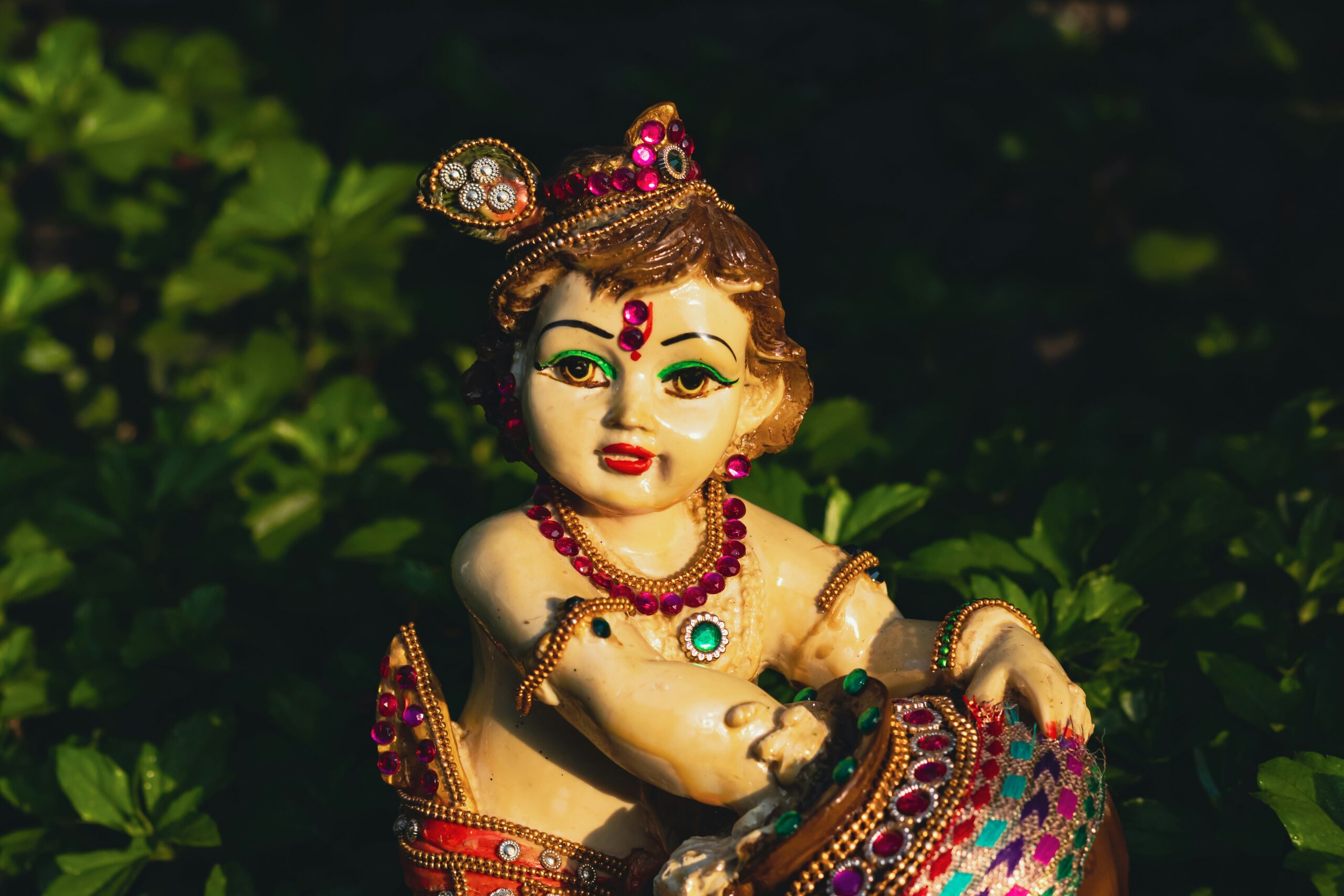
- Dark or blue skin. The name krishna itself means black, dark, or dark-blue. Artists render it as deep blue partly to signal the infinite — the colour of sky and ocean, of something whose edges you cannot find.
- The bansuri (flute). Hollow bamboo, which makes no sound of its own. It is the standing image in Vaishnava teaching for the devotee: emptied of self-will, it becomes an instrument the divine breath can play.
- The peacock feather. Worn in the crown or hair. Peacocks shed their feathers freely; the feather is also read as the eye that watches without judging.
- The tribhanga pose. The characteristic triple bend at neck, waist and knee — relaxed, almost dancing, never martial. Compare it to how warrior deities stand. The posture is the theology.
- Cows and the cowherd staff. Hence Govinda, “chief of herdsmen,” and Gopala, “protector of cows” — a word which also means protector of souls.
- The Sudarshana Chakra and the shankha (conch). His Vishnu attributes, carried in his four-armed and royal forms. Strikingly, these appear on the coinage of the Indo-Greek ruler Agathocles in the second century BCE — among the oldest surviving depictions of these emblems.
- Garuda. The eagle who serves as his vahana — the animal mount that both carries a deity and expresses something of their nature.
He is also worshipped in distinct child forms that have their own iconography and their own festivals: Bala Krishna the infant, Laddu Gopal the small image fed and dressed and put to bed in household shrines, and the cosmic child floating on a banyan leaf at the end of an age.
Major Temples of Krishna
Krishna worship is not concentrated in one region, and the images differ enough that a devotee from one tradition can find another’s unfamiliar.
- Krishna Janmasthan, Mathura — the traditional birthplace, and the focus of Janmashtami observance along with Vrindavan nearby.
- Vrindavan, Uttar Pradesh — Banke Bihari, Radha Raman, the ISKCON temple and dozens of others in a town built almost entirely around his childhood.
- Dwarkadhish Temple, Dwarka, Gujarat — Krishna as king, one of the Char Dham sites.
- Shrinathji, Nathdwara, Rajasthan — the Pushtimarg tradition of Vallabhacharya, where the image is served through an elaborate daily cycle of meals, dress and rest.
- Jagannath Temple, Puri, Odisha — Krishna as Jagannath, “lord of the world,” with Balarama and Subhadra, in a form unlike any other in India.
- Sri Krishna Matha, Udupi, Karnataka — founded in the Madhva tradition, where the image is viewed through a nine-holed window.
- Guruvayur, Kerala — Guruvayoorappan, worshipped largely as the child.
- Vithoba at Pandharpur, Maharashtra — the destination of the Warkari pilgrimage, where Krishna is Vitthal, standing with hands on hips, waiting.
Festivals Associated With Krishna
Krishna Janmashtami is his birthday: the eighth day (ashtami) of the dark fortnight of the month of Bhadrapada, falling in August or September. Devotees fast through the day, keep vigil, and mark the birth at midnight.
One practical caution. The tithi — the lunar day — does not align neatly with civil dates, and in some years it straddles two of them, which is why you will see two different Janmashtami dates circulating for the same year, with Smarta and Vaishnava observances sometimes falling on consecutive days. In 2026 that disagreement surfaced around the fourth and fifth of September. If you are reading this outside India, the problem compounds: panchang timings are calculated for a specific city, usually in IST, and a midnight observance in Delhi is not a midnight observance in Toronto or Melbourne. Always take your date and your muhurat from a panchang computed for your own location, or from your local temple.
Govardhan Puja or Annakut follows Diwali, commemorating the lifted hill with a mountain of offered food. Holi is strongly associated with him — nowhere more than in the Braj region, where the celebrations around Barsana and Nandgaon run for days and have their own local forms. Radhashtami, a fortnight after Janmashtami, marks Radha’s appearance.
Key Mantras
Three are in very wide use. As always, the sound and the attitude matter more than the count.
Om Namo Bhagavate Vasudevaya. The twelve-syllable mantra, central to the Bhagavata tradition: “I bow to the Lord, Vasudeva.” Simple, old, and usable by anyone.
The Hare Krishna maha-mantra. Sixteen words, made globally familiar by Chaitanya Mahaprabhu’s movement in the fifteenth century and by ISKCON in the twentieth. Its earliest known textual source is the Kali-Santarana Upanishad, where Brahma teaches the names to Narada — though scholars note that the date of that Upanishad is not firmly established, so claims about its great antiquity should be held loosely. A detail worth knowing: in the Upanishad the sixteen words are arranged beginning with Hare Rama, while the order chanted in Gaudiya practice begins with Hare Krishna. Both orderings are in use.
Hare Krishna Hare Krishna / Krishna Krishna Hare Hare / Hare Rama Hare Rama / Rama Rama Hare Hare.
Regional practice varies widely beyond these — the Pushtimarg, Madhva, Nimbarka and Gaudiya lineages each have their own initiatory mantras and their own disciplines around them, and a mantra received from a teacher is treated differently from one picked up from a book.
What Krishna’s Teaching Offers Today
It would be easy to end with something soothing. The Gita is not soothing. Its central instruction is harder than it looks, and more useful than most advice you will be given this year.
Act, and then let go of the result. Nishkama karma is not detachment from the work. It is detachment from the outcome — which, if you have ever shipped something and then refreshed the numbers forty times, you will recognise as the precise location of modern suffering. Krishna’s claim is that the quality of your action degrades when it is held hostage to its reception. Do the work properly; release the verdict. This is not resignation. Arjuna still has to fight.
Your duty is yours, not a better person’s. The Gita is unusually firm that doing your own imperfect work is better than performing someone else’s well. In a culture that invites constant comparison with other people’s visible lives, that is a load-bearing idea.
Devotion is open to everyone. The Gita’s most radical social move is to say that the path of bhakti — loving devotion — requires no learning, no ritual specialism, no lineage. A leaf, a flower, water, offered with love, is enough. The bhakti movements that swept India from the seventh century onward took that literally, and the poet-saints who carried it were weavers, cobblers, farmers and women shut out of temple learning.
And then there is the thing Krishna does that no amount of philosophy quite accounts for. He plays. He teases. He is late. He lets himself be scolded by his mother and outmanoeuvred by children. A tradition that puts the butter thief and the teacher of the Gita in one body is making a quiet claim: that seriousness and delight are not opposites, and that whatever the divine is, it is not grim.
Frequently Asked Questions About Lord Krishna
Is Krishna the same as Vishnu?
It depends on which tradition you ask, and both answers are legitimately Hindu. In the mainstream Vaishnava view Krishna is the eighth avatara of Vishnu — a descent of the preserver into the world. In Gaudiya Vaishnavism and the Nimbarka and Vallabha sampradayas, Krishna is Svayam Bhagavan, God in his own right, with Vishnu understood as an expansion of him rather than the other way round.
Was Radha Krishna’s wife?
Not in the earliest texts. Radha is not named at all in the Bhagavata Purana, and the Mahabharata does not know her as Krishna’s beloved. Her name appears in the Prakrit Gatha Saptasati around the first or second century CE, and her first major Sanskrit treatment is Jayadeva’s twelfth-century Gita Govinda. The Brahma Vaivarta Purana does describe a secret marriage, and the Nimbarka tradition treats her as his eternal wife; Gaudiya theology deliberately emphasises the unwedded, parakiya relationship as the higher love. The Bhagavata Purana names Rukmini as his principal queen, alongside seven others.
Why is Krishna blue?
His name literally means dark or dark-blue, and early descriptions give him a dark complexion. The vivid blue of calendar art is an interpretive choice rather than a scriptural description: blue is the colour of the unbounded — sky, deep water — and so stands in for a form whose limits cannot be found.
When is Krishna Janmashtami celebrated?
On the eighth day of the waning fortnight of Bhadrapada, which falls in late August or early September. Because the lunar day can straddle two civil dates, and because Smarta and Vaishnava traditions resolve that differently, two dates sometimes circulate for the same year — as happened in 2026 around 4 and 5 September. Panchang timings are computed for a specific city, so readers outside India should check a panchang for their own location rather than relying on IST figures.
What is the difference between Krishna in the Bhagavata Purana and Krishna in the Mahabharata?
Largely a difference of register and focus. The Mahabharata gives a political and ethical Krishna — kinsman, strategist, charioteer, teacher of the Gita — and barely touches his childhood. The Harivamsa appendix and then the Bhagavata Purana supply the Vrindavan years, and the Bhagavata recasts the whole life as lila, divine play, in a devotional and poetic voice. The Vrindavan Krishna most people love is largely the Bhagavata’s.
Which mantra should a beginner chant for Krishna?
Om Namo Bhagavate Vasudevaya is the usual recommendation: short, old, widely accepted, and attached to no particular initiation. The Hare Krishna maha-mantra is equally open to anyone. Lineage-specific mantras are traditionally received from a teacher, and practitioners within those sampradayas treat them differently from mantras learned from a book.
How did Krishna die?
After the Kurukshetra war and Gandhari’s curse, the Yadava clan destroyed itself in a drunken quarrel. Krishna lay down beneath a tree and was shot in the foot by a hunter named Jara, who had mistaken him for a deer. He forgave the man and departed. Bhalka Tirtha near Somnath in Gujarat is identified with the spot.
A Closing Thought
The locks opened on their own, in a prison, at midnight. That is the first thing that happens when Krishna arrives, and it is worth keeping as the image you carry out of his story — not the lifted hill or the parted river, but the quieter claim underneath them.
He is born into constraint and does not seem constrained. He loses the argument for peace and goes to the war anyway. He is cursed, watches his own people destroy each other, is killed by mistake by a stranger, and forgives him. Through all of it the flute keeps turning up. Whatever the tradition means by Krishna, it means something that can hold grief and play in the same hand — and that, more than any miracle, may be why he has never stopped being loved.
Continue Exploring
- Krishna – The Divine Guide of Mahabharata
- Who Is Lord Shiva? The Story, Symbolism and Worship of Mahadeva
- 10 Key Teachings of the Bhagavad Gita for Modern Life
- The Three Paths to Liberation in the Bhagavad Gita
- How to Chant Vishnu Sahasranama