
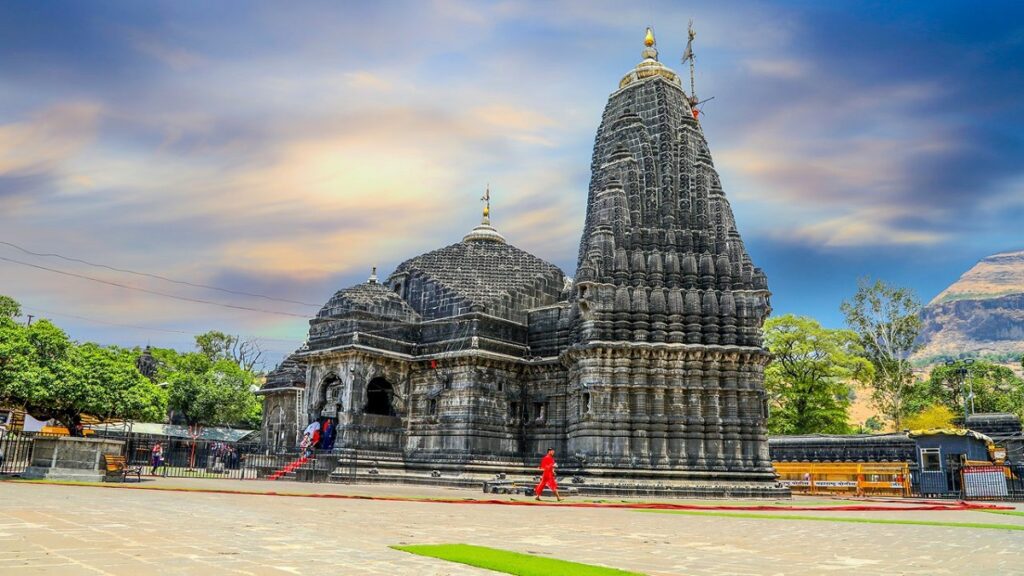
On a Shravan Monday, the queue at Trimbakeshwar begins forming while it is still dark. By late afternoon the crowd outside the north gate is thick enough that you move in inches rather than steps. And then, at around half past five, the priests bring out the Swarna Mukut — a jewelled golden crown, the face of the Trideva worked into its metal — and place it over the linga. For a few minutes the stone that most people have come to see disappears entirely behind gold.
That is the irony at the heart of this temple. The crown is spectacular, but what lies beneath it is not. Lower your eyes into the sanctum on an ordinary morning and you will not find a tall, proud shaft of stone. You will find a shallow hollow in the floor, water pooling in it, and in that water three small worn depressions, barely raised, like three thumbprints pressed into rock. That is the Jyotirlinga. Centuries of water and milk and bilva leaves have worn it almost flat.
Priests at Trimbak will tell you that the wearing-away is not damage. It is the point.
Where Trimbakeshwar Sits in the Tradition
Trimbakeshwar is one of the twelve Jyotirlingas — the shrines where Shiva is believed to have manifested not as a carved image but as a self-arisen column of light, jyoti. The twelve are scattered from Gujarat to Tamil Nadu, and completing all of them is one of the great ambitions of Shaiva pilgrimage in India. Somnath is the sea-shrine that kept being rebuilt. Mahakaleshwar is the Lord of Time at Ujjain. Trimbakeshwar is the one that is three.
No other Jyotirlinga has this form. The three faces in the stone are understood as Brahma, Vishnu and Shiva together — creator, preserver and dissolver sharing one seat. For that reason Trimbakeshwar is sometimes described as the Jyotirlinga where the whole of divinity, not one aspect of it, is present at once.
It is also the place where a river begins. The Godavari — the second-longest river in India, called Dakshin Ganga, the Ganga of the South — is held to rise on Brahmagiri, the hill that stands directly behind the temple. Pilgrims do not come to Trimbak only for Shiva. They come for the water.
And there is a reason to write about this temple now in particular. The Simhastha Kumbh Mela at Nashik and Trimbakeshwar, which comes once in roughly twelve years, is scheduled to open at the end of October 2026 and run into the following July. Trimbak is about to become one of the most crowded square kilometres in India.
The Legend: A Sage, a Cow, and a River That Would Not Leave
The story most often told at Trimbakeshwar belongs to the sage Gautama and his wife Ahalya, who lived in an ashram on the slopes of Brahmagiri.
A long and merciless drought had settled over the region. Gautama performed austerities until Varuna, the lord of waters, granted him a pit of water that would never run dry. Rice grew. Fruit ripened. Other sages and their families, with nothing left in their own fields, came to live off Gautama’s abundance — and then, as the story has it, resented him for having it.
What follows is the cruellest turn in the tale. A cow was sent to graze in Gautama’s field. When he moved to shoo it away — with a handful of straw, in most versions, nothing that could injure anything — the cow collapsed and died. Gautama stood accused of gohatya, the killing of a cow, one of the gravest sins a Brahmin could commit. He was cast out of his own community.
He did not protest. He asked what penance would clear him, and he performed it: circumambulations of Brahmagiri, the shaping and worship of a vast number of earthen lingas, and ritual bathing. At the end of it Shiva appeared — and said plainly that Gautama had never been guilty, and that the sin belonged to those who had framed him.
Gautama asked for one thing. Not vindication. He asked that the Ganga herself come down and flow here, so that anyone carrying guilt could wash in her. Ganga came, in the form that became known as the Gautami, which is the Godavari. And when she had come, the gods asked Shiva not to leave either. He stayed, as Trimbakeshwar.
It is worth being honest about this story’s sources. Trimbakeshwar’s own tradition traces the narrative to the Puranic corpus and recites it as handed down through Vyasa; the Shiva Purana is the text usually cited for the Jyotirlinga’s standing and for the merit of worshipping here. The details vary from one retelling to another — some versions bring in Varuna, some bring in Ganesha as the agent who sets the cow episode in motion, and at least one local tradition credits Vishnu, in his Trivikrama form, rather than Shiva with releasing the waters. If you hear a version at Trimbak that differs from the one above, that is normal, and not a sign that someone has it wrong.
Why the Linga Has Three Faces
The name carries the answer. Tryambaka is an ancient epithet of Shiva — it appears in the Rigvedic Mahamrityunjaya mantra, tryambakam yajamahe — and it is usually read as “the three-eyed one”, though some commentators read ambaka as “mother” and take it to mean the lord of three mothers or three worlds. Trimbakeshwar is the Tryambaka who is Ishwara, the lord.
At this shrine the three are made visible. The hollows in the stone are identified with Brahma, Vishnu and Shiva — and a devotee who has done the full round of Jyotirlingas will tell you that this is the only one where you are asked to see three where everywhere else you see one.
The erosion gets its own teaching. The linga at Trimbakeshwar has been worn down by the constant pouring of water over centuries, and the priests read that physical wearing as an image of kali yuga — the slow erosion of dharma in the world, visible in stone. Whether or not you find that persuasive, it is a striking thing to be told while looking at it.
The crown matters here too. Because the linga itself is so low and so worn, the silver and gold mask and the jewelled mukut placed over it are, for many pilgrims, the actual object of darshan. On Mondays and especially through the month of Shravan, the crown display draws crowds far larger than ordinary darshan does.
Brahmagiri and the Birth of the Godavari
Walk out of the temple and look up. The hill behind the town is Brahmagiri, flanked by Nilagiri and Kalagiri, and the whole of it is treated as sacred — Brahmagiri is regarded as a form of Shiva, which is why traditional pilgrims will not wear footwear on it and why the hill is circumambulated rather than simply climbed.
Somewhere on its slopes, at a spot called Gangadwar, the Godavari is said to emerge. The water descends and surfaces in the town at the Kushavarta Kund, the stepped tank a short walk from the temple, which is treated as the river’s formal source and is where pilgrims take the ritual bath that the Gautama story makes the whole point of coming here. The kund in its present built form is relatively recent — it was constructed by a Maratha-era noble, Sardar Raosaheb Parnerkar, whose bust stands at its edge — but the site’s sanctity long predates the masonry.
A caution worth having in advance: the Kushavarta is a working ritual tank, not a swimming pool. It can be very crowded, the steps are slippery, and during Simhastha it is one of the most tightly managed spaces in Maharashtra. Three other tirthas — Bilvatirtha, Vishwanathtirtha and Mukundatirtha — also lie within the temple precinct, and the temple’s own tank, Amritavarshini, measures roughly 28 by 30 metres.
History: Destroyed, Wagered, Rebuilt
The temple you walk into is not ancient. It is eighteenth-century.
An earlier structure on this site was destroyed during the reign of the Mughal emperor Aurangzeb. The present black basalt temple was built by the Peshwa Balaji Baji Rao — Nanasaheb — in the mid-eighteenth century, when Trimbak lay in the heart of Maratha power.
A story attaches to the rebuilding, and it is too good not to repeat with the caveat that it is a story. The Peshwa, it is said, made a wager that the rock surrounding the Jyotirlinga was hollow. It proved hollow, and he used the stone from it to raise the temple. Make of that what you will; the temple is certainly built of local basalt.
There is one more historical thread, and it is a strange one. A large diamond known as the Nassak Diamond once adorned the linga at Trimbakeshwar. It left India with the British after the Third Anglo-Maratha War in the early nineteenth century, was recut more than once, and is today in private hands abroad. The temple’s most famous ornament has not been in the temple for two hundred years.
Architecture: Hemadpanthi Basalt
Trimbakeshwar is built in the Hemadpanthi style — the dry-masonry idiom of the Yadava period in the Deccan, in which dressed stone blocks are fitted without mortar, named for the thirteenth-century minister Hemadpant with whom the style is traditionally associated. Here it is executed in black basalt, the hard volcanic stone of the Deccan plateau, which weathers to a deep grey-black and takes crisp carving.
What to look at, if you can get a moment free of the crowd: the sculpted bands on the outer walls, the carved pillars of the sabha mandapa, the stone-cut lotus and floral panels, and the shikhara rising in receding tiers with an amalaka and kalasha at the top. The temple faces the hill rather than being oriented purely to the cardinal points, which gives the whole complex a sense of being addressed to Brahmagiri.
It is a compact temple by the standards of the great southern complexes. There is no vast enclosure, no towering gopuram. The impression is of density rather than scale — dark stone, close quarters, a lot of people.
The Rituals Trimbakeshwar Is Known For
Trimbakeshwar occupies a particular place in Hindu ritual practice: it is the principal site for a set of expiatory and ancestral rites that are difficult to have performed elsewhere.
Narayan Nagbali
A three-day rite performed, by long tradition, at Trimbakeshwar. It is undertaken for the release of unfulfilled ancestral obligations and for the expiation of the sin of having caused the death of a serpent — a sin that in this tradition is understood to carry consequences down a family line. People come to it seeking relief from recurring misfortune, childlessness, illness or persistent financial trouble. The rite can only be performed on certain days of the Hindu calendar, so dates must be arranged in advance.
Kaalsarp Shanti
Performed for those whose horoscope is read as carrying kaalsarp yoga, a particular planetary configuration. Trimbakeshwar is one of the best-known places in India for it.
Tripindi Shraddha
A rite for ancestors whose death rituals were not completed, or for three generations of forebears at once.
A practical and honest word on all three. These rituals are a genuine part of the tradition and are taken very seriously by the families who come for them. They are also, at Trimbak, a substantial local economy. Prices are not fixed, touts operate around the temple and the bus stand, and visitors are sometimes quoted figures that bear no relation to what a neighbour paid for the same rite. If you intend to have any of these performed, arrange it in advance through the temple trust or a priest recommended by someone you actually know, settle the cost before you begin, and do not let anyone tell you that a larger payment produces a better result. Nothing in the tradition supports that.
The Simhastha Kumbh at Trimbakeshwar
Every twelve years or so, when Jupiter enters Leo — Simha, hence Simhastha — Nashik and Trimbakeshwar host one of the four great Kumbh Melas. The coming cycle is listed as running from late October 2026 into late July 2027, with the major bathing days spread through that period rather than concentrated in a single week. Anyone planning a visit in that window should check the official dates with the Nashik district administration and the temple trust, because bathing-day schedules and crowd-control arrangements are typically finalised and revised close to the event.
The history of the Nashik-Trimbak Kumbh is itself instructive about how living traditions change. Until the late eighteenth century the fair was held at Trimbak alone. After a violent clash over bathing precedence between Shaiva sanyasis and Vaishnava bairagis, the Peshwa separated them — moving the Vaishnava bathing to Ramkund at Nashik, while the Shaivas retained Trimbak. The two-site arrangement that pilgrims now treat as traditional is the settlement of an old quarrel. Scholars also note that the identification of this particular Nashik fair with the pan-Indian Kumbh narrative is a relatively recent development.
Crowds at Nashik-Trimbak Kumbh have run into the tens of millions. There was a fatal stampede at Ramkund in 2003. If you go during Simhastha, go with a plan, keep children physically held rather than nearby, avoid the peak bathing hours if you have any choice, and follow the police barricading even when it seems to be sending you the long way round.
A Practical Guide to Visiting Trimbakeshwar
Where it is and how to reach
Trimbakeshwar is in the town of Trimbak, Nashik district, Maharashtra, roughly 28–30 km west of Nashik city — about forty-five minutes to an hour by road, with frequent state transport buses and shared taxis from Nashik’s Old CBS bus stand. The nearest railhead is Nashik Road, around 30–40 km away depending on your route. For flights, Nashik’s Ozar airport is closest but thinly served; most visitors fly into Mumbai and drive, which is about 165–180 km and four and a half to five hours via Kasara and Igatpuri. From Pune it is roughly 210–240 km. Shirdi is about 115–120 km away, which is why the two are so often combined into one trip.
Darshan timings
The temple is generally open from around 5:30 in the morning until about 9 at night, with the sanctum closed to the public during the main ritual periods: Mangal Aarti around 5:30–6:00 am, the midday Madhyanha Puja around 12:30–1:00 pm, a closure for bhog in the late afternoon around 4:00–5:00 pm, and Shej Aarti around 9:00–9:30 pm, after which the temple closes. The golden crown is placed on the linga in the early evening, and crown darshan on Mondays is the single busiest slot of the week.
Treat all of that as indicative rather than exact. Published timings differ slightly between sources, and they change during Shravan, on festival days and through Simhastha. Confirm with the Trimbakeshwar Devasthan Trust before you build a travel day around them.
Queues and the donation pass
General darshan is free. The trust also offers a paid donation or VIP pass — commonly cited at around ₹200 per person on ordinary days and higher on Shravan Mondays and festival days — which gives access to a separate, faster queue, with darshan from outside the sanctum. Passes can be booked through the trust’s official website; carry the pass and a photo ID. Rates and arrangements change, so check current figures rather than relying on any blog, including this one.
Dress code
There is no elaborate formal dress code for general darshan, but modest traditional clothing is expected and in practice enforced: shorts, sleeveless tops and overtly Western outfits are turned away. For men, a dhoti or kurta-pyjama; for women, a saree or salwar kameez. If you are having a puja performed, the requirement is stricter — men are usually required to wear a plain cotton dhoti, with shirts and trousers set aside, and women a saree or salwar kameez. Cotton is sensible in the heat, leather accessories are best left behind, and there are changing facilities near the temple.
Best time to visit
October to March is the comfortable window: cool, dry, and clear. The monsoon from June to September is spectacular here — the Sahyadris turn green and the waterfalls off Brahmagiri run — but the hill paths become genuinely dangerous and the town is wet and congested. Shravan, usually falling in July–August, is the most devotionally charged month and the most crowded; Mahashivaratri is extraordinary and nearly impossible. For a quiet darshan, aim for a weekday morning outside Shravan, early.
Brahmagiri and the walk to Gangadwar
A stone stairway climbs from the town towards Gangadwar on Brahmagiri — several hundred steps, steep in places, with the full circuit to the top taking most people two to three hours up and down. Traditional pilgrims make the climb barefoot because the hill is held to be Shiva himself. Go early, carry water, and skip it in the monsoon or if the rock is wet.
Nearby
Within easy reach: the Nivrittinath Samadhi temple at the foot of Brahmagiri, dedicated to the eldest of the four Varkari sibling-saints and a major pilgrimage in its own right; the Gorakhnath cave on the hill; Anjaneri, a fort and hill some way back towards Nashik that local tradition identifies as the birthplace of Hanuman; and the Vaitarna reservoir. Nashik itself, with Ramkund and the Panchavati ghats, is a half-day.
What Devotees Come Here to Seek
Every Jyotirlinga has a character in the devotional imagination. Kashi Vishwanath is liberation. Mahakaleshwar is the conquest of time and of fear. Trimbakeshwar is release from what you are carrying on behalf of someone else.
That is the thread running through all of it. Gautama was punished for something he had not done. The rituals the temple is famous for — Narayan Nagbali, Tripindi, Kaalsarp Shanti — are almost all concerned with inherited burdens: an ancestor’s unfinished business, a family line’s accumulated weight, a configuration in a horoscope that nobody chose. People come to Trimbak when something has gone wrong for a long time and they cannot locate the fault in themselves.
And the answer the temple’s own founding story gives is not that you must pay for it. It is that Shiva arrived and said: you were never guilty. Here is a river. Wash.
Why Trimbakeshwar Matters Today
It is easy to be cynical about a temple whose main business is the removal of inherited misfortune. There are touts outside it. There are priests who will quote you an inflated figure. A sceptic can walk through Trimbak and see only a market in anxiety.
But look at what the tradition actually built here, and something more interesting appears. Trimbakeshwar is a piece of ritual architecture designed around a specific human problem: the experience of suffering for something that is not your fault, and not knowing where to put it. Families carry things — a grandfather’s broken promise, a death that was never properly mourned, a run of bad years nobody can explain. Modern life gives you almost no formal way to address that. You can talk about it, which helps. You cannot do anything about it.
What a rite like Tripindi Shraddha offers is an action. Three days, a specific place, water, fire, named ancestors, a beginning and an end. Anthropologists would call it a ritual of closure, and would point out that closure rituals work partly because they are bounded in time — after them, you are permitted to stop carrying the thing. You do not have to accept the metaphysics to see that this is a sophisticated response to grief and guilt, and that it has been refined by a great many generations of people who needed it.
There is a second, plainer lesson in the Gautama story, and it has nothing to do with ritual. A community turned on a man because he had something they needed and they could not bear being dependent on him. They framed him for the thing he would find hardest to live with. He went quietly and did the penance anyway. And the verdict that eventually came was not that he had been strong, but that he had been innocent all along.
Most of us will at some point be Gautama. Some of us, honestly, will be the sages. The story is told at Trimbakeshwar as the origin of a river, but it works just as well as a warning about what resentment does to people who are otherwise devout.
Frequently Asked Questions
Which Jyotirlinga is Trimbakeshwar, and what makes it different?
Trimbakeshwar is counted among the twelve Jyotirlingas and is traditionally listed tenth. It is the only one where the linga has three distinct faces, understood as Brahma, Vishnu and Shiva together, and the only one identified as the source of a major river, the Godavari.
Why is the Trimbakeshwar linga so small and worn?
Because it has had water, milk and offerings poured over it continuously for centuries, which has eroded the stone almost flat. The three faces now appear as shallow depressions in a hollow filled with water. The temple reads the erosion as an image of the gradual wearing-away of dharma in the present age. A gold mask and jewelled crown are placed over the linga at certain hours, and for many pilgrims that is the darshan they actually see.
Is the Godavari river really born at Trimbakeshwar?
The Godavari’s traditional and widely accepted source is on Brahmagiri hill at Trimbak, at a spot called Gangadwar, with the Kushavarta Kund in the town treated as the formal source where pilgrims bathe. Hydrologically, rivers rarely have a single tidy origin point and the Godavari’s headwaters involve several streams off the same hill, which is reflected in the tradition that three sources rise from Brahmagiri.
What are the darshan timings at Trimbakeshwar temple?
Broadly 5:30 am to about 9:00 pm, with the sanctum closed to the public during Mangal Aarti in the early morning, Madhyanha Puja around midday, a late-afternoon bhog closure, and Shej Aarti at night. Timings are not identical across sources and change during Shravan, festivals and the Simhastha Kumbh, so confirm with the Trimbakeshwar Devasthan Trust before travelling.
Can anyone perform Narayan Nagbali at Trimbakeshwar, and what should it cost?
Yes, it is open to anyone who wishes to have it performed, but it runs over three days and is restricted to particular days in the Hindu calendar, so it has to be booked in advance. Costs are not standardised and vary widely between priests. Arrange it through the temple trust or a priest you have a personal reference for, agree the amount before the rite begins, and treat anyone promising better results for a bigger payment as a reason to walk away.
What is the dress code at Trimbakeshwar?
Modest traditional Indian clothing. Shorts, sleeveless tops and Western outfits are not permitted inside. For pujas the requirement is stricter, typically a plain cotton dhoti for men and a saree or salwar kameez for women. Changing facilities are available near the temple.
When is the next Kumbh Mela at Trimbakeshwar?
The Simhastha Kumbh at Nashik and Trimbakeshwar is scheduled to begin at the end of October 2026 and continue into July 2027, with bathing days distributed through that period. Because the schedule depends on astronomical calculations and is subject to administrative revision, verify dates with the Nashik district administration closer to the time.
A Closing Thought
Most temples are built to make something visible. Trimbakeshwar has done the opposite: the thing it exists to show has almost worn away, and is covered in gold for part of the day besides. You stand in a dark basalt chamber looking into a few inches of water at three faint hollows, and then you walk out, climb towards the hill, and bathe in a tank fed by a river that a sage once asked for on behalf of people who had wronged him.
There is no grandeur in it. There is something better: a place that has been receiving other people’s inherited troubles for a very long time, and has not yet run out of patience.
Continue Exploring
- Who Is Lord Shiva? The Story, Symbolism and Worship of Mahadeva
- Somnath Temple: The First Jyotirlinga and the Shrine That Kept Being Rebuilt
- Mahakaleshwar Jyotirlinga, Ujjain: The Shrine of the Lord of Time
- Mallikarjuna Jyotirlinga, Srisailam: Where Shiva and Shakti Sit Together
- Kashi and Its Significance for Hinduism