
Some time in the monsoon, on a two-lane road in eastern Bihar, you can stand at the edge of a highway and watch a river of saffron go past on foot. They are barefoot. Each one carries a decorated bamboo pole across one shoulder with two sealed pots of Ganga water hanging from its ends, and the pole must not touch the ground for a hundred and five kilometres. They walk at night when the tar is cool. They call to each other in a rhythm, and they keep walking for days, and at the end of it they reach a black stone roughly the size of a melon in a town in Jharkhand, and they pour the water over it.
In 2024 that crowd numbered over four million people. The Jharkhand government describes the fair around it as the longest religious fair in the world. And the stone they are walking to is one of the twelve Jyotirlingas — the “lingas of light,” the sites where Hindu tradition holds that Shiva manifested not as an image made by hands but as a column of fire with no top and no bottom.
This one is called Vaidyanath, and of the twelve it is the only one whose address is genuinely disputed.
Where This Jyotirlinga Sits in the Tradition
The Shiva Purana gives the founding story of all twelve. Brahma and Vishnu fall into an argument over which of them is supreme. A pillar of light appears between them, and they set off in opposite directions to find its ends. Neither can. Shiva then reveals himself as the light itself — the point being that the divine has no boundary you can walk to. The Jyotirlinga shrines mark places where that pillar is said to have shown itself. Tradition speaks of sixty-four such manifestations, of which twelve are held most sacred.
Vaidyanath’s name is the key to its particular character. Vaidya means physician. Natha means lord. This is Shiva as the healer — the lord of physicians — and it is the Jyotirlinga people go to with illness, with a diagnosis they are frightened of, with a child who is not getting better. The Matsya Purana refers to the site as Arogya Baidyanathitee — Baidyanath the place of health. That is an old association, and it still shapes what you overhear in the queue.
The Dispute: Three Temples, One Jyotirlinga
Here the honest account diverges from most of what you will read online, so it is worth setting out plainly.
Three temples claim to be the Vaidyanath Jyotirlinga:
- Baba Baidyanath Dham, Deoghar, Jharkhand — by far the largest pilgrimage, the one the Kanwar Yatra converges on, and the site most widely accepted across India today.
- Shri Vaijnath Temple, Parli, Beed district, Maharashtra — whose claim is supported by the Dvadasa Jyotirlinga Smaranam, a traditional Sanskrit enumeration which places Vaidyanatha at Parli.
- Baijnath Temple, Kangra, Himachal Pradesh — an ancient Shiva temple whose name and dedication have long been read as a claim to the same identity.
The Dvadasa Jyotirlinga Stotram, the devotional hymn most often recited to name the twelve, describes Vaidyanatha as dwelling with Girija — Parvati — in a north-eastern place it calls Prajvalikanidhana. That phrase has been read as supporting the eastern (Deoghar) identification, but the hymn does not name a modern town, and the reading is inferred rather than stated.
The Government of India has never formally notified any one temple as the Jyotirlinga, and none of the three has withdrawn its claim. The friction is live, not historical: in January 2018, when the Madhya Pradesh government and the Mahakaleshwar temple management convened priests from all twelve Jyotirlingas and invited the priests of Parli, the Deoghar priests objected and lodged a formal protest with both the state government and the Mahakaleshwar administration.
What should a pilgrim make of that? Probably this: the three traditions have each been continuous and sincere for centuries, the textual evidence genuinely points in more than one direction, and no honest writer can hand you a verdict. The rest of this guide describes Deoghar, because that is where the great pilgrimage goes and what most readers mean when they say Vaidyanath. It is not a ruling on the question.
The Legend: Ravana, Nine Heads and a Shepherd Named Baiju
The Deoghar legend is one of the most vivid in the whole Jyotirlinga cycle, and unusually it casts Ravana — the demon-king of the Ramayana — not as a villain but as the most extreme devotee Shiva ever had.
Ravana undertakes a penance of such severity that he offers his own heads into the fire, one after another. Nine are gone. Shiva appears before the tenth and grants him a boon, and Ravana asks for the thing he wants most: to take Shiva home. He wants the Kamna Linga — the wish-fulfilling linga — carried to Lanka so that his own kingdom becomes Shiva’s dwelling.
Shiva agrees, with one condition. Once the linga is set down on the ground along the way, it will stay there.
The gods, alarmed at the prospect of Shiva relocating to Lanka, intervene. Vishnu arranges for Varuna, lord of waters, to enter Ravana’s body and create an urgent and undeniable need to relieve himself. Ravana, desperate, hands the linga to a shepherd standing nearby — a man named Baiju — and asks him to hold it. Baiju, left standing there, eventually sets it on the ground and walks away.
Ravana returns and cannot lift it. He pulls at it until his thumb leaves a depression in the stone, which devotees are still shown. Then he gives up, and the gods worship the linga where it stands, and Shiva has remained in Deoghar since.
Hence the two local names for the deity: Ravaneshwar, the lord of Ravana, and Kamna Linga, the linga of desires. And hence the name Baidyanath is sometimes linked in local telling to Shiva healing Ravana’s self-inflicted wounds — the physician who repairs the devotee who has gone too far.
One note of care: the legend has several regional variants, and the shepherd is called Baiju in some retellings and given other names in others. The core — Ravana’s penance, the condition, the interruption, the linga that would not move — is stable across versions.
The Temple: Twenty-Two Shrines and a Crown of Tridents
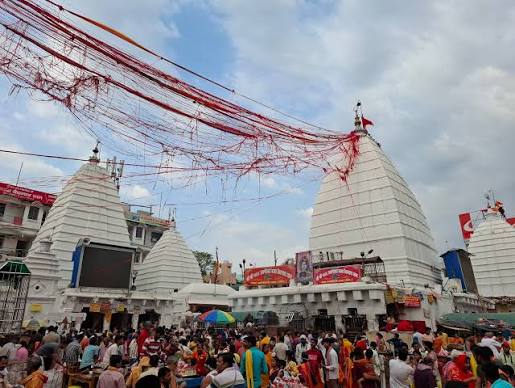
What you actually walk into at Deoghar is not a single temple but a walled courtyard holding twenty-two of them: the central shrine of Baba Baidyanath and twenty-one others, dedicated to a range of deities, arranged around and behind it. Pilgrims circumambulate the complex and visit many of them in sequence.
The main temple is built in the Nagara style — the north Indian temple idiom, identifiable by its curvilinear tower — here rising as a pyramidal shikhara to a height of roughly twenty-two metres, about seventy-two feet. Unlike the sculptural extravagance of Khajuraho or Konark, Baidyanath is comparatively plain on the outside. The impression is of weight and age rather than ornament.
Crowning it are three gilded vessels and, above them, the feature that has become the temple’s signature: the Panchshul. The name means five tridents, and it is a trident-form emblem set at the summit, understood as the mark of Shiva’s power and, in local belief, as the temple’s protection. You will find different accounts of exactly how the five are counted and arranged across the complex — sources describe it variously — so it is best treated as a distinctive emblem whose precise interpretation varies rather than a settled piece of iconography.
The linga itself is modest: a dark stone of no great size, worn smooth, bathed continuously in water and milk, and marked by the depression attributed to Ravana’s thumb.
The Gathbandhan and the Shakti Peetha
This is the detail that makes Baidyanath different from the other eleven, and it is worth going out of your way to notice.
Facing the main shrine across the courtyard is a temple of Parvati, and the two are physically joined by heavy red sacred threads strung overhead between them. The threads represent the marriage of Shiva and Shakti — the divine couple not as two shrines near each other but as two shrines tied together.
Devotees perform gathbandhan here: the tying of a knot, the same ritual gesture that binds the garments of a bride and groom in a Hindu wedding. Couples come specifically for it. At most Jyotirlingas you worship Shiva. Here the architecture insists you worship a marriage.
The Parvati shrine is also counted, in many traditional lists, among the Shakti Peethas — the sites where parts of the goddess Sati’s body are said to have fallen. The goddess here is known as Jai Durga. A caution worth stating: Shakti Peetha lists vary considerably between texts and regional traditions, with the number given as four, eighteen, fifty-one or one hundred and eight depending on the source, and the particular body part assigned to a site often differs between them. Baidyanath’s inclusion is widely attested; the specifics should be read as tradition rather than as a single agreed scripture.
Shiva and Shakti sitting together at one site is not unique — Mallikarjuna at Srisailam is celebrated for the same reason — but the red threads and the knot-tying make Deoghar’s version unusually literal.
History: What Is Known and What Is Not
The honest answer about the building’s age is that it is not settled. The site is referred to in the Matsya Purana, placing veneration there early. Local tradition credits the temple’s establishment to a figure named Raja Beiju Bhil — a legendary rather than documented founder. The present structure has been repaired and rebuilt repeatedly, and no single construction date can be stated with confidence.
The documented history is clearer from the medieval period onward. The region came under the Kings of Gidhaur, whose princely state was founded in 1266 by Raja Bir Vikram Singh, and who were associated with the temple’s patronage for centuries.
After the Battle of Plassey in 1757 the East India Company took an administrative interest. An English collector named Keating oversaw the temple’s administration, and in 1788 his assistant Hesilrigg was deputed to supervise pilgrim offerings — a revenue interest as much as a religious one. Keating later withdrew from direct interference and handed full control back to the temple’s high priest. Today the temple is governed by the Baba Baidyanath Temple Management Board.
The Shravani Mela: The World’s Longest Religious Fair
Through the entire lunar month of Shravan — roughly July to August — Deoghar is transformed.
Pilgrims known as kanwariyas gather at Ajgaibinath Dham in Sultanganj, Bihar, the one place on the Ganga where the river runs north. There they fill sealed pots with Ganga water, hang them from a decorated bamboo kanwar, and walk roughly 105 kilometres to Deoghar. They wear saffron. They go barefoot. The kanwar must not be set down on the ground for the entire journey — which means resting means hanging it from a stand, and means the discipline is genuinely punishing. Many bathe in Shivganga lake at Deoghar before joining the darshan queue, then perform abhishek, the ritual bathing of the linga, with the water they carried.
Over four million people did this in 2024. Most then continue to Basukinath temple, roughly an hour’s drive away, which tradition treats as the necessary completion of the journey.
Some undertake it as dak bam — covering the distance in a single continuous run without rest. If you are visiting in Shravan, understand what you are joining: it is extraordinary, and it is not a comfortable sightseeing trip. Darshan queues run for many hours.
On dates: Shravan falls in July–August, but its exact span depends on whether your regional calendar reckons months from full moon (purnimanta) or new moon (amanta), so the mela’s start and end shift accordingly and differ between Bihar, Jharkhand and the south. Check the current year’s dates against your own regional panchang. Mahashivratri, in February or March, is the other peak, and the temple’s hours are extended on both occasions.
Practical Visit Guide
A caution before the details: temple timings, fees and arrangements change, sometimes at short notice and often during festival periods. Everything below should be confirmed against the official temple website, babadham.org, or by phoning ahead, before you travel. Treat it as orientation, not as a timetable.
Darshan Timings
The temple’s official site lists the following daily schedule:
- 4:00 AM — the pat (sanctum door) opens
- 4:10 AM — Kancha Jal, the first offering of holy water
- 4:00 PM — the pat closes for the afternoon
- 6:00 PM — the pat reopens for evening darshan
- 6:10 PM — Shringar Puja, the ritual adornment of the deity
- 8:00 PM — the pat closes
Two genuine inconsistencies, stated rather than smoothed over. The official page’s own summary line gives the temple as open 4:00 AM to 9:00 PM, which does not match its 8:00 PM closing in the table. And several widely-read third-party sites list a quite different schedule — morning darshan 5:30 AM to 3:30 PM and evening darshan 6:00 PM to 9:00 PM. Where the temple’s own site and aggregator sites disagree, prefer the temple’s site, and verify on the day.
During Shravani Mela and Mahashivratri the hours are extended substantially, and the schedule above does not apply.
Entry, Fees and Special Darshan
General darshan is free. Third-party sources report a VIP or priority darshan option at around ₹500 per person for Indian citizens and ₹1,000 for foreign nationals, offering a separate queue; I was not able to confirm those figures on the temple’s official pages, and priority access still involves waiting at peak times. Rudrabhishek and other sponsored pujas can be arranged through the temple administration and through local pandas, with charges varying by ritual. Confirm current rates directly rather than through booking intermediaries.
Dress Code
The temple’s official site does not publish a formal dress code, and I could not verify one from an official source — so what follows is customary practice rather than a stated rule. Modest traditional clothing is expected: for men a kurta-pyjama or dhoti; for women a saree or salwar-kameez. Shoulders and knees covered. Shorts, very short skirts and sleeveless tops will draw objection. Footwear is removed well before the entrance, and there are deposit counters. Many devotees bathe before darshan, and during the mela most arrive already wet. Leather items are best left behind.
How to Reach Deoghar
By air: Deoghar Airport (DGH) is about 9 km from the temple, with connections to Delhi, Mumbai, Bengaluru and Kolkata. Patna and Gaya are larger alternative airports, considerably further by road.
By train: Jasidih Junction is the main railhead, roughly 7 km away, on the Howrah–Delhi main line and served by Rajdhani and Vande Bharat services. A short branch line runs from Jasidih to Baidyanathdham station, which is closer to the temple but served by far fewer trains. For most travellers Jasidih plus a short taxi or auto is the practical route.
By road: Deoghar is well connected by bus and taxi to Dumka, Bhagalpur, Dhanbad and Ranchi. Expect heavy congestion and road restrictions during Shravan.
Best Time to Visit
If you want the overwhelming devotional spectacle, go during Shravan and accept the crowds, the heat, the rain and the queues. If you want to actually stand in front of the linga without being carried past it, go in October to March, on a weekday, avoiding Mondays — Shiva’s day, and the busiest of the week. Early morning, shortly after the 4:00 AM opening, is the calmest darshan of the day in any season.
Nearby Sites
- Basukinath Temple — about an hour away, traditionally treated as completing the Baidyanath pilgrimage.
- Naulakha Mandir — a tall nineteenth-century shrine in Deoghar itself, architecturally quite unlike the main temple.
- Trikut Pahar — a three-peaked hill with a ropeway, associated with the sage Atri, a short drive from town.
- Tapovan — caves and a hilltop shrine on Deoghar’s outskirts, long used by ascetics.
- Shivganga — the tank beside the temple complex where pilgrims bathe before darshan.
What Devotees Seek Here
Every Jyotirlinga has a character, and Baidyanath’s is health.
Because this is Shiva the physician, people come here with bodies that are failing — their own or someone else’s. The Matsya Purana’s name for the place, Arogya Baidyanathitee, makes the association roughly two millennia old. Stand in the courtyard for twenty minutes and you will hear it: prayers for a scan result, for a parent in hospital, for a treatment to work.
And because this is the Kamna Linga, the wish-fulfilling linga, it also draws people with ordinary unfinished hopes — a marriage, a child, a job. The gathbandhan threads draw couples specifically, and newly married pairs come to tie a knot where Shiva and Shakti are tied.
There is something fitting in that combination, and it is the reason the Ravana legend sits at the centre of this particular shrine rather than another. The devotee in that story wants too much. He asks to carry God home and keep him. He is denied, and in the denial he gets something he had not asked for: the god stays in the world, reachable, where anyone can come to him. The desire is not punished. It is redirected into a place.
Frequently Asked Questions
Which is the real Vaidyanath Jyotirlinga — Deoghar or Parli?
There is no official answer. Three temples claim it: Baba Baidyanath Dham in Deoghar (Jharkhand), Shri Vaijnath in Parli (Maharashtra) and Baijnath in Kangra (Himachal Pradesh). The Dvadasa Jyotirlinga Smaranam places Vaidyanatha at Parli; the Dvadasa Jyotirlinga Stotram points to a north-eastern location without naming a town, which is read as supporting Deoghar. The Government of India has notified none of them, and the dispute remains active — Deoghar’s priests formally protested when Parli’s were invited to a gathering of the twelve Jyotirlingas in 2018. Deoghar is the most widely accepted and by far the largest pilgrimage, but that is popular consensus, not an adjudication.
What are the darshan timings at Baba Baidyanath Dham, Deoghar?
The temple’s official site lists the door opening at 4:00 AM with Kancha Jal at 4:10 AM, closing at 4:00 PM, reopening at 6:00 PM with Shringar Puja at 6:10 PM, and closing at 8:00 PM. Note that the same official page elsewhere states 4:00 AM to 9:00 PM, and several third-party sites list 5:30 AM–3:30 PM and 6:00–9:00 PM instead. Timings are extended during Shravan and Mahashivratri. Verify on babadham.org before travelling.
Why is this Jyotirlinga called Vaidyanath?
Vaidya means physician and natha means lord — so Vaidyanath is Shiva as the lord of healers. The Matsya Purana refers to the site as Arogya Baidyanathitee, “Baidyanath of health,” and the shrine has been associated with healing for roughly two thousand years. Local tradition also connects the name to Shiva healing the wounds Ravana inflicted on himself during his penance.
What is the Panchshul at Baidyanath temple?
It is the trident-form emblem set at the summit of the temple, above three gilded vessels. The name means five tridents, and it is understood as the sign of Shiva’s power and as the temple’s protection — a feature particular to Baidyanath. Accounts differ on exactly how the five are counted across the complex, so descriptions you read will not always agree.
What is the Kanwar Yatra to Deoghar and how long is it?
Pilgrims collect Ganga water at Ajgaibinath Dham in Sultanganj, Bihar, and carry it roughly 105 kilometres on foot to Deoghar, barefoot and in saffron, without letting the kanwar touch the ground. It runs through the month of Shravan (July–August) as part of the Shravani Mela, which drew over four million participants in 2024. On arrival they bathe the linga with the water they carried, and most then continue to Basukinath temple.
Is Baidyanath Dham also a Shakti Peetha?
The Parvati temple in the complex, where the goddess is known as Jai Durga, is counted among the Shakti Peethas in many traditional lists, and is joined to the main shrine by red threads representing the marriage of Shiva and Shakti. Shakti Peetha lists vary widely between texts — four, eighteen, fifty-one and one hundred and eight are all attested, with differing assignments — so Baidyanath’s inclusion is well attested while the specifics are tradition rather than a single settled scripture.
What is the dress code at Baidyanath temple?
No formal dress code is published on the temple’s official site. Customary practice is modest traditional dress — kurta-pyjama or dhoti for men, saree or salwar-kameez for women, shoulders and knees covered. Shorts and sleeveless tops are best avoided. Footwear is removed before entering, with deposit counters available.
A Closing Thought
Three temples claim this linga, the texts disagree, and the government has declined to rule. You might expect that to weaken the place. Stand in Deoghar in Shravan and it clearly does not.
What four million people are walking a hundred kilometres barefoot to reach is not a settled historical fact. It is a stone that would not move, and a god who agreed to stay where he was set down. The devotee in the story wanted to take Shiva home with him and was refused — and the refusal is the whole gift, because it left the shrine standing in a field in eastern India where a shepherd and a frightened parent and a newly married couple can all reach it.
The red threads overhead say the rest. Whatever you came here carrying, you are not standing in front of power alone. You are standing in front of a marriage.
Continue Exploring
- Who Is Lord Shiva? The Story, Symbolism and Worship of Mahadeva
- Somnath Temple: The First Jyotirlinga and the Shrine That Kept Being Rebuilt
- Mallikarjuna Jyotirlinga, Srisailam: Where Shiva and Shakti Sit Together
- Kedarnath Temple: The Highest Jyotirlinga and a Complete Pilgrim’s Guide
- Mahakaleshwar Jyotirlinga, Ujjain: The Shrine of the Lord of Time