
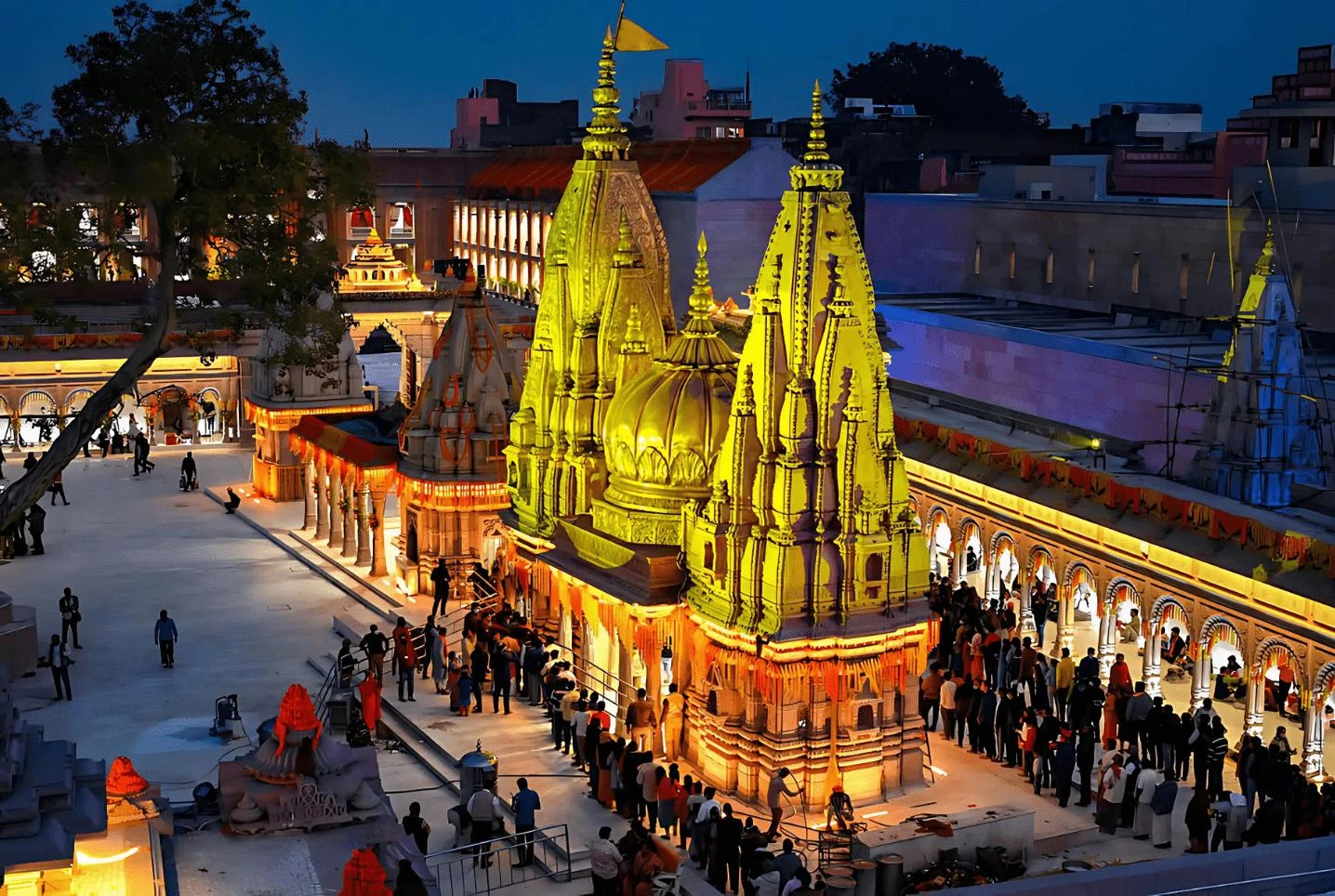
At a quarter to three in the morning, Vishwanath Gali is almost silent. The flower sellers have not opened. The lane is barely wide enough for two people to pass, and the stone underfoot is wet from the night wash. A few hundred people stand in a queue that bends out of sight, holding nothing, because nothing is allowed inside — no phone, no bag, no camera. Then somewhere ahead a conch sounds, a bell answers it, and the Mangala Aarti — the waking of the Lord — begins in a chamber most of the queue cannot yet see.
This happens every single morning, and it has happened, in one building or another, on one adjacent plot or another, for longer than almost any continuously worshipped site on earth. The temple has been pulled down at least four times. The lingam has been hidden in a well. The present structure is less than 250 years old and was built by a widowed Maratha queen. And still, every day, roughly 45,000 people come to stand in that lane.
This is the Kashi Vishwanath Temple, and understanding it means understanding something that is not quite like any other Hindu shrine.
Why Kashi Is Not Just Another Pilgrimage Town
Most holy places in India are holy because something happened there. Kashi is different: in the tradition’s own self-understanding, Kashi is holy because Shiva lives there. Not visited, not manifested once — resides.
The Kashi Khanda, a long section of the Skanda Purana devoted entirely to this city, and the Kashi Rahasya portion of the Brahmavaivarta Purana, both build the same picture. Kashi is Avimukta — the never-forsaken — the one place Shiva does not abandon, not even at the dissolution of the world. A widely repeated devotional image holds that the city rests on the tip of Shiva’s trident, lifted clear of the ordinary earth and therefore clear of ordinary destruction. You should read that as theology rather than geology, which is exactly how the texts intend it.
The Kashi Khanda also gives a number worth knowing: it describes 1,099 temples in the city, of which 513 were Shiva shrines. Whether the count is a census or a devotional flourish is impossible to settle, but it tells you what kind of place this was understood to be — a city that is itself a temple, with Vishwanath at its centre.
And that centre carries a particular promise. Kashi is a mukti-kshetra, a place of liberation. The tradition says that one who dies within its sacred boundary receives the Taraka mantra — the ferrying word — whispered by Shiva himself, and does not return to the cycle of rebirth. It is why the dying still come. It is why Manikarnika’s cremation fires have not gone out in living memory. If you want the fuller picture of the city itself, we have written about Kashi and its significance for Hinduism separately; this post stays with the temple.
Vishwanath: The Lord of All That Is
The deity’s name is a claim. Vishwanath joins vishwa, meaning the universe or all-that-exists, to natha, lord or protector. Vishweshwara, the other common form, says the same thing with ishvara. Not the lord of this temple, not the lord of this city — the Lord of the Universe, worshipped in a sanctum you can cross in three steps.
The lingam itself is small and dark, roughly 60 cm tall and about 90 cm around, set in a silver altar at floor level. Devotees traditionally pour Ganga water over it with their own hands — jalabhishek — which is one of the things that makes darshan here feel different from a shrine viewed from behind a rail. Whether you can touch the lingam on any given day depends on the crowd and the current arrangements, and a ticketed sparsh darshan system now governs much of it. Do not assume; ask at the gate.
Kashi Vishwanath is counted among the twelve Jyotirlingas, the shrines where Shiva is held to have appeared as a pillar of light rather than as an image made by human hands. There is a strand of tradition, reflected in the temple’s own literature, that treats Kashi as the first of these self-manifestations. Other traditions give that primacy to Somnath. Both claims are held sincerely, and neither is the sort of thing that can be adjudicated from outside — the Jyotirlinga list in the Shiva Purana‘s Koti Rudra Samhita enumerates the shrines without ranking them.
The Legend of the Jyotirlinga at Kashi
The story most often told at Kashi is the one about the light that had no top and no bottom.
Brahma and Vishnu fell into an argument about which of them was supreme. While they argued, a shaft of light appeared between them, burning without fuel, stretching beyond sight in both directions. Each set out to find its end — Brahma upward, Vishnu downward. Vishnu returned and admitted he had failed. Brahma returned and claimed he had reached the top, producing a ketaki flower as witness. The light then spoke, revealing itself as Shiva, and the lie was exposed. This is the archetypal Jyotirlinga narrative, told at several of the twelve shrines, and it is the reason a lingam is understood as a mark or sign of the infinite rather than a portrait of a god.
Kashi adds its own layer. In the city’s local tradition, this is where Shiva chose to settle permanently with Parvati, making the place his household rather than his shrine. Parvati is present here as Vishalakshi — the wide-eyed one — in a temple near Mir Ghat, about 250 metres from Vishwanath, counted among the Shakti Pithas as the spot where a gem from Sati’s earring fell. She is present again as Annapurna, the goddess who feeds, in the temple adjoining Vishwanath itself. The pairing is the point: Kashi is not a shrine Shiva visits but a home where he and the Goddess keep house, and the city feeds its guests because she does. For more on Shiva’s wider story and symbolism, see Who Is Lord Shiva.
One honest caution. The narratives told to pilgrims at Kashi draw on the Kashi Khanda, on local Sthala Purana material, and on centuries of oral retelling, and they do not always agree with one another on detail. Where this post attributes a story to a text, it does so deliberately; where it says local tradition, that is also deliberate.
Eight Centuries of Demolition and Rebuilding
There is no polite way to tell this part. The history of Kashi Vishwanath is a history of the same shrine being destroyed and raised again, and the documented sequence is this.
1194: the Adi Vishveshwar temple falls
The temple standing at the end of the twelfth century, known as Adi Vishveshwar, was demolished during the campaigns associated with Muhammad of Ghor and his commanders. It was rebuilt. It was pulled down again in the period of Sikandar Lodi, in the first years of the sixteenth century.
1585: Raja Todar Mal rebuilds
Under Akbar, and with the support of Raja Todar Mal — the Mughal finance minister — the temple was reconstructed around 1585. This is the structure that stood for most of the following century, and the one that European and Mughal-era accounts describe.
1669: Aurangzeb’s order
In 1669 the emperor Aurangzeb ordered the temple demolished. The Gyanvapi mosque was raised on the site, conventionally dated to 1678. Local tradition holds that in the confusion the lingam was lowered into the Jnana Vapi, the Well of Wisdom, to the north of the present temple, where it could not be found. The well is still there, and still part of pilgrims’ route.
The adjoining mosque and the question of what lies beneath it are the subject of litigation that remains unresolved in the Indian courts. That is a legal matter, actively contested, and this post does not attempt to settle it or to characterise the claims of either side. If you are planning a visit, the practical consequence is simply that security in the complex is heavy and photography is prohibited.
1780: Ahilyabai Holkar builds the temple you will actually see
The structure devotees enter today was built in 1780 by Ahilyabai Holkar, the Maratha queen of Indore — not on the original footprint, but on an adjacent plot. She is one of the most consequential figures in the history of Hindu sacred architecture and is rarely given her due: the same ruler funded the rebuilding at Somnath, at Gaya, at Omkareshwar and at a long list of other sites, and she did it as a widow administering a small state in a period of general disorder. When you stand in front of Kashi Vishwanath, you are standing in front of her decision.
1835: the gold
In 1835, Maharaja Ranjit Singh of the Sikh Empire donated roughly one tonne of gold for the plating of the temple’s dome — at the urging, the accounts say, of his wife Maharani Datar Kaur. In 2022 an anonymous donor from south India gave about 60 kg of gold for the plating of the sanctum. The gold you see is therefore not ancient; it is a continuing habit of gift.
Since 1983 the temple has been administered by a board of trustees constituted by the Government of Uttar Pradesh rather than by a hereditary priestly family, which is why the ticketing, queuing and booking systems are as formalised as they now are.
What You Actually See: The Architecture
By the standards of the great southern temples, Kashi Vishwanath is small. That is not an accident of ambition but of its history — it was built quickly, on a constrained plot, in a dense medieval lane.
The plan is the classic north Indian arrangement: a garbha griha (the sanctum holding the lingam) opening into a sabha griha or congregation hall. Above the sanctum rises a shikhara of about 15.5 metres, gold-plated, and beside it a smaller gold spire carrying a flag and a trident. In the Varanasi haze those two gold peaks are the landmark; from the river they are what you look for.
The complex is not a single shrine. Within the enclosure you will find subsidiary temples to Kala Bhairava, who is held to be the city’s guardian and magistrate, to Kartikeya, to Avimukteshwara (an older Shiva form of the site, which some traditions treat as the more ancient focus of worship), and to Vishnu, Ganesha, Shani and Parvati. Pilgrims following the Antargriha circuit move between these in a prescribed order rather than making straight for the lingam.
The Kashi Vishwanath Dham Corridor
If you visited before 2019 and return now, you will not recognise the approach. For most of its modern history the temple was reached only through the capillary lanes of the old city — which many pilgrims loved and which was, in crowd terms, dangerous.
The Kashi Vishwanath Dham corridor project, inaugurated on 13 December 2021, cut a roughly 20-foot-wide paved route from Lalita Ghat on the Ganga up to a new Mandir Chowk at the temple, across a redeveloped area of about five lakh square feet. Published figures put the first phase at around ₹339 crore and the full project in the region of ₹800–900 crore; cost figures for a project of this kind vary between sources and phases, so treat any single number as approximate. Twenty-three new buildings went up, among them a tourist facilitation centre, a museum, a food court, a viewing gallery, a Mumukshu Bhavan for those who come to the city to die, and a large convention hall.
Two things about it deserve honest statement. First, around 300 properties were acquired and roughly 1,400 residents, shopkeepers and tenants were relocated — a real cost to real families, and the project was contested on exactly those grounds. Second, in the course of clearing the accreted buildings, more than 40 old temples that had been swallowed by later construction were found and restored rather than removed. Both facts are part of the record.
What it means practically is that you can now walk from a boat at the ghats to the temple gate without entering the galis at all, and that the complex can absorb crowds that the old approach could not.
A Practical Guide to Visiting Kashi Vishwanath
Everything in this section is drawn from the temple’s official channels and recent pilgrim reporting as of late 2026. Temple administrations change timings, ticket prices and access rules frequently, and radically during festivals. Re-check on shrikashivishwanath.org or the official app within a few days of travelling.
Where it is and how to reach
The temple sits in Vishwanath Gali, central Varanasi, Uttar Pradesh. Lal Bahadur Shastri International Airport is about 26 km away, usually 45–60 minutes by road. Varanasi Cantt railway station is roughly 3 km. No vehicle reaches the temple itself; you will be dropped at Godaulia Chowk or near Dashashwamedh Ghat and walk the last five to ten minutes, or arrive on foot from Lalita Ghat through the corridor.
Timings and the four aartis
The temple opens very early — around 2:30 to 3:00 am — and closes near 11:00 pm. All times below are Indian Standard Time for Varanasi. Four aartis structure the day:
- Mangala Aarti — the waking of the Lord, in the hour before dawn. Entry for ticket-holders is typically from about 2:30 am, with the ritual itself beginning in the 3:00–4:00 am window. This is ticketed and the best-known of the four; the official portal has listed it at around ₹500 per person, with free entry for children under 12, and requires a printed ticket plus photo ID.
- Bhog Aarti — the midday offering of food, around 11:15 am to 12:20 pm.
- Sapta Rishi Aarti — the evening aarti of the seven sages, roughly 7:00 to 8:30 pm. For many devotees this is the most atmospheric of the four.
- Shringar Aarti — the adorning of the Lord, late at night, in the 9:00 to 10:15 pm range, followed by a brief Shayan or sleeping aarti before closing.
General darshan is free. Between the aartis, the sanctum is open for ordinary queueing. The ticketed Sugam Darshan gives priority entry during daytime hours for a modest fee, and Mangala Aarti bookings open on the official portal on a rolling basis with a same-day tatkal quota. Different gates serve different ticket categories — Gate 1 near Dhundi Raj Ganesh and Gate 4B are both in use — so read your ticket rather than following the longest queue.
Dress code and what you cannot carry
There is no elaborate published dress code, but the expectation is modest, covered clothing: shoulders and legs covered, nothing sheer, nothing beachwear-adjacent. Men very commonly wear a dhoti or kurta-pyjama for Mangala Aarti and some abhishek rituals, and for certain ticketed rituals traditional dress may be insisted upon — worth confirming when you book.
Mobile phones, cameras and all electronics are prohibited inside, along with bags, leather items and outside food. Free lockers are available near the gates, but the queues for them are their own small pilgrimage, so carry as little as you can. Footwear is left outside. Expect airport-style security.
Best time to go
For a quiet darshan, a weekday morning between roughly 6:00 and 8:00 am, avoiding Monday — Shiva’s day, and by far the busiest. Avoid the lunar month of Shravan (roughly July–August) and Maha Shivaratri entirely unless the crowd is the experience you want; on those days the wait can run to many hours. October to March is the comfortable season for Varanasi generally. Rangbhari Ekadashi, twelve days after Maha Shivaratri, marks Shiva’s return to Kashi with Parvati and is one of the city’s most joyful days.
One note for readers outside India: festival dates here are set by lunar tithis, which begin and end at a particular moment in a particular place. The date observed in the United States, the United Kingdom, Canada or Australia can fall a day either side of the Indian date, and two temples in the same city sometimes differ. Check your local panchang or your temple’s calendar rather than an Indian one.
What Devotees Come to Ask For
Pilgrims at most shrines come with requests. At Kashi, strikingly often, they do not.
What people come for here is moksha — release — and the associated sense of having settled an account. Many come to perform shraddha and pind daan for their dead. Many come once in a lifetime, deliberately late in life. The Mumukshu Bhavan in the new complex exists because a measurable number of people still travel to Varanasi to spend their last weeks there.
Alongside that, Kashi Vishwanath is a working temple with ordinary human traffic: students before examinations, families before weddings, people carrying illness and debt and grief. There is no contradiction. The tradition has never required that you arrive with a refined motive.
Temples and Sites Within Walking Distance
- Annapurna Devi Temple — immediately adjoining Vishwanath. The goddess who feeds Kashi; devotionally inseparable from the main shrine.
- Vishalakshi Temple — near Mir Ghat, about 250 m away. A Shakti Pitha.
- Kaal Bhairav Temple — about 2 km north. Tradition holds that one should seek Bhairava’s permission to be in the city at all; many pilgrims go here either before or immediately after Vishwanath.
- Dashashwamedh Ghat — a short walk. The evening Ganga Aarti here, around sunset, is the other thing everyone comes to Varanasi for.
- Manikarnika Ghat — the principal cremation ghat. Visit with restraint and without a camera.
- Sankat Mochan Hanuman Temple and Durga Kund — a short ride south.
- New Vishwanath Temple on the Banaras Hindu University campus — a twentieth-century temple built with Birla family patronage, open to all without restriction, and a calm alternative if the main shrine’s crowds defeat you.
- Sarnath — about 10 km, where the Buddha gave his first sermon. Worth a half day.
Why Kashi Vishwanath Still Matters
Here is the thing that strikes me most about this temple, and it has nothing to do with gold or tithis.
Kashi Vishwanath is the clearest available demonstration that in this tradition, sanctity does not live in a building. The building has been taken down at least four times. The lingam has spent time at the bottom of a well. The structure now standing was raised on a different plot by a queen from Indore, 250 years ago, and the dome was gilded with Punjabi gold. Not one stone of the original is in use. And the site has not lost a day of worship.
That is a genuinely useful idea to carry out of the gali. Most of us organise our sense of security around things that can be destroyed — a house, a job, a body, a reputation. Kashi makes a different proposal: that what you are attached to and what is actually permanent are two different lists, and that confusing them is the whole problem. The city whose name means the luminous has been sacked repeatedly and is still luminous. Something there survives the demolition, and the tradition’s claim is that the same is true of you.
You do not have to accept the metaphysics to take the point. Standing in a 250-year-old building worshipping something that has been worshipped on that spot for perhaps three thousand years is a correction to the scale at which most of us measure our troubles.
Frequently Asked Questions
Why is Kashi Vishwanath so important among the Jyotirlingas?
Because of where it is. Kashi is held in the tradition to be Shiva’s permanent dwelling — Avimukta, the never-forsaken — and a place where death itself brings liberation. Some strands of tradition, including the temple’s own, treat Kashi as the first Jyotirlinga to manifest. Other traditions give that honour to Somnath, and the Shiva Purana‘s list does not rank them, so it is fair to say the question is not settled.
How many times has the Kashi Vishwanath temple been destroyed?
At least four documented episodes: 1194, under Sikandar Lodi in the early 1500s, and in 1669 on Aurangzeb’s orders, with a reconstruction by Raja Todar Mal in 1585 in between. The present temple dates from 1780. Older claims of destruction exist but are less securely documented.
Who built the current Kashi Vishwanath temple?
Ahilyabai Holkar, the Maratha queen of Indore, in 1780, on a plot adjacent to the earlier site. Maharaja Ranjit Singh donated about a tonne of gold for the dome in 1835.
What are the Kashi Vishwanath temple timings and aarti schedule?
The temple is generally open from around 2:30–3:00 am to about 11:00 pm IST, with Mangala Aarti before dawn (roughly 3:00–4:00 am), Bhog Aarti around midday, Sapta Rishi Aarti in the early evening and Shringar Aarti late at night. General darshan is free; the aartis are ticketed. Always verify current timings on the official temple website before travelling, as they change on festival days.
Is there a dress code at Kashi Vishwanath, and can I take my phone?
Modest covered clothing is expected — shoulders and legs covered. Traditional dress may be required for some ticketed rituals. Phones, cameras and all electronics are prohibited inside the complex; free lockers are available at the gates, as is footwear storage.
Can non-Hindus enter the Kashi Vishwanath temple?
Access rules at the main shrine have varied over time and are administered by the temple trust; foreign and non-Hindu visitors have at various points needed to register or been restricted from the inner sanctum. Because this has changed more than once, do not rely on a blog post — including this one. Contact the temple administration directly, or visit the New Vishwanath Temple at Banaras Hindu University, which is open to everyone.
How long does darshan take?
On an ordinary weekday morning, 30 to 90 minutes including security and lockers. On a Monday, during Shravan, or at Maha Shivaratri, it can run to several hours. Sugam Darshan and aarti tickets shorten the wait considerably.
A Last Thought
If you go, go early. Not for the shorter queue, though that helps, but because of what the lane is like at three in the morning — the cold stone, the few hundred silent people, the bell starting up somewhere ahead of you in the dark. Everything else about this temple is contested: its dates, its ruins, its legal status, its archaeology. That one sound is not. It has been going off in that lane every morning for longer than most of the world’s nations have existed, and it will go off tomorrow whether any of us are standing there or not.
Har Har Mahadev.
Continue Exploring
- Kashi and Its Significance for Hinduism
- Who Is Lord Shiva? The Story, Symbolism and Worship of Mahadeva
- Somnath Temple: The First Jyotirlinga and the Shrine That Kept Being Rebuilt
- Mallikarjuna Jyotirlinga, Srisailam: Where Shiva and Shakti Sit Together
- Shiva Trilogy: Key Highlights and Takeaways