
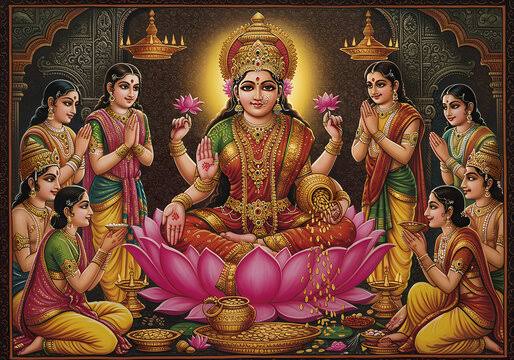
On Diwali night, something happens in Indian homes that happens on no other night of the year. The front door is left open. Lamps are set on the threshold, on the window ledges, along the compound wall, up the stairs — not for the people inside, who can see perfectly well, but for someone expected from outside. The floor is washed twice. A rangoli is drawn exactly where feet would fall. And somewhere in the house, a small heap of coins, a ledger or a bank passbook sits waiting on a square of red cloth.
The guest is Lakshmi — the goddess of wealth, abundance and auspicious good fortune — and the instinct behind all that lamplight is very old and very simple. She walks where there is light. She walks past where there is dust, darkness and disorder. Nobody in the house would put it quite that literally if you asked them. But everybody sweeps.
She may be the most worshipped and the least examined goddess in Hinduism. Her image is on shop shutters, wedding invitations, lorry mudflaps and account books. Her name is given to more Indian daughters than almost any other. And yet ask what she actually is — where she comes from, why an owl, why elephants, why a lotus and not a throne — and the answers tend to thin out quickly. This is an attempt at the fuller picture, with the sources named as we go.
Who Is Lakshmi? Shri Before Lakshmi
Before she was Lakshmi, she was Shri — radiance, splendour, the quality of a thing being lustrous and well-favoured. The distinction matters, because the two names enter Indian religious language at different times and from slightly different directions.
In the Rigveda, the word shri appears roughly a hundred and thirty times, almost always as an attribute rather than a person: the glory of a king, the sheen of a well-run household, the fullness of a good harvest. The word lakshmi occurs just once in the Rigveda proper, and there it means something closer to a mark or sign — the auspicious token by which fortune can be recognised. The name is usually traced to the Sanskrit root laksh, to perceive, mark or aim at, which is why some teachers like to say that Lakshmi is not simply wealth but the capacity to see clearly what is worth aiming for.
The Shri Sukta — the hymn to Shri — is where she begins to take on a face. It is not part of the Rigveda’s core books but sits in the khila, an appendix layer preserved in the Bashkala recension and usually attached to the fifth mandala. Scholars read it as composed in layers, the earliest of which is pre-Buddhist and probably belongs to the Brahmana period. It asks for gold, cattle, horses, fame and food, and it asks for one more thing that tells you a great deal about the Indian imagination: it asks Shri to drive out her own elder sister, Alakshmi, who is hunger, thirst, need and ill fortune. We will come back to her.
In the Shatapatha Brahmana, Shri emerges from Prajapati in such splendour that the gods immediately begin asking her for things, each taking a different gift. In the end she settles beside Vishnu. By the Puranic period the two names have fused, the goddess is firmly Vishnu’s consort, and Lakshmi has become the dominant name in worship.
Where Does Lakshmi Come From? Three Origin Accounts
Hindu tradition does not offer one birth story for Lakshmi. It offers several, held side by side without much anxiety. Being honest about that is more useful than flattening them.
1. The churning of the ocean
The best-known account is the Samudra Manthan — the churning of the ocean of milk — told in the Ramayana, the Vishnu Purana and, at length, in the eighth canto of the Bhagavata Purana. Gods and asuras take opposite ends of the serpent Vasuki, use Mount Mandara as a churning staff, and turn the cosmic ocean for ages. Poisons come up, then treasures, then the divine physician with the pot of nectar. And at one point the ocean yields a woman standing on an open lotus, holding a lotus, so luminous that every being present — gods, sages, kings, asuras — wants her to choose him.
She chooses Vishnu, and garlands him. This is the detail that carries the theology: fortune is not seized in the churning, it is given, and it goes to the one who was not grasping for it. From this emergence she takes the name Padma or Kamala, the lotus one.
2. The daughter of Bhrigu
The Garuda Purana, Linga Purana and Padma Purana give her a lineage instead of an emergence: she is the daughter of the sage Bhrigu and his wife Khyati, and from this she takes the name Bhargavi. In this telling she is born into the world of rishis rather than drawn out of the sea.
3. Lotus-born at the beginning
A third strand makes her primordial — present at the start of creation, floating on an open lotus on the waters, not born of anything. Vaishnava theology, especially in the Pancharatra and Srivaishnava traditions, leans this way: Lakshmi is not a being who appeared at some point in time but Vishnu’s inseparable shakti, his own power and agency, without which he does not act at all.
These are not errors to be resolved. They are three different answers to three different questions — where does fortune come from, whose household does it belong to, and is it created or eternal — and the tradition kept all three because each is useful.
The Symbolism of Lakshmi: Reading the Image
Almost every element in a Lakshmi image is doing specific work. Once you can read them, the calendar print on the shop wall becomes a fairly dense piece of writing.
The lotus
She sits or stands on a lotus and holds one or two more. The lotus grows in mud, rises through opaque water and opens clean — which is exactly the claim being made about wealth in this tradition. It emerges from the messy material world, and it need not be dirtied by it. The lotus also does not cling; the flower rests on the water without being wetted by it. Prosperity held like that is considered auspicious. Prosperity gripped is not.
The four arms
The standard four-armed form is read as the four aims of human life: dharma (right living and duty), artha (material security), kama (desire and enjoyment) and moksha (liberation). Lakshmi presides over all four, not merely the second. This is worth pausing on, because it is the single most common misreading of her: she is not the goddess of money. She is the goddess of a complete and well-provisioned life, of which money is one quarter.
The coins
Gold coins stream from her lower right palm. The hand is open and turned down. The iconography of giving — dana — is deliberate: she is almost never shown holding wealth, only releasing it. Her other hands commonly show the abhaya mudra (the gesture of fearlessness and protection) and the varada mudra (the gesture of boon-giving).
The elephants
In the Gaja Lakshmi form, two elephants flank her, trunks raised, often pouring water over her from pots. Elephants in Indian art mean rain, fertility and royal authority at once — the three things an agrarian kingdom depended on. Gaja Lakshmi is among the oldest recognisable Lakshmi images in India and appears on early Buddhist monuments and on coins well before the Puranic literature was settled, which tells you the image is older than most of the stories about it.
Her vahana — and why nobody agrees
This is the one honest point of confusion, so it is worth stating plainly rather than picking a side. Lakshmi’s vahana (the animal that carries a deity) is given differently in different places. The elephant is her oldest and most widespread companion. The owl — ulooka — appears regularly, especially in eastern India and in Bengali and Odia iconography, and is also the form in which she is most often shown in popular Diwali prints across the north. Gupta-period art and some South Indian traditions, particularly around the martial Veera Lakshmi, pair her with a lion. Eighteen-armed descriptions mention Garuda, lion or tiger.
The owl in particular attracts a lot of modern explanation, much of it invented: that it signifies wisdom, or alternatively that it warns against blindness to the real. Some of these readings are devotionally rich, but they are commentary rather than scripture, and it is fairer to a reader to say so. What the owl certainly does is place her among the night and the harvest field — a bird of the granary and the dark hours, which is when the lamps go on.
Lakshmi and Vishnu: Never Worshipped Alone
In Vaishnava understanding Lakshmi is not Vishnu’s companion so much as his functioning capacity. He is the principle; she is the principle in action. The paired form Lakshmi-Narayana is extremely common in temple sculpture, and in Srivaishnava theology she is also the purushakara — the one who intercedes, the reason a devotee can approach at all.
Where Vishnu descends, she descends with him. As Rama she is Sita. As Krishna she is Rukmini, and in many devotional traditions Radha. At Tirupati, the goddess appears doubled as Sridevi and Bhudevi — prosperity and the earth itself — flanking the lord, and her own shrine as Padmavathi stands a few kilometres away at Tiruchanur, where tradition holds a pilgrimage is incomplete until you have visited her too.
Alakshmi: The Sister Nobody Invites
The Shri Sukta does not only praise. It asks for a removal. Alakshmi — sometimes identified with Jyestha, the elder — is misfortune personified: hunger, thirst, debt, quarrel, the slow souring of a household. Later tradition gives her her own iconography and even her own small shrines, and in some regional practice she is placated on the night before Diwali rather than ignored.
This is one of the quietly sophisticated things about Lakshmi worship. It does not pretend that fortune is simply earned. It treats fortune and misfortune as sisters who travel the same roads, and so the practice around her is as much about what you clear out as what you invite in. The pre-Diwali cleaning is not housekeeping with a religious coat of paint. It is the ritual itself.
The Ashta Lakshmi: Eight Forms of Abundance
Many households and temples honour Lakshmi in eight aspects, the Ashta Lakshmi. The usual list runs:
- Adi Lakshmi — the primordial form, associated with spiritual wealth and the seeker’s path
- Dhana Lakshmi — money and material wealth
- Dhanya Lakshmi — grain, food, agricultural sufficiency
- Gaja Lakshmi — royal splendour, and in some readings wealth in cattle and animals
- Santana Lakshmi — children and progeny
- Veera Lakshmi — courage and strength, also called Dhairya Lakshmi
- Vijaya Lakshmi — victory, also called Jaya Lakshmi
- Vidya Lakshmi — knowledge, the arts and the sciences
Here an honest note is due, because it is widely repeated as ancient and is not quite. The individual attributes are old and thoroughly traditional. The specific grouping of exactly these eight, however, was popularised by the Ashtalakshmi Stotram, a hymn composed by the Srivaishnava scholar U. V. Srinivasa Varadachariar and circulated from around the 1970s. The scholar Vasudha Narayanan has made this point: the attributes are inherited, the eightfold set is recent. Lists also vary — some substitute Aishwarya Lakshmi for Vidya Lakshmi, others add Saubhagya, Rajya or Vara Lakshmi. None of this makes the devotion less real. It simply means a living tradition was still composing in the twentieth century, which is a rather hopeful thing to know.
Major Lakshmi Temples
Lakshmi is present in essentially every Vishnu temple in India, but a number of shrines are hers in her own right.
- Shri Mahalakshmi (Ambabai) Temple, Kolhapur, Maharashtra. The most important Lakshmi temple in the country, and counted among the Shakti Peethas. Its carvings and plan point to construction around the sixth to seventh century CE in the Chalukya period, though the complex was much extended later. The stone image is around four feet, west-facing — unusual, since most temple images face east or north — and is described as holding a mahalunga citron, a mace, a shield and a drinking bowl. Twice a year, around late January and early November, the setting sun aligns with the western doorway and falls directly on the image: the Kiranotsav. Dates shift slightly year to year, so check the temple trust’s announcement rather than a travel blog. Nearest airport and station are both within about fifteen kilometres. Dress modestly; as at most active Maharashtra temples, covered shoulders and knees are expected and phone cameras are usually restricted inside the sanctum. Timings and any queue system change often — verify close to your travel date.
- Sri Padmavathi Ammavari Temple, Tiruchanur, Andhra Pradesh. Lakshmi as Padmavathi, consort of Venkateshwara, about five kilometres from Tirupati and administered by the same devasthanam. Varalakshmi Vratam here is a very large observance.
- Ashtalakshmi Kovil, Besant Nagar, Chennai. A modern temple, built in the 1970s, with the eight forms enshrined on successive levels — effectively the Ashta Lakshmi scheme rendered in architecture.
- Mahalakshmi Temple, Mumbai. On the Breach Candy seafront, dating to the late eighteenth century, with Mahalakshmi, Mahakali and Mahasaraswati together. One of the busiest urban shrines in western India, especially on Fridays and through Navratri.
- Lakshmi Narayan temples across north India, of which the Birla Mandir in Delhi is the best known, keep the paired form at the centre.
Festivals of Lakshmi
Her calendar is dense, and most of it clusters around harvest and the turn of the year.
- Diwali and Lakshmi Puja. The main observance, on the Amavasya of Kartika. In 2026 Diwali falls on 8 November, with Dhanteras on 6 November. The evening puja is timed to a muhurat calculated from the local sunset and the exact tithi, which means the widely circulated Indian Standard Time windows do not apply if you are in London, Toronto, New Jersey or Melbourne. Use a panchang calculated for your own city, or ask your local temple.
- Sharad Purnima / Kojagari Purnima. The full moon of Ashwin, kept as a harvest night. In Bengal and Odisha especially, Lakshmi is said to move through the world asking ko jagarti — who is awake — and households stay up for her. Gaja Lakshmi Puja is observed on this day in parts of Odisha.
- Varalakshmi Vratam. The Friday before the full moon in Shravana, around July or August, observed mainly in the south and especially Tamil Nadu, Andhra Pradesh, Telangana and Karnataka. A decorated kalasham stands in for the goddess, and a turmeric-dyed thread is tied on the right wrist.
- Lakshmi Panchami, on the fifth day of the bright fortnight of Chaitra, and the Lakshmi puja observed during Navratri in several regions.
Regional practice varies far more than most single-source accounts suggest. In Bengal, Kojagari Lakshmi Puja can matter more in the domestic calendar than the Diwali puja does. In Gujarat and much of the trading north, the Diwali chopda pujan — the worship of new account books — is the heart of it. Both are entirely orthodox.
Mantras and Stotras to Lakshmi
Four texts carry most of the devotional weight, and they are worth distinguishing.
- Shri Suktam. The oldest, from the Rigvedic khila layer. Recited in its Vedic accents it is the most formal of her hymns, and the one commonly chanted during abhisheka in temples.
- Mahalakshmi Ashtakam. Eight verses beginning Namastestu Mahamaye, traditionally drawn from the Padma Purana and framed as Indra’s praise of the goddess. Short, metrically simple, and the most common household recitation.
- Kanakadhara Stotram. Attributed to Adi Shankaracharya. The legend holds that as a young boy on alms rounds he came to a house so poor the woman had only a single dried gooseberry to give — and gave it anyway. He composed these verses on the spot, and Lakshmi is said to have rained gold on the house. The attribution is traditional rather than externally documented, as with much of the Shankara corpus, but the poem itself is magnificent.
- The bija mantra Om Shreem Mahalakshmiyei Namaha, and the seed syllable Shreem alone, used in japa. If you are being taught these with a specific count or discipline, follow your teacher rather than an internet instruction.
Why Lakshmi Matters Today
It would be easy to say Lakshmi worship is just a religious coat of paint on wanting to be rich. The tradition is actually far less naive about money than that, and the specific ways it is less naive are genuinely useful.
First, she is never worshipped alone. In a Lakshmi-Narayana shrine, wealth sits beside the principle that orders it; in the Diwali sequence she is worshipped alongside Ganesha, who removes obstacles, and in many homes alongside Saraswati, who is learning. The arrangement is an argument: money without direction, without competence, without something to be for, is not considered auspicious. It is considered dangerous.
Second, she is chanchala — restless, mobile, known for leaving. Hindu tradition never promised that fortune stays. Build for her departure as much as her arrival, which in plain terms is the case for savings, for not confusing a good year with a permanent condition, and for not identifying yourself with your balance.
Third, every gesture in her iconography is a gesture of release. Her hand is open and tipped downward. The devotional logic is that wealth is a current, not a reservoir, and that it comes to those through whom it keeps moving. Whatever you make of the theology, the behavioural instruction is clear enough: give some of it away, regularly, before you feel you can afford to.
And fourth, there is the sweeping. The practice begins not with asking but with clearing — the house, the accounts, the unresolved quarrels, the debts. That ordering comes first, and only then the lamp. For a reader anywhere in the world in any month of the year, that is the part of Lakshmi puja that travels best.
Frequently Asked Questions About Goddess Lakshmi
Who is Goddess Lakshmi in Hinduism?
Lakshmi is the Hindu goddess of wealth, prosperity, abundance and auspicious good fortune, and the consort of Vishnu. Her older name is Shri. In Vaishnava theology she is not merely Vishnu’s wife but his shakti — his active power — without which he is understood not to act at all. She governs all four aims of life, not only material security.
Why is Lakshmi shown with an owl?
The owl, or ulooka, is one of several animals associated with her, and it is most prominent in eastern Indian iconography and in popular Diwali imagery across the north. Her oldest and most widespread companions are elephants, as in the Gaja Lakshmi form, and some traditions pair her with a lion. There is no single scriptural statement fixing one vahana, and many of the moral explanations given for the owl are later devotional commentary rather than textual.
How was Goddess Lakshmi born?
There is more than one account. The best known, told in the Ramayana, the Vishnu Purana and the eighth canto of the Bhagavata Purana, has her emerge from the churning of the ocean of milk standing on a lotus, after which she garlands Vishnu. The Garuda, Linga and Padma Puranas instead make her the daughter of the sage Bhrigu and Khyati, giving her the name Bhargavi. A third strand treats her as primordial and uncreated.
What is the difference between Lakshmi and Mahalakshmi?
In common usage they are the same goddess, with Mahalakshmi simply the honorific — great Lakshmi. In some Shakta traditions, however, Mahalakshmi is one of a triad with Mahakali and Mahasaraswati and is treated as the supreme Devi in her own right rather than specifically as Vishnu’s consort. The Kolhapur temple sits within this second understanding, which is also why it is counted among the Shakti Peethas.
Which day of the week is best for Lakshmi puja?
Friday is traditionally associated with Lakshmi across most of India, and many households keep a simple Friday observance. The major annual occasions are the Diwali Amavasya, Sharad Purnima in the east, and Varalakshmi Vratam in the south. Timings for the Diwali puja depend on your local sunset and tithi, so a panchang for your own city matters more than a published Indian Standard Time window.
Are the Ashta Lakshmi forms mentioned in the Puranas?
The individual attributes — grain, courage, progeny, knowledge, victory and the rest — are old and traditional. The specific set of exactly eight, in the familiar order, was popularised by the Ashtalakshmi Stotram composed by U. V. Srinivasa Varadachariar and circulated from about the 1970s. Scholars such as Vasudha Narayanan have noted this distinction. The forms are authentically devotional; the eightfold list is a modern synthesis of older material.
Can Lakshmi be worshipped without elaborate ritual?
Yes, and most households do. A clean space, a lit lamp, water, a flower, a little rice and whatever you can honestly offer is a complete puja in the view of every tradition that discusses it. The texts on bhakti are consistent that intention outranks apparatus. If you are learning a formal vidhi from a family or a teacher, follow that; if you are not, the lamp is enough to begin.
A Closing Thought
There is a reason the lamps go outside the house and not in. The gesture is outward-facing by design: light placed at the boundary, where someone arriving in the dark would need it. For a few nights every autumn, millions of thresholds are lit for a guest nobody expects to literally see.
Whatever you believe about who walks past, the practice has shaped something in the Indian grain — that abundance is a visitor rather than a possession, that she is drawn to order and generosity and repelled by neglect, and that the right response to good fortune is to keep the door open. Sweep first. Then light the lamp.
Continue Exploring
- Lakshmi Puja at Home: Muhurat, Vidhi and Meaning for Diwali 2026
- Significance of Diwali: The Spiritual Meaning of the Festival of Lights
- The Five Days of Diwali Explained: Rituals, Dates and Meaning
- Who Is Lord Shiva? The Story, Symbolism and Worship of Mahadeva
- How to Chant Vishnu Sahasranama