
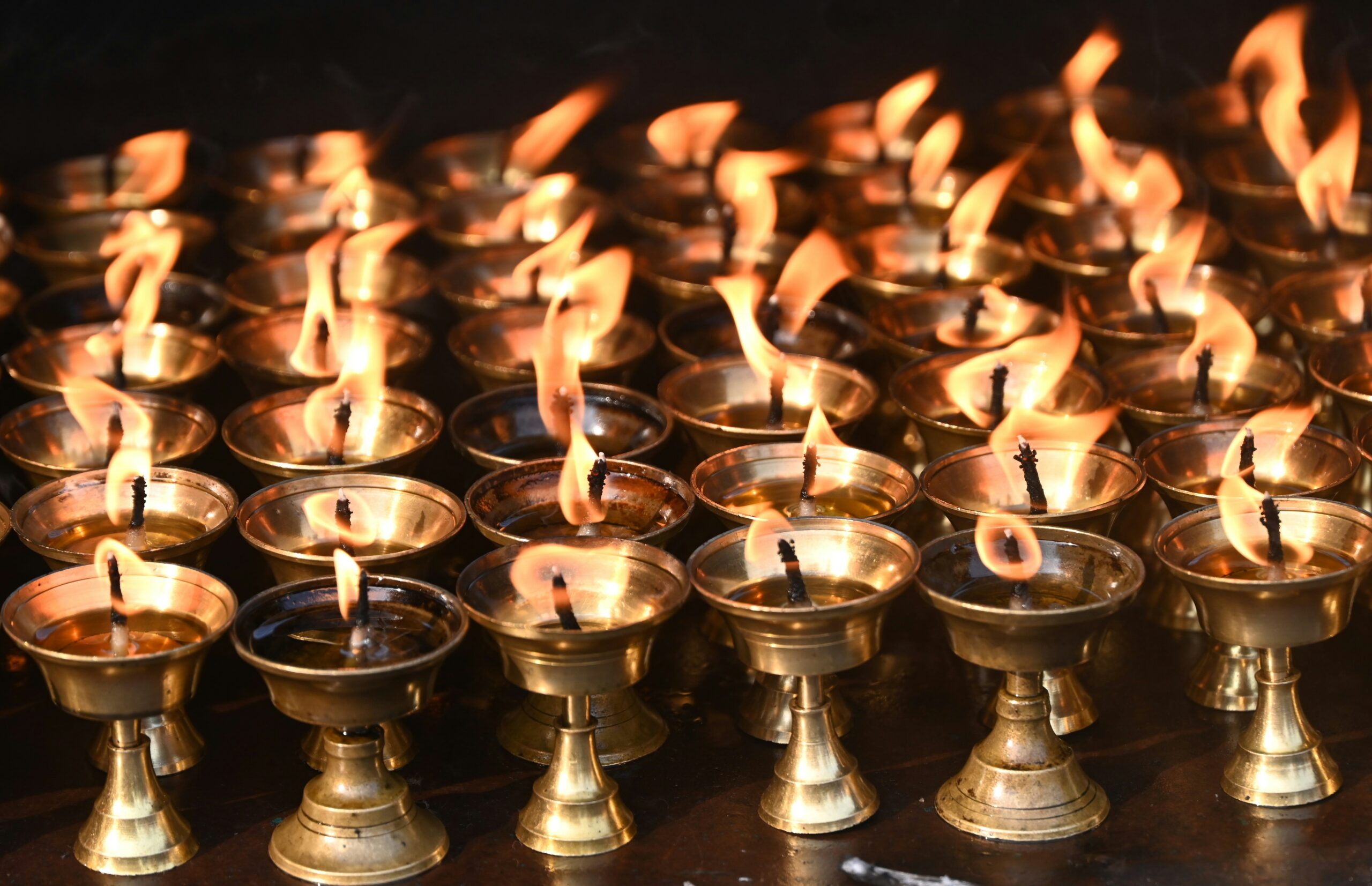
In the week before Diwali, my grandmother used to sit on the back step with a bucket of water and a stack of new clay lamps, soaking them. She never explained why. Years later I learned the reason: an unsoaked diya (a small clay oil lamp) drinks the oil straight out of its own bowl and burns out in twenty minutes. Soak it first and the clay is already full, so the oil stays where the wick can find it, and the flame holds through the night.
That is a very small piece of household knowledge. It is also, if you sit with it, the whole festival. Diwali is not about producing a brief, spectacular burst of light. It is about preparing yourself so that light can last.
What Diwali Actually Is
Diwali — from the Sanskrit Deepavali, literally a row of lights (deepa, lamp; avali, row) — is the largest festival in the Hindu year, and among the most widely observed religious festivals anywhere on earth. It runs for five days, though which five days depends on where you are standing, and it is built around a single astronomical fact: the new moon of the lunar month of Kartika. That is the darkest night of one of the year’s darkest fortnights. Into that darkness, hundreds of millions of households put out light.
It would be easy to assume a festival this big must have one origin story. It does not. Diwali is better understood as several distinct festivals that grew towards each other over many centuries and eventually merged — which is why the Diwali of a Tamil household, a Gujarati one, a Bengali one, and a Punjabi one are recognisably the same festival and yet genuinely not the same observance at all. Anyone who tells you Diwali is one story is telling you about their region, not about Diwali.
Diwali 2026 Dates: The Five Days
In 2026, the main day of Diwali — Lakshmi Puja, falling on Kartika Amavasya, the new moon of the Hindu lunar month — is Sunday, 8 November 2026. The five-day sequence runs:
- Friday, 6 November 2026 — Dhanteras (Dhanatrayodashi), the thirteenth day of the waning fortnight
- Saturday, 7 November 2026 — Naraka Chaturdashi, also called Chhoti Diwali or Kali Chaudas
- Sunday, 8 November 2026 — Lakshmi Puja / Diwali, the new moon and the principal day
- Monday, 9 November 2026 — Govardhan Puja / Annakut, called Bali Pratipada in Maharashtra, Karnataka and parts of Gujarat
- Tuesday, 10 November 2026 — Bhai Dooj (Bhau Beej, Bhai Tika)
A Necessary Word on Muhurat Timings
You will see a great many websites publish a precise Lakshmi Puja muhurat (an auspicious time window) for Diwali, down to the minute. Widely circulated panchang calculations put the 2026 Pradosh Kaal window for Delhi at roughly 5:54 p.m. to 7:50 p.m. IST. Treat that as an illustration, not an instruction.
Here is why. A muhurat is derived from the position of the sun and moon at your location. Sunset in Delhi on 8 November is not sunset in Chennai, in London, in Toronto, in Sydney or in Nairobi — and Pradosh Kaal, the twilight period in which Lakshmi Puja is traditionally performed, is defined by your own sunset. An IST timing is simply wrong for a family in New Jersey. Different panchang traditions also compute the boundaries of the tithi slightly differently, which is why two reputable calendars can disagree by fifteen or twenty minutes.
The practical guidance is the same one that Indian families have always followed: use a panchang calculated for your own city, or ask the priest at your local temple. If you want the underlying principle rather than a number — the traditional recommendation is that Lakshmi Puja is performed after sunset, during Pradosh Kaal, while Amavasya tithi is running. Lamps lit with attention a few minutes outside a published window are not a failure of anything.
Why the Darkest Night?
Most of the world’s festivals of light sit near a solstice and celebrate the sun’s return. Diwali does something subtler. It picks the night when the moon is entirely absent and asks householders to supply the light themselves.
That choice is the theology. The tradition does not describe darkness as evil; it describes it as tamas — inertia, heaviness, the condition of not-seeing. Tamas is not defeated by argument. It is displaced by light, and a lamp is a small, deliberate, physical act. One of the oldest prayers in the Hindu canon, from the Brihadaranyaka Upanishad (1.3.28), asks exactly this: tamaso ma jyotir gamaya — lead me from darkness to light. Diwali is that verse performed with your hands, in a courtyard, by a family that has spent three days cleaning the house.
The Stories Behind Diwali
Several major narratives attach to Diwali. They are regionally distributed, they come from different texts, and they do not need to be reconciled.
Rama’s Return to Ayodhya
Across most of northern India, Diwali marks the night the people of Ayodhya lit lamps along every road and rooftop to welcome Rama, Sita and Lakshmana home after fourteen years of exile and the defeat of Ravana. It is the story most Indians outside the south will name first, and it has shaped the North Indian festival profoundly — the lamps as welcome, the homecoming, the restoration of rightful order.
One point of honesty is worth making here, because it is often glossed over. The association is old and deeply held, but the Valmiki Ramayana and Tulsidas’s Ramcharitmanas do not themselves name Deepavali or describe it as an annual festival. Scholars who have traced the festival’s history note that the link between Rama’s return and the festival of lights appears to have been made later, as two traditions grew together. That does not make the observance less real. It does mean that anyone stating flatly that Diwali began when Rama returned to Ayodhya is stating a tradition as though it were a documented origin.
Krishna and Narakasura
In Tamil Nadu, Andhra Pradesh, Telangana, Karnataka and Goa, the central story is different, and the emphasis falls on the day before the new moon. Naraka Chaturdashi commemorates Krishna’s killing of the demon king Narakasura and the release of the sixteen thousand women he had imprisoned — a narrative told in the Bhagavata Purana. This is why the South Indian observance centres on Deepavali as a single principal day observed at dawn, not dusk, with the ritual oil bath called Ganga Snanam or Abhyanga Snan performed before sunrise. A Tamil family and a Delhi family will both say they are celebrating Deepavali and will be doing different things on different days for different reasons. Both are correct.
Lakshmi and the Churning of the Ocean
The third great strand is Lakshmi herself — goddess of wealth, prosperity, beauty and auspiciousness — who in Puranic accounts emerges from the churning of the cosmic ocean of milk. The Padma Purana connects her closely to these days, associating her appearance with Dhanteras and her marriage to Vishnu with the main day of the festival. This strand is what makes Diwali a householder’s festival above all: the goddess is said to visit clean, lit, welcoming homes, which is the theological reason behind the ferocious pre-Diwali cleaning that anyone raised in an Indian household will remember with mixed feelings.
Bali and Vamana
In Maharashtra, Karnataka and parts of Gujarat, the fourth day is Bali Pratipada — the day associated with the demon-king Bali, whose generosity was such that Vishnu, in his dwarf incarnation Vamana, had to trick him out of the three worlds, and who was granted an annual return to his people. Elsewhere in the north and west the same day is Govardhan Puja or Annakut, recalling Krishna lifting Mount Govardhan to shelter the cowherds of Vraja from Indra’s storm, as told in the tenth book of the Bhagavata Purana. Mountains of food are built and offered. Two entirely different commemorations, one calendar slot.
Kali Puja in Bengal
In West Bengal, Odisha and Assam, the Amavasya night of Kartika is not primarily Lakshmi’s. It is Kali’s. Kali Puja is performed at midnight, and the mood is quite different from the lamplit domesticity of the north — fiercer, more nocturnal, addressed to the goddess who stands beyond fear. Bengali households may light lamps too, and many now observe both; but to call the Bengali night Diwali without acknowledging Kali Puja is to miss what is actually happening in the room.
Jain, Sikh and Newar Buddhist Observances
Diwali is not only Hindu. For Jains, this is Mahavira Nirvana Divas, marking the moment the twenty-fourth Tirthankara attained final liberation; the lamps commemorate the great light of his passing. For Sikhs, the same period is Bandi Chhor Divas, the Day of Liberation, marking Guru Hargobind’s release from imprisonment at Gwalior Fort — and, characteristically, his refusal to leave unless the fifty-two imprisoned princes held with him were released as well. Among Newar Buddhists in Nepal, uniquely in the Buddhist world, Lakshmi is worshipped across a five-day sequence that includes Kukur Tihar, the day dogs are garlanded, and Mha Puja, a worship of the self.
What the Oldest Sources Say
If you want the historical layer rather than the devotional one, the picture is genuinely interesting. Diwali’s ancestry is visible in texts well before its modern form settled. Vatsyayana’s Kamasutra describes Yaksha Ratri, a night festival of the yakshas — attendants of the god of wealth — with lamps and gambling. King Harsha’s seventh-century Sanskrit play Nagananda refers to a festival of lamps, Deepotsava. References to the observance appear in the Padma, Vishnu and Kalika Puranas, and in stone and copper inscriptions across several centuries. The names shift — Deepotsava, Deepavali, Divali, Divalige — and the regional practices thicken as you move forward in time.
What this tells us is that Diwali was not decreed. It accreted: a wealth-festival with lamps, a harvest and new-year marker, a Lakshmi observance, several regional victory narratives, and a Jain and Sikh commemoration on the same dates, all layered over roughly two thousand years. The fact that no single explanation covers it is not a gap in the record. It is the record.
The Five Days, Day by Day
Day One: Dhanteras
The thirteenth day of the waning fortnight opens the festival and is associated with Dhanvantari, the physician of the gods who emerged from the same ocean-churning as Lakshmi, and with the acquisition of dhan (wealth). Households buy metal — gold and silver if they can, brass or steel utensils if they cannot. The buying is not superstition so much as a ritualised act of hope: you bring something durable into the house at the start of the light.
Day Two: Naraka Chaturdashi
Chhoti Diwali in the north, where it is a quieter evening of a few lamps and preparations. Kali Chaudas in Gujarat. In the south, as described above, it is the principal day, observed at dawn with an oil bath and new clothes.
Day Three: Lakshmi Puja
The new moon and the heart of the festival. The house is cleaned and lit at every threshold and window. Rangoli — patterns drawn on the floor in coloured powder or rice flour — marks the entrance. Lakshmi is invoked, usually alongside Ganesha, who removes obstacles, and often with the account books or a laptop placed before the shrine; in much of Gujarat and Rajasthan this day begins the new business year. Sweets are exchanged. Lamps, in the older practice, are left burning through the night rather than blown out.
Day Four: Govardhan Puja / Bali Pratipada / Annakut
Food is the medium: a mountain of it, offered and then shared. In Maharashtra this day also carries a husband-and-wife observance, and in Gujarat it is new year’s day.
Day Five: Bhai Dooj
Sisters mark their brothers’ foreheads and pray for their long life; brothers give gifts and, in the older form of the promise, protection. The associated story is of Yama, the god of death, visiting his sister Yamuna — which is to say that the festival of lights ends by placing a family bond in front of mortality itself.
Why Diwali Matters Today
It is easy to let a festival become logistics — the sweets order, the flights, the cleaning, the fireworks argument. Three things about Diwali repay actual attention, and they are more practical than they sound.
The cleaning is the practice, not the preparation for it. The tradition says Lakshmi enters a clean, lit house. Read that as a statement about attention rather than hygiene and it becomes surprisingly demanding: prosperity is said to arrive where there is order, care and welcome, and to leave where there is neglect. A week spent clearing out what has silently accumulated in your home — and, if you want to take it seriously, in your commitments and your accounts — is not preamble to the festival. It is the festival’s first movement.
Lakshmi is not only money. The Sanskrit shri, the quality Lakshmi embodies, means something closer to radiance, auspiciousness, well-being, dignity — what makes a life abundant rather than merely funded. The traditional Diwali pairing of shubh (auspicious) and labh (gain), written on either side of a doorway, puts them in that order deliberately. Gain that is not auspicious is not what is being asked for. This is a useful corrective in a season that the market has worked hard to convert into a shopping event.
Give while the lamps are lit. Across regions, Diwali involves distribution: food to neighbours, sweets to workers, clothing and money to those who have less, and in many households a day’s earnings set aside. A festival of prosperity that does not move anything outward has quietly inverted itself.
Two practical notes for the present. On fireworks, the honest position is that they are a late and regional addition to Diwali rather than its scriptural core, that Indian cities have measurable air-quality emergencies on and after Diwali night, and that many observant families have moved to lamps, small quantities, or none at all without any sense of loss. Nothing in the tradition requires noise. And for the very large number of readers celebrating in the US, UK, Canada, Australia or the Gulf: Diwali in the diaspora usually has to be moved to the nearest weekend, celebrated in a rented hall, or split across a workday. That is not a lesser Diwali. The festival was portable long before aeroplanes — it travelled with traders, indentured labourers and migrants to Mauritius, Trinidad, Fiji, Malaysia and South Africa, and it survived by adapting. Light the lamp on the evening you actually have.
Frequently Asked Questions
What is the significance of Diwali in Hinduism?
Diwali marks the victory of light over darkness, knowledge over ignorance and order over chaos, observed on the new moon of Kartika — the darkest night of the lunar month. Its specific meaning varies by region: the return of Rama to Ayodhya in much of the north, Krishna’s defeat of Narakasura in the south, the worship of Lakshmi as goddess of prosperity almost everywhere, and Kali Puja in Bengal. The common thread is the deliberate lighting of lamps at the year’s darkest point.
Why is Diwali celebrated for five days?
The five days each carry a distinct observance: Dhanteras (wealth and Dhanvantari), Naraka Chaturdashi (Krishna’s victory), Lakshmi Puja on the new moon (the principal day), Govardhan Puja or Bali Pratipada, and Bhai Dooj (the sister and brother bond). They were not designed as a set; they represent several observances that came to occupy adjacent days in the same fortnight.
What is the correct time for Lakshmi Puja?
Traditionally after sunset, during Pradosh Kaal, while Amavasya tithi is running. Because that window depends on your local sunset, published IST timings do not apply outside India — and even within India they shift by city. Use a panchang calculated for your own location, or ask at your local temple.
Is Diwali only a Hindu festival?
No. Jains observe Mahavira Nirvana Divas on the same night, marking Mahavira’s final liberation. Sikhs observe Bandi Chhor Divas, commemorating Guru Hargobind’s release from Gwalior Fort. Newar Buddhists in Nepal observe a five-day Lakshmi-centred sequence. The dates coincide; the commemorations are distinct.
Do Hindus have to light clay lamps, or do candles and electric lights count?
The clay diya with cotton wick and oil or ghee is the traditional form, and most households keep at least some. Beyond that there is no scriptural prohibition on other lights, and electric lights are near-universal now. If you live somewhere an open flame is not allowed, a single diya at the shrine with the rest electric is an ordinary, unremarkable accommodation.
Why do people gamble or play cards on Diwali?
The custom is old — the lamp-and-gambling night appears as Yaksha Ratri in the Kamasutra, and one tradition holds that Parvati decreed that those who gamble on this night would prosper in the coming year. In practice it now functions as a family social ritual with small stakes. The tradition does not endorse gambling as a habit, and taken past the festival evening it becomes exactly the kind of loss the festival prays against.
A Closing Thought
The thing about a diya is that it is almost absurdly inadequate. One clay bowl of oil against a moonless November night. Nobody lights a single lamp because they expect it to illuminate the street.
That is why there is a row of them. Deepavali — a row of lights. The lamp on your threshold is not doing the work alone; it is doing its part next to your neighbour’s, and theirs next to the next, until a street that was dark is not. There is a whole ethic hidden in the grammar of the festival’s name, and it has nothing to do with being the brightest thing in the dark. It has to do with showing up, in your own doorway, on the night it is hardest to see.
Soak the lamp first. Then light it.
Two threads here are worth following on their own. The lamp itself has a whole meaning behind it, which I have set out in why we light diyas on Diwali. And the festival does not rest on a single origin story but on several, depending on which part of India you are standing in — those are gathered in the stories behind Diwali.
Continue Exploring
- Significance of Navratri: The Spiritual Meaning of the Nine Nights
- The Nine Forms of Durga: Navadurga Explained, Day by Day
- Why We Celebrate Holika Dahan?
- Introduction to the Ramayana — Story, Characters, and Meaning
- How to Celebrate Navratri at Home: Ghatasthapana, Puja Vidhi and Fasting