On a granite boulder at Mamallapuram, on the Tamil coast south of Chennai, somebody carved a goddess into the living rock somewhere between 630 and 674 CE. She has many arms. She is standing on a buffalo’s severed head. A lion crouches beside her. Around her, small attendant figures are in violent motion.
Her face is completely calm.
That is the detail which everything else about Durga has to be built around, and it is the detail most popular accounts skip. She is the warrior goddess of the Hindu tradition, the one summoned specifically to kill, and across thirteen hundred years of sculpture her expression almost never changes. No snarl. No ecstasy. No strain. The violence is being done because it is necessary, and she is not enjoying it, and she is not being damaged by it.
This post is about who she is: where her name comes from, which text actually tells her story, how she was made, what every weapon in her hands is and who handed it to her, how she relates to Parvati and Kali and Shakti, where she is worshipped, and what she is understood to teach. The battle with Mahishasura has its own full account elsewhere on this site, and her nine Navratri forms are covered in the Navadurga post, so both are treated here only as much as the larger picture requires.
The Name: What “Durga” Actually Means
The word is usually glossed as the inaccessible one, the impassable one, the impenetrable one. It is connected to durg, a fortress — a thing hard to get past. Monier-Williams derives it from dur (difficult) plus gam (to go through). Alain Daniélou reads it simply as beyond defeat.
So the name is not a description of the goddess’s temperament. It is a description of what happens to anyone who comes at her. She is the wall.
A second reading circulates widely and is also traditional: Durgati Nashini, she who destroys durgati — misfortune, suffering, the bad road. And there is a third, found in post-Vedic usage, in which Durg is the name of an asura who became invincible to the gods, and Durga is the goddess who kills him and takes his name as a trophy. All three are in circulation. None cancels the others.
A correction worth making: she is not “in the Rigveda”
You will often read that Durga appears in the Rigveda. The word and its relatives do appear — in hymns 4.28, 5.34, 8.27, 8.47, 8.93 and 10.127, and in the Atharvaveda at 10.1 and 12.4. The problem is that in Vedic usage the word carries none of the later story. There is no Mahishasura, no lion, no many-armed goddess. The same thing happens with the word shiva, which starts life in the Rigveda as an adjective meaning auspicious, and with ganapati, which in the Rigveda refers to Brahmanaspati and Indra rather than to the elephant-headed god.
What the Rigveda does contain is the beginning of reverence for the feminine divine, chiefly in the tenth mandala — the Devi Suktam is the best known hymn there. Post-Vedic texts then use the word Durga proper: the Mahabharata at 2.451, the Ramayana at 4.27.16. The Mundaka Upanishad at 1.2.4, usually dated around the fifth century BCE, mentions Kali as an epithet in the same family.
None of this makes Durga recent. It makes her story traceable, which is more interesting.
Where Her Story Is Actually Written: the Devi Mahatmya
Almost everything Hindus know about Durga comes from one text, and it is worth naming it precisely rather than gesturing at “Hindu mythology.”
The Devi Mahatmya — the Glory of the Goddess — forms chapters 81 to 93 of the Markandeya Purana. It runs to thirteen chapters and seven hundred verses, which is why it is also called the Durga Saptashati, the seven hundred on Durga, and, in eastern India, the Chandi Path.
On dating, the evidence is unusually firm for a Sanskrit religious text. It is generally placed at 400–600 CE; Wendy Doniger O’Flaherty proposes around 550 CE. It was inserted into the Markandeya Purana — itself dated to roughly the third century CE — in the fifth or sixth century. And there is a hard floor: the Dadhimati Mata inscription of 608 CE quotes it, so it was composed, circulated and had become quotable before then. The traditional attribution to Vyasa has no independent support.
Thomas Coburn’s assessment is the one most often cited and deserves repeating: this is the earliest text in which the object of worship is conceptualised as Goddess. Not a consort, not a power belonging to a male god, but the ground of things. C. Mackenzie Brown reads it as both the culmination of older ideas about the divine feminine and the foundation of everything written about her afterwards. It has been called the testament of Shakta philosophy.
Its three parts
The text is built in three unequal episodes, each with its own presiding form of the Goddess:
- Chapter 1 — Devi as Mahamaya, the power that holds Vishnu in deep sleep on the cosmic waters while the demons Madhu and Kaitabha arise. She is cosmological here, prior to the drama.
- Chapters 2–4 — the Mahishasura episode. This is the middle part, and in ritual practice it is the most important.
- Chapters 5–13 — Shumbha and Nishumbha seize heaven; Ambika, also called Kaushiki, emerges from the kosha, the sheath, of Parvati’s body; Kali kills Chanda and Munda and then Raktabija; the seven mothers assist against Nishumbha; and in the final battle the Devi reabsorbs Kali and the mothers into herself and fights Shumbha alone.
How it is used
The Devi Mahatmya is not read as literature. It is treated like a Vedic hymn, with an attributed sage, a metre, a presiding deity and a viniyoga — a prescribed application — for japa. The whole text is regarded simultaneously as one mantra and as a collection of seven hundred mantras. It is recited through Navratri, through Durga Puja, and daily in Durga temples across India.
One practical point from the tradition is worth knowing before you begin: once a recitation of the middle episode is started it is held that it must be finished, because an interrupted reading is said to leave a chink in the armour. Whether or not one accepts the metaphysics, it is a sensible instruction about not treating the text casually.
How She Was Made
The origin story is specific, and the specifics are the theology.
Mahishasura, a shape-shifting buffalo demon, had extracted a boon from Brahma: he could not be killed by a man. He read that as immortality, because the gods were men. He took the three worlds, drove the devas out of svarga, and the gods, comprehensively beaten, went to the Trimurti to say so.
What happened next is described at Devi Mahatmya 2.13: unequalled light, born from the bodies of all the gods, coalesced into a female form. Not one god producing a daughter or dispatching an agent. Every one of them emptying out their radiance into a single shape.
The text then does something striking: it itemises her.
- From Shiva’s light came her face; from Yama’s, her hair; from Vishnu’s, her arms (2.14)
- The moon gave her breasts, Indra her waist, Varuna her legs, the earth her hips (2.15)
- Brahma gave her feet, Surya her toes, the Vasus her fingers, Kubera her nose (2.16)
- Prajapati gave her teeth; Agni gave her three eyes (2.17)
- Dawn and dusk became her eyebrows; the wind shaped her ears (2.18)
Read that list slowly and the point lands. She is not a goddess who was sent. She is what the entire pantheon becomes when it stops competing and pools everything it has. There is no part of her that belongs to her alone and no god who is not physically present in her. This is, as far as the major Hindu deities go, unique.
Then they armed her
The arming sequence at 2.20–2.32 is just as deliberate, and most retellings reduce it to “the gods gave her weapons.” Here is who actually gave what:
- Shiva drew a second trident out of his own trident (2.20)
- Vishnu, his discus; Varuna, a conch; Agni, a spear (2.21)
- Vayu, a bow and two quivers of arrows; Indra, his thunderbolt (2.22)
- Indra also gave the bell from the neck of his elephant Airavata; Yama, his staff; Varuna, a noose (2.23)
- Brahma, prayer beads and a water pot; Surya, his rays, set into the pores of her skin (2.24)
- Kala — time — a sword and a shield; the ocean of milk, a pearl necklace and garments that never fade (2.25)
- Vishvakarman, the divine craftsman, an axe and armour that cannot be pierced (2.28)
- The ocean, a garland of unfading lotuses and a lotus for her hand (2.29)
- Himalaya, a lion to ride, and jewels (2.30)
- Kubera, a drinking cup that is always full (2.30)
- Shesha, the great serpent, a garland of gem-studded snakes (2.31)
Notice what is in that inventory besides weapons. Brahma hands her a rosary and a water pot — the implements of prayer and ritual purification — and they sit in her hands alongside Indra’s thunderbolt. Kubera gives her a cup that never empties. The ocean gives her flowers. She goes into battle carrying the instruments of worship, the signs of abundance and a garland of lotuses, and nobody in the text finds this odd. The Shakta reading of her weapons as emblems of self-discipline, service, prayer and meditation is not a modern softening; the text put the prayer beads in there itself.
Reading Her Form
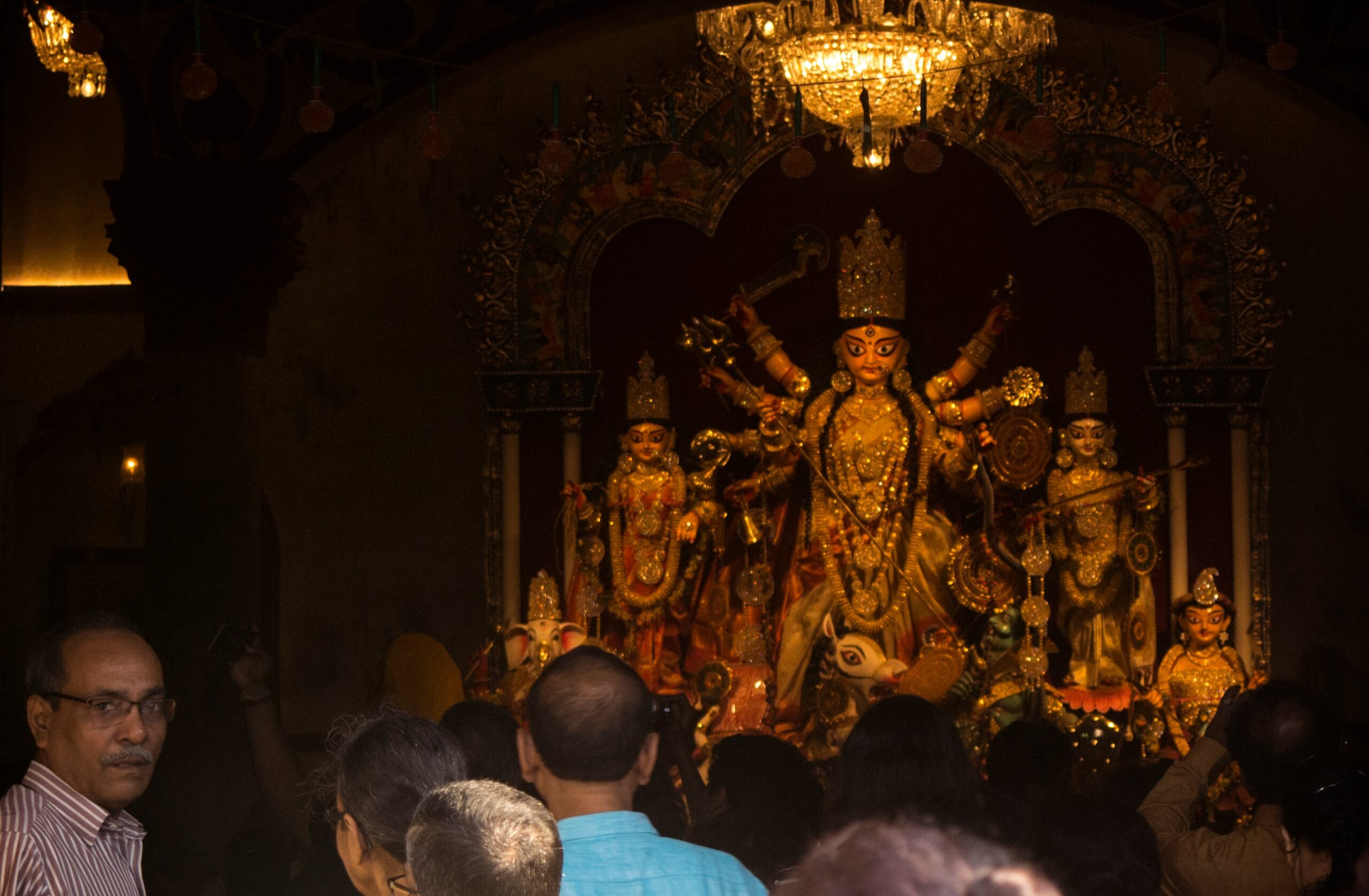
Durga is conventionally shown with between eight and eighteen arms, each holding one of the gifts above — most often the discus, conch, bow, arrow, sword, spear, trident, shield, mace, lotus and noose.
Her vahana is almost always the lion, and the Devi Mahatmya is explicit that it was given to her by Himalaya, the mountain personified. In some depictions and some regional traditions she rides a tiger instead. Asko Parpola has linked a seal from Kalibangan to a Durga-like war goddess associated with the tiger, which would push the imagery back into the Indus Valley — but that identification is contested, as Indus iconographic identifications almost always are, and should not be stated as settled. The safer and still remarkable historical claim is that her iconography was already common across India by roughly the fourth century CE.
Her three eyes come from Agni. Her face comes from Shiva — which is why, if you look at a good Durga image beside a good image of Shiva in meditation, you are looking at the same stillness in two registers.
And then there is the composure. She is mid-slaughter and her features are at rest. Across Mamallapuram, the Chola bronzes, the Bengali clay images and the Pahari miniatures, the convention holds: the face of a goddess who is killing is the face of a goddess who is not angry. Read devotionally, that is a statement that her violence is not appetite. Read practically, it is a model of something most of us never manage — acting decisively against something harmful without being deformed by the act.
Durga, Parvati, Kali, Shakti: Who Is Who
This is where popular writing tends to collapse into confident nonsense, usually by arranging everyone into a single hierarchy. There isn’t one. There are several theological systems, each internally coherent, and they describe the relationships differently.
In the Puranic mainstream, Durga is the warrior form of Parvati, and comes to be identified as Shiva’s wife. In Bengal she is additionally the mother of Ganesha, Kartikeya, Lakshmi and Saraswati — the family group you see in every Durga Puja pandal. That particular household is a regional construction, not a feature of the Sanskrit Puranas, and it is one of the clearest examples on this subject of a local tradition becoming so visually dominant that people assume it is the pan-Indian norm.
Within the Devi Mahatmya, Kali is not a separate goddess so much as something Durga does. Kali emerges from the Devi’s forehead. The Matrikas, the seven mothers, are produced from seven male gods. And in the final battle the Devi draws Kali and the mothers back into herself and fights alone — a deliberately monist move, telling you that the multiplicity was never more than her own extension.
In Shakta theology, Durga is identified with Adi Shakti and with Adya Shakti, the primordial energy itself; the gods are her expressions rather than the other way round.
In Vaishnava texts, she is Yogamaya or Yoganidra, Vishnu’s sister or his female counterpart, and she appears as one of Lakshmi’s three forms — Sri, Bhu, Durga.
And then there is Chandi or Chandika, from canda, fierce or terrible. Within the Devi Mahatmya the names Chandi, Chandika, Ambika and Durga are used interchangeably for the one Supreme Goddess. Outside it, Chandi acquires her own life, especially in Bengal and Gujarat: the Bengali Chandi Mangal Kavyas, composed from the thirteenth to the early nineteenth century, worked local and village goddesses into the mainstream under her name, and forms such as Mangal Chandi and Olai Chandi are still worshipped. The city of Chandigarh is named after her.
The honest summary is that these are different answers to the question, not stages of one answer, and a reader who holds them all loosely will understand the tradition better than one who forces them into a chart.
How Far She Travelled
Durga’s reach outside Hindu practice is not well known and is worth stating, carefully.
Vajrayana Buddhism adopted her. Images of the buffalo-slaying goddess appear at Buddhist sites between roughly the eighth and eleventh centuries in Afghanistan, Indonesia and northeastern India. The Tara form Durgottarini-tara rides a lion. In Tibet, Palden Lhamo carries similar fierce protective functions. In Nepal, Vajrayogini is often worshipped alongside Durga during her festivals. The Japanese Cundi, or Butsu-mo, shares features with her, though scholars treat them as distinct figures rather than the same goddess travelling.
In Jain contexts, the medieval Sacciya Mata mirrors her closely. At Ellora, Jain carvings show Durga with her lion — but peacefully, not slaying the buffalo demon. The same goddess, with the killing removed.
In the Sikh tradition, the Dasam Granth, traditionally attributed to Guru Gobind Singh, exalts Durga. Some Sikhs contest that reading on the grounds that it sits badly with Sikh monotheism. This post does not adjudicate it; Sikh institutions are the authority on Sikh scripture.
In Southeast Asia, Indonesia holds at least a hundred and thirty-five Durga statues, and in parts of Java she is known as Loro Jonggrang. Cambodian images show her standing on the buffalo’s severed head — a composition distinct from the Indian convention. In Sri Lanka she is worshipped as Vaishnavi, with Vishnu’s iconography.
Her Temples
Durga shrines are everywhere; a few are worth knowing in detail.
Kanaka Durga, Vijayawada. On Indrakeeladri hill above the Krishna river, and effectively synonymous with the city. The deity is held to be swayambhu — self-manifested — and the icon is about four feet tall, eight-armed, standing over Mahishasura and driving a trident into him. A Telugu inscription of 1229 CE from the Chola period records a donation at Indrakiladri and calls the place Dakshina Varanasi, the Varanasi of the south. Its Dasara is a ten-day sequence of ten forms of the goddess, with a Chandi homam and a boat festival, the Teppotsavam; its Sakambhari festival in Ashadha worships her for crops and food.
Durga Mandir, Varanasi. At Durga Kund in Bhelupur, a short walk north of the Tulsi Manas temple. It was built in the eighteenth century by Rani Bhabani of Natore, a Bengali queen; the exact year is not known. The architecture is North Indian Nagara, built as a cluster of many small shikharas joined together, and the whole building is painted red with ochre to match the icon inside, which devotees hold was not made by human hands. Chapter 23 of the Devi-Bhagavata Purana gives the temple’s origin story, in which Durga fights on behalf of the king of Kashi and is then asked to stay and guard the city. The kund beside it was once connected to the Ganga.
Varanasi also holds major Durga shrines carrying reliefs drawn directly from the Devi Mahatmya — the text rendered as stone.
Beyond these, the great destinations are Vaishno Devi in the hills above Katra, Jammu; Kamakhya in Guwahati, the most important of the Shakti Peethas; Chamundeshwari on the hill above Mysuru; and Ambaji in Gujarat. Lists of the Shakti Peethas vary between four, eighteen, fifty-one and a hundred and eight depending on which text you follow, with differing assignments, so treat any confident enumeration with caution.
In Nepal her festival, Dashain, is the longest national holiday in the country.
Her Festivals
Navratri — nine nights — occurs twice a year, in Chaitra and in Ashvina, and the autumn observance is the great one. It runs into Vijayadashami, Dussehra, the day of her victory. The spiritual meaning of the nine nights and the nine forms are covered separately.
In Bengal, Odisha, Assam, Jharkhand and Bihar the same window is Durga Puja, kept over the five days from Shashti to Vijaya Dashami in Ashvina (September–October), with the festive mood beginning around Mahalaya when the pandals open. Clay images are made, the Devi Mahatmya is recited, and at the end the images are carried to the water and immersed.
A short history, because it is often garbled. Records of royal and wealthy patronage of Durga Puja go back to at least the sixteenth century, and for a long time the festival belonged to rajbaris and zamindar households — the Sabarna Roy Choudhury family has held theirs at Barisha since 1610, probably the oldest in Kolkata, and Nabakrishna Dev began the Shobhabazar Rajbari puja in 1757. The barowari or community puja is traditionally traced to Guptipara in Hooghly, where a group of Brahmin friends, excluded from a household puja, organised their own; sources give the year as either 1761 or 1790, and the number as twelve friends in one telling and seven organisers in another. The first community puja in Kolkata itself was held at Balaram Bose Ghat Road in Bhowanipore — dated 1909 in some accounts and 1910 in others. The word sarbojanin, all-inclusive, has since largely replaced barowari.
On 15 December 2021, at the sixteenth session of its committee which had opened in Paris two days earlier, UNESCO inscribed “Durga Puja in Kolkata” (reference 00703) on the Representative List of the Intangible Cultural Heritage of Humanity — India’s dossier having been prepared after the historian Tapati Guha-Thakurta was tasked with it in 2019.
The scale is genuinely unusual for a religious festival. Around three thousand community pujas were held in Kolkata in 2022, more than two hundred of them on budgets above a crore of rupees. A British Council mapping exercise valued the festival’s creative economy at roughly ₹32,000 crore for 2019, about 2.58% of West Bengal’s state product that financial year, and later estimates put the collective economy near ₹40,000 crore in 2022, supporting something like three lakh livelihoods. These are press and mapping estimates rather than audited figures, and they move every year, so read them as orders of magnitude.
One practical note for readers outside India. Hindu festival dates are set by tithi — the lunar day — which begins and ends at a particular moment in a particular place, and is then assigned to the civil day running at sunrise. The consequence is that the observance date in the United States, the United Kingdom, Canada or Australia can fall a day away from the Indian date, and two temples in the same city sometimes differ. Any timing printed in Indian Standard Time does not travel. Check your local panchang, or simply ask your temple.
Her Mantras
A few things are worth distinguishing carefully here, because mantra sources are frequently misattributed.
The Navarna or Navakshari mantra — Om Aim Hrim Klim Chamundayai Vichche — is the central mantra of Durga worship, named for its nine syllables and ranked alongside the Sri Vidya mantras as a principal mantra of Shakti practice. It is recited with the Devi Mahatmya and used in the Chandi Homa, the fire ritual performed across India especially during Navratri, often together with Kumari Puja and Suvasini Puja. Its home is the ritual apparatus built around the Saptashati rather than the seven hundred verses themselves, and in most lineages it is taken from a teacher rather than picked up from a page. Readers who want something to begin with today are better served by Om Namash Chandikayai, which carries no such convention.
The Ya Devi verses are, to my mind, the most extraordinary thing in the whole text, and they sit in chapter 5, verses 14 to 76. The gods are praising her, and the hymn proceeds as a litany, each triplet closing with the same line: namas tasyai namas tasyai namas tasyai namo namah — to her, salutations, salutations, salutations again and again. What varies is the form being named. She abides in all beings as Vishnumaya; as consciousness; as intelligence; as sleep; as hunger; as shadow; as power; as thirst; as forgiveness; as modesty; as peace; as faith; as loveliness; as good fortune; as activity; as memory; as compassion; as contentment; as mother; and — the last one, and nobody expects it — as error.
Sit with that list. The hymn does not say she grants peace and removes hunger. It says she is the hunger. She is the sleep you cannot shake and the mistake you keep making. There is no tidy division in it between the divine and the parts of your own experience you would rather disown.
The Mahishasura Mardini Stotra, universally known from its opening words Ayi Giri Nandini, is a twenty-one verse hymn built on the Devi Mahatmya, touching the Raktabija and Chanda-Munda episodes as well as Mahishasura. It is traditionally attributed to Adi Shankaracharya, and it is mentioned in chapter 53 of the first portion of the Shivarahasya Purana. The attribution is traditional rather than demonstrated — over three hundred texts carry Shankara’s name and most are not his, as the post on his life and works sets out — so enjoy it as the magnificent thing it is without treating the authorship as settled.
Why This Matters Today
Three things in Durga’s story are genuinely useful, and none of them is a platitude about inner strength.
First, she is a collective. Every other major Hindu deity is singular in origin. Durga exists because a roomful of beaten gods stopped protecting their own portfolios and poured everything they had into one shape, and then handed over their personal weapons as well — Shiva his trident, Indra his thunderbolt, Vishnu his discus. No god held anything back and no god got the credit. If you want a scriptural image for what it actually takes to deal with a problem that has already defeated everyone individually, it is hard to beat.
Second, the loophole is the lesson. Mahishasura could not be killed by a man, and he thought that made him safe, because he could not conceive of the other possibility as a threat. The thing his system dismissed was precisely the thing it had no defence against. That pattern is not confined to the fifth century.
Third, the face. Most of us know only two ways to confront something harmful: to go cold and avoid it, or to go hot and be consumed by the confrontation. The iconography insists on a third, and insists on it for over a millennium without variation: full force, fully engaged, and composed. Not the absence of anger but anger that is doing a job rather than running the person. That is the practical content of her image, and it is harder than it sounds.
Frequently Asked Questions
Who is Goddess Durga in Hinduism?
Durga is the warrior form of the Supreme Goddess, created from the combined radiance of all the gods to kill the buffalo demon Mahishasura, who could not be defeated by a man. Her story is told in the Devi Mahatmya, chapters 81–93 of the Markandeya Purana. In Puranic terms she is the warrior aspect of Parvati; in Shakta theology she is Adi Shakti, the primordial power itself; in Vaishnava texts she is Yogamaya.
What does the name Durga mean?
It means the inaccessible, impassable or impenetrable one, from durg, a fortress — Monier-Williams derives it from dur (difficult) plus gam (to go through). She is also called Durgati Nashini, she who destroys suffering. A third tradition holds that Durg was an asura she defeated, whose name she then carried.
Is Durga the same as Parvati and Kali?
It depends which theology you are inside, and the honest answer is that there is no single hierarchy. The Puranas generally treat Durga as Parvati’s warrior form. The Devi Mahatmya has Kali emerge from Durga’s own forehead and then be reabsorbed into her, which makes Kali an extension rather than a separate goddess. Shakta theology makes Durga the primordial Shakti from which the gods derive. Vaishnava texts identify her as Yogamaya and as one of Lakshmi’s three forms. These are different answers, not stages of one answer.
Why does Durga ride a lion?
Because Himalaya, the mountain personified, gave her one — the Devi Mahatmya says so directly at 2.30, alongside a gift of jewels. Some images and regional traditions show a tiger instead. Asko Parpola has connected a Kalibangan seal to an early tiger-associated war goddess, which would make the imagery very old indeed, but that identification is contested and should not be treated as established.
How many arms does Durga have, and what does she hold?
Between eight and eighteen, depending on the depiction. The Devi Mahatmya itemises the gifts: Shiva’s trident, Vishnu’s discus, Varuna’s conch and noose, Agni’s spear, Vayu’s bow and quivers, Indra’s thunderbolt and Airavata’s bell, Yama’s staff, Kala’s sword and shield, Vishvakarman’s axe, the ocean’s lotus — and, less often mentioned, Brahma’s prayer beads and water pot and Kubera’s ever-full cup. Shakta interpretation reads the whole array as emblems of self-discipline, service, prayer and meditation as much as of war.
Which text should I read to learn about Durga?
The Devi Mahatmya, also called the Durga Saptashati or Chandi Path — seven hundred verses in thirteen chapters. Many good translations exist with the Sanskrit alongside. If you are reading devotionally rather than academically, the tradition advises completing the middle episode (chapters 2–4) in one sitting once begun. For a single hymn, the Ya Devi verses in chapter 5 are the place to start.
A Closing Thought
The gods in the Devi Mahatmya are not noble when they summon her. They are humiliated. They have lost heaven, they have no plan, and the only thing left to do is to give up everything they individually own and watch it become somebody else entirely. Then they stand back and hand her their weapons one by one, and the story is not about them any more.
There is a particular grace in that, and it is not the grace of the warrior. It is the grace of knowing when your own power is not the answer and offering it up anyway. The goddess who results is called the impassable one — and she is made entirely out of what other people let go of.
Continue Exploring
- Durga and Mahishasura: The Story Behind Navratri’s Nine Nights
- The Nine Forms of Durga: Navadurga Explained, Day by Day
- Significance of Navratri: The Spiritual Meaning of the Nine Nights
- Who Is Lord Shiva? The Story, Symbolism and Worship of Mahadeva
- Dussehra (Vijayadashami): Meaning, the Two Legends, and How India Celebrates