
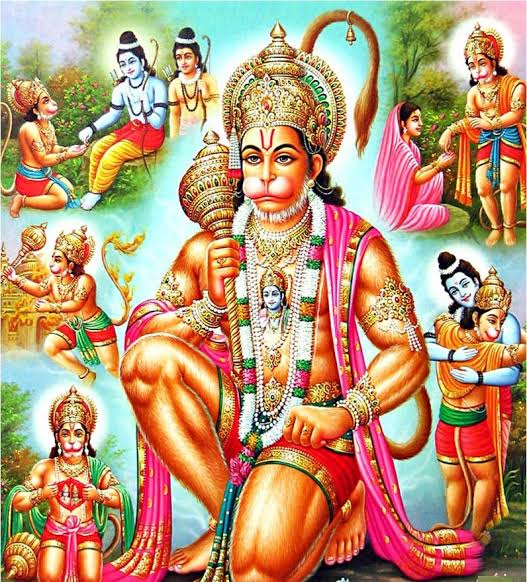
He is standing on the southern tip of the Indian mainland, and the ocean will not end. Behind him sit an army of monkeys and bears who have searched the world for a stolen queen and found nothing. Ahead of him is a hundred leagues of salt water and a fortress city of demons. The others have measured the distance and given their answers: forty leagues, sixty, eighty. Only one of them says nothing, because he has just been reminded of who he is.
Then he climbs a mountain, compresses himself like a drawn bow, and jumps.
Every tradition has its heroes. Hinduism has something rarer: a god whose entire divinity consists of how completely he loves somebody else. Hanuman is not worshipped because he is the Supreme Being. He is worshipped because he is the perfect bhakta (devotee) — and in the logic of devotion, that turns out to be the same thing. Millions of people who find Rama remote and Shiva terrifying can speak to Hanuman the way you speak to an elder brother who has never once let you down.
Who Is Lord Hanuman?
Hanuman is the vanara (monkey-formed being) who becomes Rama’s messenger, scout, warrior and closest servant in the Ramayana. He is a chiranjivi — one of the immortals, still present, still listening. He is the deity of strength, courage, breath, celibate discipline and the dissolving of trouble. And he is, by a long distance, the most casually beloved figure in Hindu practice: on the wall of a truck cab, above a shop till, in a roadside shrine under a peepal tree, at the foot of a wrestling pit.
His names describe him better than any definition. Anjaneya — son of Anjana. Kesarisuta — son of Kesari. Pavanputra and Vayuputra and Maruti — son of the wind. Bajrang Bali — the one whose limbs are hard as a thunderbolt. Mahavira — the great hero. Rama Doota — Rama’s envoy. And the one murmured most often, in the worst weeks of a life: Sankata Mochana, the remover of difficulties.
Even his principal name is not fully settled. One traditional reading takes Hanuman to mean something like “one with a disfigured jaw” — a reference to the childhood injury described below. Other derivations have been proposed, and honest scholarship admits the etymology is uncertain. In the south he is Anuman in Tamil, Hanumantha in Kannada, Hanumanthudu in Telugu; the figure travels and the name bends.
The Birth of Hanuman
The oldest account is in Valmiki’s Ramayana itself, in the Kishkindha Kanda. Anjana, a vanara woman, is blessed by Vayu, the wind god, with an extraordinary son. Valmiki is careful about the double fatherhood in a way later retellings often blur: Kesari is Hanuman’s kshetraja father, the social and legal father, while Vayu is called his aurasa son — begotten, direct. This is why Hanuman is simultaneously Kesarisuta and Vayuputra without contradiction. The Garuda Purana goes further and calls him a portion of the wind itself.
Later Puranas (the vast encyclopaedic texts compiled over many centuries) layer on more. Anjana’s long austerities, a bowl of sacred pudding carried by the wind from Ayodhya’s own fire ritual, a celestial curse that made her a vanara until she bore a son — the versions multiply, regionally and sectarianly, and they do not agree. This is normal for Hindu sacred literature and worth saying plainly rather than smoothing over.
Is Hanuman an avatar of Shiva?
You will hear this stated as settled fact. It is not; it is a genuine difference between traditions.
The Shiva Purana presents Hanuman as an avatar (descent, incarnation) of Shiva, and Shaiva devotees hold to that. Some texts call him an avatar of Rudra, or specifically the eleventh Rudra. A South Indian recension of the Shiva Purana makes him the son of Shiva and Mohini, Vishnu’s enchantress form. Vaishnava traditions, by contrast, generally keep him as the son and manifestation of Vayu — and in the Madhva school, Vayu’s whole function is to serve Vishnu’s incarnations, which makes Hanuman’s role theologically necessary rather than incidental.
So: if someone tells you Hanuman is Shiva, they are reporting a real and ancient position held by real devotees. If someone tells you he is Vayu’s son, they are reporting another. The tradition has lived comfortably with both for a very long time, and a reader is not obliged to arbitrate.
Where was Hanuman born?
Three places claim him, each with temples, each with local conviction: Anjaneri near Nashik in Maharashtra; Anjanadri near Hampi in Karnataka, in the landscape identified with the vanara kingdom of Kishkindha; and Anjanadri Hill at Tirumala in Andhra Pradesh. There is no way to settle this historically, and the competing claims are themselves part of the story of how widely he is loved.
The sun, the thunderbolt and the curse of forgetting
Two childhood episodes shape everything that follows.
In the first, the infant Hanuman mistakes the sun for a ripe fruit and leaps for it. Indra, king of the gods, strikes him with the vajra (thunderbolt) and breaks his jaw. Vayu, in grief and fury, withdraws the air from the worlds until the child is revived — by Shiva in many tellings — and the gods, in apology, each grant him a boon: immunity to weapons, freedom from fire, the ability to change his size at will, a life that ends only when he chooses. A striking detail survives even outside Hindu sources: the eighth-century Jain text Dhurtakhyana has him burned to ash and restored, and still keeps the disfigured jaw.
In the second, the boy’s enormous power meets an enormous lack of restraint. He torments meditating sages and is cursed — not with the loss of his powers, but with the loss of the memory of them. He will be unable to recall what he can do until someone reminds him.
Hold on to that, because it is the hinge of the whole epic. The mightiest being in the story spends his youth not knowing it. On the shore of the ocean, when the search has failed and every calculation says the crossing is impossible, the bear-king Jambavan turns to him and tells him who he is. Only then does he jump.
Hanuman in the Ramayana
He enters the epic late and takes it over. One of the Ramayana’s seven kandas — the Sundara Kanda, the “beautiful book” — is essentially his.
The meeting
Rama and Lakshmana, wandering in search of Sita, arrive near Kishkindha. Sugriva, the exiled monkey prince, sends Hanuman to find out who these armed strangers are. Hanuman approaches in the guise of a mendicant and speaks — and Rama, hearing him, remarks on the sheer quality of his Sanskrit. It is a small, lovely moment: the relationship begins with Rama noticing how well this creature speaks.
The leap and the finding
After Sugriva is restored to his throne, the search for Sita turns south. Hanuman crosses the strait, enters Lanka shrunk to the size of a cat, and searches a hostile city room by room until he finds a woman sitting under a tree in a grove, surrounded by demonesses, refusing food.
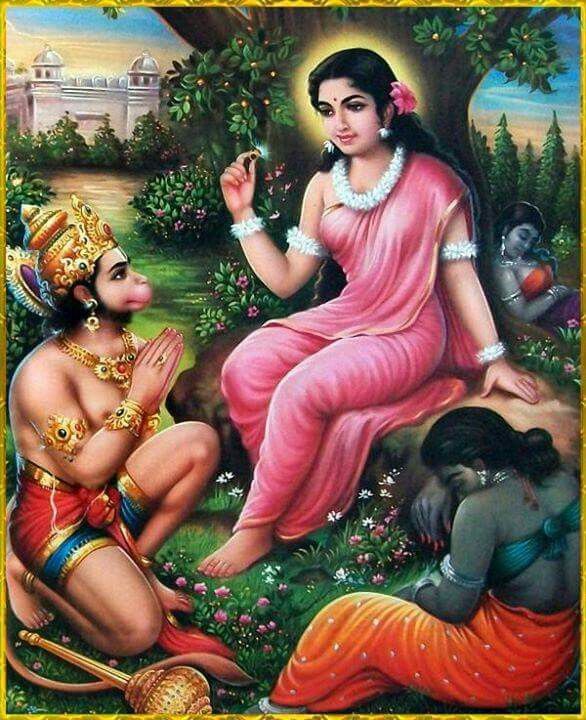
What happens next is the measure of the man. He offers to carry her out on his back immediately. She refuses — partly because being rescued by stealth would rob her husband of his duty and his honour, partly because she will not be touched by another. He accepts her reasoning without argument, takes Rama’s ring to her and her jewel back, and goes to get caught on purpose.
The burning of Lanka
Dragged before Ravana, he delivers a warning instead of a plea. The demon king orders his tail set alight. Hanuman, growing enormous, drags his burning tail across the rooftops of the city, then douses it in the sea and leaps home with news.
The mountain
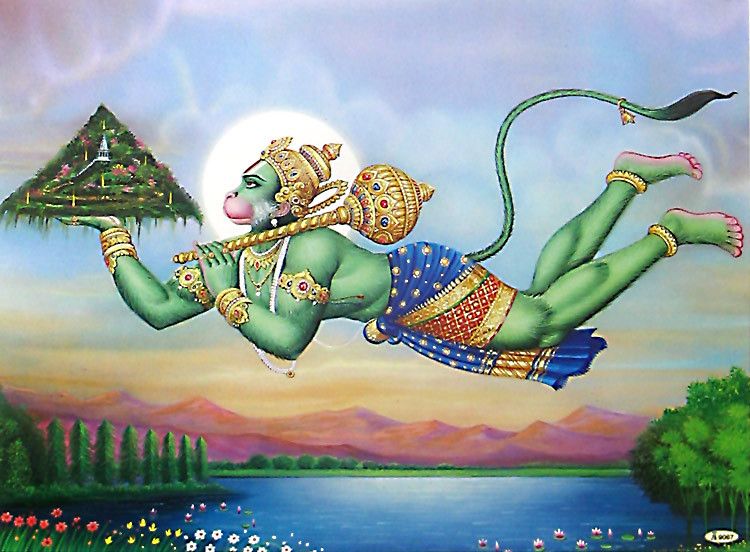
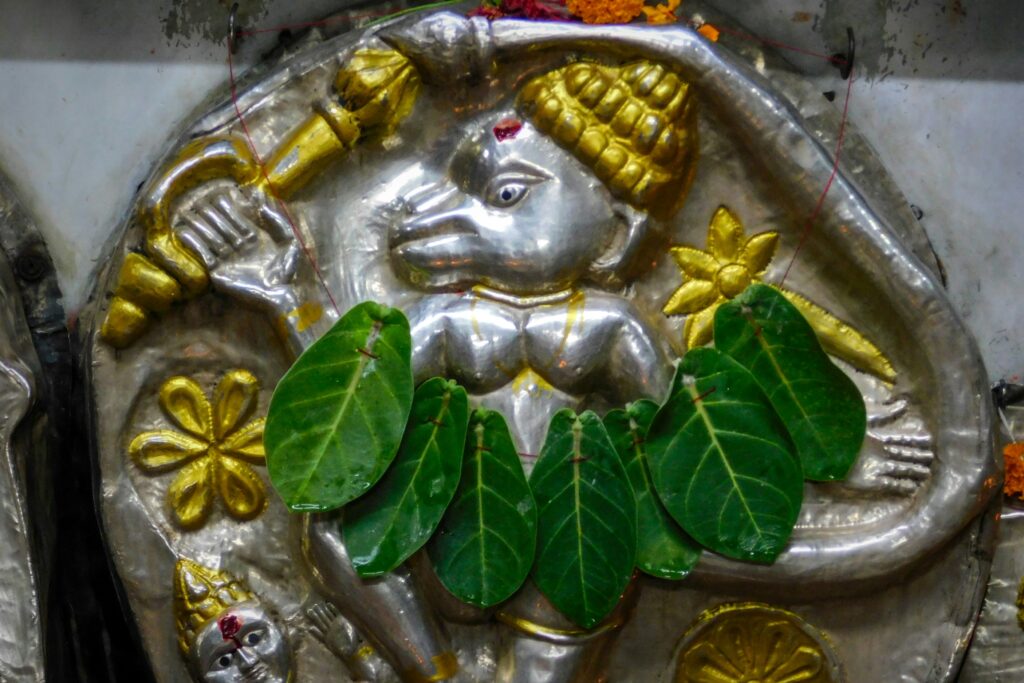
In the war that follows, Lakshmana falls, mortally wounded, and the healing herbs grow on a mountain in the Himalaya. Hanuman flies north, cannot identify the right herb among thousands, and so — unwilling to waste a second — lifts the entire mountain and carries it back. This is the image on a thousand calendars and shrine walls: a flying figure with a hill in one raised hand. It is a portrait of a particular kind of love, the kind that does not optimise.
Presence of Lord Rama in the Heart
After the war, gifts are distributed. Hanuman receives a pearl necklace from Sita and is seen biting each pearl and throwing it away. Asked why, he says he is looking for Rama inside it, and that anything without Rama in it is worthless to him. Challenged — is Rama inside you, then? — he tears open his own chest, and there they are. Rama grants him immortality and, in the devotional reading, something more: a permanent place as the one through whom human beings reach Rama at all.
Hanuman in the Mahabharata
He outlives his own epic. In the Vana Parva of the Mahabharata, an aged monkey lies across a forest path and refuses to move. Bhima, the strongest of the Pandavas, orders him aside, then tries to shift his tail, and cannot. The monkey reveals himself. The meeting is a family one in the texts’ own logic: both are sons of the wind, which makes Hanuman Bhima’s half-brother. He promises to be present at Kurukshetra as a roar from the banner of Arjuna’s chariot — a detail Bhima’s own brother never learns the full weight of.
The Symbolism of Hanuman’s Form
Nothing in the iconography is decorative.
The gada (mace) rests on his shoulder rather than being brandished. It is the weapon of raw, unsubtle strength held in reserve — the strength of someone with no interest in using it.
The vajra appears in his epithets rather than his hands: Bajrang, thunderbolt-limbed. The weapon that broke his jaw became the description of his body.
The mountain in his raised hand is the Sanjeevani episode frozen in stone, and more broadly the sign that he is the one who fetches what cannot be fetched.
The folded hands of the standing temple image, eyes down, tail curled high — this is the far commoner form, and it is the theologically serious one. The most powerful being in the epic is shown waiting for instructions.
The orange-red coating. Hanuman murtis are routinely smeared with sindoor (vermilion) mixed with oil, which is why so many of his images look molten rather than carved. The popular explanation is charming: Hanuman saw Sita applying sindoor to her hair parting for her husband’s long life, and reasoned that if a little was good for Rama, covering himself entirely would be better. The practice, whatever its origin, is how a great many of his shrines are maintained.
No vahana. Most Hindu deities ride a mount. Hanuman is a mount — he has carried Rama, Lakshmana and a mountain. He is his own vehicle.
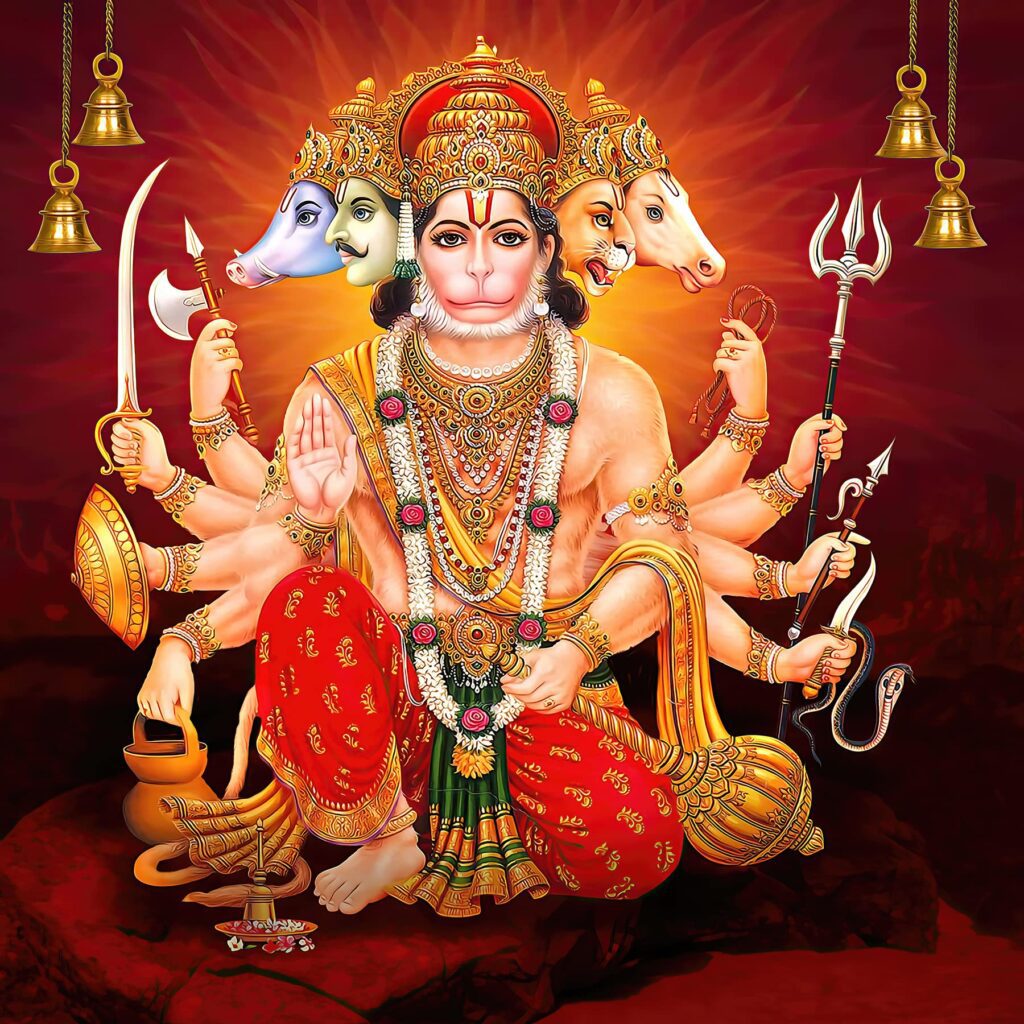
Panchamukhi Hanuman, the five-faced form, combines his own face with those of Narasimha, Garuda, Varaha and Hayagriva, each facing a direction. It is a protective, almost tantric form, invoked when something needs to be guarded on every side.
The monkey body itself carries the teaching. The mind in Indian thought is famously a monkey — restless, grabbing, leaping. Hanuman is that same nature with the leaping aimed at one object. He is not a tamed mind. He is a devoted one, which is a different and more achievable thing.
Hanuman’s Relationships
Rama is the whole of him. The relationship is dasya bhava, the devotional mood of the servant, and Hanuman is its textbook example.
Vayu is his father and the reason he governs breath, speed and the invisible. Shiva is his origin in Shaiva theology and his reviver in the sun episode. Surya, the sun he once tried to eat, becomes his teacher in several traditions. Sita blesses him as a son would be blessed. Bhima is his half-brother. Indra, who broke his jaw, is also among the gods who compensated him with boons — a very Hindu kind of resolution.
Is Hanuman celibate?
In the mainstream tradition, unambiguously yes: he is a lifelong brahmachari, and this is central to how he is worshipped, particularly by wrestlers, students and ascetics. The vow is understood not as deprivation but as the conservation of a tremendous energy and its redirection toward one purpose.
Honesty requires noting the exceptions, because they exist. Jain retellings such as Vimalasuri’s Paumacariya have him marry and only later become an ascetic. The Thai Ramakien makes him frankly amorous and gives him a son by a mermaid. Javanese shadow-puppet tradition gives him a wife and children. And a handful of regional South Indian sources describe a marriage to Suvarchala, a daughter of Surya, usually framed in a way that preserves his celibacy in substance. These are not errors to be corrected; they are what a figure looks like after fifteen hundred years of travel.
Major Hanuman Temples
He may be the most densely enshrined deity in India, because he does not require a temple — a daubed stone at a crossroads will do. Among the famous:
- Sankat Mochan, Varanasi — associated by tradition with Tulsidas himself, and thronged on Tuesdays and Saturdays. The city’s own significance is covered in our piece on Kashi.
- Hanumangarhi, Ayodhya — a hilltop fort-temple in Rama’s own city, traditionally visited before the Rama temple.
- Salasar Balaji and Mehandipur Balaji, Rajasthan — vast, intense pilgrimage centres; Mehandipur in particular is known for rites of exorcism and attracts the desperate.
- Jakhu Temple, Shimla — identified with the Sanjeevani flight, crowned by a statue roughly 108 feet tall.
- Paritala, Andhra Pradesh — a colossal figure of about 135 feet, among the tallest anywhere.
- Khajuraho, Madhya Pradesh — home to what is generally identified as the oldest known independent Hanuman shrine and image, dated to roughly 922 CE, which tells you his independent worship is a thousand years old at minimum.
- Hanuman Dhara, Chitrakoot and the Panchmukhi temple in Karachi round out a geography that runs well past modern borders.
Timings, dress expectations and queue systems at all of these change, sometimes at short notice. Check the temple’s own announcements before travelling.
Hanuman Jayanti: Why the Date Keeps Moving
If you have ever been confused about when Hanuman’s birthday falls, the confusion is correct. There is no single date, and the differences are regional and calendrical rather than mistaken.
- Most of North India observes it on Chaitra Purnima, the full moon of the month of Chaitra, in March or April.
- Maharashtra also keeps Chaitra Purnima, though some panchangs there place the birth on the Chaturdashi of the dark fortnight of Ashvin instead — a straightforward disagreement between almanacs.
- Tamil Nadu and Kerala observe it in the month of Margazhi / solar Dhanu, in December or January, on the new-moon day.
- Telangana and Andhra Pradesh run a 41-day observance that begins on Chaitra Purnima and culminates in Vaishakha, in April or May.
- Karnataka keeps a Shukla Paksha Trayodashi, placed in Margashirsha or Vaishakha depending on the source.
- Odisha celebrates on Pana Sankranti, the first day of the solar month of Mesha, which is also the Odia new year in mid-April.
- Lucknow has its own beloved institution in Bada Mangal, the Tuesdays of the month of Jyeshtha, marked by free food stalls across the city.
Two practical notes. First, these are lunar or solar calendar positions, not fixed Gregorian dates, so they shift each year. Second — and this matters for readers in the United States, Britain, Canada or Australia — a tithi calculated for Ujjain or Chennai can begin and end on a different calendar day where you live, because tithis are tied to sunrise at a specific location. Always check a panchang computed for your own city rather than an Indian one. A festival that falls on a Thursday in Delhi can quite legitimately fall on Wednesday in California.
Mantras and Texts for Hanuman
The great popular text is the Hanuman Chalisa, composed in Awadhi and traditionally attributed to Tulsidas in the sixteenth century. Despite the name — chalis, forty — it runs to forty-three verses: two opening dohas, forty chaupais and a closing doha. Its hold on Indian life is hard to overstate; it is recited in traffic, in hospital corridors, in exam halls. Read it with meaning in our line-by-line translation of the Hanuman Chalisa.
Alongside it: the Sundara Kanda, read in full as a devotional act, particularly in the south and especially during illness or crisis; the Bajrang Baan, a fiercer protective composition; and the Sankatmochan Hanuman Ashtak, eight verses that list the troubles he has removed and ask for one more — we have a full translation with commentary.
Simple mantras in common use include Om Han Hanumate Namah and Om Shri Hanumate Namah. There is also a quiet theological joke embedded in all of it: the mantra Hanuman himself chants is Rama. Worship of the devotee leads to the one he is devoted to, which is the entire point.
Tuesday and Saturday are his days. Many devotees fast on one of them, and the Tuesday offering of boondi or laddoo at a Hanuman shrine is among the most widespread small rituals in India.
What Hanuman Actually Teaches
Strip away the mace and the mountain and a very specific ethic remains.
Strength is for carrying things. Hanuman’s power is never once used to acquire anything for himself. He has no kingdom, no consort, no ambition. The texts give him every capacity and no appetite.
Service is not servility. He argues with Sita, warns Ravana to his face, and makes his own tactical decisions constantly. Obedience in this tradition is compatible with initiative, and the Sundara Kanda is mostly a record of him improvising.
You have forgotten what you can do. The curse of forgotten power is the most psychologically modern thing in the story. Hanuman does not acquire strength at the ocean’s edge; he recovers the memory of it, because someone said it out loud.
Devotion over everything. He is not the cleverest, the most learned or the most royal figure in the epic. He is the one who loves most completely, and the tradition ranks that above all the rest.
Why Hanuman Matters Today
It is easy to make this section into platitudes. Here is the version that is actually useful.
He is the deity of the overwhelmed. Sankata Mochana is not a poetic title; it describes a function. People turn to Hanuman specifically when the situation is too big — a diagnosis, a court date, a child in trouble, a job gone. If you have ever wondered why the Chalisa is the single most recited text in India, it is because anxiety is the single most common human condition, and this is what Indians reach for. Whether you read that devotionally or psychologically, the forty-three verses give a frightened mind something rhythmic and absorbing to hold for eight minutes. That is not a small thing.
He makes physical discipline spiritual. The traditional akhada (wrestling gymnasium) is a Hanuman institution: strength training as worship, celibacy as fuel, the body as an offering. For anyone trying to connect a gym habit to something larger than vanity, this is a ready-made and very old framework.
He is the answer to the diaspora’s hardest question. Parents raising Hindu children outside India often struggle to explain why a monkey is divine. The real answer is better than the embarrassed one: he is divine because he is not grand. He is the figure who proves that in this tradition, proximity to God is earned by love rather than by birth, species, caste or learning. That is a genuinely radical claim and it is worth making to a sceptical teenager.
A practice you can actually start. Pick Tuesday. Light a lamp. Read the Chalisa once, slowly, with the meaning beside it. Do it for eight weeks. The tradition asks for nothing more elaborate than that, and resists the idea that more elaborate would be better.
Frequently Asked Questions
Who is Lord Hanuman and why is he worshipped?
Hanuman is the vanara devotee of Rama in the Ramayana, worshipped as the god of strength, courage, protection and devotion. He is revered above all as the ideal bhakta — the being whose love for God is so complete that he himself became worthy of worship — and as Sankata Mochana, the remover of troubles.
Is Hanuman an incarnation of Shiva?
Depends on the tradition, and both answers are legitimate. The Shiva Purana and Shaiva theology present him as an avatar of Shiva or of Rudra. Vaishnava traditions, and Valmiki’s Ramayana itself, present him as the son and manifestation of Vayu, the wind god. Many devotees hold both ideas at once without discomfort.
Who are Hanuman’s parents?
His mother is Anjana. Kesari is his father in the social and legal sense, and Vayu is his divine father — Valmiki uses precise terms for each relationship, which is why Hanuman is called both Kesarisuta and Vayuputra.
Why is Hanuman covered in orange sindoor?
Hanuman images are traditionally coated in sindoor mixed with oil. The popular story is that Hanuman, seeing Sita apply sindoor for Rama’s long life, covered his whole body in it so Rama would benefit the more. The practice is widespread but not universal; some shrines keep the stone image uncoated.
Is Hanuman still alive?
In the tradition, yes. He is a chiranjivi, an immortal, blessed by Rama to remain as long as Rama’s story is told. His appearance to Bhima in the Mahabharata, generations later, is the texts’ own demonstration of this, and many devotees regard him as the deity most immediately present in the world.
Which day is best for Hanuman worship?
Tuesday is the most widely observed, with Saturday close behind in many regions. Both days carry a tradition of fasting, temple visits, Chalisa recitation and offerings of laddoo, boondi or chola — a sindoor-and-oil coating applied to the murti.
What should I chant if I am new to this?
The Hanuman Chalisa, once, with an English translation open beside the text so the words mean something. If that is too long to begin with, Om Han Hanumate Namah repeated quietly is a complete practice in itself.
A Closing Thought
There is a reason the Ramayana gives its most beautiful book not to its king, its queen or its villain, but to the servant. Rama is dharma; Sita is endurance; Ravana is brilliance ruined by appetite. Hanuman is the only figure in the epic whose problem is simply that he has forgotten what he is capable of — and whose solution is that somebody tells him.
That is why his shrine is the one under the tree, unlocked, unstaffed, with a rag of orange cloth and a few marigolds. He does not ask for a temple. He asks to be reminded, and to be given something to carry.
Continue Exploring
- Lord Hanuman FAQs — quick answers to the questions devotees ask most
- Hanuman Chalisa: Meaning in English — the full text, verse by verse
- Sankatmochan Hanuman Ashtak: Translation and Meaning
- Introduction to the Ramayana — the epic Hanuman walks into
- Who Is Lord Shiva? — the deity some traditions name as Hanuman’s source