
In Delhi on Dussehra evening, a fifty-foot effigy with ten heads goes up in flames while a crowd of thousands cheers. Four hundred miles east in Kolkata, on the same evening, women in red-bordered white saris smear each other with vermilion and weep as clay idols are carried to the river. Eight hundred miles south in Mysuru, a decorated elephant carries a golden howdah through streets lined with lights.
Three cities, one date, and — if you ask what is being celebrated — three answers that do not obviously match.
This is the peculiar thing about Dussehra. It is not one festival that regions decorate differently. It is genuinely two victories, remembered on the same day, and in some places a third set of meanings layered on top. Understanding that is the key to understanding why the festival looks so different depending on where you stand.
Dussehra 2026: The Date
Dussehra, or Vijayadashami, falls on Tuesday, 20 October 2026 — the tenth day of the bright fortnight of Ashwin, immediately following the nine nights of Sharad Navratri (11–19 October).
Unusually among Hindu festivals, the important rituals of this day are performed in the afternoon, not the morning. The governing period is Aparahna Kaal, the fourth of the five divisions of daylight. Within it sits Vijaya Muhurat — the eleventh muhurta counted from sunrise, a window of roughly forty-five minutes. The day takes its name from it. Timings shift with local sunrise and sunset, so check a panchang for your own city rather than using a national figure.
What the Names Mean
Vijayadashami is the straightforward one: vijaya (victory) plus dashami (the tenth lunar day). The tenth day of victory.
Dussehra is generally derived from dasha (ten) and hara (removing or defeating) — the defeat of the ten-headed one, meaning Ravana. An alternative reading takes it as the removal of ten specific vices: lust, anger, greed, attachment, pride, jealousy, selfishness, injustice, cruelty and ego. Both readings are widely taught, and the second has become the more popular sermon.
Regional names vary: Dasara in Karnataka and Maharashtra, Dashain in Nepal, Bijoya Dashami in Bengal.
The Two Legends
Rama defeats Ravana
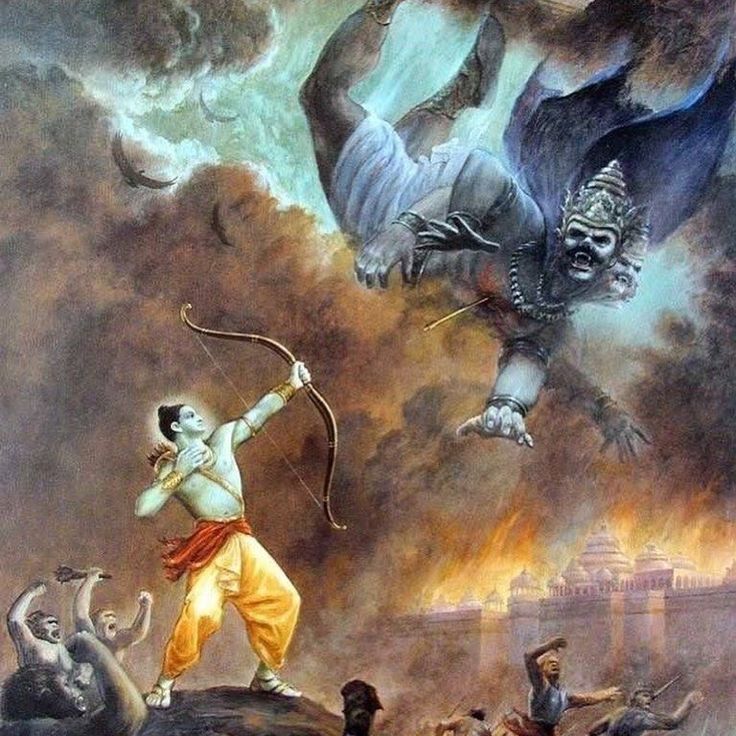
In the northern, western and much of the eastern telling, this is the day Rama killed Ravana and ended the war in Lanka. Ravana had abducted Sita; Rama, with Lakshmana, Hanuman and the vanara army, crossed to Lanka and fought a war that ended with the ten-headed king’s death.
The Ramayana is performed as Ramlila across the nine preceding nights precisely so that it reaches this scene on this day. The effigies burned in the evening are Ravana, his brother Kumbhakarna and his son Meghnad.
Durga defeats Mahishasura
In Bengal, Assam, Odisha and much of the east and south, the tenth day marks a different victory: the Goddess killing the buffalo demon Mahishasura after a battle that ran the nine preceding nights.
Neither legend is a corruption of the other, and the tradition has never required anyone to choose. They share a structure — nine days of struggle, victory on the tenth — and a meaning, which is that dharma outlasts what opposes it. Many households observe both, and there is a widely told connection: Rama himself is said to have invoked Durga before the final battle, performing an out-of-season worship of the Goddess that gives Bengal’s autumn Durga Puja its name, Akal Bodhan, the untimely awakening.
The Rituals of Vijayadashami
Shami Puja
The shami tree (Prosopis cineraria, known regionally as khejri, banni or jammi) is worshipped on this day. The reason lies in the Mahabharata: during their final year of exile in disguise, the Pandavas hid their weapons in the hollow of a shami tree, and Arjuna retrieved them from it on this day before the war at Kurukshetra.
In Maharashtra the custom takes a particular form — people exchange leaves of the apta tree, calling them sona, gold, and offering them to elders and neighbours as a token of prosperity and goodwill. The greeting that accompanies it translates roughly as: take this gold, and let our relationship be golden.
Aparajita Puja
Aparajita means the unconquered — a form of Durga invoked on this day for a victory that lasts. The puja is performed in the Aparahna window, traditionally facing north-east, with aparajita flowers where they can be found.
Ayudha Puja and Shastra Puja
This began as a warrior practice: a king honoured his weapons before a campaign. It widened over centuries into the worship of every implement by which a household earns its living.
Tools are cleaned, rested from work for the day, marked with haldi and kumkum, garlanded, and offered aarti. In practice this means mechanics garlanding their spanners, drivers decorating their vehicles, musicians honouring their instruments, students their books, and — increasingly — professionals their laptops, with no sense of absurdity whatsoever.
Timing differs by region: much of South India observes Ayudha Puja on Mahanavami, the ninth day, while North and West India more commonly perform Shastra Puja on Vijayadashami itself.
Seemollanghan
Literally, crossing the boundary. Kings would ceremonially cross their kingdom’s border on this day to mark the opening of the campaigning season, which in practical terms began when the monsoon ended. The custom survives in a domesticated form: many families step out beyond the limits of their town or village, or simply walk out of the house in a chosen direction, to mark a new beginning.
Vidyarambham
In Kerala and much of South India, this is the day children are first guided to write — a letter traced in rice or sand with an adult’s hand over theirs. Books that were ceremonially set aside during Navratri are taken up again. Victory, in this reading, includes the victory of knowledge over ignorance, which makes Dussehra the natural day to begin learning anything.
Ravan Dahan
After sunset, in towns across North India, the effigies burn. They are built over weeks from bamboo and paper, packed with fireworks, and often stand fifty feet or more. Ravana’s ten heads are the last thing to go.
Unlike the afternoon rituals, this has no fixed scriptural muhurat — it happens after dark simply because the crowds can gather safely and the fire is visible. Local committees set the time.
One Day, Many Festivals
North India — Ramlila through the nine nights, Ravan Dahan in the evening, melas and fairgrounds around the burning grounds.
Bengal and the East — Bijoya Dashami. The idols receive a final offering, married women perform Sindoor Khela, smearing each other with vermilion, and the immersion processions move to the river with drums. Afterwards people visit one another to exchange sweets and embraces, and the greeting Shubho Bijoya carries on for days.
Karnataka — Mysuru Dasara, the state festival, with the illuminated palace and the Jamboo Savari procession carrying the idol of Chamundeshwari in a golden howdah.
Himachal Pradesh — Kullu Dussehra, which runs backwards to everywhere else: it begins on Vijayadashami, when the rest of India finishes, and continues for about a week. Hundreds of village deities are carried in palanquins to Dhalpur maidan to attend on Lord Raghunath. There is no Ravana effigy at all.
Chhattisgarh — Bastar Dussehra, which runs for roughly seventy-five days and is dedicated not to Rama but to the local goddess Danteshwari. It is among the longest festivals anywhere in the world.
Maharashtra — apta leaves exchanged as gold, and Dasara counted among the most auspicious days of the year.
Tamil Nadu and Kerala — Saraswati Puja and Vidyarambham, with the emphasis on learning rather than on battle.
The Place Where Ravana Is Not Burned
Here is a detail that surprises most people, including many Hindus.
In a handful of places, Ravana is not treated as a villain. Bisrakh in Uttar Pradesh, held by local tradition to be his birthplace, has historically refrained from Ravan Dahan and observes mourning instead. In Mandsaur in Madhya Pradesh, believed locally to be Mandodari’s home, Ravana is regarded as a son-in-law of the town. Certain Brahmin communities in Jodhpur claim descent from him. There is a Ravana temple in Kakinada in Andhra Pradesh.
The reasoning is not perverse. Ravana in the Valmiki Ramayana is a formidable figure — a great devotee of Shiva, a master of the Vedas, a scholar and a musician, brought down by one catastrophic flaw rather than by being simply wicked. The tradition has always known this. Some communities have chosen to remember the scholar alongside the abductor.
It is a useful corrective to the flattest version of the festival. The story is not that a bad man was destroyed by a good one. It is that a brilliant man was destroyed by his own arrogance, which is a considerably more uncomfortable lesson and rather more applicable to most of us.
Beginning Things on Dussehra
Vijayadashami is one of the most auspicious days in the year for starting something. In the Maharashtrian reckoning it is counted among the saade teen muhurat — the three and a half most auspicious days of the year, alongside Gudi Padwa, Akshaya Tritiya and the half-day of Balipratipada. Versions of the list vary slightly by region.
The practical result: new businesses open, vehicles and property are bought, children are enrolled in music or dance, and the logic of the day is followed literally. It is the day Arjuna picked up his weapons again after thirteen years. It is the day the campaigning season opened. It is the day children write their first letter.
If there is something you have been circling for months without starting, the tradition is fairly direct about what this day is for.
Why It Still Matters
What strikes me most about Dussehra is not the victory. It is the timing of the celebration.
Rama’s victory is not celebrated when he returns home. That comes twenty days later at Diwali, when Ayodhya lights its lamps. Durga’s victory is not celebrated in triumph either — Bengal’s Vijayadashami is a day of weeping, because the Mother is leaving. In both cases the tenth day marks the end of the struggle, not the enjoyment of its rewards.
There is something honest in that separation. The day the thing is finally beaten is not, usually, the day it feels good. It is the day you are exhausted, the day the structure you built around the fight is dismantled, the day the thing that organised your last nine months is simply over. The celebration comes later, once you have gone home.
Dussehra marks the harder of the two moments. Ten vices, ten heads, nine nights of a shape-shifting adversary — and then a fire at sunset, and everyone goes home.
Frequently Asked Questions
What is the significance of Dussehra?
Dussehra, or Vijayadashami, marks the victory of good over evil through two legends: Rama’s defeat of Ravana and Durga’s slaying of Mahishasura. It falls on the tenth day after Navratri’s nine nights and is observed with Shami Puja, Aparajita Puja, Ayudha Puja and, in North India, the burning of Ravana’s effigy.
What is the difference between Dussehra and Vijayadashami?
None — they are two names for the same festival, on Ashvin Shukla Dashami. Vijayadashami means the tenth day of victory; Dussehra is usually derived from the defeat of the ten-headed Ravana. It is also called Dasara, Bijoya Dashami and Dashain in different regions.
Why is Ravana’s effigy burned on Dussehra?
It marks Rama’s victory and is widely interpreted as the symbolic destruction of ego, greed and cruelty within oneself rather than as a re-enactment of history. Effigies of Kumbhakarna and Meghnad are usually burned alongside his. A few places associated with Ravana do not burn effigies at all.
What is Vijaya Muhurat and when is it in 2026?
Vijaya Muhurat is the eleventh muhurta counted from sunrise, a roughly forty-five minute window within Aparahna Kaal, traditionally used for Shami Puja, Aparajita Puja and beginning new ventures. It falls in the afternoon of 20 October 2026 and shifts by city, so check a local panchang.
What is Ayudha Puja and who performs it?
Ayudha Puja is the worship of the tools by which one earns a living — instruments, vehicles, machinery, books. They are cleaned, rested for the day, marked with haldi and kumkum, garlanded and offered aarti. South India generally observes it on Mahanavami; North and West India on Vijayadashami.
Is Dussehra a good day to start something new?
Yes — it is considered one of the most auspicious days of the year for new beginnings, counted in the Maharashtrian tradition among the three and a half most auspicious days. New businesses, major purchases, and a child’s first lesson are all traditionally begun on this day.
A Closing Thought
The last thing to burn on a Ravana effigy is the ten heads, because they are highest and the fire climbs. For a few seconds they are still there, lit from beneath, above a body that has already gone.
Ten heads: ten forms of knowing, in one traditional reading, or ten vices in another. Either way, the part of him that goes last is the part that was thinking. Not his strength, not his kingdom — his brilliance, burning after everything holding it up has already collapsed.
Whatever you have been fighting through these nine nights, may this be the day it ends. And may you notice, afterwards, that the ending and the celebrating are two different days — and give yourself both.
Continue Exploring
- Significance of Navratri: The Spiritual Meaning of the Nine Nights
- Durga and Mahishasura: The Story Behind Navratri’s Nine Nights
- Introduction to the Ramayana — Story, Characters, and Meaning
- Seven Kandas of the Ramayana Explained