Eight hundred and fifty-two steps drop down the hillside from the temple town to the river. They are steep, uneven in places, and in summer the stone is hot enough that most pilgrims take them early or pay for the ropeway instead. At the bottom is the Krishna, wide and green and moving slowly between forested ridges, and at this particular bend the river has another name: Patala Ganga, the Ganga of the underworld. Water is carried up those steps for the bathing of the deity. People have been carrying it up for a very long time.
The temple at the top is Sri Bhramaramba Mallikarjuna Swamy Devasthanam, on the Srisailam hill in the Nallamala range of Andhra Pradesh. For Shaivas it is the second of the twelve Jyotirlingas, the self-manifest lingams of light named in the traditional Dwadasha Jyotirlinga verse. For Shaktas it is one of the great Shakti Peethas, the places where a part of Sati’s body is said to have fallen. Very few shrines in India carry both titles at full strength. Srisailam does, and the two deities are not guests in each other’s house — they share the hill as equals.
And there is one more thing about this temple, unusual enough that it shapes how people plan their journey here. At most Jyotirlingas you see the lingam from a distance, through a crowd, for a few seconds. At Srisailam, if you take the right ticket, you may put your hands on it.
Where Srisailam Is
The temple stands in the town of Srisailam in Nandyal district, Andhra Pradesh — and this detail matters if you are searching for older information, because Srisailam was in Kurnool district until Andhra Pradesh reorganised its districts in 2022. A great deal of travel writing online still says Kurnool. Both refer to the same place.
The hill sits inside the Nallamala ranges, part of the Eastern Ghats, in terrain that is genuinely forested — this is the Nagarjunsagar-Srisailam Tiger Reserve, the largest tiger reserve in India. The Krishna river cuts through the hills below the town, dammed here as the Srisailam reservoir. The approach from any direction is by ghat road through forest, which is part of why the journey still feels like a journey.
In the older texts and in local usage the hill carries several names: Srigiri, Siddhavatam, and above all Sriparvata, the sacred mountain. It appears in Sanskrit literature as a place of siddhas and ascetics long before it appears in tourist guides.
Why Shiva Is Called Mallikarjuna Here
The name is a compound, and the tradition offers more than one way to unpack it. Both readings are worth knowing, and they are not in competition.
The first is botanical and devotional. Mallika is jasmine — malle in Telugu — and arjuna is the arjuna tree. The lingam here is worshipped with jasmine, traditionally offered beneath or in association with the arjuna tree, and the deity takes his name from the flower that is brought to him.
The second reading is the story that local tradition tells most often. A princess named Chandravati, having withdrawn into these hills, noticed that one particular cow in her herd would come daily to a rock and release its milk over it. When she examined the rock she found it had the form of a Shiva lingam. She began worshipping it, and the flower she brought was jasmine — malle — and so the Lord of that rock became Mallikarjuna. Versions differ on her lineage and her reasons for retreating to the forest; the cow and the jasmine are constant.
A third strand ties the name to Shiva and Parvati themselves. In the account attached to this hill, Kartikeya — Shiva and Parvati’s younger son — left home in dejection after losing a contest to his brother Ganesha and settled on Mount Krauncha. His parents followed him there. Having come, they stayed, and presided on the mountain as Mallika (Parvati) and Arjuna (Shiva). On this reading the name is not one deity but two, which fits a shrine where Shiva and Shakti hold equal rank.
These narratives come down to us through Puranic and local sthala purana material rather than through one single authoritative text, and it is more honest to present them as a cluster of traditions attached to the site than to pin each to a chapter and verse. Where a specific text is identifiable — as with the Jyotirlinga enumeration itself, which belongs to the Shiva Purana’s tradition — it is worth naming; where it is not, the tradition is no less real for being plural.
Bhramaramba: The Goddess Who Came as a Bee
Uphill and slightly apart from the main shrine is the temple of Bhramaramba Devi, and she is not an appendage. In Shakta reckoning Srisailam is a Shakti Peetha — the tradition holds that Sati’s neck fell here — and the goddess is worshipped in her own right by pilgrims who have no particular interest in the Jyotirlinga.
Her name explains her story. Bhramara means bee. In the legend attached to this site, the Devi took the form of a bee — or of a swarm — in order to destroy the demon Arunasura, who had secured a boon that made him invulnerable to weapons but had neglected to account for insects. Having killed him, she remained on this hill, and is worshipped here as Bhramaramba, the Bee Goddess.
Devotees at her shrine sometimes report a faint humming from behind the sanctum wall, which is taken as her presence. Whether one hears it or not, the theological point of the pairing is clear enough: the same hill holds the still, stone, formless Jyotirlinga and the swarming, moving, weapon-defeating goddess. Shaiva and Shakta streams are not merely tolerated side by side at Srisailam — they are structurally joined. The Devi Bhagavata and Shakta Peetha literature count this among the most important of the seats, and pilgrims traditionally do not consider a visit complete until both shrines have been attended.
The Jyotirlinga You Are Allowed to Touch
This is Srisailam’s most distinctive practice, and for many pilgrims it is the reason they come here specifically rather than to a nearer Shiva temple.
Sparsha Darshan — literally touch-darshan — permits the devotee to enter the sanctum and place their hands on the lingam, offer water or bilva leaves, and perform a brief personal abhishekam. At most of the twelve Jyotirlingas this is either impossible or reserved for temple priests and special permissions. At Srisailam it is a ticketed category available to ordinary pilgrims on most days.
What you should know before planning around it, based on recent reporting and the temple’s own booking system:
- It is a paid darshan, most recently around ₹500 per person, and is issued per individual rather than per family.
- Traditional dress is enforced for this category specifically — for men typically a dhoti with an upper cloth or panchakacham, bare-chested in the sanctum; for women a saree, half-saree or salwar kameez with dupatta. Western clothing and shorts will not get you in.
- Photography and phones are not permitted inside, and photo identification is generally required at the counter.
- It is commonly suspended during Maha Shivaratri and other peak days, when crowd volumes make it impossible.
Prices, slot structures and eligibility rules at large Indian temples change without much notice, and they changed more than once in recent years. Treat every figure in this article as indicative and confirm on the official Srisailam Devasthanam portal, or by phone, before you build a trip around a particular darshan category.
History: A Shrine with a Paper Trail
Srisailam is unusually well documented for a hill temple, because successive dynasties left inscriptions here.
The earliest epigraphic evidence at the site is associated with the Satavahana period, which places recognisable temple activity here as early as around the 2nd century CE. The Mallikarjuna shrine itself is generally dated to about the 7th century, with substantial building and rebuilding layered on top of it over the following thousand years.
The Reddy rulers of the 12th to 14th centuries were major patrons: the veerasheromandapam and, significantly for every pilgrim since, the flight of steps down to Patala Ganga are credited to their period. Under the Vijayanagara empire the temple received its most conspicuous expansion — Harihara I is named in connection with major renovation, and the finely carved Mukha Mandapa belongs to the Vijayanagara style.
Two further associations are worth reporting carefully, because they are widely repeated and less firmly documented. Adi Shankara is held by tradition to have visited Srisailam around the 8th century, and his Shivananda Lahari — a hundred Sanskrit stanzas in varied metres — is traditionally said to have been composed here; the hymn does open with an invocation to Mallikarjuna and Bhramarambika, which is the strongest internal support for the claim. Chhatrapati Shivaji is locally remembered as a devotee and benefactor of the shrine, and a memorial to him stands in the town; specific attributions of particular structures to him are traditional rather than firmly established, and should be treated as such.
The hill also has a strong association with Akka Mahadevi, the 12th-century Kannada Veerashaiva poet-saint, whose fierce vachanas address Shiva as Chennamallikarjuna — “lovely Lord of jasmine” — which is, unmistakably, this deity. The caves on the Krishna near Srisailam that bear her name are visited on the strength of that connection, though the historical specifics of her time there rest on tradition rather than record.
The Temple Complex and Its Architecture
The walled complex covers roughly two hectares. The enclosing prakara wall runs approximately 183 metres by 152 metres and stands about 8.5 metres high, with four gopurams opening on the cardinal sides — the eastern one serving as the main entrance for most pilgrims.
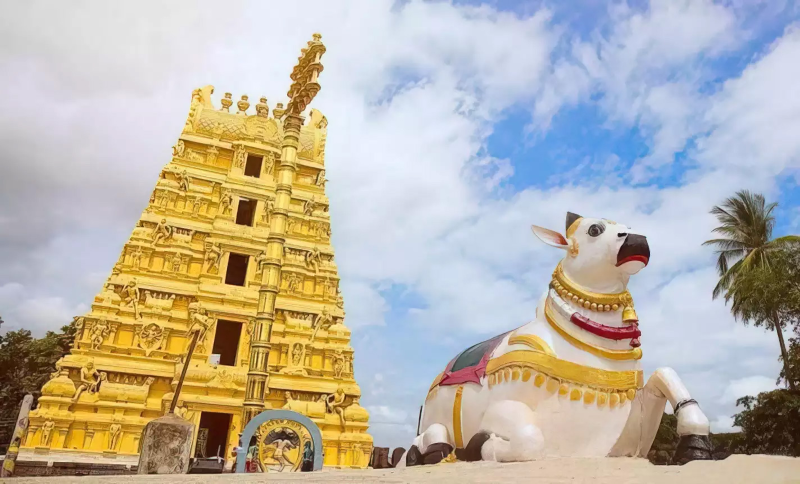
The architecture is broadly Dravidian, but layered: a 7th-century core, Reddy-period mandapas and steps, Vijayanagara-period pillared halls and carving. The Mukha Mandapa in front of the sanctum is the piece most visitors remember, its pillars worked with figures, narrative panels and floral bands. The outer walls carry relief sculpture in long registers — scenes from the epics and Puranas, processions, dancers, and a good deal of the ordinary iconographic vocabulary of a South Indian temple, executed with real confidence.
Inside the complex, alongside the two principal shrines, look for the Sahasra Linga — a single lingam bearing a thousand smaller lingams carved on its surface, which local tradition attributes to Rama — and a set of smaller subsidiary shrines including Sakshi Ganapati, positioned a short distance from the main temple. Sakshi Ganapati is the “witness” Ganesha, and the custom is that he records your visit and reports it to Shiva; pilgrims traditionally stop there so that the journey is formally noted. It is a charming piece of temple bureaucracy and a genuinely old practice.
Planning a Visit: A Practical Guide
Srisailam is a hill temple inside a tiger reserve, reached by ghat road, and that shapes the logistics more than the distances suggest. Plan the day around the road, not around the kilometres.
Getting there
By road is the normal way and the easiest. From Hyderabad it is roughly 215 km, about five to six hours via NH765, and this is the most-used approach; APSRTC and TSRTC buses run the route, as do private operators. From Kurnool it is roughly 100 km. From Bengaluru expect around 530 km and a ten to eleven hour drive. From Vijayawada it is a long day.
A point most first-time visitors miss: the ghat road is closed overnight, in recent practice from about 9:00 PM to 6:00 AM, because the route passes through core forest. If you are driving up in the evening, you need to clear the checkpoint before it shuts or you will be spending the night at the bottom. Confirm current hours locally before you set out, as forest department timings vary seasonally.
By train, there is no station at Srisailam. Markapur Road is the usual railhead at roughly 90 to 100 km, with Nandyal and Cumbum as alternatives; from any of them you continue by road.
By air, the practical airports are Hyderabad (Rajiv Gandhi International) and Kurnool (Orvakal), with Hyderabad far better connected for anyone flying in from abroad.
Darshan timings and darshan types
Recent published schedules give the temple as open for darshan from about 4:30 AM to around 3:30 PM and again from about 6:00 PM to 9:00 PM, with extended hours during the month of Shravana and on Maha Shivaratri. Mangala Aarti is at about 4:30 AM, and the Maha Mangala Aarti in the evening, around 5:20 PM to 6:00 PM, is the one regular visitors recommend arranging your day around.
Darshan is offered in tiers, most recently structured as:
- Sarva Darshan — the free general queue
- Seeghra Darshan — a faster queue, recently around ₹150
- Athi Seeghra Darshan — priority, recently around ₹300
- Sparsha Darshan — touch darshan, recently around ₹500, single person per ticket, traditional dress required
- VIP Break Darshan — requires a protocol recommendation
Abhishekams, archanas and other sevas are bookable, and accommodation in Devasthanam guest houses can be reserved through the official portal. Booking windows open some weeks ahead and Sparsha Darshan slots go early around weekends and festivals.
A necessary caveat, stated plainly: all of these timings and prices are drawn from recent secondary reporting and are liable to change. Temple administrations revise darshan categories, rates and slot availability regularly, and special arrangements during festivals override the normal schedule entirely. Verify on the official Srisailam Devasthanam website before travelling, and if a particular seva matters to you, telephone the temple office.
Dress code
For general darshan the requirement is simply decent traditional or modest clothing; shorts and Western casual wear are not appropriate and may be refused. For Sparsha Darshan the code is strict and enforced — dhoti with upper cloth or panchakacham for men, saree, half-saree or salwar kameez with dupatta for women. Carry the clothes with you rather than relying on buying them at the gate.
Best time to visit
October to March is the comfortable window; the Nallamala summer is punishing and the ghat road in heavy monsoon is no pleasure. Maha Shivaratri is the temple’s greatest festival and the crowds are extraordinary — magnificent if that is what you have come for, impossible if you wanted an unhurried darshan, and Sparsha Darshan is typically unavailable. Ugadi, the Telugu new year, and the Dasara period also draw heavy footfall. For a quiet visit with a realistic chance of touching the lingam, choose a weekday outside festival season and arrive for the pre-dawn opening.
Nearby, and worth the extra day
- Bhramaramba Devi shrine — within the complex, and not optional if you want the visit to be complete.
- Patala Ganga — the Krishna below the temple, reached by 852 steps or by ropeway. Pilgrims bathe here before darshan.
- Sakshi Ganapati — the witness Ganesha, a short distance from the main temple.
- Srisailam Dam — the reservoir and its viewpoints, striking in the hour before sunset.
- Akka Mahadevi Caves — reached by boat on the Krishna, with a naturally formed lingam inside; check boat operations before committing, as they depend on water levels and forest permissions.
- Nagarjunsagar-Srisailam Tiger Reserve — the forest you have been driving through; guided access is regulated by the forest department.
What Pilgrims Come Here Seeking
Every great temple acquires a reputation for what it gives, and Srisailam’s is unusually clear.
People come for contact. That is the whole meaning of Sparsha Darshan and it explains why pilgrims will travel past three closer Shiva temples to reach this one. In a tradition that is otherwise careful to keep a distance between the sanctum and the crowd, Srisailam collapses that distance deliberately. For a great many devotees the memory of a cold stone lingam under their own palm is the single most vivid religious experience of their lives, and no amount of theology about the formless quite substitutes for it.
People come for the pair. Couples visit Srisailam specifically because Shiva and Parvati are here together as Mallika and Arjuna, and prayers for marriage, for children and for the healing of a marriage are among the most common intentions brought up the hill. The Shakti Peetha status doubles this: you can bring a petition to the goddess in her own shrine on the same morning.
People come for release from what cannot be fought directly. The Bhramaramba legend is about a demon that no weapon could touch, defeated by something small and swarming and unexpected. Devotees facing chronic illness, entrenched litigation, addiction or long family conflict bring exactly that kind of problem here, and the story is why.
And people come, as they have for two thousand years, simply because the hill is Sriparvata. Ascetics and siddhas were on this mountain before the temple was built and the sense of accumulated practice is not something the architecture explains.
If you are visiting from abroad
A word for readers planning this from the United States, the United Kingdom, Canada or Australia. Srisailam is a full commitment from Hyderabad — realistically two days, three if you want the dam, the caves and an unhurried second darshan. Do not attempt it as a day trip with a late-afternoon departure, because of the overnight ghat road closure. Book Devasthanam accommodation or a Srisailam hotel in advance rather than arriving and looking. Carry traditional clothing if Sparsha Darshan is your reason for coming. And budget for the reality that at Indian temples, published timings are a plan rather than a promise; go with a spare morning in hand.
Frequently Asked Questions
Which Jyotirlinga is Srisailam?
Srisailam is the second of the twelve Jyotirlingas in the traditional enumeration, after Somnath in Gujarat. The deity is Mallikarjuna Swamy. It is also counted among the Shakti Peethas through the shrine of Bhramaramba Devi, which makes it one of very few sites holding both distinctions in full measure.
Can you touch the Shiva lingam at Srisailam?
Yes. Srisailam offers Sparsha Darshan, a paid darshan category that allows a devotee into the sanctum to touch the lingam and make a personal offering. It has recently cost around ₹500 per person, requires traditional dress and photo identification, prohibits phones and cameras inside, and is usually suspended on Maha Shivaratri and other peak days. Confirm current rules and rates with the temple before planning around it.
How do I reach Srisailam from Hyderabad?
By road, roughly 215 km and five to six hours via NH765, by bus or private vehicle. There is no railway station at Srisailam; Markapur Road at about 90 to 100 km is the usual railhead. The nearest well-connected airport is Hyderabad. Note that the ghat road up to the temple is closed overnight, in recent practice from around 9:00 PM to 6:00 AM, as it passes through tiger reserve forest.
What are the Srisailam temple darshan timings?
Recent schedules show darshan from about 4:30 AM to around 3:30 PM and again from about 6:00 PM to 9:00 PM, with longer hours in Shravana and on Maha Shivaratri. Mangala Aarti is around 4:30 AM and the evening Maha Mangala Aarti around 5:20 PM to 6:00 PM. These are subject to change, particularly during festivals; check the official Srisailam Devasthanam portal before you travel.
What is the dress code at Srisailam temple?
General darshan requires modest, preferably traditional clothing; shorts and Western casual dress are not appropriate. For Sparsha Darshan the code is strict — dhoti with upper cloth or panchakacham for men, saree, half-saree or salwar kameez with dupatta for women. Bring the clothing with you.
Why is Srisailam both a Jyotirlinga and a Shakti Peetha?
Because two distinct traditions converge on the same hill. Shaiva tradition names Mallikarjuna among the twelve self-manifest Jyotirlingas of light. Shakta tradition holds that Sati’s neck fell here, establishing a Peetha, where the goddess is worshipped as Bhramaramba — the one who took the form of a bee to destroy the demon Arunasura. Pilgrims traditionally visit both shrines, and the site is a working example of how closely Shaiva and Shakta streams are braided together in South Indian practice.
What is the best time of year to visit Srisailam?
October to March, for the weather and for the ghat road. Maha Shivaratri is spectacular but extremely crowded, with Sparsha Darshan typically unavailable; Ugadi and Dasara are also busy. A weekday outside festival season, arriving for the pre-dawn opening, gives the best chance of an unhurried darshan.
A Closing Thought
There is a moment, if you take the ticket and the queue moves and you are finally inside, when nothing is happening at all. The sanctum is small and dim and smells of camphor and old ghee. The lingam is cool. A priest says something you may not catch. Someone behind you is being told to move along.
And then the hand comes away and it is over, and you are walking out into the light on a hill in the Nallamala forest with the Krishna somewhere below, eight hundred and fifty-two steps down. It is such a small thing, that contact. Two thousand years of inscriptions, four gopurams, a dozen dynasties of patronage and a whole literature of legend, all arranged around the possibility of a person putting their hand on a stone and finding that, for a moment, nothing stands in between.
Continue Exploring
- Kashi and Its Significance for Hinduism
- The Nine Forms of Durga: Navadurga Explained
- Durga and Mahishasura: The Story Behind the Battle
- The Shiva Trilogy: Key Highlights and Takeaways
- How to Chant the Vishnu Sahasranama