
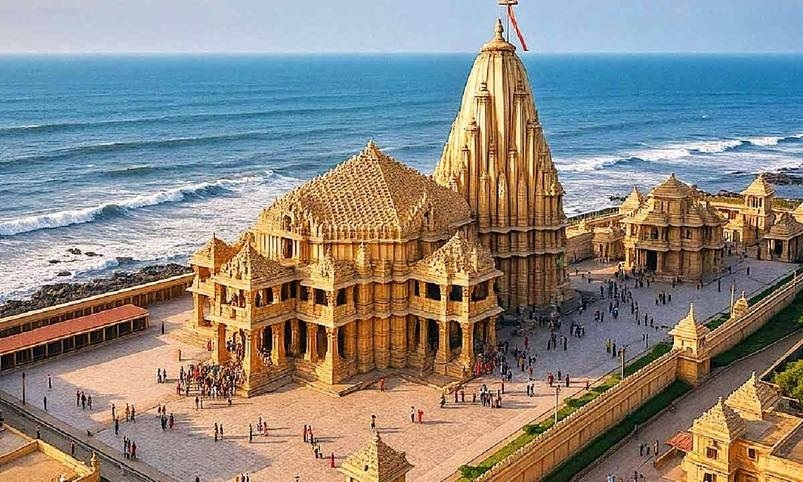
On the seaward edge of the Somnath temple complex, past the last of the stone paving, there is a modest pillar facing the Arabian Sea. It is called the Baan Stambh — the arrow pillar — and its claim is geographical rather than devotional. Draw a line due south from this point, it says, and you will not touch land again until Antarctica. The Trust that maintains the temple puts the distance at roughly 9,936 kilometres of unbroken water.
Stand there at dusk, with the sea working at the rocks below and the temple’s spire behind you, and the pillar does something to your sense of the place. This is not a shrine tucked into a safe valley. It is the last thing on the coast, built and rebuilt facing outward, which turns out to be exactly the right way to understand it. Somnath is the Hindu temple that has been destroyed more times than any other, and is still standing.
Where Somnath Stands
The temple is at Prabhas Patan, near the port town of Veraval in the Saurashtra region of Gujarat, on India’s western coast. Prabhas Patan is very old — excavation has placed occupation here in the Indus Valley period, roughly 2000 to 1200 BCE, followed by abandonment and reoccupation around 400 BCE. Long before any temple structure is archaeologically attested, the site appears in Sanskrit literature as Prabhasa Tirtha, a place of pilgrimage. Prabhasa means lustre, radiance, splendour.
Somnath is counted as the first of the twelve Jyotirlingas — the shrines where Shiva is held to be present as a column of light — and is often called the Aadi Jyotirlinga, the original one. For pilgrims making the full Dwadasha Jyotirlinga circuit, this is where it begins.
What a Jyotirlinga Is
The word combines jyoti, radiance or light, with linga, sign or mark. Behind it lies one of the most striking narratives in Shaiva literature. Brahma and Vishnu fell into a dispute over supremacy, and Shiva appeared between them not as a figure but as an infinite pillar of light, without top or bottom. Both set off to find its limit. Neither could. The point of the story is that the divine is not an object you can measure the edges of — and the linga, the aniconic form in which Shiva is worshipped, is a sign of exactly that unbounded presence rather than a statue of anybody.
The canonical list of twelve Jyotirlingas appears in the Shiva Purana, in the Shatarudra Samhita, with the individual shrines narrated at length in the Kotirudra Samhita. A Sanskrit hymn, the Dwadasha Jyotirlinga Stotram, names all twelve in verse and is still recited by pilgrims: Somnath in Gujarat, Mallikarjuna at Srisailam, Mahakaleshwar at Ujjain, Omkareshwar near Khandwa, Kedarnath in Uttarakhand, Bhimashankar near Pune, Kashi Vishwanath at Varanasi, Trimbakeshwar near Nashik, Vaidyanath at Deoghar, Nageshwar near Dwarka, Rameshwaram in Tamil Nadu and Grishneshwar near Chhatrapati Sambhaji Nagar. It is worth noting that the identification of one or two of these — Nageshwar in particular — is contested, with more than one site claiming the status.
The Legend: Chandra’s Curse and the Moon’s Waxing
The story of how Shiva came to be present here is told in the Shiva Purana’s Kotirudra Samhita, chapter fourteen, and it is unusual among temple legends in that it explains something you can see in the sky.
Daksha, the great progenitor, married his twenty-seven daughters — the twenty-seven nakshatras, the lunar mansions — to Chandra, the moon, also called Soma. Chandra, however, loved only Rohini, and neglected the other twenty-six. Daksha warned him. Chandra ignored the warning. So Daksha cursed him with kshaya roga — a wasting disease — and the moon began to fade.
The gods, alarmed at losing the moon altogether, consulted Brahma, who sent Chandra here, to Prabhasa Kshetra, with an instruction: worship Shiva with the Mahamrityunjaya mantra, the great death-conquering verse, for six months without break. The Purana says Chandra recited it ten crore times and held the mantra in a completely stilled mind. Shiva appeared and lifted the disease — but not entirely, and this is the elegant part. Rather than simply cancelling Daksha’s curse, Shiva established a settlement: the moon would wane and wax, fortnight by fortnight, forever. The illness became a rhythm.
Shiva then remained at Prabhasa as Somanatha — the lord of Soma, lord of the moon — and the place is said to have retained the power to restore what has been depleted. The name of the town and the name of the god carry the same meaning: this is where lustre was recovered.
Where the older Sanskrit sources are concerned, a careful distinction is worth keeping. Texts including the Mahabharata and the Bhagavata Purana refer to Prabhasa Tirtha as a sacred place, and the Chandra narrative is Puranic. What they do not give us is a description of a temple building. Archaeology has not found traces of a structure earlier than about the ninth or tenth century, though it has found the settlement. Historians therefore separate two claims that popular accounts tend to merge: the antiquity of the tirtha, which is not in doubt, and the antiquity of the temple, which is.
A History of Destruction and Rebuilding
The Somnath Trust’s own telling describes seven temples: built in gold by Soma himself, in silver by Ravi the sun, in wood by Krishna and in stone by King Bhimadeva, desecrated six times, and rebuilt a seventh time in our own era. That is the devotional framework. The documented history underneath it is dramatic enough without embellishment.
The Early Temple
The Chaulukya (Solanki) king Mularaja is reported to have built or renovated a temple here before 997 CE — historians disagree over whether he raised the first structure or restored an existing one. Archaeological excavation in 1950 and 1951, led by B. K. Thapar, found the foundations of a tenth-century temple, which the architectural historian M. A. Dhaky dated to roughly 960 to 973 CE.
1026: Mahmud of Ghazni
The best-known event in the temple’s history is the raid by Mahmud of Ghazni in 1026, during the reign of Bhima I, in which the Jyotirlinga was desecrated and an enormous quantity of gold — sources put it near twenty million dinars — carried off. This is the episode that made Somnath a byword.
Two points of honest scholarship belong here, because they are routinely dropped. First, sources disagree on the scale: whether Mahmud destroyed the temple structurally or desecrated and looted it. An inscription of 1038 that makes no mention of destruction has led some historians to conclude that whatever damage was done was repaired within about twelve years. Second, the frequently quoted figure of fifty thousand defenders killed is regarded by the historian Romila Thapar as a boastful and formulaic claim of the kind that recurs in court chronicles written to magnify Mahmud’s campaigns, rather than a count. None of this diminishes what happened. It does mean the event is better held as a documented raid with disputed dimensions than as a fixed set of numbers.
The Long Cycle
What followed, over some seven centuries, is a pattern with very few parallels anywhere:
- 1169 — The Chaulukya king Kumarapala rebuilt the temple in stone, urged on by the Pashupata ascetic Bhava Brihaspati, replacing a deteriorating wooden structure.
- 1299 — Alauddin Khalji’s army under Ulugh Khan defeated the Vaghela king Karna and sacked the temple. The fate of the image is disputed: some later accounts say the Jalore ruler Kanhadadeva recovered it; others, closer to the event, say it was taken to Delhi.
- 1308 — The Chudasama king Mahipala I rebuilt; his son Khengara installed the lingam sometime between 1331 and 1351.
- 1395 — Muzaffar Shah I, founder of the Gujarat Sultanate, destroyed the temple again.
- 1451 — Sultan Mahmud Begada desecrated it.
- 1665 and 1706 — Aurangzeb ordered its destruction; the first order appears not to have been carried out, the second largely was.
- c. 1783 — Ahilyabai Holkar, the queen of Malwa, built a smaller temple near the ruins so that worship at the site could continue safely while the main shrine lay destroyed. That temple still stands, and pilgrims visit it.
It is worth pausing on Ahilyabai. She did not attempt to restore the great temple; she built something modest and workable beside its wreckage so that the lamp would not go out. There is a particular kind of realism in that, and it kept the site alive for another century and a half.
1947 to 1951: The Seventh Temple
After Independence, the princely state of Junagadh — which included Somnath — acceded to India following a referendum. On 12 November 1947, Deputy Prime Minister Sardar Vallabhbhai Patel ordered the temple’s reconstruction. The Somnath Trust was established under K. M. Munshi to carry it out, funded by public subscription rather than the state — a distinction Mahatma Gandhi had specifically urged, on the view that a temple should be rebuilt by the devotion of the people and not from the treasury of a secular republic.
The ruins were cleared in October 1950. The new temple was raised by the Sompura Salats, the hereditary temple-builders of Gujarat, to a design by Prabhashankarbhai Oghadbhai Sompura, who worked to fold recoverable elements of the old structure into the new one. On 11 May 1951, President Rajendra Prasad performed the installation ceremony.
On the question that visitors most often ask: no, the linga you see today is not the object Mahmud struck. It could not be. What has been continuous here is not a piece of stone but a place and a practice, re-established after each interruption — which is, arguably, a more remarkable kind of continuity than a surviving artefact would have been.
The Architecture of Somnath Temple
The present temple is built in the Maru-Gurjara style — also called Chaulukya or Solanki architecture — in the form known as Kailash Mahameru Prasad, a temple type conceived as a representation of Shiva’s mountain.
It is a two-level structure with a pillared mandapa (assembly hall) leading to the garbhagriha (sanctum), and it carries 212 relief panels. The shikhara, the spire above the sanctum, rises about fifteen metres, topped by a flag pole of some 8.2 metres. Every surface that can hold carving does, in the Sompura manner: bracket figures, ceiling rosettes, bands of ornament running the height of the walls. It is a twentieth-century building executed in an eleventh-century idiom by craftsmen whose families had never stopped practising it — which is itself part of what makes it worth looking at slowly rather than walking straight to the sanctum.
The Baan Stambh
The arrow pillar on the shore is a modern marker of an old claim: that the sea route due south from Somnath to the pole is unobstructed. The Sanskrit line associated with it speaks of an unimpeded path of light from the ocean to the southern pole. Read it as geography and it is a notable observation about a coastline; read it devotionally and it is a statement about the reach of what is worshipped here. Either way, it is where most visitors end up standing for the longest.
Bhalka Tirth and Krishna’s Last Journey
Somnath is not only a Shaiva site, and this catches many first-time visitors by surprise. A few kilometres away is Bhalka Tirth, held to be the spot where Krishna, resting under a tree, was struck by a hunter’s arrow — the wound that ended his earthly life. From there, tradition says, he went to the Triveni Sangam, the confluence where the rivers Hiran, Kapila and Saraswati meet and enter the sea, and departed from the world.
So this stretch of Gujarat coast holds two of the tradition’s great endings within a short drive: the place where the moon’s decline was turned into a rhythm, and the place where an avatara laid down his body. Pilgrims routinely do both in one visit, and the pairing gives the trip a weight that the temple alone would not.
Planning Your Visit to Somnath
The details below are as published by the Shree Somnath Trust. Temple timings, aarti schedules and rules do change — particularly during Shravan, Mahashivratri and Kartik Purnima, when crowds are very heavy — so check somnath.org or call the Trust before you travel, especially if you are coming from abroad.
Timings and Aarti
- Darshan: 6:00 a.m. to 10:00 p.m.
- Aarti: 7:00 a.m., 12:00 noon and 7:00 p.m.
- Light and sound show: 8:00 p.m. to 9:00 p.m., suspended during the monsoon
- Entry: free
The evening aarti at seven, with the sea audible behind the bells, is the one to plan around if you can only manage one.
What You Cannot Take Inside
This is the point that catches people out, so it is worth being blunt about it. Electronic devices are prohibited — mobile phones, cameras, smartwatches, laptops. Photography inside is strictly not allowed; high-resolution photographs and frames are sold at the souvenir counter. Footwear is removed before entering, with free shoe storage provided. Smoking is not permitted anywhere on the grounds. Free cloakroom and locker facilities are available, so plan to arrive, deposit everything, and go in unencumbered.
Dress Code
Modest dress is required. Traditional Indian clothing, trousers, t-shirts and ordinary skirts are all acceptable; very short skirts and clothing the Trust describes as disrespectful are not. Shoulders and knees covered is a safe standard anywhere in India and removes the question entirely.
How to Reach Somnath
- By train: Somnath station is about half a kilometre from the temple; Veraval, a larger junction, is roughly 7 km away.
- By air: the nearest airport is Diu, about 85 km. Rajkot and Ahmedabad are further but much better connected — Ahmedabad is around 400 km northeast.
- By road: Somnath is well served by state and private buses; Junagadh is about 82 km north.
Access and Facilities
The Trust provides wheelchairs and golf-cart access for elderly and disabled visitors, and there is a lift inside the temple. A Tirth Darshan bus runs to nearby temples, departing at 8:30 a.m. and 3:30 p.m. — a straightforward way to cover the surrounding sites without arranging a car.
Best Time to Visit
November to February is the comfortable window: dry, pleasant, and easier on the long barefoot walk across hot stone. Mahashivratri, which falls in February or March, is spiritually the most charged time here and correspondingly the most crowded. Shravan, roughly July and August, brings very large numbers of Shaiva pilgrims and extended temple hours. The monsoon is atmospheric but the light and sound show stops.
What Devotees Seek at Somnath
Given the legend, the prayers offered here have a particular colour. Chandra came to Prabhasa depleted and left with his waxing restored, and that is what people ask for: recovery of health, of strength, of something that has been draining away. The Mahamrityunjaya mantra, the verse Chandra is said to have recited here ten crore times, is the mantra most associated with the site, and it is traditionally chanted for healing, protection and the wearing away of fear — including the fear of death.
There is a second register too, harder to name but present the moment you understand the history. People come to Somnath to stand in a place that was levelled repeatedly and is nonetheless full of light and noise at seven in the evening. Whatever one’s view of the politics that has swirled around this temple in the modern era — and a great deal has — the plain fact of the building is a statement about not being finished.
Nearby Sites Worth Your Time
- Bhalka Tirth and the Triveni Sangam, for the Krishna sites described above.
- Ahilyabai’s Somnath temple, the eighteenth-century shrine in the complex area — small, old-feeling, and often quieter than the main temple.
- Prabhas Patan Museum, which holds sculptural fragments recovered from the earlier temples. If you want to see the actual stone of what was destroyed, this is where it is.
- Veraval, a working fishing port a few kilometres away, worth an hour.
- Gir National Park, roughly a two-hour drive, the only wild habitat of the Asiatic lion — commonly combined with Somnath on a Saurashtra itinerary.
- Dwarka and the Nageshwar Jyotirlinga, further up the coast, for pilgrims continuing the circuit.
Why Somnath Matters Today
Most sacred places ask you to contemplate permanence. Somnath asks something harder and more useful: what do you do when the thing you built is knocked down, and then knocked down again, and you are not the generation that will see it finished?
The answer this site gives is not defiance exactly. Look closely at the sequence and what you find is a series of ordinary, practical decisions — Kumarapala choosing stone over decaying wood; Mahipala rebuilding and his son finishing the installation two decades later; Ahilyabai declining to attempt the grand restoration and building a small usable shrine instead so that worship would not lapse; Munshi raising public subscriptions rupee by rupee rather than waiting for a government cheque. Nobody in that chain saw the whole arc. Each one did the next available thing.
That is a more transferable lesson than most temple histories offer, and it does not require you to be a Shaiva to take it. Also worth taking from Somnath: the legend’s own quiet refusal of a clean fix. Shiva did not abolish Chandra’s curse; he converted it into a cycle, so that waning became part of a functioning rhythm rather than a terminal decline. Anyone who has tried to recover from exhaustion, illness or loss by demanding that it simply be over has met the limit that story is describing.
Frequently Asked Questions
Why is Somnath called the first Jyotirlinga?
Somnath appears first in the traditional enumeration of the twelve Jyotirlingas and is called the Aadi Jyotirlinga — the original or primordial one — on the strength of the Shiva Purana’s account of Shiva manifesting at Prabhasa in response to Chandra’s worship. Pilgrims undertaking the Dwadasha Jyotirlinga circuit conventionally begin here.
How many times was the Somnath temple destroyed?
Tradition speaks of six desecrations before the present seventh temple. Historically documented attacks include Mahmud of Ghazni in 1026, Alauddin Khalji’s forces in 1299, Muzaffar Shah I in 1395, Mahmud Begada in 1451 and Aurangzeb’s orders in 1665 and 1706. Historians differ over the extent of damage in individual episodes — the 1026 raid in particular is disputed as to whether the structure was destroyed or looted and desecrated.
What are the Somnath temple darshan timings?
Darshan runs from 6:00 a.m. to 10:00 p.m., with aarti at 7:00 a.m., 12:00 noon and 7:00 p.m., and a light and sound show from 8:00 to 9:00 p.m. except in the monsoon. Entry is free. Timings can change during major festivals, so confirm with the Shree Somnath Trust before travelling.
Are mobile phones allowed inside Somnath temple?
No. Mobile phones, cameras, smartwatches and laptops are prohibited inside the temple, and photography is not permitted. Free cloakroom and locker facilities are provided at the complex, so leave your devices there before entering.
What is the dress code for Somnath temple?
Modest clothing is required. Traditional Indian dress, trousers, t-shirts and ordinary skirts are acceptable; very short skirts and clothing considered disrespectful are not permitted. Covering shoulders and knees is the simplest way to be certain.
Is the Shiva lingam at Somnath the original one?
No. The temple was destroyed and rebuilt repeatedly, and the present structure was consecrated on 11 May 1951. The linga worshipped today is not the one desecrated in 1026. What has been continuous at Somnath is the sanctity of the site and the practice of worship there, re-established after each destruction, rather than any single physical object.
Which mantra is chanted at Somnath?
The Mahamrityunjaya mantra is most closely associated with Somnath, because the Shiva Purana describes Chandra reciting it here to be freed from Daksha’s curse. It is chanted for healing, longevity and freedom from fear. The simple Om Namah Shivaya is universal at any Shiva shrine.
A Closing Thought
The Baan Stambh points at almost ten thousand kilometres of empty water. It is, when you think about it, a strange thing to build: a monument to the absence of anything in a particular direction.
But that is the honest shape of this place. Somnath has spent a thousand years being emptied out and filled again, its treasury carried off, its image broken, its stones scattered and gathered and scattered once more. And each time, somebody stood on this shore facing all that open water and decided to start again — not because the odds had improved, but because the lamp was theirs to light.
Jay Somnath.
Continue Exploring
- Kashi and Its Significance for Hinduism
- Shiva Trilogy — Key Highlights and Takeaways
- Krishna — The Divine Guide of the Mahabharata
- How to Chant Vishnu Sahasranama
- The Nine Forms of Durga: Navadurga Explained, Day by Day