
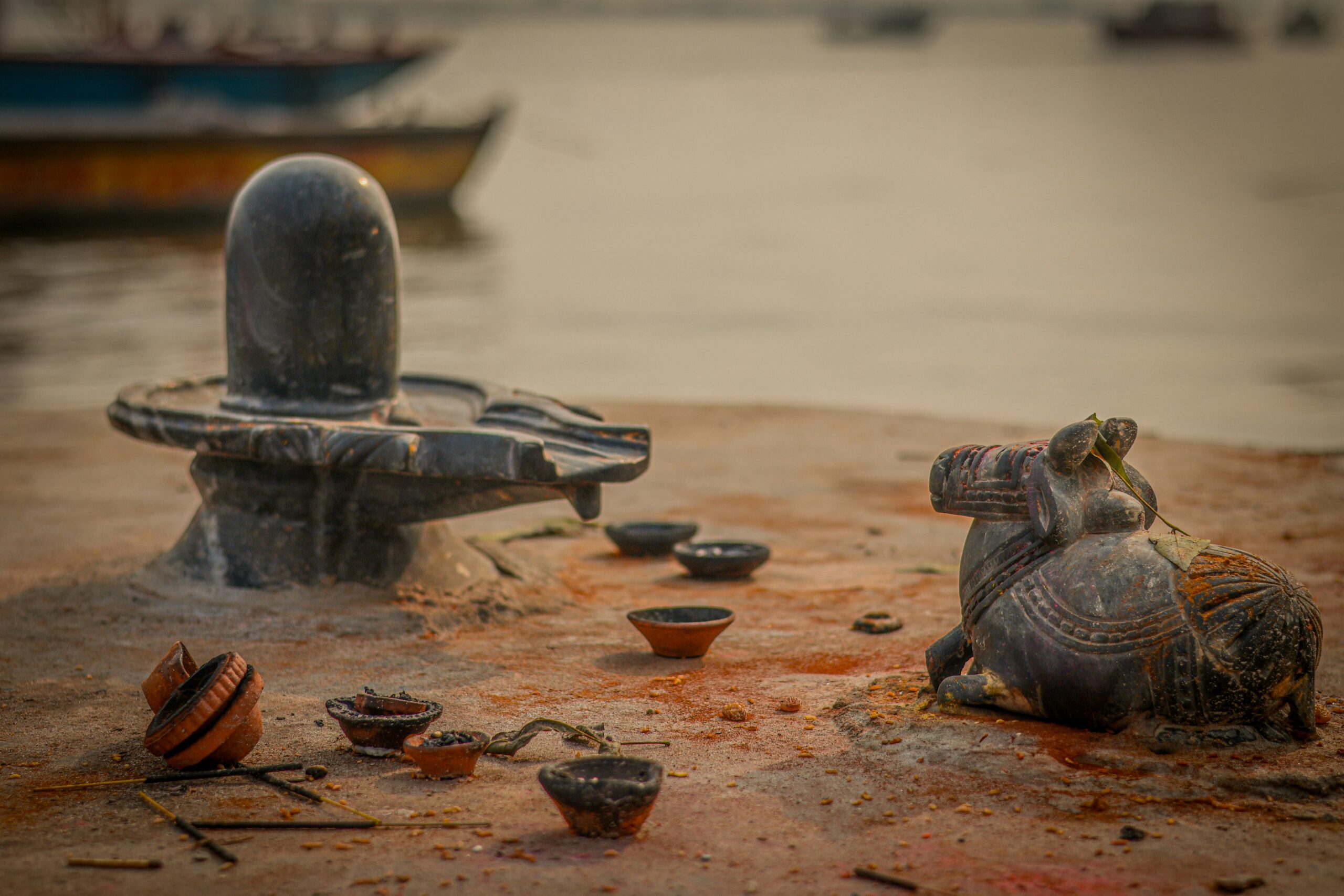
On a dusty road outside almost any Indian town, you will meet him without looking for him. A peepal tree. A platform of cracked cement. A smooth dark stone rising from a stone basin, and above it a brass pot with a pinhole in its base, so that water falls on the stone all day, one drop at a time. No priest. No ticket counter. Often no roof. Someone has left marigolds. Someone has smeared the stone with ash and drawn three lines of sandalwood paste. A bus conductor walking home will stop, pour a little water from his bottle, press his palm to the stone, and carry on.
That is Shiva. The greatest of the gods, worshipped in a form a child could lift, under a tree, for nothing.
And a thousand kilometres away, in a bronze cast by a Chola sculptor a thousand years ago, the same god dances inside a ring of fire with one foot on the back of a dwarf, hair flying, utterly serene. Both are him. Holding those two pictures in your mind at once is the beginning of understanding Shiva.
Who Is Lord Shiva? The God Who Resists a Single Definition
Most introductions to Hinduism give Shiva one job. Brahma creates, Vishnu preserves, Shiva destroys. It is a tidy formula and it is almost useless, because it describes a committee that Shiva has never really belonged to.
For the hundreds of millions who worship him as the supreme reality — the broad family of traditions called Shaivism (the paths that take Shiva as the highest truth rather than one god among many) — Shiva is not a department head. He is everything: the ground of being, the source of the world and its dissolution, the teacher, the inner Self. The destroyer label survives because it is convenient for textbooks, and because what Shiva destroys is genuinely frightening: not people, but the universe itself at the end of its cycle, and before that, in each of us, the attachments we would rather keep.
He is Mahadeva, the great god. He is Shankara, which simply means the one who causes good. He is Bholenath, the innocent lord, a name used with real affection — the god who is easily pleased, who gives boons to demons without reading the fine print, who smokes and dances and is often the least respectable figure in the pantheon. He is also Bhairava, the terrifying, and Rudra, the howler. Devotees do not experience this as contradiction. They experience it as range.
From Rudra to Shiva: Where the Name Comes From
Shiva has deep Vedic roots, though they look different from what most of us picture.
In the Rig Veda — the oldest layer of Sanskrit scripture — the god in question is called Rudra, from a root meaning to howl or cry out. Three complete hymns are addressed to him (Rig Veda 1.114, 2.33 and 7.46), two more are shared with Soma, and he is referred to around seventy-five times in all. The Rudra of those hymns is a storm god of the wild places, a brilliant archer whose arrows bring disease, invoked with a kind of careful courtesy: please be kind, please spare our cattle and our children.
The word shiva itself began as an adjective meaning auspicious, kindly, propitious. Scholars generally hold that it was first applied to Rudra as a soothing epithet — a way of addressing a dangerous god by his best quality. Over centuries that adjective swallowed the name. The euphemism became the deity.
Two Vedic-era texts matter enormously here. The first is the Shri Rudram, also called the Shatarudriya, a long litany of names and salutations to Rudra preserved in several recensions of the Yajur Veda, including the Taittiriya, Maitrayani, Kathaka and Vajasaneyi samhitas. It is still chanted daily in Shiva temples across India — one of the longest continuously recited liturgies on earth. The second is the Shvetashvatara Upanishad, usually dated to the last centuries BCE, which takes the step that changes everything: it treats Rudra-Shiva not as one god among many but as the single reality behind all of them.
You will also read that a seal from the Indus Valley civilisation shows a proto-Shiva seated in yoga posture surrounded by animals. It is a lovely idea and it may be true, but it is contested — scholars including Gavin Flood and John Keay have been openly sceptical of the identification. An honest answer is that we do not know, and a tradition this old does not need an archaeological trophy to be ancient.
The Form of Shiva: How to Read the Symbolism
Shiva is the most densely coded figure in Hindu iconography. Nothing he wears is decorative.
The Third Eye
The vertical eye in his forehead gives him one of his oldest names, Tryambaka, the three-eyed one. It is the eye of insight that sees past surfaces, and it is also a weapon: the Puranas tell how Shiva opened it and burned Kama, the god of desire, to ash. The lesson devotees take from that story is not that desire is evil but that it is combustible, and that attention turned inward can consume it.
The Crescent Moon and the Ganga
A thin crescent sits in his hair, and from that hair the river Ganga pours. The moon is the measure of time, waxing and waning, worn lightly by a god who stands outside it. The Ganga is more pointed: she is a river so powerful that her unbroken fall would have shattered the earth, and Shiva catches her in his matted locks and lets her out gently. It is one of the great images of what spiritual discipline actually does — not block force, but moderate it into something that nourishes.
The Serpent, the Ash and the Rudraksha
The cobra coiled at his throat is traditionally Vasuki, the serpent king: the most feared creature in the forest, draped around him like an ornament, because fear has no purchase on him. His body is smeared with vibhuti (sacred ash) — the end state of everything that burns, worn as a daily reminder of impermanence. Around his neck and wrists are rudraksha beads, the seeds of Elaeocarpus ganitrus, whose name means the tears of Rudra.
The Trishula and the Damaru
The trishula (trident) is read in several ways: creation, preservation and destruction held in one hand; or the three gunas, the three fundamental qualities of nature, kept in balance; or past, present and future. The damaru is a small hourglass drum, and it is the more interesting object. Sound, in this tradition, is where the universe begins. The drum is not accompaniment to the dance. It is the dance making the world.
Nandi, the Bull Who Waits
Every Shiva temple has a bull outside the sanctum, lying down, facing in. Nandi is Shiva’s vahana (mount) and his doorkeeper, and devotees whisper their requests into his ear. Iconographically he is strength at complete rest — the ideal of a mind that is powerful and entirely still. In most temples you are meant to look at the lingam between his horns.
Four Stories That Explain Shiva Better Than Any Definition
The Poison and the Blue Throat
When the gods and the asuras churned the cosmic ocean for the nectar of immortality — the episode called Samudra Manthan, told at length in the Bhagavata Purana and the Mahabharata, with variations across the Puranas — the first thing the churning produced was not nectar. It was halahala, a poison so virulent it threatened every world at once. Nobody else would touch it. Shiva drank it.
What happened next differs by text. In many versions his consort seized his throat with both hands so the poison could go no further, leaving it burned blue forever; some accounts name her as Sati, others as Parvati, and other versions bring in Vayu, the wind, to weaken the poison first. Hence Nilakantha, the blue-throated one. It is worth knowing that the sources disagree on the details, because the meaning survives all of them intact: the one who can hold what would destroy everyone else, and hold it without being destroyed, is the one fit to be called great.
Sati, Daksha and the Grief of a God
Shiva’s first marriage ends in catastrophe. Sati, daughter of Daksha, marries him against her father’s wishes; Daksha holds a great sacrifice and pointedly excludes his son-in-law; Sati goes anyway, is humiliated, and gives up her life in the sacrificial fire. Shiva’s grief is uncontainable. He destroys the sacrifice, and in some versions wanders the world carrying her body until it falls away piece by piece, each place where a part lands becoming a Shakti Peetha, a seat of the Goddess.
The story is told in the Shiva Purana and in the Devi Bhagavata Purana, among others, and the versions differ substantially — the number of Shakti Peethas alone ranges from four to a hundred and eight depending on which text and which region you ask. What does not vary is the astonishing thing at the centre of it: a supreme god who grieves, and whose grief is treated by the tradition as holy rather than embarrassing.
Bhagiratha and the Taming of the Ganga
The descent of the Ganga, told in the Ramayana and retold across the Puranas, begins with a king named Bhagiratha performing austerities for generations so that the heavenly river will come to earth and release his ancestors. The request is granted and immediately becomes a problem: the river will arrive with enough force to split the world open. Shiva agrees to stand in the way and take the entire weight of her fall on his head.
Indian thought keeps returning to this image. The sacred is not automatically safe. Something has to be strong enough and still enough to receive it.
The Dance at Chidambaram
Then there is Nataraja, the lord of dance, the form the Chola bronzecasters perfected around the tenth century CE after earlier Pallava-period experiments, and the form most closely tied to the great temple at Chidambaram in Tamil Nadu.
Read it element by element. The upper right hand holds the damaru: the rhythm of creation. The upper left holds fire: destruction. The lower right is raised in abhaya mudra, the gesture that means do not be afraid, with a cobra uncoiling along the forearm. Under his right foot is Apasmara, a struggling dwarf who stands for ignorance. The raised left leg is release. The hair flies out in thin strands with Ganga among them. And the whole figure stands inside the prabha mandala, a ring of flames that is the cosmic fire from which everything comes and into which everything returns.
Scholars rightly caution that this image has meant different things to different communities in different centuries, and that the neat cosmological reading popularised in the twentieth century is one interpretation among several. But stand in front of a good Chola Nataraja and the central paradox lands without translation: violent motion, perfectly calm face.
The Lingam: What It Is and What It Is Not
The form in which Shiva is most often worshipped is not a human figure at all. It is the lingam, usually a smooth vertical column set in a lipped disc called the yoni, representing Shakti, the goddess and the active power of the universe.
This is where readers from outside the tradition are most likely to have picked up a half-truth, so it is worth being direct. The Sanskrit word linga literally means mark, sign or emblem — that is the sense Monier-Williams and Yudit Greenberg give it, and the sense in which worshippers overwhelmingly understand it: the aniconic mark of a reality that has no form. Some scholars, Wendy Doniger prominently among them, read the shape as primarily phallic. Others, including Swami Vivekananda, Stella Kramrisch and S. N. Balagangadhara, reject that reading as a reductive import. The disagreement is real and it is not going to be settled here.
What is not in doubt is the devotional logic. Pouring water on a lingam is the simplest possible act of worship: no image, no mediation, no wealth required. A stone, some water, and attention.
Shiva’s Family
Shiva is the great ascetic who is also a householder, and the tradition never resolves that tension because the tension is the point.
His consort is Parvati — also called Uma, Gauri, and in her earlier form Sati, with Durga and Kali understood in many traditions as her fiercer aspects. Their marriage is the model Indian weddings still invoke, and their arguments are the subject of some of the most affectionate poetry in Sanskrit.
Their sons are Ganesha, the elephant-headed remover of obstacles, invoked before every undertaking, and Kartikeya, the warrior god, known as Skanda in the north and worshipped with enormous devotion in Tamil Nadu as Murugan. Regional traditions add more: some texts name a daughter, Ashokasundari; in Bengal, Manasa the serpent goddess is counted among his children; and in Kerala, Ayyappan of Sabarimala is understood to be born of Shiva and Mohini, Vishnu in female form. Which of these you grew up with depends entirely on where you grew up, and all of them are authentic to the people who hold them.
Where Shiva Is Worshipped
The Twelve Jyotirlingas
The Jyotirlingas — lingams of light — are the twelve most sacred Shiva shrines, traditionally enumerated as Somnath in Gujarat, Mallikarjuna at Srisailam in Andhra Pradesh, Mahakaleshwar at Ujjain and Omkareshwar in Madhya Pradesh, Kedarnath in Uttarakhand, Bhimashankar and Trimbakeshwar and Grishneshwar in Maharashtra, Kashi Vishwanath at Varanasi, Vaidyanath, Nageshwar, and Rameshwaram in Tamil Nadu.
Two of those twelve are genuinely disputed. Vaidyanath is identified by most pilgrims with Deoghar in Jharkhand, but a strong tradition in Maharashtra claims Parli; Nageshwar is usually placed near Dwarka in Gujarat, though Aundha Nagnath in Maharashtra also claims it. These are live disagreements between devout communities, not errors, and anyone planning a Jyotirlinga pilgrimage should know they exist.
The Five Element Temples
South India preserves an elegant set called the Pancha Bhuta Sthalam, five temples where Shiva is worshipped as one of the five elements. Earth at Ekambareswarar temple in Kanchipuram. Water at Jambukeshwarar temple in Thiruvanaikaval near Tiruchirappalli. Fire at Annamalaiyar temple in Thiruvannamalai. Air at Srikalahasti in Andhra Pradesh. And space or ether at the Nataraja temple in Chidambaram, where the innermost shrine is famously empty — a curtain drawn back over nothing at all.
Kailasa, Kashi and the Cave Shrines
His home is Mount Kailasa in the Himalaya, in present-day Tibet, which Hindu, Buddhist, Jain and Bon traditions all hold sacred and which is circumambulated rather than climbed. The city most associated with him is Kashi — Varanasi — where dying is considered a blessing. In the Kashmir Himalaya, pilgrims walk to the Amarnath cave to see a lingam that forms naturally from ice and melts each year. In Kathmandu, Pashupatinath has drawn worshippers for well over a millennium.
The Festivals of Shiva
Maha Shivaratri — the great night of Shiva — is the central observance: a night-long vigil with fasting, chanting and the pouring of water, milk, honey and bilva leaves over the lingam. It falls on the fourteenth day of the dark fortnight, and here is a detail that confuses people every single year: in the north, which uses the purnimanta calendar, that month is called Phalguna, while in the south, using the amanta reckoning, the same day falls in Magha. The date is identical; only the month name differs.
Panchang sources place Maha Shivaratri 2027 on 6 March. Treat that as the day and not the hour. Every muhurat and prahar timing published for a festival is calculated for a specific city from local sunrise and sunset, which is why a chart prepared for Ujjain is of no practical use in New Jersey, Leicester or Melbourne. If you are observing outside India, look up a panchang set to your own city, or ask your local temple what timings they are following.
Beyond Shivaratri: the month of Shravan (Sawan, roughly July to August) is given over to Shiva across northern and western India, with Mondays kept as fast days and pilgrims carrying Ganga water on foot to Shiva shrines. Pradosha, the twilight of the thirteenth lunar day, is observed twice a month. Kartik Purnima, Thiruvathirai in Tamil Nadu, Thiruvathira in Kerala and Bhairava Ashtami each have their own regional shape.
Mantras of Shiva
Two mantras do most of the work in everyday Shaiva practice.
Om Namah Shivaya is the panchakshara, the five-syllable mantra, counting Na-Ma-Shi-Va-Ya and setting Om apart. Its wording comes from the Shri Rudram in the Taittiriya Samhita of the Yajur Veda, at 4.5.8, where the line runs namah shivaya cha shivataraya cha — salutations to the auspicious one, and to the one more auspicious still. Shaiva Siddhanta maps the five syllables onto the five elements, and also onto a compact theology: Na as the lord’s concealing grace, Ma as the world, Shi as Shiva, Va as his revealing grace, Ya as the soul.
The Mahamrityunjaya mantra is older still and more precisely located. It is Rig Veda 7.59.12, in the hymn collection attributed to the rishi Vasishtha Maitravaruni, and it recurs in the Yajur Veda at Taittiriya Samhita 1.8.6 and Vajasaneyi Samhita 3.60. Scholars note that the last four verses of that Rigvedic hymn, this one among them, appear to be later additions. It reads: tryambakam yajamahe sugandhim pushtivardhanam, urvarukamiva bandhanan mrityor mukshiya mamritat — we worship the three-eyed one, the fragrant, the increaser of abundance; like a cucumber from its stem, may I be freed from death, not from deathlessness.
That last line is one of the most precise images in Vedic literature. A ripe cucumber does not have to be torn from the vine. It comes away on its own. The prayer is not to escape death but to arrive at it ready.
Longer practice usually means the Shri Rudram, or one of the several versions of the Shiva Sahasranama, the thousand names.
Why Shiva Matters Today
It would be easy to end with something soothing about inner peace. Shiva does not especially reward that approach. Four things in his iconography are genuinely useful, and none of them are comfortable.
He holds what he cannot fix. The poison does not get cured in that story. It gets held, in the throat, permanently, and it changes him. Most of what a long life asks of us is this and not problem-solving: carrying something that will not resolve, and continuing to function. Shiva is the god who models that.
He wears the ash. Not as morbidity — as accuracy. A practice as simple as noticing, once a day, that the thing currently consuming your attention will one day be of no consequence to anyone, is a reliable corrective to the scale distortion that modern life produces.
He is both the ascetic and the householder. Shiva meditates in a cremation ground and he is also a husband and a father who gets into domestic arguments. The tradition refuses to tell you that you must choose between an inner life and an ordinary one. This matters especially to readers who feel they would be serious about practice if only they did not have a job, a mortgage and children.
He destroys what has outlived its use. The destroyer label is less frightening once you notice what is actually being destroyed: the role you have outgrown, the identity you are defending past its expiry, the grudge, the version of yourself that worked at twenty-five. Something has to clear the ground.
If you want a practice rather than a thought: sit for five minutes, breathe, and on each exhalation give away one thing you are gripping. Not forever — just for those five minutes. That is the entire logic of the ash, the drum and the dance, in a form that fits a weekday morning.
Frequently Asked Questions About Lord Shiva
Is Shiva the destroyer or the supreme god?
Both answers are correct within their own framework. In the Trimurti scheme, where Brahma creates and Vishnu preserves, Shiva is assigned dissolution. In Shaivism, the family of traditions for whom Shiva is the highest reality, he is not a specialist at all — he is the source, the sustainer and the end, and creation and destruction are both aspects of a single activity. Smarta Hindus take a third position, worshipping Shiva as one of five equivalent forms of one divinity.
Why is Shiva worshipped as a lingam instead of a statue?
Because the point is formlessness. The word linga means mark or sign, and the lingam functions as an emblem of a reality that no image can contain. It is also the most democratic form of worship in Hinduism: it needs a stone, water and nothing else, which is why you find lingams under roadside trees as readily as in great temples.
Why does Shiva have a snake around his neck?
The cobra, traditionally identified as the serpent king Vasuki, represents the most feared power in nature worn as an ornament by someone it cannot touch. Snakes are also associated with coiled, dormant energy and with the shedding of skin, so the image carries the sense of latent power and of renewal.
What is the difference between Rudra and Shiva?
Historically, Rudra is the Vedic storm god and shiva was an adjective meaning auspicious that was applied to him as a gentler form of address until it became his name. Theologically, the tradition treats them as one person, with Rudra naming the fierce aspect and Shiva the benign. Both names are used in the same breath in the Shri Rudram.
Which day of the week is best for worshipping Shiva?
Monday, Somavara, is traditionally his day, and Mondays in the month of Shravan are especially observed, often with a fast. The fourteenth lunar day, Chaturdashi, and the twilight of the thirteenth, Pradosha, are also kept. None of this is a requirement; the roadside shrine takes visitors every day of the week.
Can non-Hindus visit Shiva temples or chant Om Namah Shivaya?
The mantra is freely chanted by anyone, and widely is. Temple access varies: most Shiva temples welcome all visitors, while a minority of major shrines restrict entry to the sanctum or to Hindus, and some set dress codes. Check the specific temple before you travel, and when in doubt, ask at the entrance rather than assume — staff are generally glad to explain.
A Closing Thought
What stays with people about Shiva is rarely the theology. It is the combination of things that should not fit together: a god of the cremation ground who is a devoted husband, an ascetic covered in ash who dances, the most powerful figure in the pantheon worshipped in the humblest object imaginable.
The brass pot keeps dripping on the stone whether anyone is watching or not. There is something in that which the great temples, for all their gold, do not improve on.
Continue Exploring
- Kashi and Its Significance for Hinduism — the city Shiva is said to have never left
- Durga and Mahishasura: The Story Behind Navratri’s Nine Nights — the Goddess who is Shiva’s other half
- The Nine Forms of Durga: Navadurga Explained
- Shiva Trilogy: Key Highlights and Takeaways — how modern fiction reimagined Mahadeva
- How to Chant Vishnu Sahasranama — the thousand-name tradition Shiva shares