
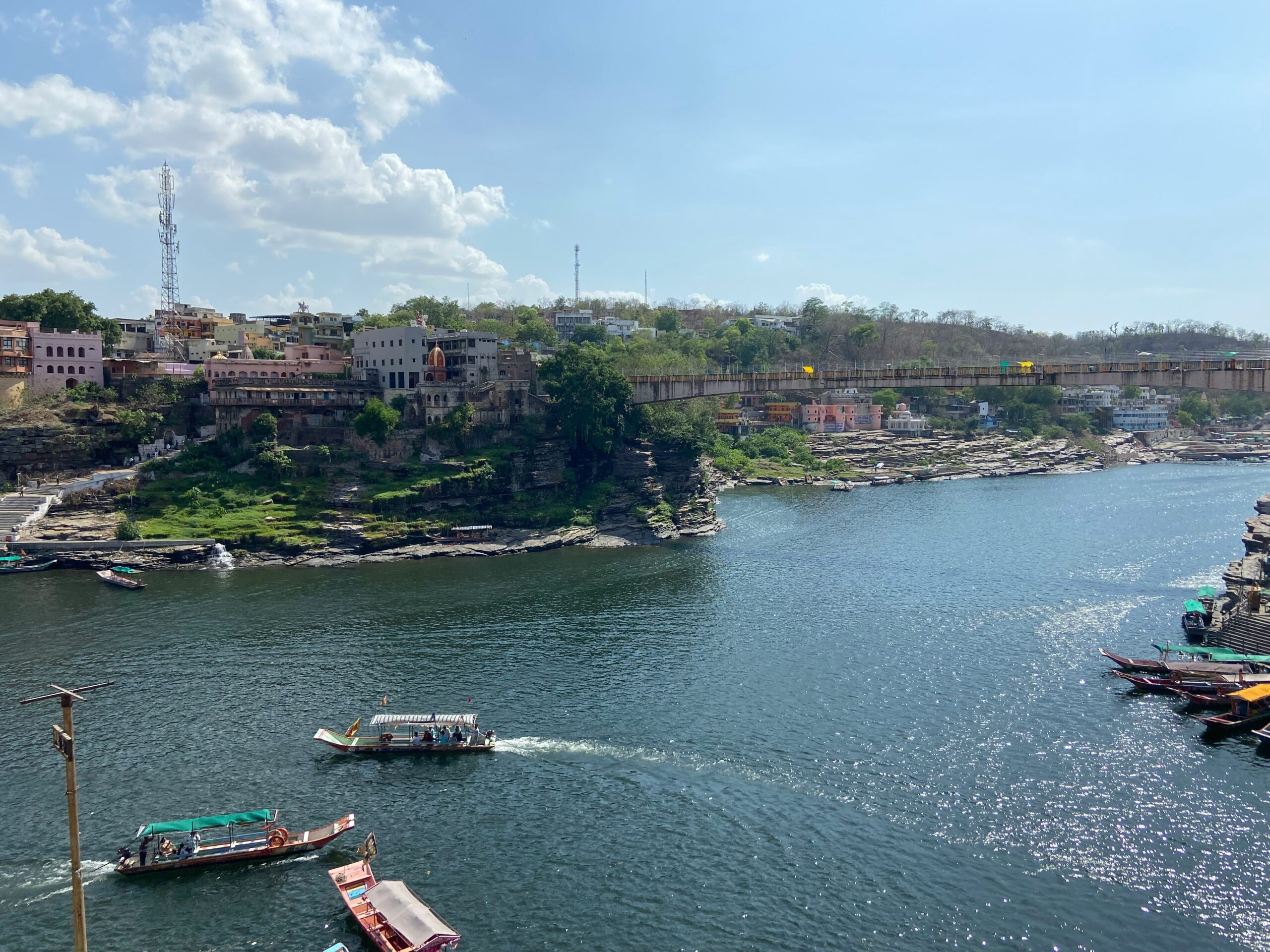
Stand on the north bank of the Narmada at Mandhata and the river does something unusual. It splits. One arm goes around the island, the other goes the long way, and between them sits a low green hill crowded with shrines and steps and the sound of bells. Pilgrims say that if you could lift yourself high enough above the water, you would see that the island itself is drawn in the shape of a single syllable — Om (ँ), the sound that the Upanishads call the seed of everything else.
That is the whole claim of this place, held in its geography. Not a temple built to honour a sound, but a landscape that is said to be the sound. The shrine on that island is Omkareshwar — Omkara-ishwara, the Lord of the Om — and it is counted among the twelve Jyotirlingas, the self-manifest shrines of Shiva that form the most important pilgrimage circuit in Shaivism.
It is also one of the most confusing of the twelve, and one of the most rewarding. There are two shrines here, not one, and devotees have argued for centuries about which is the real Jyotirlinga. We will come to that honestly rather than pretending the question is settled.
Why Omkareshwar Is Counted Among the Twelve Jyotirlingas
The word Jyotirlinga breaks into jyoti, light, and linga, the aniconic form in which Shiva is worshipped. A Jyotirlinga is not a lingam that someone carved and installed. It is a place where, in the understanding of the tradition, Shiva made himself present as light, and the lingam is the trace of that appearance.
The story the Shiva Purana tells is a famous one. Brahma and Vishnu fell into a dispute about which of them was supreme. While they argued, a pillar of light appeared before them, without beginning and without end. Each set off to find one of its limits — Brahma upward, Vishnu downward — and neither could. The pillar was Shiva, declaring that the question itself was badly formed. The twelve Jyotirlingas are the places where that infinite column of light is said to have touched the earth.
Omkareshwar appears in the traditional lists of the twelve alongside Somnath in Gujarat, Mahakaleshwar in Ujjain, Kedarnath in the Himalaya, Kashi Vishwanath in Varanasi and the rest. A devotee who completes all twelve has walked, in effect, the length of the subcontinent. Omkareshwar is the one that sits in its middle, on the Narmada, in Madhya Pradesh.
The Island Shaped Like Om
The island is called Mandhata, and it lies in the Narmada in Khandwa district, Madhya Pradesh. It is small — roughly four kilometres long and a little over two and a half square kilometres in area — and it is reached either by boat or across a footbridge from the mainland.
The claim that its outline traces the Devanagari character for Om is a traditional one, repeated in local accounts and in tourism literature, and it is better understood as a devotional reading of the landscape than as a surveyor’s observation. Look at a satellite image and you will see a shape you can argue about. Stand on the hill at dusk and the argument stops mattering. The Narmada herself is the point: of all Indian rivers she is the one whose darshan — the sight of her — is said to be purifying on its own, without immersion.
For a sense of why a river and a city can carry this kind of weight in Hindu practice, our piece on Kashi and its significance for Hinduism covers the same logic at India’s most famous riverside shrine.
The Legends of Omkareshwar
Two origin stories circulate here, and most pilgrim guides give both without choosing. They are not really in competition; they explain different things.
Vindhya’s Penance and the Two Lingams
In the first, the deity of the Vindhya range — the mountains that run across central India just south of here — undertook severe austerities to win Shiva’s favour. He drew a sacred diagram and shaped a lingam out of sand and clay, and worshipped it. Shiva was pleased, and the tradition holds that he appeared not in one form but in two: Omkareshwar, on the island, and Amaleshwar or Mamleshwar, on the southern bank of the river.
That doubling is the single most important thing to understand about this place. The split is not an accident of later temple-building. It is written into the founding story.
King Mandhata and the Island That Bears His Name
In the second, the island takes its name from Mandhata, a king of the Ikshvaku dynasty — the solar line that the Ramayana also traces, the line of Rama. Mandhata is said to have performed penance here until Shiva manifested before him as a Jyotirlinga. The island has carried his name since.
Both accounts are drawn from Puranic material rather than from a single authoritative passage, and different retellings differ in detail — which is normal for Puranic literature and worth saying plainly rather than smoothing over. If you want to see how two versions of one story can both be authoritative in Hindu tradition, our comparison of the Valmiki and Tulsidas Ramayanas is a useful companion.
Omkareshwar and Mamleshwar: Which One Is the Jyotirlinga?
Here is the honest answer: the tradition does not speak with one voice, and you should be suspicious of any source that tells you otherwise.
One widely held position is that the Jyotirlinga of the twelve is the shrine on the island, Omkareshwar. Another, held just as seriously, is that Mamleshwar on the south bank is the original Amareshwar of the Puranic lists, and that it is the true Jyotirlinga. A third — and in practice the most common among pilgrims — is that the two shrines are a single Jyotirlinga manifest in two places, exactly as the Vindhya story describes, and that a pilgrimage here is incomplete unless you visit both.
The practical consequence is simple. Go to both. They are a short distance apart, connected by the river crossing, and Mamleshwar is the quieter and in some ways the more architecturally rewarding of the two, with older stone walls and dense carving. Devotees who treat Omkareshwar as a day-trip to one temple usually leave feeling they missed something, and they did.
The Temple Itself: Architecture and Atmosphere
Omkareshwar is built in the Nagara idiom — the North Indian temple style, with a curvilinear tower rising over the sanctum, assembled here from courses of stone that give the shikhara its layered, almost stacked appearance.
Five Storeys of Shrines
Unusually, the complex rises through five levels, with shrines on the upper floors as well as the ground. The assembly hall, the mandapa, is carried on sixty pillars standing around fourteen feet high, their surfaces and the surrounding walls worked with carving. The effect from inside is less of a single soaring space than of a dense vertical honeycomb of worship, which is part of why the queue here moves the way it does.
Accounts of which deity occupies which floor vary between guides, and we have not been able to verify a single consistent list from an authoritative source. Treat floor-by-floor descriptions you read elsewhere with some caution.
The Lingam That Sits Off-Centre, Wrapped in Water
The main lingam is on the ground floor, and it is not where a planner would have put it. It does not sit in the geometric centre of the sanctum, and it is permanently surrounded by water — the Narmada, in effect, worshipping it continuously. Abhishekam, the ritual bathing of the lingam, is performed here multiple times through the day.
Devotees read the off-centre placement as proof that the lingam is swayambhu, self-manifest: it was found where it is, and the temple was built around it, rather than the reverse. That is the standard devotional interpretation, and it is also the kind of detail that tells you a shrine is older than the building that houses it.
Adi Shankaracharya’s Cave and the Statue of Oneness
Below the main temple is a cave that carries a very large claim: it is traditionally identified as the place where the young Adi Shankaracharya met his teacher, Govinda Bhagavatpada. If you accept the identification, this is where the most consequential intellectual lineage in Hindu philosophy — the Advaita Vedanta of non-duality — began with a boy finding a guru on the bank of the Narmada.
Madhya Pradesh has built on that association in the most literal sense. On 21 September 2023, a 108-foot statue of Adi Shankaracharya, called the Statue of Oneness (Ekatmata ki Pratima), was unveiled at Omkareshwar as part of a larger Ekatma Dham complex. The height is not arbitrary: 108 is among the most significant numbers in Hindu practice, the count of beads on a japa mala.
The statue has transformed the visitor experience here, for better and worse. It has brought a great many more people, and more infrastructure, to a place that was until recently a relatively quiet stop on the Jyotirlinga circuit. If you last came before 2023, expect a different town.
Who Built Omkareshwar: A History in Layers
The temple as it stands is a palimpsest, which is true of nearly every great Indian shrine.
The principal construction is generally attributed to the Paramara kings of Malwa in the eleventh century CE — the dynasty whose patronage shaped much of the temple architecture of central India. Later rulers, including the Chauhans, added to and repaired the complex.
The eighteenth and nineteenth centuries brought the Holkars of Indore. Work is credited to Gautama Bai Holkar and completed by her daughter-in-law, the remarkable Devi Ahilyabai Holkar, whose temple restorations across north and central India — Kashi Vishwanath among them — amount to one of the great building programmes in Indian history. Sources differ on whether to date the Holkar work to the eighteenth or the nineteenth century, and we have not found a resolution we would state flatly.
The temple today is maintained with involvement from the Archaeological Survey of India, which is why you will see conservation signage alongside the devotional infrastructure.
A Practical Guide to Visiting Omkareshwar
Where It Is and How to Reach
Omkareshwar is in Khandwa district, Madhya Pradesh, on the Narmada.
- By air: Devi Ahilya Bai Holkar Airport, Indore, is the nearest airport. Published distances vary between roughly 77 and 90 km depending on the route quoted.
- By rail: Khandwa Junction (roughly 70–77 km) and Indore Junction (roughly 78 km) are the usual broad-gauge railheads. Mhow is also used.
- By road: About 80 km from Indore, generally two to two and a half hours. Roughly 140 km from Ujjain, around three and a half hours. Taxis and buses run from both.
- The last stretch: the island is reached across the footbridge (Jhula Pul) or by boat from the ghats. Boats are part of the pleasure of coming here; take one at least one way.
Darshan and Aarti Timings
This is where you should be careful, and where we will not pretend to more certainty than exists. Published timings for Omkareshwar differ substantially between sources, and they change for festivals, for the month of Shravan, and for Mahashivratri.
What the better sources broadly agree on is a pattern rather than a precise clock: the temple opens very early, around 4.30 to 5.00 a.m., with a morning mangala aarti; general darshan and jal abhishek run through the morning until around midday; there is a midday break for the food offering, roughly between 12.20 and 1.15 p.m.; evening darshan resumes in the afternoon, somewhere between 4.00 and 4.30 p.m., and runs into the evening; and the temple closes after the night shayan aarti, generally between 8.30 and 9.30 p.m.
One source quotes a paid expedited darshan (shighra darshan) pass at around ₹300; we have not been able to confirm this against an official temple notice, so treat it as indicative only. General darshan is free.
Please check current timings directly with the temple administration or a recent local source before you travel. Temple schedules in India are revised without much notice, and a guide written months earlier is not a reliable basis for planning a 5 a.m. darshan.
What to Wear and What to Expect
We have not found a formally published dress code for Omkareshwar of the kind some South Indian temples enforce. What is customary, and what will spare you any awkwardness, is modest traditional or semi-traditional dress: shoulders and knees covered, nothing sheer, nothing with slogans. Footwear and leather items are left outside the shrine, as at any Shiva temple. Expect wet stone underfoot near the sanctum, because of the continuous abhishekam, and dress for that.
Queue times reported by visitors run from twenty minutes on a quiet weekday morning to several hours on weekends, during Shravan and at Mahashivratri. Mobile phones and cameras are usually restricted inside the sanctum; assume they are and leave them with your shoes.
Best Time of Year
October to March is the comfortable season — central India in May is punishing, and the Narmada in full monsoon spate is spectacular but awkward for boats and bridges. The spiritually charged times are the opposite of the comfortable ones: the month of Shravan (July–August), which belongs to Shiva, and Mahashivratri, when the island is at its fullest and its most alive. Choose according to what you came for.
The Narmada Parikrama and the Ghats
Circumambulation — parikrama — is the proper way to receive a sacred site in Hindu practice, and at Omkareshwar there is a riverbank path of roughly six to seven kilometres around the island. Walked slowly, early, it is the best few hours available here: the crowd is behind you, the river is beside you, and you pass ghats and small shrines that nobody queues for.
The ghats are part of the pilgrimage in their own right. Kotitirtha Ghat is associated with the evening shayan aarti worship, and Fanase and Peshawar ghats are among those pilgrims use along the circuit. A hanging bridge of around 270 feet improves the connection between the two banks.
What Devotees Come Here Seeking
Every Jyotirlinga has a character, shaped by what people have asked for there over centuries.
Omkareshwar is approached above all as the Lord of Om — which means it is a shrine for people concerned with sound, mantra and recitation. Devotees come to begin or renew a practice of japa, to have a mantra practice blessed, to sit somewhere the syllable is understood to be physically present in the land.
The Narmada draws a second group: those performing shraddha and ancestral rites, for whom a river of this standing matters, and those undertaking the full Narmada parikrama, the extraordinary circumambulation of the entire river, for whom Omkareshwar is a major station.
And because of the Shankaracharya cave, it has become a place of pilgrimage for students — people who come looking for the beginning of a lineage of thought, or for their own teacher. That is a quieter traffic, and you will notice it if you watch who sits longest.
Nearby Sites Worth Adding to the Trip
- Mamleshwar (Amareshwar) on the south bank — not optional, as discussed above.
- Ekatma Dham and the Statue of Oneness — the Adi Shankaracharya complex at Omkareshwar itself.
- Mahakaleshwar, Ujjain — a second Jyotirlinga roughly 140 km away, and the obvious pairing for anyone working through the twelve.
- Maheshwar — Ahilyabai Holkar’s fort town on the Narmada, with ghats that are among the most beautiful in India. Check current road distances when planning, as routes vary.
- Indore — the practical base for most visitors, and worth an evening for its food alone.
Why Omkareshwar Matters Today
It would be easy to file this temple as a stop on a checklist — number four of twelve, photograph taken, move on. The Jyotirlinga circuit invites that, and plenty of tour operators sell it that way.
But there is something specific on offer here that is worth slowing down for. Omkareshwar makes a claim that no other Jyotirlinga makes: that a sound has a shape, and that you can walk around it. Whatever you believe about the island’s outline, the practice that follows from taking the claim seriously is real enough. You walk the parikrama. You say the syllable while you walk. By the fourth kilometre the two things have stopped being separate, which is more or less the entire point of mantra practice and is very hard to explain to someone sitting still.
There is a second, more practical lesson in the place, and it is in the history. This temple was built by the Paramaras, added to by the Chauhans, restored by two Holkar women, conserved by a government agency, and expanded in 2023 with a 108-foot statue. Nobody inherited it finished. Every generation that cared about it changed it, and the tradition absorbed each change without losing the thread. For anyone who worries that honouring a tradition means freezing it, Mandhata island is a useful argument.
And if you are visiting from outside India — a large part of the people who read about Omkareshwar before they come — the honest advice is to give it a night rather than a morning. The temple at 5 a.m., before the buses, with the river invisible in the dark and the bells starting, is a different place from the temple at eleven.
Frequently Asked Questions
Which Jyotirlinga is Omkareshwar?
Omkareshwar is one of the twelve Jyotirlingas of Shiva, located on Mandhata island in the Narmada river in Khandwa district, Madhya Pradesh. Its name means Lord of the Om sound. In the traditional listings it is usually counted fourth, though the order varies between sources.
Is Omkareshwar or Mamleshwar the real Jyotirlinga?
The tradition genuinely disagrees. Some hold that the island shrine of Omkareshwar is the Jyotirlinga; others identify Mamleshwar (Amareshwar) on the south bank as the original. Many devotees hold that both together constitute one Jyotirlinga manifest in two forms, which matches the Puranic story of Shiva appearing twice at Vindhya’s request. Most pilgrims visit both, and that is the safest practice.
How do I reach Omkareshwar temple?
The nearest airport is Indore (Devi Ahilya Bai Holkar), and the nearest railheads are Khandwa Junction and Indore Junction, each roughly 70–80 km away. Omkareshwar is about 80 km by road from Indore and about 140 km from Ujjain. The island itself is reached by footbridge or by boat from the ghats.
What are the darshan timings at Omkareshwar temple?
Published timings vary between sources and change during Shravan, Mahashivratri and other festivals. Broadly, the temple opens very early (around 4.30–5.00 a.m.) with a morning aarti, closes briefly around midday for the food offering, reopens in the afternoon, and closes after the night shayan aarti between about 8.30 and 9.30 p.m. Verify current timings with the temple administration before travelling, especially if you are planning an early darshan.
Why is the Omkareshwar lingam surrounded by water?
The main lingam sits on the ground floor of the temple and is permanently surrounded by water, receiving ritual bathing (abhishekam) through the day. Devotees understand this as the Narmada herself worshipping Shiva continuously. The lingam is also not placed in the geometric centre of the sanctum, which the tradition reads as evidence that it is swayambhu — self-manifest, found rather than installed, with the temple built around it.
What is the Statue of Oneness at Omkareshwar?
It is a 108-foot statue of Adi Shankaracharya, unveiled on 21 September 2023 as part of the Ekatma Dham complex at Omkareshwar. It commemorates the tradition that Adi Shankaracharya met his guru Govinda Bhagavatpada in a cave below the Omkareshwar temple. Its height echoes the number 108, among the most sacred in Hindu practice.
Is Omkareshwar worth visiting if I have already seen Mahakaleshwar?
Yes, and the two are usually done together — they are about 140 km apart. They are very different in character. Mahakaleshwar is an urban temple with the famous Bhasma Aarti; Omkareshwar is a river island with a parikrama path, a Shankaracharya association and a much slower rhythm if you give it time.
The Narmada does not hurry at Mandhata. She divides, goes around, and rejoins, and in the long arc of that detour a hill became a syllable and a syllable became a shrine. You can get through Omkareshwar in three hours if you need to. You can also sit at a ghat at dawn with the bells somewhere above you and understand, without anybody explaining it, why someone once looked at this island and heard a sound.
Continue Exploring
- Kashi and Its Significance for Hinduism — how a city becomes a sacred geography
- Shiva Trilogy — Key Highlights and Takeaways
- How to Chant Vishnu Sahasranama — on recitation as practice
- The Concept of Dharma in the Bhagavad Gita
- Lord Hanuman FAQs