In March 2020, as the world worked out that shaking hands had become a problem, something quietly strange happened. Heads of state who had never said the word in their lives began pressing their palms together in front of cameras. Within weeks, a Sanskrit greeting from the Indian subcontinent had become the default way for strangers to acknowledge each other across half the planet.
Most of them had no idea what they were saying. That is not a criticism — most people who say namaste every day in India are not parsing the grammar either. But the word rewards unpacking, because when you look at what it actually says, it turns out not to mean hello at all.
It means: I bow to you.
That is a much stranger thing to say to a stranger, and a much more interesting one.
The Grammar of a Greeting
Namaste is a compound of two Sanskrit words, and in Sanskrit, compounds do not hide their seams.
The first is namas — a noun meaning bow, obeisance, reverential salutation, homage. The dictionary form is namaḥ, and it shifts to namas before the following sound according to the rules of sandhi, the elaborate Sanskrit system governing how words change at their joins. If you have ever chanted Om Namah Shivaya, you have already used it: namaḥ there is the same word, offered to Shiva.
The second is te — the dative singular of the second person pronoun. To you.
Put them together and you have namas te: bowing to you, homage to you, salutations to you. There is no verb in it. No I, no say, no greet. Just an act of reverence and its recipient. The construction is almost shockingly economical — two words, one of which is a pronoun, and the whole transaction of respect is complete.
Notice also what the word does not contain. It does not refer to the time of day, as good morning does. It does not ask after your health, as how do you do does. It does not invoke a deity on your behalf, as adieu or goodbye originally did. It reports the posture of the person speaking. That is all.
How Old Is Namaste?
Older than most people assume, and the paper trail is reasonably specific.
Forms built on namas appear throughout Vedic literature. The related form namas-krita occurs in the Rigveda, the oldest layer of Sanskrit text, around verse 10.85.22. The noun namaskara turns up in the Atharvaveda, in the Taittiriya Samhita and in the Aitareya Brahmana, carrying the sense of worship, adoration, homage, salutation. The exact compound namas te occurs in the Rigveda at 8.75.10, and in a great many later Hindu texts after that.
Two things are worth drawing out of this.
First, in the Vedic material, namas is overwhelmingly directed at the divine. It is liturgical vocabulary. You said namas to Agni, to Indra, to Rudra. Its migration into everyday human greeting is a later and genuinely remarkable development: a word reserved for addressing gods became the word you use for the person at the next desk.
Second, the word is attested but the ancient social practice is harder to pin down than the ancient vocabulary. We can say with confidence that the phrase is three thousand years old. We should be more careful about claiming that people in the Vedic period greeted each other with it in the way an Indian family does today. Words survive better than manners.
The Gesture: Anjali Mudra
The word usually travels with a gesture, and the gesture has its own name and its own logic.
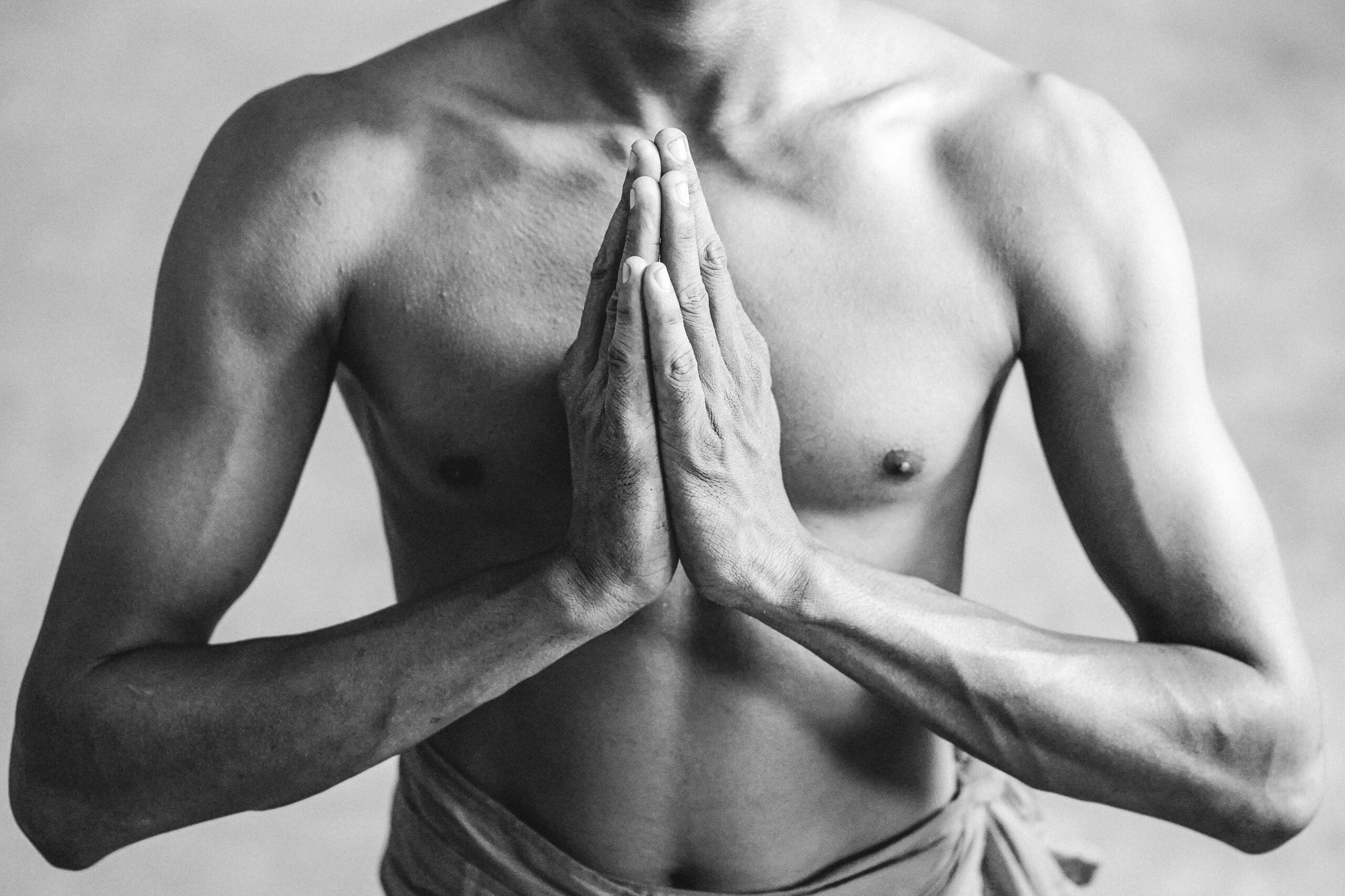
Palms pressed together, fingers aligned and pointing upward, hands held in front of the body, head inclined slightly. In Sanskrit this is anjali mudra. Anjali refers to the hollow formed between the palms when the hands are folded together — the cupped space you make — and derives from the root anj, to honour or to celebrate. Mudra means seal, or gesture.
So the gesture is not merely a mime of the word. It is a container. You are forming a hollow between your hands and offering it, which is why the same shape is used to offer water, flowers and rice at a shrine. Anjali mudra is a vessel before it is a greeting.
Where You Hold Your Hands Changes What You Mean
This is the detail that most explanations of namaste leave out, and it is the most useful one.
The Natya Shastra, the classical Sanskrit treatise on theatre, dance and performance, specifies that the placement of the folded hands is itself meaningful. According to its guidance:
- Above or near the head — for prayer to the deity, in the temple, before the divine.
- Before the face — for greeting a venerable person: a teacher, an elder, someone to whom you owe deference.
- At the chest — for friends, peers, equals.
Three altitudes, three relationships. It is a greeting with a volume control, and fluent users adjust it without thinking. Watch an Indian family greeting guests at a door and you will see the hands rise and fall by a few inches from person to person. Nobody is instructing anybody. The hierarchy of the room is being negotiated silently, in real time, at the level of the wrist.
The most common placement in practice is at the heart, thumbs resting lightly against the sternum. In yoga and in Indian classical dance — Bharatanatyam in particular — anjali mudra is foundational, used to open and close sequences and to hold the body in a centred, symmetrical attitude.
An Older Trail
Terracotta figures from the Indus Valley Civilization, from the Mature Harappan period, have been found in postures that look very like anjali mudra. This is tantalising and it is worth saying carefully: a similar posture in a figurine from four and a half thousand years ago is suggestive, not proof of unbroken continuity. We cannot read the Indus script, and we do not know what those figures were doing. What we can say is that the shape of the hands has a very long history in this part of the world, and that temple reliefs across India have used it continuously for two millennia.
Namaste, Namaskar, Pranam: They Are Not the Same Thing
English-language sources often use these interchangeably. Indian speakers do not.
Namaste uses te, the singular and comparatively intimate form. It is warm. It works for one person.
Namaskar (from namaskara) is generally felt as more formal and more ceremonious, and it is what you use for a group, a gathering, an audience, or a person whose standing you want to acknowledge with some weight. A politician opens a speech with namaskar, not namaste. Many speakers consider it the more respectful of the two.
Pranam (pranama, literally a bending forward) indicates a deeper bow, and in practice signals a more pronounced act of submission and respect — often to a guru, a parent, or an elder, and often accompanied by actually lowering the body rather than just the head.
And at the far end of the same spectrum sits charan sparsh, touching the feet of an elder — the full physical form of what namaste performs at a distance.
Thinking of these as four settings on one dial, rather than four synonyms, gets you much closer to how they are actually used.
India Does Not Have One Greeting
A point worth making firmly: namaste is not the Indian greeting. It is the most widely recognised one, and it is standard in Hindi-speaking regions, but India is a subcontinent with dozens of major languages and no single default.
- Vanakkam — Tamil, in Tamil Nadu, with the same folded hands.
- Namaskara — Kannada and Marathi.
- Namaskaram — Telugu and Malayalam.
- Nomoshkar — the Bengali form of namaskar.
- Sat Sri Akal — Punjabi, and specifically a Sikh greeting; it is usually rendered as something close to God is truth, and it is not a generic regional hello.
- Ram Ram — Haryana, parts of Uttar Pradesh and Rajasthan, invoking Rama’s name.
- Adab — among Urdu speakers of north India, roughly I offer you respect, with its own distinctive hand gesture.
- Jai Jinendra — among Jains.
Several of these carry religious or community specificity, and using the wrong one is not offensive so much as simply odd — the equivalent of greeting someone in Lisbon in Spanish. When in doubt, namaste or namaskar travels furthest, and adding -ji to someone’s name is a small courtesy that works almost everywhere.
About That Famous Translation
You have almost certainly encountered this one: the divine in me bows to the divine in you. It appears on studio walls, on tote bags, in the closing minute of a thousand yoga classes.
Here is the honest position on it.
The phrase is not a literal translation. The words namas and te contain no term for the divine, no in me, no in you. As translation, it is an expansion rather than a rendering, and you will not find it verbatim in classical Sanskrit sources.
But it is also not a fabrication, and dismissing it as Western invention is too quick. It is a modern articulation of a genuinely classical idea. Advaita Vedanta holds that the atman, the self, is not ultimately separate from Brahman, the absolute — which means that what is essential in you and what is essential in me are not two things. If you accept that, then a reverential salutation offered to another person really is being offered to the divine, and the popular gloss is drawing out something the tradition does hold.
The Indologist Stephen Phillips has noted that the informal te can carry an undertone of intimacy, and has suggested a secondary sense along the lines of salutations to the divine child within your heart.
So: a modern phrasing of an old idea, not a translation of the word. Use it if it helps you, but do not tell people it is what the Sanskrit says, because it is not.
How to Use Namaste Well
Some practical guidance, particularly for readers who did not grow up with it.
It is both greeting and farewell. You say it on arrival and on leaving. There is no separate word.
The correct reply to namaste is namaste. It is not a compliment requiring acknowledgement; it is an exchange. Both people bow.
Both hands, and look at the person. A one-handed namaste while holding a phone is the equivalent of a limp handshake. The point of occupying both hands is that you are, briefly, doing nothing else.
Adjust the height. Chest for peers, face for elders and teachers, higher for the shrine. This single habit will make the gesture read as fluent rather than borrowed.
It is not a sign-off. Ending a yoga class with namaste is a studio convention that developed largely outside India; it is not wrong, exactly, but it is not how the word is used in Indian daily life, where it brackets an encounter with a person rather than concluding an activity.
It removes a problem that handshakes create. In contexts where physical contact between men and women is not customary, or between people of very different age or status, namaste lets two people greet each other warmly with no negotiation at all. That is not a limitation of the gesture. It is one of its principal virtues.
Why Namaste Matters Today
There is a cultural appropriation argument around namaste, and it deserves a fair hearing rather than a dismissal. The complaint is not that non-Indians use the word. It is the mismatch: a formal expression of reverence, traditionally reserved for teachers, elders and the divine, printed on leggings and used as a punchline. Scholars and practitioners have pointed out, reasonably, that this is a reverent word being handled casually.
The constructive response is not to stop saying it. It is to say it properly — to understand that you are claiming to bow, and then to mean it.
Which points at what the word is actually for, and why it has outlasted three thousand years of changing manners.
A handshake is a transaction between equals; it is good at that and it has no other setting. Namaste does something different. It establishes, before any content is exchanged, that the person in front of you is owed something. Not because of their position, their usefulness, or whether you like them. Just because they are there.
You can test this. Try it for a week on the people you habitually look past — the security guard, the delivery rider, the person who cleans your office. Not the word necessarily; the posture behind it. Stop, both hands, actually look. What usually happens is that you discover how many people you have been moving past as furniture, which is uncomfortable information and the most useful thing this greeting has to offer.
For a fuller treatment of the same principle — seeing the divine in the ordinary person in front of you — our piece on Swami Vivekananda covers the thinker who made that idea the centre of his teaching, under the name daridra narayana, God in the poor.
Frequently Asked Questions
What does namaste literally mean?
Namaste is Sanskrit for I bow to you or salutations to you. It combines namas, meaning bow, obeisance or reverential salutation, with te, the dative form of you. It contains no verb and no word for hello; it simply names an act of reverence and its recipient.
Does namaste really mean the divine in me bows to the divine in you?
Not literally. That phrasing is a modern interpretation rather than a translation — the Sanskrit words contain no term for the divine. However, it does draw out a genuinely classical idea from Advaita Vedanta, in which the self (atman) is not ultimately separate from the absolute (Brahman). So it is a fair expansion of the thought, but not what the word itself says.
What is the difference between namaste and namaskar?
Both come from the same root. Namaste uses the singular, somewhat more intimate te and is used for one person. Namaskar is generally felt as more formal and ceremonious, and is used for groups, gatherings, and people whose standing you wish to acknowledge with weight. Many speakers consider namaskar the more respectful of the two.
How do you do namaste correctly?
Press the palms together with fingers pointing upward, hold the hands in front of you, and incline the head slightly. According to the Natya Shastra, the height matters: at the chest for friends and peers, before the face for elders and teachers, near or above the head for prayer to the divine. Use both hands and make eye contact. The reply to namaste is namaste.
Is namaste Hindu or is it just Indian?
Both, in different ways. The word is Sanskrit and its earliest uses in the Vedas are liturgical, addressed to deities, so its roots are unambiguously within the Hindu tradition. In practice it has long been a general Indian and Nepali greeting used across communities, and the accompanying anjali mudra appears in Buddhist, Jain and other traditions across Asia. Many Indian communities use their own greetings instead, such as Sat Sri Akal among Sikhs or Adab among Urdu speakers.
Is it disrespectful for non-Indians to say namaste?
Saying it is not the issue. Using a reverential expression casually or commercially — as a joke or a slogan — is what practitioners and scholars have objected to. Said deliberately, with the gesture, to an actual person, it is received as a courtesy almost everywhere in India.
When do you say namaste — hello or goodbye?
Both. Namaste serves as greeting and as farewell; there is no separate parting word. In Indian daily use it brackets an encounter with a person, rather than marking the end of an activity, which is how it is often used in yoga classes outside India.
It is a small thing, two syllables and a change in the position of the hands, and it would be easy to treat it as etiquette. But the grammar will not quite let you. There is no subject in namas te — nobody doing the bowing, just the bow and the one who receives it. Whoever shaped that phrase left themselves out of it on purpose, and three thousand years later it is still the most interesting thing about the word.
Continue Exploring
- Who Was Swami Vivekananda: A Journey Beyond Religion
- The Concept of Dharma in the Bhagavad Gita
- What Krishna Says About the Soul (Atman) in the Gita
- How to Chant Vishnu Sahasranama — on Sanskrit recitation in practice
- Kashi and Its Significance for Hinduism