
Sometime in the twelfth century, in the Kannada-speaking town of Kalyana, a hall full of philosophers was interrupted.
The hall was the Anubhava Mantapa — roughly, the hall of lived experience — a kind of open religious parliament where potters and washermen and cobblers debated metaphysics alongside Brahmins, on the radical principle that spiritual insight has nothing to do with birth. Into that assembly walked a young woman from a village near Shivamogga. She had left her home and, according to every account that survives, her clothes: she wore nothing but her own hair.
The men in that hall could have done many things. What they did was call her Akka — elder sister — and ask her to speak. She has been Akka Mahadevi ever since.
She is one of a remarkable company. Across roughly twelve centuries and at least six languages, India produced a line of women who became saints on their own terms: who composed in the spoken tongue rather than Sanskrit, who declined the marriages arranged for them or walked out of the ones they were already in, and whose verses are still sung by people who have no idea they are reciting a woman’s theology. Some are worshipped in temples today. Most of their lives are, in strict historical terms, barely recoverable. All of them are worth knowing.
Why the Bhakti Movement Made Room for Women
The thread connecting almost all of these figures is bhakti — devotional love directed at a personal God, offered directly, without an intermediary.
That last clause is the whole revolution. The older ritual order of Vedic religion ran on Sanskrit, on sacrifice, and on a priesthood with hereditary access to both. Women and those outside the upper varnas were, in practice and often explicitly, shut out. Bhakti proposed something that bypassed the entire apparatus: if God responds to love, then the only qualification is loving, and a woman grinding grain in a kitchen has exactly as much of that available to her as a scholar in a temple.
Once you accept that, a great many doors come off their hinges. The bhakti poets wrote in Tamil, Kannada, Kashmiri, Marathi, Braj and Rajasthani — languages their neighbours actually spoke. They sang rather than recited. And women, for the first time at this scale, became authors of scripture rather than subjects of it.
It is important not to romanticise this. None of the women below had an easy time. They were beaten, disinherited, mocked in the street, accused of theft and madness and worse. Several were very nearly killed. The tradition honours them now; it did not necessarily make room for them then. What is true, and genuinely remarkable, is that in each case a community of men eventually conceded that this woman was further along than they were — and said so in writing.
Karaikkal Ammaiyar: The Woman Who Asked to Lose Her Beauty
She is probably the earliest of them, and her story is the strangest.
She was born Punitavati, the daughter of a prosperous merchant in the Tamil port town of Karaikal, and she was devoted to Shiva from childhood. Married to a merchant named Paramadattan, she ran a generous household and fed any wandering devotee who came to the door.
Then came the mangoes. Her husband sent two home for his meal. A hungry Shaiva ascetic arrived; she gave him one. When Paramadattan asked for the second, she prayed, and a mango appeared in her hand — sweeter, by every telling, than anything he had eaten. He asked her to do it again. She did. And this time the fruit vanished the moment he touched it.
What happens next is, in its way, more unsettling than the miracle. Her husband does not rage. He is frightened. He stops treating her as a wife at all, leaves on a trading voyage, settles in another kingdom, marries again — and names his new daughter after her, in reverence. When her relatives eventually bring her to him, he prostrates himself on the ground and tells everyone present to worship her.
And she, confronted with being venerated as a goddess by the man who was supposed to be her husband, asks Shiva to take her beauty away. She asks to be stripped down to bone, so that nothing is left of her but a body that praises him. The request is granted. Her relatives run.
She then set out for Kailash. Unwilling to put her feet on a mountain she regarded as Shiva himself, she is said to have climbed it on her head. Shiva, seeing her come, called her Ammai — mother. She asked for three things: love for him that would not end, release from rebirth, and, if she were reborn anyway, never to forget him. She added a fourth, and it is the most beautiful line in her story: that she be allowed to remain beneath his feet while he danced.
Karaikkal Ammaiyar is one of only three women among the sixty-three Nayanars, the canonised Tamil Shaiva saints, and her poems form part of the Tamil Shaiva canon, the Tirumurai. She is credited with the Arputa Tiruvantati, the Tiruvirattai Manimalai and the Mutta Tirupatikam, and she appears to have been the first to compose in the patikam form — which is precisely why her hymns are called the mutta, the elder ones. Her iconography is unmistakable: an emaciated figure, ribs showing, cymbals in her hands, dancing at the edge of Shiva’s dance in the forest at Tiruvalangadu.
Her dating is genuinely uncertain. She is variously placed from the fifth to the seventh century, and the tradition itself only insists that she preceded Tirugnana Sambandar. Her narrative life comes to us principally through Sekkizhar’s twelfth-century Periya Puranam — which is to say, through a hagiography composed six hundred years or more after she lived.
Andal: The Only Woman Among the Alvars
In the Tamil Vaishnava tradition, twelve poet-saints called the Alvars — those immersed in God — sang the Tamil hymns that became the Nalayira Divya Prabandham, treated in Srivaishnavism as a Tamil Veda. One of the twelve is a woman.
Tradition says Periyalvar, a childless devotee who tended the garden of the temple at Srivilliputhur, found an infant girl beneath a tulasi plant and raised her as his own. He named her Kotai. She grew up in love with Krishna — not devotionally fond of him, in love with him, and she never treated that as a metaphor.
The story that gave her her name is small and tells you everything. Her father wove garlands daily for the temple deity. Kotai began wearing them first, before they were offered — a serious ritual impropriety. When he discovered it and was horrified, Vishnu is said to have appeared to him in a dream and asked, in effect, for the garlands she had worn, because those were the ones he wanted. She became Andal: she who rules.
She refused every human marriage proposed to her and declared she would marry only Vishnu, in his form as Ranganatha. The tradition holds that she did — that she went to him as his bride and did not come back. The sources are inconsistent about whether this happened at Srivilliputhur or at Srirangam, which is the kind of detail that gets smoothed over in retelling and should not be.
Her poetry survives in two works. The Tiruppavai is thirty verses in which a group of young girls wake each other before dawn in the Tamil month of Margazhi (mid-December to mid-January) and go to call Krishna awake. It is tender, specific and full of ordinary things: cold water, bangles, buffalo, sleeping neighbours. It is also one of the most widely recited devotional texts in India — sung every morning in Margazhi in Tamil Nadu and across the Srivaishnava diaspora. The Nachiyar Tirumozhi, in a hundred and forty verses, is far less polite: it is a work of open erotic longing and frustration directed at God, and it has never been softened.
At Srivilliputhur her shrine stands beside Ranganatha’s, and in Srivaishnava tradition she is understood as an incarnation of Bhumi Devi, an aspect of Lakshmi. Tamil brides still wear the garland style associated with her. She is usually placed in the eighth century.
Akka Mahadevi: Lord White as Jasmine
Back to that hall at Kalyana.
Akka Mahadevi was born around 1130 in Udutadi, near Shivamogga in present-day Karnataka, and belonged to the Lingayat or Virashaiva movement then taking shape under Basavanna — a tradition that rejected caste hierarchy, temple ritual and the authority of the Vedas in favour of a direct relationship with Shiva, carried literally on the body as a small linga.
She addressed Shiva as Chennamallikarjuna, the name of the deity at Srisailam. A. K. Ramanujan’s famous rendering of it — “lord white as jasmine” — is the phrase most English readers know her by, though a more literal reading is closer to “Mallika’s beautiful Arjuna”. Either way, the name is a love-name, and she used it as her signature.
Accounts say a Jain king named Kaushika sought to marry her; medieval sources are ambiguous about whether the marriage took place at all, and modern historians treat the whole episode as unsettled. What is consistent across the tradition is that she left — husband, household, possessions, clothing — on the grounds that she already had a husband and he was Chennamallikarjuna. Asked about her nakedness, she is said to have answered that her hair covered her, and that the problem belonged to anyone who looked at her body and saw temptation rather than a devotee.
Her vachanas — short, unmetred, fiercely plain prose-poems, the characteristic form of the Lingayat movement — survive in the hundreds; counts given range from around 350 attributable by her signature to about 430. They are startling to read even now. She writes about the exhaustion of being a wife and a devotee at once, about an earthly husband as something that will rot, about hunger and theft and nakedness, about wanting God with an urgency she describes in frankly erotic terms and refuses to apologise for.
She left Kalyana and travelled south to the Srisailam hills — to the mountain where Chennamallikarjuna actually stands — and lived there as an ascetic. The tradition holds that her life ended in the Kadali forest nearby, in union with him.
Janabai: God in the Kitchen
Janabai was born in the last decades of the thirteenth century at Gangakhed in Maharashtra, into a family of the matang caste — outside the caste order, at the bottom of every ladder available. Her mother died; her father brought her, a small child, to Pandharpur, and she entered the household of Damasheti, the tailor, as a servant. Damasheti’s son was Namdev, who became one of the towering saint-poets of the Marathi tradition. Janabai, probably a little older, helped raise him.
She stayed a domestic servant for the rest of her life. And in the hours of grinding grain, drawing water, sweeping, washing and pounding rice, she composed roughly three hundred abhangas — the devotional songs of the Varkari tradition, whose deity is Vithoba, the form of Krishna at Pandharpur. She had no schooling at all. Her verses were preserved alongside Namdev’s, and she signed herself Namdev’s Jani.
What the Varkari tradition did with her is astonishing. In Mahipati’s eighteenth-century hagiography the Bhaktavijaya, it is not Janabai who describes helping God. It is Vithoba who describes helping Janabai: grinding her grain from before dawn, carrying her water, sweeping her floor, washing her clothes, pounding her rice, even picking the lice from her hair. God is cast as the kitchen help of an untouchable serving-woman, and this is recorded admiringly by a Brahmin chronicler.
Her own verses are not sentimental about the work. She writes about wanting out of the drudgery. She writes, in lines that are still quoted, that it was only by being Nama’s servant that she got to see Vitthal at all — servitude and vision in the same breath. Near the end of her life she is said to have described her state very simply: that she ate God and slept in God.
Her abhangas are still sung by women at work in Maharashtra, which is probably the only memorial she would have recognised.
Lal Ded: Kashmir’s Shared Saint
In Kashmir she is Lal Ded — Mother Lal. To Hindus she is Lalleshwari or Lalla Yogishwari; to Muslims, Lal’arifa, Lalla the knower of God. She has been venerated by both communities for close to seven centuries, which in that particular valley is not a small thing.
Modern scholarship places her birth between about 1301 and 1320 near Pandrethan or Sempore, in a Kashmiri Brahmin family. She was married at twelve and renamed Padmavati, into a household that by every account treated her badly. Somewhere in her mid-twenties she walked out, became a disciple of the Shaiva teacher Siddha Srikanth, and then went on the road alone and on foot, living on alms, until she became a teacher in her own right.
Her poems are called vakhs — from Sanskrit vac, speech — and around two hundred and eighty-five are attributed to her. They are among the oldest surviving works in the Kashmiri language, which makes her a founding figure of a literature as well as a saint. They belong broadly to Kashmir Shaivism, the non-dual Shaiva philosophy of the valley, and they are shot through with its central conviction: that what you are looking for is not elsewhere. Her recurring subjects are the uselessness of ritual performed without understanding, the impermanence of everything you are clinging to, the body as a leaky vessel, and the discovery that the divine was never external in the first place. Later Kashmiri Sufi tradition absorbed her entirely, and her idiom sits so comfortably in both Shaiva and Sufi registers that separating them is largely a modern project.
The best-known story about her concerns the infant who became Nund Rishi, the great Kashmiri Sufi saint, who refused to nurse. Lal Ded is said to have told him: if you were not ashamed to be born, why be ashamed to be fed? He fed. Nund Rishi, grown, left verses praising her and asking God for whatever it was she had been given.
The translator Ranjit Hoskote has noted something worth holding onto: her two names, Hindu and Muslim, are increasingly being promoted at each other’s expense. She belonged to both, and the valley has been poorer every time someone has insisted otherwise. She is thought to have died around 1373, though 1392 is also given; a grave near Bijbehara is attributed to her without confirmation.
Mirabai: The Rajput Princess Who Would Not Be Widowed
She is the most famous of them all, and the hardest to pin down.
Mirabai was born around 1498 at Kudki, in a branch of the Rathore Rajput ruling house — a great-granddaughter of Rao Jodha, the founder of Jodhpur — and raised largely at Merta. In 1516 she was married into the house of Mewar, to Bhoj Raj, the crown prince. He was wounded in battle in 1518 and died of it in 1521. She was widowed at about twenty-three.
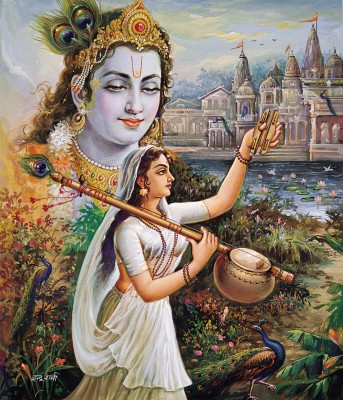
What a Rajput widow of that rank was expected to do, she declined to do. She had been devoted to Krishna — Giridhar, the lifter of the mountain — since childhood, and she maintained, flatly and in public, that Krishna was her husband and always had been, which made the question of widowhood meaningless. She sang in the courtyards. She danced in temples. She kept company with wandering devotees and, in some traditions, took the Dalit saint-poet Ravidas as her guru — a chhatri in front of her Chittorgarh temple carries an engraved footprint of his.
The legends of attempted murder are famous: poison served to her as nectar, a basket with a snake coiled in it, an order to drown herself. In the hagiographies she survives all of it — the snake becomes an image of Krishna or a garland, she floats instead of sinking. The most commonly repeated ending has her poisoned by a brother-in-law and disappearing into a Krishna image at Dwarka, around 1547.
Here is where honesty is required, because Mirabai is a case study in how little we know about figures we think we know well. There are no manuscripts of her poetry from her lifetime. The three oldest records of her life are all seventeenth-century, well after her death, and most of her verses were first written down in the eighteenth century. Only two hymns appear in the earliest written sources. Tradition attributes an enormous body of song to her — the figure is sometimes put absurdly high — while scholars consider only a few hundred plausibly hers. The poisoning and the disappearance are contested. The scholar Nancy Martin-Kershaw has argued that the persecution she suffered probably had as much to do with Mewar’s political turmoil and its conflict with the Mughals as with religious scandal. John Stratton Hawley has written that there is always an element of enigma in the link between the Mira poems and any historical woman.
None of which has dented her in the slightest. Her padas are sung in classical concerts, in village courtyards, in films and in Sikh devotional contexts; a temple inside Chittor Fort is dedicated to her memory; and for several centuries she has been the figure Indian women reach for when they need a precedent for refusal.
Bahinabai: The Saint Who Wrote About the Problem
The last of the seven is the one who said out loud what the others largely lived.
Bahinabai was born in 1628 at Devgaon near Ellora, in a Brahmin family, and married at the age of three to Gangadhar Pathak — a scholar of thirty, and a widower. She remained with her parents until puberty, as custom required, and then entered a marriage she had had no part in choosing.
Her turning point involves a calf, and it is one of the sadder stories in the Varkari corpus. A cow given to her husband bore a calf that attached itself to Bahinabai and followed her everywhere. When a visiting swami, Jayaram, patted the calf, her husband beat her for the attention it had drawn. The cow and the calf then refused food and water, and the calf died. Bahinabai collapsed — and in that state had the visions that reordered her life: Vithoba, and Tukaram, the greatest of the Marathi saint-poets.
She declared Tukaram her guru. He initiated her into bhakti and told her to repeat the name of Vithoba. Her husband’s objection is recorded and is worth quoting in substance, because it shows exactly what the bhakti movement was up against: a Brahmin woman, he said, had no business following a Shudra saint. She followed him anyway, for the rest of her life.
Her Atmanivedana, also called the Bahinabai Gatha, runs to 473 verses, of which the first seventy-eight concern her present life and the remainder describe twelve previous births. It is, in effect, a spiritual autobiography by a seventeenth-century Indian woman — a genuinely rare document.
And in it she does something none of the others quite do: she states the structural problem directly. She laments, in plain terms, that being born a woman barred her from the Vedas and from the sacred mantras, not by any defect of hers but by rules men had made. The scholar Susie Tharu reads those passages as evidence of Bahinabai’s scepticism and rebelliousness, and of her refusal to give up the pursuit of truth in spite of them. She did not resolve the contradiction. She wrote it down, which is arguably more useful. She died in 1700, aged about seventy-two, and is buried at Shivoor.
What the Seven Have in Common — and Where They Differ
Spread across twelve hundred years, six languages, Shaiva and Vaishnava traditions, Brahmin households and the bottom of the caste order, these women have strikingly similar biographies.
Each one faced a conflict between marriage and devotion, and each resolved it in God’s favour. Each composed in her mother tongue rather than Sanskrit. Each was mocked, punished or endangered for it. Each was eventually recognised as a teacher by men who had every institutional incentive not to. And in almost every case, the language they reached for to describe their relationship with God was the language of erotic love — not as decoration, but because it was the only available vocabulary with enough intensity in it.
The differences matter just as much, and flattening them does these women a disservice. Andal is a temple deity with her own shrine and a liturgy; Janabai is a voice in a work-song. Akka Mahadevi’s vachanas are spare and confrontational; Andal’s Tiruppavai is intimate and domestic. Lal Ded is a philosopher in the non-dual Kashmiri mould, concerned with the dissolution of the self; Mirabai never wanted dissolution, she wanted Krishna, specifically and personally. Karaikkal Ammaiyar asked to be reduced to bone; Bahinabai wanted her marriage, her learning and her God all at once and said so.
India has never been one thing, and its women saints are a good place to see that.
A Note on Dates, Sources and What We Actually Know
If you read about these figures elsewhere you will find confident dates and vivid biographical detail. Treat both with some care.
Nearly all of these lives come to us through hagiography — devotional biography written to edify, often centuries after the subject died. Sekkizhar’s Periya Puranam, our main narrative source for Karaikkal Ammaiyar, postdates her by six hundred years or more. Mahipati, who gives us the best stories about Janabai, was writing in the eighteenth century about a thirteenth-century woman. The earliest records of Mirabai’s life are seventeenth-century and her poetry was mostly written down in the eighteenth.
Dates are correspondingly soft. Karaikkal Ammaiyar is placed anywhere from the fifth to the seventh century. Lal Ded’s death is given as 1373 or 1392. Mirabai’s traditional death date of 1547 rests on a legend scholars dispute. Even verse counts vary — Akka Mahadevi’s vachanas are put at 350 or 430 depending on the criterion used.
This is not a reason to dismiss any of it. It is a reason to hold the historical and the devotional slightly apart, and to be suspicious of anyone who presents either as the whole story. The verses themselves are the firmest ground we have: whoever composed the Tiruppavai or the vachanas signed Chennamallikarjuna, that person existed and that person was doing something new.
Why These Women Matter Today
The obvious reading is that they were early feminists, and there is something in it — Bahinabai in particular names the problem in terms a modern reader recognises immediately. But that framing is also a little lazy, and it misses what is actually useful about them.
Three things seem worth carrying away.
The first is a practical point about access. Every one of these women was shut out of the recognised route to the sacred — the language, the training, the priesthood, in several cases the temple itself. None of them campaigned for admission. They went around it, and the detour turned out to be the main road: the songs they made in Tamil and Kannada and Marathi and Kashmiri reached more people over the following centuries than the Sanskrit commentaries of the men who excluded them. If you have ever felt that a tradition you love has no shelf with your name on it, this is the relevant precedent.
The second is about the quality of their refusals. What these women declined was not domestic life as such — Bahinabai stayed married; Janabai stayed in service for fifty years. What they declined was the claim that their inner life belonged to someone else. That is a narrower and far more demanding distinction than simple rebellion, and it is probably the more useful one.
The third is the least comfortable. The tradition that honours these seven women also produced the men who beat them, disinherited them and tried to poison them. Both are Hindu history. A living tradition does not stay alive by pretending its worst moments did not happen; it stays alive the way Kalyana did, by eventually having the sense to listen to the person in the room who is further along — and by using, for her, the word Akka.
Frequently Asked Questions
Who are the most famous female saints of India?
The most widely known are Mirabai in Rajasthan, Andal in the Tamil Vaishnava tradition, Akka Mahadevi in Karnataka, Lal Ded in Kashmir, and Janabai and Bahinabai in Maharashtra. Karaikkal Ammaiyar, probably the earliest, is central to Tamil Shaivism. Many others — Muktabai, Sahajobai, Mahadevi of the Shaiva traditions, and a long line of regional figures — are revered locally without being nationally famous.
Were women allowed to be saints in Hinduism?
There was no formal mechanism admitting or barring them, but the older ritual order effectively excluded women from Sanskrit learning and priestly function, and several of these women say so explicitly. What changed matters was the bhakti movement, which held that direct devotional love requires no qualification of birth, gender or caste. Within bhakti, women were accepted as composers and teachers, and in Andal’s case as an object of worship with her own temple shrine.
Who was the first female saint in India?
Karaikkal Ammaiyar is usually given that position, as one of the earliest named women mystics whose own compositions survive. Her dates are uncertain, with estimates ranging from the fifth to the seventh century, and the tradition fixes her chronologically only by holding that she lived before the Tamil saint Sambandar. The Vedic corpus also preserves hymns attributed to women seers such as Lopamudra, Ghosha and Apala, who are far older — so the answer depends on whether you mean a bhakti saint or a rishika.
Why did Akka Mahadevi reject clothing?
She held that she already had a husband in Shiva as Chennamallikarjuna, and that a devotee’s body was not a thing to be dressed up for human eyes. Tradition says her hair covered her, and that when challenged she replied that the shame belonged to those who looked at her and saw an object of desire rather than a devotee. The surviving accounts are hagiographical, so the exact exchanges should be read as tradition rather than transcript.
What is the difference between Mirabai and Andal?
Both loved Krishna and refused human marriage, but they sit in different traditions and function differently. Andal belongs to the Tamil Srivaishnava canon as one of the twelve Alvars, is regarded as an incarnation of Bhumi Devi, has her own temple shrine and a liturgical role — her Tiruppavai is recited daily through the month of Margazhi. Mirabai, roughly seven centuries later and writing in Rajasthani and Braj, is a beloved saint-poet rather than a canonised scriptural author or a temple deity, and her appeal is more personal and pan-Indian than liturgical.
Are the stories about these female saints historically true?
The poetry is on firm ground; the biographies are not. Nearly all of these lives come down through devotional hagiographies written long after the subjects died, and scholars treat details such as Mirabai’s poisoning, Akka Mahadevi’s marriage and the miracles attributed to Karaikkal Ammaiyar as traditional rather than documented. Dates vary by decades or centuries. The verses, which several of them signed, are the most reliable evidence that these women existed and what they thought.
Are female saints worshipped in temples today?
Some are. Andal has shrines at Srivilliputhur and elsewhere in the Srivaishnava world and receives regular worship. Mirabai is commemorated in a temple within Chittor Fort. Karaikkal Ammaiyar is honoured in Tamil Shaiva temples and in the annual Mangani festival at Karaikal. Janabai, Bahinabai and Akka Mahadevi are revered chiefly through their verses, which are sung in Varkari and Lingayat practice rather than through image worship.
A Closing Thought
There is a thread that runs from a woman climbing Kailash on her head in the Tamil country, through a servant girl composing abhangas over a grindstone at Pandharpur, to a Kashmiri widow walking the valley on foot with nothing, to a Rajput princess singing in a courtyard where she was supposed to be silently mourning.
None of them asked for the authority they ended up holding. They were not given a place; they made one, usually at considerable cost, in whatever language they happened to speak. And the tradition — slowly, reluctantly, and then wholeheartedly — wrote them in.
The next time you hear the Tiruppavai at dawn in Margazhi, or an abhanga sung by women working, remember who composed it, and what it cost her to be heard.
Continue Exploring
- Mallikarjuna Jyotirlinga, Srisailam: The Shrine Where Shiva and Shakti Sit Together
- Who Is Lord Shiva? The Story, Symbolism and Worship of Mahadeva
- Bhagavad Gita Chapter 12: The Path of Devotion
- The Three Paths to Liberation in the Bhagavad Gita
- Why We Touch Feet: The Meaning of Charan Sparsh in Indian Tradition