
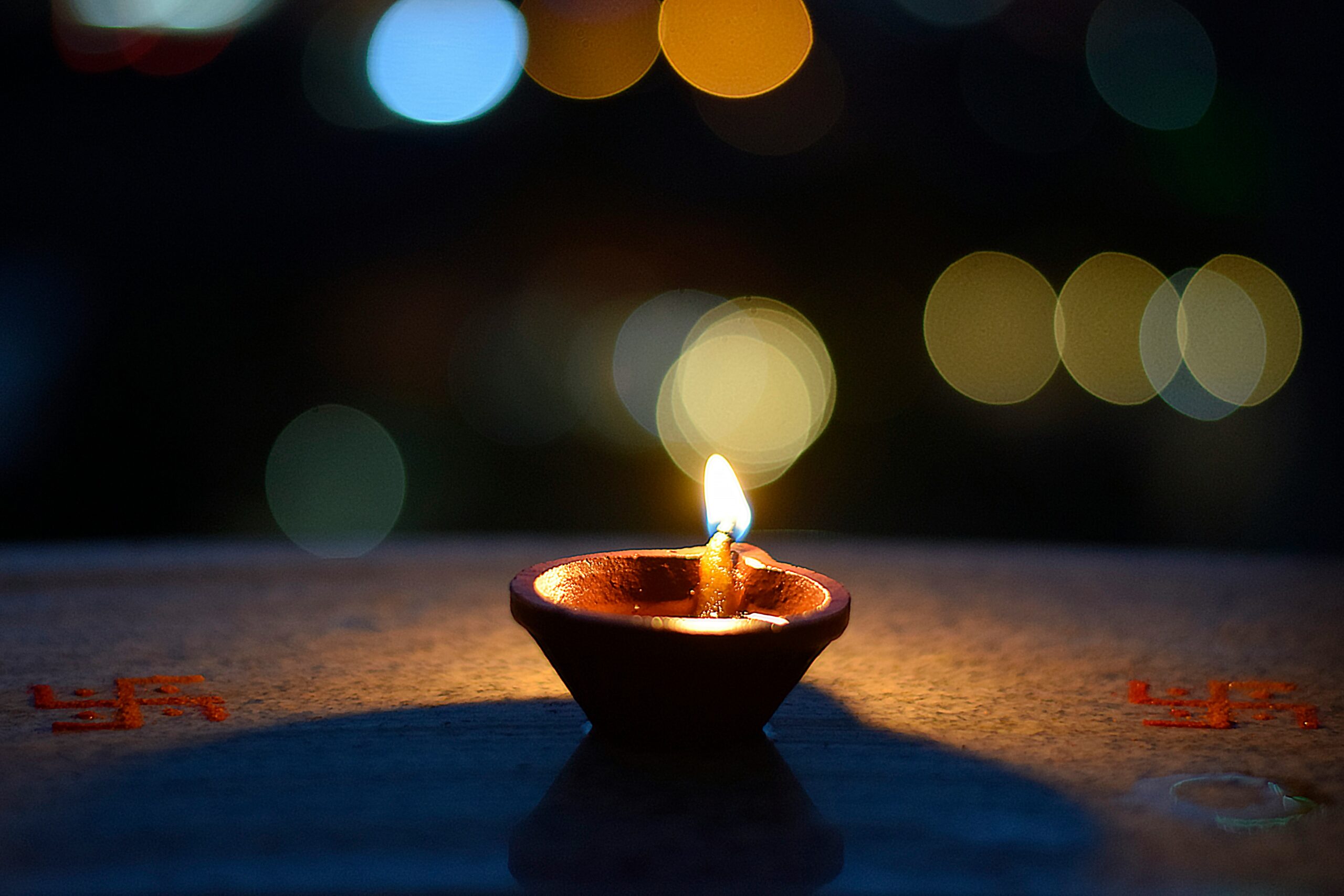
There is a moment on Diwali night that happens in almost every Indian home, and almost nobody photographs it. The sweets are set out, the rangoli is finished, somebody is shouting about the matchbox. And then one person — usually the oldest woman in the house — sits down on the floor with a plate of small clay bowls, a bottle of oil, and a twist of cotton, and starts making lamps. She does it the way she has done it for fifty years. A thumbprint of oil in each bowl. A wick rolled between the palms, laid so that the tip rests on the rim. Then the first flame, passed from one diya to the next, until the plate is a small constellation and the room smells faintly of warm oil.
Everything else about Diwali can be bought. The lamps have to be lit.
That is the part of the festival worth slowing down over. We say Diwali is the festival of lights, but the word itself is more specific than that. Deepavali is a compound of deepa, a lamp, and avali, a row or series — a row of lamps. Not fireworks, not fairy lights, not a glowing house. A row of lamps. The festival is named after an object you can hold in one hand.
What a Diya Actually Is
A diya (also called deepa, deepak, panti in Malayalam, agal vilakku in Tamil, pradeep in parts of the east) is an open oil lamp. The classic form is a shallow, kiln-fired earthenware bowl with a pinched lip at one edge to hold the wick steady. Brass and silver versions exist, often with two, five or seven wick-spouts for temple and aarti use, and Tamil Nadu’s Nachiarkoil lamps — made by the Pather community and sometimes called “Annam lamps” — are objects of real craft.
But the everyday Diwali diya is clay, and deliberately so. It costs a few rupees. It is made by a potter who will be paid for it. It will crack within a season. You are not meant to keep it.
Terracotta lamps are among the oldest everyday objects excavated from ancient South Asian sites, and popular accounts often push the diya back to the Indus Valley cities of four and a half millennia ago. That claim is worth repeating with a little care — archaeologists do not always agree on which small terracotta vessels were lamps and which were something else. What is not in dispute is that the oil lamp is very old, very widespread, and almost unchanged. The diya in your hand this November is close to a design that worked the first time.
The Four Parts and What They Are Said to Mean
There is a teaching about the diya that circulates widely in modern Vedanta classes and family satsangs. It is not, so far as I can trace, a verse from a named scripture — treat it as a devotional reading rather than a scriptural one, which is exactly how most teachers present it:
- The clay body is the physical form — borrowed, temporary, returning to earth.
- The oil is the accumulated tendencies and attachments we carry, our vasanas. The flame consumes them slowly.
- The wick is the ego, the sense of a separate “I”. It must be in contact with the oil to burn, and it burns down as it works.
- The flame is awareness, knowledge, the self that does not go out.
And one more thing, which is the part I find hard to argue with: a flame points upward no matter how you tilt the lamp. You can turn the diya sideways and the fire still reaches up.
Why the Lamp and Not Something Else
Hinduism has an unusually old relationship with fire. The Vedic ritual world is built around agni — fire as the mouth that receives offerings and carries them, fire as witness, fire as the one element that transforms rather than merely exists. When a bride and groom walk the saptapadi, they walk around a fire. When a body is given its last rites, it is given to fire. A lamp is the smallest possible version of that altar: a household fire you can keep on a windowsill.
And light, in Indian thought, is almost never just light. It is the standing metaphor for knowledge. The best-known expression of it is the Pavamana mantra from the Brihadaranyaka Upanishad (1.3.28), which asks for three movements in a row:
asato ma sad gamaya — from the unreal, lead me to the real
tamaso ma jyotir gamaya — from darkness, lead me to light
mrityor ma amritam gamaya — from death, lead me to immortality
Note the middle line. The prayer does not ask for the darkness to be destroyed. It asks to be led out of it. That is a lamp’s logic, not a floodlight’s. A diya does not abolish the dark; it gives you enough to take the next step.
There is also a short verse that many families recite while lighting the lamp — shubham karoti kalyanam, arogyam dhana sampadah / shatru buddhi vinashaya, deepa jyotir namostute: “You who create auspiciousness and wellbeing, health and wealth, who destroy the hostile mind — salutations to you, light of the lamp.” It appears in household prayer collections and stotra compilations rather than being securely attributed to a single text, and the wording varies between regions and families. If your grandmother’s version differs from the one above, hers is not wrong.
The Stories Behind the Lamps
Diwali is not one festival with one origin. It is several observances that happen to land on the same dark night of the lunar month, and the lamps mean something slightly different in each. This matters, because the confident single-sentence explanations you will see online (“Diwali celebrates Rama’s return”) are each true somewhere and incomplete everywhere.
Ayodhya Welcoming Rama
The best-known association, especially across north India, is the return of Rama, Sita and Lakshmana to Ayodhya after fourteen years of exile and the defeat of Ravana. The city, the story goes, lit lamps along every street and rooftop so that the returning king would come home to a city in light.
A note on sources, because this is where popular writing gets careless. The Valmiki Ramayana describes Ayodhya decorated and jubilant at Rama’s return, but the specific, vivid image of rows of earthen lamps lining the city is most strongly associated with the later devotional retellings — above all Tulsidas’s Ramcharitmanas — and with regional performance traditions. The connection is ancient and the devotion is real; the exact scriptural pedigree of the lamps themselves is looser than the internet suggests.
Krishna and Narakasura
In much of the south and west, the central story belongs to the day before the new moon — Naraka Chaturdashi — and to Krishna’s killing of the demon Narakasura, in which his wife Satyabhama plays a decisive part. Krishna frees the thousands of women Narakasura had imprisoned. The lamps here are victory lamps, and the morning ritual is the abhyanga snana, a pre-dawn oil bath — sesame oil massaged into the body and head, often followed by an ubtan paste, before bathing.
This is also why Diwali’s date is not the same everywhere. In Tamil Nadu, Deepavali is traditionally kept on Naraka Chaturdashi, a day earlier than the new-moon night most of north India calls Diwali. Karnataka and Maharashtra begin their celebrations from that day too. Neither is a mistake.
Lakshmi and the Dark Night
On the amavasya itself — the darkest night of the lunar month — the worship across most of India turns to Lakshmi, goddess of prosperity and wellbeing, in some accounts connected to her emergence during the churning of the cosmic ocean. Here the lamps have a job: they are not decoration but invitation. A dark house is not somewhere auspiciousness enters. Lamps at the threshold, the doorway, the window and the courtyard mark a home as awake and ready. (For the ritual itself, see our guide to Lakshmi Puja at home.)
Kali Puja in Bengal
On the same new-moon night, much of Bengal, Odisha and Assam worships not Lakshmi but Kali. The lamps are still lit, the night is still the point, but the goddess being invoked is the fierce one who stands at the edge of the dark rather than the one who brings the lotus. Bengali and Bangladeshi households also commonly light fourteen lamps around the house on Naraka Chaturdashi — one for each of fourteen forefathers understood to visit that night, with the lamps set out to guide them.
The Lamp for Yama
Related, and often overlooked, is Yama Deepam — a single lamp lit for Yama, lord of death, and placed outside the house, traditionally facing south, his direction. It is a petition for protection, for the household, from untimely death and from suffering. Which evening it falls on genuinely varies: many families keep it on Naraka Chaturdashi, others on Dhanteras. Follow your family’s practice, or ask.
Mahavira’s Nirvana and Bandi Chhor Divas
Two other traditions light lamps on this night for reasons of their own, and they are not Diwali-by-adoption — they are their own observances.
For Jains, the new-moon night marks Mahavira Nirvana Divas, the final liberation of Mahavira, the twenty-fourth Tirthankara, traditionally placed in 527 BCE. Jain accounts describe eighteen kings gathered for his last teachings proclaiming that lamps be lit in memory of “the great light” that had passed. The festival of lamps, in that telling, is a memorial.
For Sikhs, the day is Bandi Chhor Divas — “the day of liberation of the prisoners” — commemorating Guru Hargobind’s release from imprisonment at Gwalior Fort, and his insistence on bringing imprisoned princes out with him. Harmandir Sahib in Amritsar is illuminated, and the lamps mark a release, not a homecoming.
How Many Diyas, and Where to Put Them
There is no scripturally fixed number, and anyone who tells you there is should be asked for the citation. What exists is a body of regional and family custom, which is a different and more honest thing. Among the patterns you will encounter:
- Thirteen on Dhanteras, in many north Indian households — the day falls on the thirteenth lunar day, trayodashi, and the count follows the tithi.
- Fourteen on Naraka Chaturdashi, widely in Bengal and the east, for the fourteen ancestors; and in many homes simply because the day is the fourteenth.
- Odd numbers — five, seven, eleven, twenty-one — preferred for puja in a great many families.
- As many as you can manage on Lakshmi Puja night. This is the honest answer for most households.
Placement is where the custom gets practical and rather beautiful. The thresholds are the priority: the main doorway, with a lamp on each side; the tulsi plant if you keep one; the puja room; the kitchen, because that is where the household’s abundance is actually handled; the windows facing the street, so the light is for passers-by and not only for you. Some families put one lamp at the water source — tap, well, water tank — and one near the place where money or account books are kept. A lamp is left burning through the night near the puja space in many homes, which is partly devotional and partly why you should read the next section.
Oil, Ghee, and What Actually Burns Well
Ghee is considered the most auspicious fuel and burns with the cleanest, steadiest flame — it is the usual choice for the single lamp before the deity. Sesame (til) oil is traditional across much of the south and is widely used for Yama Deepam. Mustard oil is the north and east’s workhorse and is what most households actually use for the twenty lamps on the balcony. Coconut oil is common in Kerala. These preferences are regional and devotional rather than ranked by scripture, with one practical truth underneath: thinner oils burn faster and gutter in wind, and a cotton wick rolled slightly thicker will hold a flame far longer than a thin one.
Diwali 2026: The Nights the Lamps Are Lit
For 2026, the five days of the festival fall as follows:
- Dhanteras — Friday 6 November 2026
- Naraka Chaturdashi / Chhoti Diwali (and Deepavali in Tamil Nadu) — Saturday 7 November 2026
- Diwali / Lakshmi Puja, the new-moon night — Sunday 8 November 2026
- Govardhan Puja / Annakut — Monday 9 November 2026
- Bhai Dooj — Tuesday 10 November 2026
Two honest caveats, and they matter especially if you are reading this outside India.
First, these are the dates for the Indian calendar. Hindu festival days are fixed by lunar tithis, and a tithi begins and ends at a particular moment in a particular place. When the new moon falls late in the Indian evening, the corresponding local date in North America, Britain or Australia can shift by a day, and different temples in the same city sometimes observe on different dates as a result. Check the panchang your local temple or community follows before you book anything.
Second, I have deliberately not printed muhurat times here. Every auspicious window — the Pradosh Kaal and Sthir Lagna periods used for Lakshmi Puja, the pre-dawn window for the oil bath — is calculated for a specific latitude and longitude. An IST timing from an Indian panchang site is simply the wrong number in New Jersey or Melbourne. Use a panchang set to your own city, or ask the priest at your temple. Our guide to the five days of Diwali goes through what happens on each one.
The Lamps That Come After Diwali
It is worth knowing that the lamp-lighting season does not end on Bhai Dooj. The whole lunar month of Kartik is considered especially auspicious for deepdan — the offering of lamps, often floated on a river or set at a temple — and two observances in particular are built entirely around light.
Dev Deepawali falls on Kartik Purnima, the full moon of the same month, and is kept most spectacularly at Varanasi, where the stone steps of the ghats are lined with lakhs of earthen lamps and the whole riverfront reads as a single sheet of flame from the water. The name means the Diwali of the gods.
Karthikai Deepam (Karthika Deepam) is observed on the Kartika full moon across Tamil Nadu, Kerala, Andhra Pradesh, Telangana, Karnataka and Sri Lanka, with lamps at every doorway and, at Tiruvannamalai, a great beacon lit on the summit of the hill itself. If your only association with Hindu lamps is Diwali, this is the other half of the story.
Why This Matters Today
I want to resist the temptation to make this section a greeting card, because there is something genuinely useful in the diya that gets lost when we treat it as decoration.
The lamp requires you to be there. This is the whole thing. A string of LEDs is a switch. A diya is a sequence of small physical acts: pour, roll, place, light, and then — crucially — come back in two hours and check it. It cannot be automated and it cannot be scheduled. For one night a year, the tradition builds in an hour of unavoidable attention, performed with your hands, in the dark, usually alongside other people. We have very few of those hours left. Do not outsource this one to a switch.
It scales down without losing anything. One lamp lit properly is not a worse Diwali than two hundred. This is not a consolation prize for people in small apartments; it is closer to the actual logic of the ritual, which is about a flame being present, not about quantity. If you are a student in a dorm, in a hospital, newly arrived somewhere, alone this year — one diya on a plate, with the tamaso ma jyotir gamaya line said once, is the festival.
It is a practice in not needing to see the whole way. This is the part I come back to. A diya lights a few feet. In a power cut, that is enough to cross a room you know. The Upanishadic prayer asks to be led from darkness to light, and the lamp is an honest instrument for that request: it does not promise clarity about everything, only enough to move. Most of the decisions any of us are sitting with in November are like that. We want the floodlight. We get the diya. It turns out to be sufficient.
A Practical Note for Readers Outside India
Open flames and apartment living need a little planning. Clay diyas on a metal or stone tray, away from curtains, dupattas and crawling children; smoke detectors are triggered more often by the oil smoke of twenty lamps than people expect, so check whether yours is in the same room. Many rental buildings and HOAs in the US, UK, Canada and Australia prohibit open flames on balconies — worth reading before you line the railing. A reasonable compromise that a lot of diaspora families have landed on: one or two real ghee lamps at the puja space and the threshold, where the ritual meaning sits, and battery diyas for the long outdoor rows. Nobody in the tradition has ever ranked you on lamp count.
Frequently Asked Questions
Why do we light diyas on Diwali?
Because the festival is named after them: deepavali means a row of lamps. The lamps carry several meanings at once — welcoming Rama home to Ayodhya in the northern tradition, marking Krishna’s victory over Narakasura in the south and west, inviting Lakshmi into a lit and waking house on the new-moon night, and, in Indian thought generally, standing for knowledge dispelling ignorance as in the Upanishadic prayer tamaso ma jyotir gamaya.
How many diyas should be lit on Diwali?
There is no scripturally fixed number. Common customs include thirteen on Dhanteras, fourteen on Naraka Chaturdashi, odd numbers such as five, seven or eleven for puja, and as many as the household can manage on Lakshmi Puja night. Follow your family’s practice; one lamp lit with attention is complete.
Should I use oil or ghee in a diya?
Ghee is considered the most auspicious and burns the cleanest, and is usually chosen for the lamp before the deity. Sesame oil is traditional in the south and for Yama Deepam, mustard oil across the north and east, coconut oil in Kerala. These are regional preferences rather than rules, so use what your family uses.
Where should diyas be placed in the house?
Thresholds first — the main door, with one lamp on either side — then the puja space, the kitchen, the tulsi plant if you keep one, and windows facing the street so the light reaches passers-by. Many families also place a lamp at the water source and one near where accounts or valuables are kept. Keep every lamp on a non-flammable tray and away from fabric.
What is Yama Deepam and when is it lit?
Yama Deepam is a single lamp offered to Yama, lord of death, placed outside the home and traditionally facing south, as a prayer for the household’s protection. Practice varies genuinely by region and family: many light it on the evening of Naraka Chaturdashi, others on Dhanteras.
When is Diwali in 2026, and do the dates apply outside India?
In the Indian calendar, Dhanteras falls on 6 November 2026, Naraka Chaturdashi on 7 November, Diwali and Lakshmi Puja on 8 November, Govardhan Puja on 9 November and Bhai Dooj on 10 November. Because festival days follow lunar tithis calculated for a specific place, the corresponding local date in North America, the UK or Australia can differ by a day — check the panchang your own temple or community follows, and get muhurat timings calculated for your city rather than using IST figures.
Is it correct to light candles or electric lights instead?
The tradition’s object is the oil lamp, and if you can light even one real diya, do. But the meaning is in the light being offered and attended to, not in the vessel’s material, and nothing in the tradition penalises a household that uses safer lighting where open flames are not permitted or not wise. The common middle path is a real lamp at the puja space and the door, with electric lights for the rest.
A Closing Thought
The clay cracks. That is not a flaw in the design — it is the design. You buy the lamps, you fill them, you light them, and by the next Kartik most of them will have chipped or broken and you will buy new ones from the same potter. Nothing about a diya pretends to permanence. It gives light for a few hours, on one night, in a small circle around itself, and then it is done.
Which is a fairly exact description of a human life, and of why the tradition keeps handing us this particular object rather than something more impressive. Light it anyway. That is the instruction. Not because it will last — light it anyway.
This Diwali, before the crackers and the sweets and the phone calls, sit down on the floor for ten minutes with a plate of clay bowls and a bottle of oil, and make the lamps yourself. Pass the flame from one to the next. You will find it is not a chore.
Continue Exploring
- Significance of Diwali: The Spiritual Meaning of the Festival of Lights
- The Five Days of Diwali Explained: Rituals, Dates and Meaning
- Lakshmi Puja at Home: Muhurat, Vidhi and Meaning
- Dussehra (Vijayadashami): Meaning, the Two Legends, and How India Celebrates
- Significance of Navratri: The Spiritual Meaning of the Nine Nights