
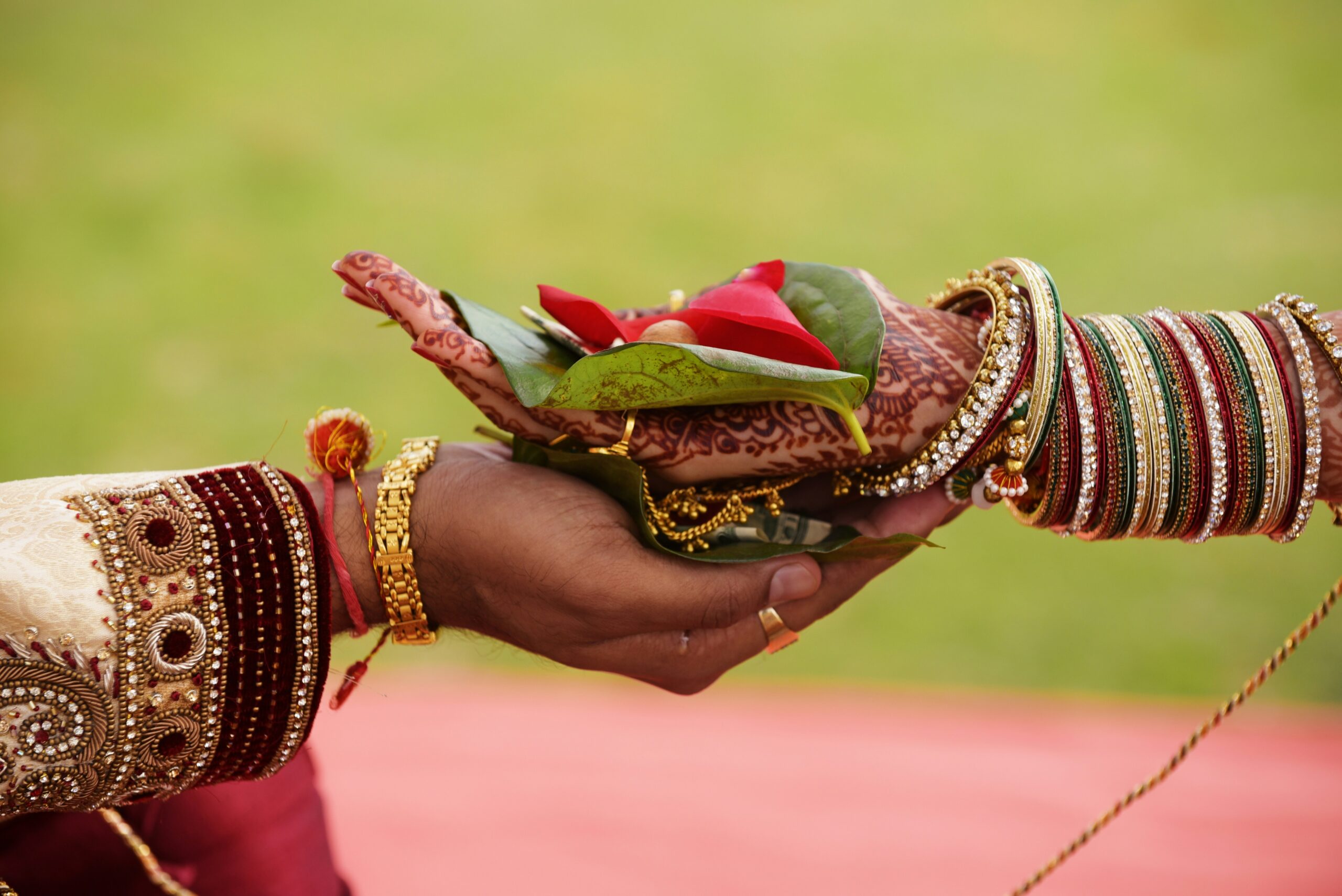
Somewhere around the fourth hour, the guests have given up. The buffet has been raided twice. An uncle is asleep upright in a plastic chair. Children are sliding across the marble in their socks. And at the centre of all this, inside a small square of fire and flowers, a priest is reciting verses in Sanskrit that almost nobody in the hall understands, while a bride’s brother pours puffed rice into her cupped hands.
That moment — the rice, the brother, the fire — is roughly three thousand years old. It is prescribed in the Grihya Sutras, the Vedic household manuals, and it is called Laja Homa. It has survived the collapse of empires, the arrival of photographers with drones, and the fact that the groom’s cousins are filming it for Instagram.
Indian weddings are famous for their scale. What gets lost in the scale is that almost every single thing happening is a sentence — a specific statement about what marriage is for, made in the grammar of ritual rather than in words. This is an attempt to translate it.
What Vivaha Actually Is
The Sanskrit word is vivaha — literally something like “carrying away in a special manner,” from vi (distinctively) and vah (to carry). Regionally you will hear lagna in Marathi, pelli in Telugu, kalyanam in Malayalam and Tamil, biye in Bengali.
In the classical framework, vivaha is one of the samskaras — the sacraments that mark the passages of a human life, from conception and naming through education and finally cremation. The lists vary; the most commonly cited count is sixteen. Across these lists, marriage is almost always treated as the pivotal one, because it is the samskara that establishes the grihastha — the householder — on whom the entire social and ritual order depends. Before marriage you are a student. After it you are the person who feeds the students, the renunciates, the ancestors and the gods.
That is the first thing to understand about a Hindu wedding, and it is genuinely different from the romantic model many of us grew up with: the ceremony is not primarily a celebration of two people’s feelings for each other. It is an installation. Two individuals are being commissioned as a household — a unit with ritual duties, economic duties, and duties to the generations in both directions.
The Texts Behind the Ritual
The source material is remarkably specific:
- Rigveda 10.85, the long hymn describing the marriage of Surya — the daughter of the Sun — to Soma. Verses from this hymn are still recited at weddings today, which means a bride in Toronto in 2026 may be hearing lines composed before the Buddha was born.
- The Grihya Sutras — the household ritual manuals of Ashvalayana, Apastamba, Baudhayana, Paraskara and Sankhayana, composed roughly in the first millennium BCE. These are the actual stage directions: who stands where, what is poured into what, which mantra accompanies which gesture. Different communities follow different sutras, which is one real reason rituals differ across India.
- The Manusmriti (3.21), which catalogues eight forms of marriage — Brahma, Daiva, Arsha, Prajapatya, Gandharva, Asura, Rakshasa and Paishacha. The classification is worth knowing because it is frequently misquoted. Brahma (the father gives his daughter to a learned man of good character, expecting nothing) is the form held up as ideal and is essentially what modern Hindu weddings enact. Gandharva is marriage by mutual love and choice alone — recognised, if not idealised, which is to say the tradition has a word for a love match. The last three — Asura (purchase), Rakshasa (abduction) and Paishacha (violation of the unconscious) — are listed and then explicitly condemned. They are in the text as a taxonomy of what exists, not a menu.
Before the Wedding: Setting the Stage
Vagdana / Nischitartha — The Word Given
The engagement is not a modern import. Vagdana means literally “the gift of the word”: the bride’s father makes an oral promise, and in the classical understanding that promise is binding. Many communities also produce a written declaration — the Marathi lagna-patrika, the north Indian lagna-patra. Regional names: nischitartha or nishchayathartham in the south, sakhar puda (“packet of sugar”) in Maharashtra, roka or sagai in the north.
Ganesh Puja and Nandi Shraddha — Clearing the Path
Almost every Indian wedding opens with an invocation of Ganesha, remover of obstacles — the logic being that a rite this long and this consequential should not be begun without clearing the road first.
Less visible to guests is Nandi Shraddha, a rite addressed to the pitrs, the ancestors, performed on the morning of the wedding. Both families are formally informing their dead. In Tamil weddings this appears as Sumangali Prarthanai, in which the married women of the family — living and remembered — are honoured and asked for blessing. Maharashtrians perform Kelvan, a puja to the family deity. The underlying grammar is the same: a marriage is being contracted between lineages, not just persons, and the lineages include the departed.
Haldi, Mehndi and Sangeet — The Body and the Noise
The turmeric ceremony has as many names as India has regions: haldi in the north, gaye holud in Bengal, halad chadavane in Maharashtra, mangala snanam in Tamil Nadu, pithi in Gujarat. Married women apply a paste of turmeric — often with sandalwood and kumkum — to the bride and groom, followed by a ritual bath.
Turmeric is a well-known antiseptic, and the practical reading is popular. But the ritual meaning is about auspiciousness and transition: the yellow-gold colour is the colour of the sun, of Vishnu, of fertility. The person who is bathed in it is being marked as set apart and prepared. This is a liminal state, which is why in many communities the bride or groom does not leave the house afterward until the wedding.
Mehndi (henna) and sangeet (the music-and-dance night) are the most joyfully unregulated parts of the whole business, and they have expanded enormously in the last forty years. They are not in the Grihya Sutras. That does not make them inauthentic — living traditions grow — but it is worth knowing which parts are three thousand years old and which are three generations old.
The Wedding Day: Ritual by Ritual
Baraat / Var Yatra — The Arrival
The groom’s procession arrives with music, usually loudly. He is received at the gate by the bride’s family in a rite called Seemant Puja in Maharashtra and variously milni or swagatam elsewhere, in which the bride’s mother washes his feet, applies tilak and feeds him something sweet. In a milni, matching relatives from the two families — the elder brothers, the maternal uncles — are formally introduced to each other, pair by pair. Two kinship networks are being stitched together in public, and the stitching is itemised.
Madhuparka — The Honoured Guest
The groom is offered madhuparka, a mixture of honey, curd and ghee, with mantras about sweetness. In the classical form the bride’s father also offers a cow. The rite comes from the protocol for receiving a distinguished guest, and that is precisely the point: the man about to take the daughter away is first treated as the most honoured visitor the house can receive.
Kashi Yatra — The Last Chance to Run
One of the loveliest and most comic rites, chiefly southern. The groom pretends to renounce the world — he picks up an umbrella and a fan and sets off for Kashi to spend his life in study and austerity. The bride’s father intercepts him and argues him out of it, usually offering his daughter as the reason that a householder’s life is the better path.
It is staged, everyone laughs, and it encodes something serious: the tradition openly acknowledges that the renunciate’s path is a real alternative, and the choice of marriage is a deliberate rejection of it in favour of engagement with the world.
Antarpat and Shubho Drishti — The First Look
In Maharashtrian weddings, a cloth screen — the antarpat — is held between the couple while the priest chants the Mangalashtak verses. At the appointed moment the cloth drops and they see each other.
This is not a modern flourish. The classical rite is Parasparasamikshana, “mutual beholding,” and the verses recited as the screen falls are drawn from Rigveda 10.85. Bengal has its own gorgeous version, shubho drishti — “the auspicious glance” — where the bride, carried in on a low wooden seat and circled seven times around the groom (saat paak), finally lowers the betel leaves from her face and looks at him.
Jaimala / Mala Badal — The Exchange of Garlands
The couple garland each other. In the Bengali mala badal the exchange is explicitly read as mutual acceptance; elsewhere it has become an occasion for cousins to hoist the bride and groom in the air so that neither can reach. The underlying meaning is consent, performed by both parties, in front of everyone.
Kanyadaan — The Most Debated Rite
Kanyadaan — the father places his daughter’s hand in the groom’s. In the classical form the groom then promises not to transgress dharma, artha and kama in his dealings with her, and answers three times: “naticharami” — “I shall not transgress.”
The word daan means gift, and it is the element that many modern couples now question, since it can read as a transfer of property. It is worth being accurate about the textual position rather than arguing either side from feeling. A few things are genuinely true at once: the rite is structured as a formal daan, which in Hindu ritual grammar is the highest-status way of conveying anything and places obligations on the recipient, not merely rights; the groom’s triple vow is the counterweight built into the rite itself; and the framing nonetheless reflects a patrilocal society in which the daughter left her natal home. Some communities — including a number of Tamil and Nair traditions — have historically given kanyadaan little or no role. Many couples today retain it, some modify it so that both sets of parents give both children, and some omit it. All three choices have precedent in the sheer diversity of Hindu practice; none requires pretending the text says something it does not.
Panigrahana — Taking the Hand
Panigrahana (literally “grasping the hand”) is the groom taking the bride’s right hand in his, with mantras invoking the gods as witnesses. In Punjabi and Gujarati weddings the step is called hast-milap or hast-milan, and the couple’s garments are often knotted together at this point. This knot — the gathbandhan — is the image most people carry of an Indian wedding, and it is doing exactly what it looks like it is doing.
Vivaha Homa and Laja Homa — The Fire as Witness
The sacred fire is established (Agnisthapana) and becomes the formal witness to everything that follows. No registrar, no signature: Agni is the attesting party, and this is the single most important structural fact about a Vedic wedding.
Into that fire comes Laja Homa: the bride’s brother fills her cupped hands with parched rice or puffed grain, and the couple offer it to the fire together. Read it closely — the grain comes from her family, passes through her hands, and is offered jointly. The bride’s natal family is contributing the substance of the new household’s first offering. Her brother’s role is a formal statement that she is not being cut loose; her people are endowing this.
Ashmarohana — The Stone
The bride places her right foot on a stone — a millstone or, in Tamil weddings, the ammi grinding stone, with the groom often holding her toe to guide it. The mantra asks that she be as firm as the stone. It is the only rite in the sequence that asks for something unmoving in a ceremony otherwise full of circling and stepping.
Agni Parinayana and Saptapadi — Circling and Stepping
These two are frequently confused, including in wedding programmes, so it is worth separating them carefully.
Agni Parinayana (the pheras or mangal phera) is the couple circling the fire — commonly three, four or seven times depending on community. Gujarati weddings do four mangal pheras, with the bride leading the last. North Indian weddings commonly do seven, with the bride leading some and the groom the others.
Saptapadi is different: seven steps, taken together to the north of the fire, each with a vow. The traditional seven ask for, in sequence:
- Food and nourishment — for the household, its guests and its dependents.
- Strength — of body, character and health.
- Prosperity, and the just management of it.
- Shared decisions — happiness arrived at together, and contribution to the wider community.
- Progeny and the care of living things — in the classical form, cattle, agriculture and livelihood.
- The seasons — living through the full span of life’s weathers together.
- Friendship — sakhya, lasting companionship.
Notice what is and is not in that list. There is no vow about romantic feeling, and no vow of obedience. Four of the seven are about food, money, strength and livestock. The final one — the climax of the entire ceremony — is friendship. A Hindu wedding spends six steps on the material basis of a shared life and the seventh on the thing that has to hold it together.
Saptapadi carries legal weight too. Section 7 of the Hindu Marriage Act, 1955 provides that a Hindu marriage may be solemnised according to the customary rites of either party, and that where those rites include saptapadi, the marriage becomes complete and binding when the seventh step is taken. Courts have read this carefully: in S. Nagalingam v. Sivagami (2001) the Supreme Court held that saptapadi is essential only where the parties’ own custom treats it as essential, so a marriage performed under a custom that omits it can still be valid. Communities that have historically not performed saptapadi — several South Indian and Nair traditions among them — are not thereby unmarried. This is a point where internet summaries are frequently wrong in both directions; anyone with an actual legal question should consult a lawyer rather than a wedding blog, including this one.
Mangalsutra and Sindoor — The Visible Marks
The groom ties the mangalsutra (“auspicious thread”) around the bride’s neck. This rite has an interesting status: it is near-universal in practice today, yet it has no Vedic mantra of its own and appears in the literature later than the fire rites. Regional forms differ sharply — the Tamil and Telugu thali or mangalyam is tied with three knots, with the groom’s sister traditionally tying the third; Maharashtrian mangalsutras use two black-beaded vatis; Bengal uses the shakha-paula conch and coral bangles and the iron loha bangle rather than a neck thread at all.
Sindoor daan — vermilion placed in the parting of the bride’s hair — follows the seven steps in north Indian and Bengali weddings. In Bengal, where it takes place at the chhadnatala and is followed by the groom draping the lajja-bastra over her head, sindoor daan is popularly treated as the moment that concludes the wedding. South Indian weddings generally do not use sindoor this way, using kumkum differently and giving the thali and the metti (silver toe rings) the role of visible marital markers.
These markers are, historically, asymmetrical — worn by the wife, not the husband — and many couples today address that directly, some by exchanging rings or chains, some by the husband wearing a thread. This is a live and reasonable conversation, and it is being had within the tradition rather than against it.
Hridaya Sparsha, Suryodikshana and Dhruva Darshana
Three quieter rites that often get cut for time, and are worth reviving:
Hridaya Sparsha — the groom touches the bride’s heart with a mantra for the union of their minds. Suryodikshana — the bride looks at the sun, with a verse wishing her husband a hundred-year life. And Dhruva Darshana — on the wedding night the couple go outside and look at the Pole Star and the star Arundhati (the double star in the Great Bear, named for the famously steadfast wife of the sage Vasishtha). The point is not astronomy. It is that the two most fixed things in the visible sky are shown to the couple as an image of what they have just promised.
Vidaai and Griha Pravesha — Leaving and Arriving
The vidaai is the departure from the bride’s home, and it is the part of the wedding that is unambiguously about grief. In many communities the bride throws a handful of rice back over her shoulder as she leaves — a gesture of returning the prosperity she received to the house she grew up in.
At the other end, Griha Pravesha: she enters her new home right foot first. In Maharashtra she first topples a measure of rice at the threshold; in Bengal, the bodhu boron welcome involves watching milk boil over and leaving footprints in alta and milk on white cloth. The vocabulary is abundance, arriving.
India Is Not One Wedding
It cannot be said often enough: there is no single Hindu wedding, and the differences are not decorative. Some examples of real structural divergence:
- Tamil Nadu: the muhurtham timing is paramount, the oonjal (swing ceremony, where the couple are rocked while women sing and elders offer milk and banana) has no northern equivalent, Kashi Yatra is standard, and the thali is tied with three knots.
- Bengal: saat paak (the bride carried around the groom seven times) precedes the fire rites, shubho drishti stages the first look, and sindoor daan is treated as the concluding act. The post-wedding bou bhaat and bhat kapor — the husband formally presenting food and clothing — have their own distinct meaning.
- Maharashtra: the antarpat screen and the Mangalashtak verses structure the central moment; karmasampati at the end includes the bride’s father playfully twisting the groom’s ear to remind him of his duties.
- Kerala: among many communities the ceremony is strikingly brief — in some Nair traditions historically a matter of minutes, with the tying of the thali and the gift of a pudava cloth, reflecting a matrilineal social order quite unlike the patrilocal north.
- Gujarat: four mangal pheras rather than seven, the jaan welcome, and the maayra gift ritual led by the maternal uncle (also Rajasthani).
If you are attending a wedding in a tradition not your own, the single most useful thing you can do is ask the family what each rite is called in their language. The names carry the meaning, and people are almost always delighted to be asked.
Why These Rituals Still Matter
Here is the practical case, for anyone planning a wedding or attending one with a faint sense of going through motions.
Choose fewer rites and understand them. The most common failure in a modern Indian wedding is not shortening the ceremony; it is keeping all of it while understanding none of it, so that four hours pass in a blur and the couple remember only being hot. A wedding in which six rites are performed slowly, with someone explaining each one aloud in a language the room speaks, is a more traditional wedding than one in which twenty are rushed. The Grihya Sutras themselves differ about which rites are required — selection is built into the system.
Ask for the vows in translation. Request that the priest read the seven saptapadi vows in English or the local language as well as Sanskrit. This single change does more than any amount of décor. Couples routinely report that this was the moment the ceremony became theirs rather than something performed around them — not least because the vows turn out to be about groceries, health, money and friendship, which is to say about actual marriage.
Negotiate the contested rites honestly and in advance. Kanyadaan, the asymmetry of the marital markers, who leads the pheras: these are worth discussing with both families weeks before, not improvising at the mandap. The tradition is wide enough to accommodate most reasonable choices, and the arguments go much better when they are not conducted in front of three hundred people and a drone.
Keep the rites that acknowledge the people not in the room. Nandi Shraddha, Sumangali Prarthanai, Kelvan — the rites addressed to the ancestors are the first to be cut and the most missed. A wedding that formally mentions the grandparents who did not live to attend it is doing something no reception can do.
And do the Dhruva Darshana. It takes five minutes, costs nothing, requires only that the two of you walk outside after everyone has gone and look up. For a diaspora couple married in a hotel ballroom in New Jersey or Wembley, it is the one rite that needs no priest, no fire licence and no venue permission — just a sky.
Frequently Asked Questions About Indian Wedding Rituals
What is the most important ritual in a Hindu wedding?
Most traditions treat saptapadi, the seven steps taken together beside the sacred fire, as the decisive rite — and Section 7 of the Hindu Marriage Act, 1955 gives it legal effect where a couple’s custom includes it. That said, several communities do not perform saptapadi at all, and in Bengal sindoor daan is popularly treated as the concluding act. The honest answer is that it depends on the tradition being followed.
What do the seven vows of a Hindu wedding mean?
They ask, in order, for nourishment for the household, strength of body and character, prosperity justly managed, happiness in shared decisions, progeny and the care of living things, companionship through all seasons of life, and finally lasting friendship. Notably there is no vow of obedience and none about romantic love — the seventh and climactic vow is friendship.
What is kanyadaan and why is it controversial?
Kanyadaan is the rite in which the bride’s father places her hand in the groom’s, who then vows three times not to transgress dharma, artha and kama with her. The debate turns on the word daan, “gift,” which some read as treating a daughter as property. Several Hindu communities have historically given the rite little or no place, and couples today variously keep it, modify it so both sets of parents give both children, or omit it — all of which have precedent somewhere in Hindu practice.
Why do Hindu weddings have a sacred fire?
Agni, fire, is the witness to the marriage. In the Vedic framework there is no human officiant whose authority makes the marriage; the vows are made before the fire, which carries offerings to the gods and attests the contract. This is why the fire must be lit, tended and formally concluded, and why rites like laja homa involve offering something into it.
How long does a Hindu wedding ceremony take?
The core ceremony typically runs ninety minutes to three hours, with the full sequence of pre- and post-wedding events spanning two to five days. Kerala’s Nair tradition has historically been among the briefest — sometimes minutes. Many families now shorten the ceremony deliberately, which the tradition permits, since the Grihya Sutras themselves disagree on which rites are indispensable.
What is the difference between pheras and saptapadi?
Pheras (agni parinayana, or mangal phera) are circles walked around the fire — three, four or seven depending on the community. Saptapadi is seven individual steps taken beside the fire, each with its own vow. They are separate rites that are often run together or confused in wedding programmes.
Can a Hindu wedding be valid without saptapadi?
Yes, where the couple’s own customary rites do not include it. The Supreme Court held in S. Nagalingam v. Sivagami (2001) that saptapadi is essential only where the parties treat it as essential, and a marriage solemnised under customary ceremonies that omit it can be valid. Anyone with a specific legal question should consult a lawyer — we are explaining the tradition, not giving legal advice.
A Closing Thought
The thing that strikes you, once you know what the rites say, is how unsentimental they are. There is a vow about cattle. There is a formal gift of honey and curd to a guest. The bride’s brother brings grain, because someone has to think about where the first meal comes from. The last promise is not passion but friendship.
Which means that for all the gold and the noise and the uncle asleep in the plastic chair, an Indian wedding is in its bones a sober document — a list of the things a shared life will actually require, recited in front of a fire by people who had no illusions. The flowers are new. The honesty is old.
Continue Exploring
- Why We Touch Feet: The Meaning of Charan Sparsh in Indian Tradition
- The Meaning of Namaste: What You Are Actually Saying
- The Concept of Dharma in the Bhagavad Gita
- Kashi and Its Significance for Hinduism
- Who Is Lord Shiva? The Story, Symbolism and Worship of Mahadeva