
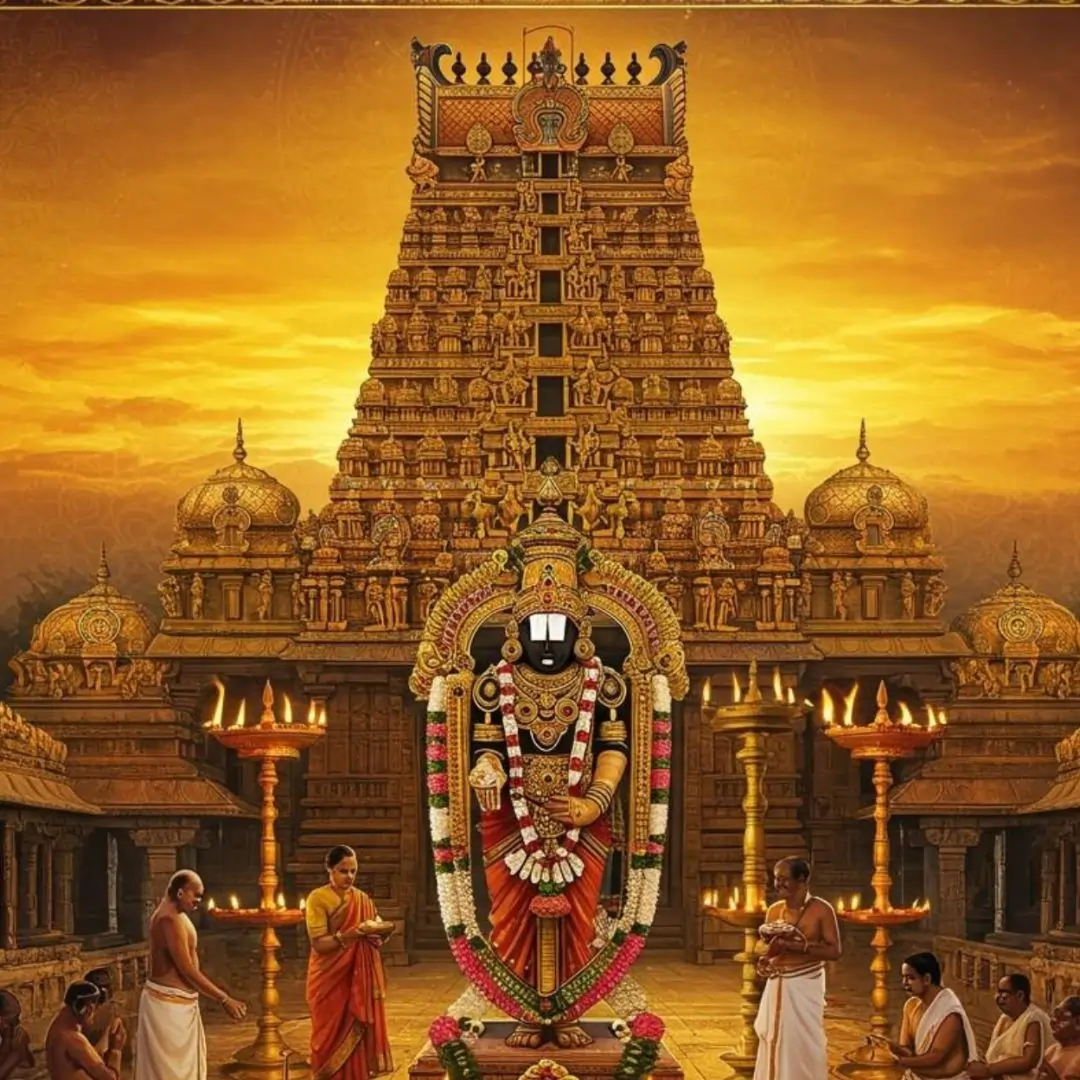
By tonight, more than a tonne of human hair will have been gathered on this hill. Men and women will have climbed the steps or the ghat road, queued for hours, sat on a stone floor while a barber shaved their head, bathed, and then joined another queue. They will have given away the one thing they brought with them that nobody asked them to buy. Then they will shuffle past a dark, garlanded, roughly eight-foot figure for perhaps four seconds, and some of them will weep.
Tirupati Balaji is the Sri Venkateswara Swamy temple at Tirumala, in Tirupati district, Andhra Pradesh — a Vishnu shrine on a hill about 853 metres (2,799 ft) up in the Seshachalam range, administered by the Tirumala Tirupati Devasthanams (TTD). The deity is Venkateswara, also called Srinivasa, Govinda and Balaji. It is reported to receive around 24 million pilgrims a year, which makes it, by most accounts, the busiest Hindu temple in the world.
Tirupati is the town at the bottom. Tirumala is the hill at the top. That distinction confuses first-time visitors constantly, and getting it right is the beginning of planning a trip properly.
The hill came before the temple
Every great Hindu site has a story about why the ground itself is holy, and at Tirumala the ground is holy twice over before Venkateswara arrives at all.
The hill range is traditionally read as the body of Shesha (also called Ananta, the endless one) — the great serpent on whom Vishnu reclines between cycles of creation. The seven peaks are his seven heads. This is why the range is called Seshachalam, the hill of Shesha, and why pilgrims speak of the Saptagiri, the seven hills, as a single body rather than a group of summits.
Earlier still, the Sri Venkatachala Mahatyam — the local sthala purana, the text that tells a particular place’s own sacred history — places the boar incarnation here. Vishnu as Varaha, the white boar, lifts the earth out of the cosmic waters, defeats the demon Hiranyaksha, and then chooses this hill as his dwelling. The site’s older name is Varaha Kshetra.
That detail has a consequence you can still see in practice. Because Varaha was here first, tradition holds that Srinivasa asked his permission to settle on the hill. So devotees are expected to take darshan of Bhu Varaha Swamy, on the bank of the temple tank, before going to Venkateswara. Most pilgrims in the general queue do not manage it, and most guides do not mention it. If you want to do the pilgrimage as the tradition describes it rather than as the crowd performs it, that is the first thing to get right.
The seven hills of Tirumala
| Hill | Named for |
|---|---|
| Vrushabhadri | Vrishabhasura, the bull demon |
| Anjanadri | Anjana’s son, Hanuman |
| Neeladri | Neela Devi |
| Garudadri (Garudachalam) | Garuda, Vishnu’s eagle |
| Seshadri (Seshachalam) | Shesha, the serpent |
| Narayanadri | Narayana — site of the Srivari Padalu, the footprints |
| Venkatadri | Venkateswara — the hill the temple stands on |
The name Venkata itself is read by the Sri Vaishnava tradition through a Rig Vedic line (X.155.1) as a place that burns up sin and clears obstacles to peace and prosperity. Treat that as a devotional etymology rather than a settled philological one — it is how the tradition hears the name, which is a different claim from how the word was formed.
Who is Lord Venkateswara?
Venkateswara is Vishnu, standing. Not reclining, not riding, not in the middle of an avatara’s battle — simply standing on a hill, four-armed, waiting. The theology of the place is that in the Kali Yuga, the present degraded age, Vishnu made himself unusually available: he came down and stayed put, and anyone who climbs the hill can see him.
The best-known story of how he got there is the Bhrigu episode, and it is worth telling carefully because it is usually told badly. The sage Bhrigu, in a dispute about which god is supreme, finds Vishnu asleep and kicks him in the chest. Vishnu responds with courtesy rather than a curse. Lakshmi, who lives on Vishnu’s chest and has just been kicked, is not so forgiving — of Bhrigu or of her husband’s indulgence — and leaves Vaikuntha. Vishnu follows her down to the Seshachalam hills and waits. Lakshmi is later born on earth as Padmavati, and Vishnu, now living as Srinivasa, marries her.
That wedding is the single most consequential story in the economics of Indian religion. To pay for it, Srinivasa is said to have borrowed from Kubera, the treasurer of the gods, on the understanding that his devotees would repay the loan. The money dropped into the Srivari Hundi, the great donation vessel inside the temple, is understood as instalments on a divine debt. Whether or not that story moves you theologically, it is a remarkable piece of religious design: giving is framed not as charity or purchase but as helping settle a bridegroom’s account.
A caution on sources. These narratives are carried chiefly by the Sri Venkatachala Mahatyam and by a web of regional and oral tradition. The Varaha Purana, Skanda Purana and Padma Purana are cited as mentioning the site, but the detailed Srinivasa-and-Padmavati cycle as temple guides tell it is not cleanly traceable to a single early Sanskrit Purana, and the loan-from-Kubera episode in particular is flagged even in standard reference accounts as poorly sourced. It is the tradition’s story about itself, held with real devotion. It is not an episode you can point to in the Valmiki Ramayana and read off a verse number, and it is more honest to say so.
The epithet Balaji, by which north India mostly knows him, came in through Maratha usage and spread with Maratha patronage. In Telugu the deity is Venkateswara or Venkanna; in Tamil Sri Vaishnava hymnody he is Thiruvengadam Udaiyan, the lord who possesses Tiruvenkatam. One hill, several linguistic homes.
What the sanctum actually holds
The Moolavirat or Dhruva Beram — the fixed, principal image — is a standing four-armed figure roughly eight feet tall, held to be swayambhu, self-manifested. No sculptor and no installing king is recorded for it. Lakshmi is believed to be present on its chest as Vyuha Lakshmi. It wears the vajra kiritam, the diamond crown, and layers of jewellery that are changed through the ritual day.
Around it stand the other four of the Pancha Beramulu, the five images, each with its own job: Kautuka Beram (Bhoga Srinivasa, a silver image, for daily intimate service), Snapana Beram (Ugra Srinivasa, for ritual bathing), Utsava Beram (Malayappa Swami, the one who goes out in procession) and Bali Beram (Koluvu Srinivasa, who holds court and, in a detail devotees love, is shown the temple’s daily accounts). The god you see in the sanctum never leaves it. The god in the street at festival time is a different bronze doing the same work.
Worship follows the Vaikhanasa Agama, one of the two major Vaishnava ritual systems, and it is one of the few great temples where the Vaikhanasa tradition is still the operating manual rather than a historical note. The ritual order follows Vadakalai (northern) Sri Vaishnava usage, while the Tamil Naalayira Divya Prabandham is recited in the Tenkalai (southern) manner — and both traditions are permitted to recite. That arrangement is the residue of centuries of sectarian negotiation, and it is unusual in its generosity.
The temple is one of the 108 Divya Desams, the shrines sung by the Tamil Alvar poet-saints, and is counted among the eight swayambhu kshetras of Vishnu.
Ananda Nilayam: the architecture
The style is Dravidian, grown by accretion over many centuries rather than built in one campaign. Three concentric prakarams — enclosure walls — wrap the sanctum, each defining a circumambulation path: the outer Sampangi Pradakshinam, the inner Vimana Pradakshinam, and the Angapradakshina Margam.
You pass through three gateways. The Maha Dwaram or Simhadvaram, the outer gopuram about 15 m tall, flanked by the guardian figures Sankanidhi and Padmanidhi. Then the Vendi Vakili, the silver entrance. Then the Bangaru Vakili, the golden entrance, with gilt door panels and the doorkeepers Jaya and Vijaya, which opens towards the sanctum.
Over the sanctum rises the Ananda Nilayam, the gold-plated three-storey vimana that is the temple’s defining image. Gilding is associated with renovations around the thirteenth century; a gold kalasha was installed around 1262 by the Pandya king Jatavarman Sundara I; and Krishnadevaraya of Vijayanagara gave gold and jewels for the roof in the early sixteenth century. It was renovated again in the 1950s and 60s. On the north-west corner of the second tier is a small carved replica of the deity, Vimana Venkateswara — a figure most pilgrims never notice and which rewards looking up.
North of the temple lies Swami Pushkarini, the tank, over an acre and a half, which tradition says Garuda brought from Vaikuntha. A mandapam built in 1468 by Saluva Narasimha Raya once stood at its centre.
The documented history — and where the dates fight
Around 640 inscriptions survive at Tirumala, in Kannada, Sanskrit, Tamil and Telugu. They are the reason this temple’s institutional history is unusually well lit while its origins stay dark.
The earliest named patron is the Pallava queen Samavai. Here the standard accounts contradict themselves: her endowment is given both as 966 CE and as 614 CE for the gift of the silver Bhoga Srinivasa image. Both dates circulate in print, including on the same reference pages, and the conflict is not resolved. Do not trust any guide that prints one of them flatly.
After that the line of patrons is clear enough: Cholas in the tenth century, Pandyas, the Reddi kings in the twelfth and thirteenth centuries, and then Vijayanagara, which gave the temple most of the wealth it still holds. Krishnadevaraya installed his own statue in the temple on 2 January 1517 — it is still there, and it is a reminder that a king’s piety and a king’s publicity were never separable.
Ramanujacharya, the great eleventh-to-twelfth-century Sri Vaishnava teacher, visited three times. He is credited with settling a Shaiva-Vaishnava dispute over the nature of the image, regularising ritual on Vaikhanasa lines, introducing recitation of the Divya Prabandham, and establishing the Tirupati Jeeyar Mutt, dated to 1119 CE. (The tradition that he lived to 102 is devotional, not documented.)
Then Annamacharya of Tallapaka, the Telugu poet-composer whose sankirtanas became the hill’s own music. His dates are usually given as 1408–1503 CE, though some accounts place him more loosely in the fourteenth century, and the count of his songs is given variously as about 32,000 and about 36,000. Around 3,000 copper plates preserving his and his descendants’ compositions survive at the temple — which is the solid fact underneath the shifting numbers.
The later administrative history reads like a map of who held south India. Golconda took control in July 1656, then the French, then the Nawab of the Carnatic until 1801. Under the East India Company, Regulation VII of 1817 moved oversight to the Board of Revenue, and Bruce’s Code of 1821 set out management rules. In 1843 administration passed to the Mahants of the Hathiramji Mutt, who held it for six generations. The Maratha general Raghoji I Bhonsle had earlier set up a permanent arrangement for worship and donated jewels. The TTD Act of 1933 created the Tirumala Tirupati Devasthanams; the Madras Hindu Religious and Charitable Endowments Act of 1951 superseded it, the state took direct control in 1966, and the TTD Act of 1979 restored a committee arrangement. TTD’s head is appointed by the Andhra Pradesh government, which is why temple administration here is a recurring subject of public argument.
The laddu, the hundi and the hair
Three things make Tirumala unlike any other temple in the world, and none of them is the building.
The laddu. Laddu offerings at Tirumala are recorded as beginning on 2 August 1715 (one cited source gives 1716). The recipe, the dittam, follows Agamic prescription and has been formally revised six times. It is made in the Laddu Potu, a kitchen inside the Sampangi prakaram, which switched from firewood to LPG in 1984 and now runs conveyor belts installed in 2007, 2010 and 2014. Average production is around 2.8 lakh laddus a day against a capacity of about 8 lakh. Daily consumption runs to roughly 10 tonnes of gram flour, 10 tonnes of sugar, 700 kg of cashews, 150 kg of cardamom, 300–500 litres of ghee, 500 kg of sugar candy and 540 kg of raisins. The small proktham laddu given to ordinary pilgrims weighs 65–75 g; the astanam laddu, made only on festival occasions, weighs 750 g and carries more cashew, almond and saffron. TTD applied for a Geographical Indication in 2008 and secured it in 2009 under the GI Act 1999, so no one else may lawfully make or sell a Tirupati laddu. A GI tag on a temple offering was and remains legally novel, and it has been criticised on exactly that ground.
In September 2024 the laddu became the subject of a political controversy, with allegations about adulterated ghee supplied to the temple, a laboratory report, a proposed Special Investigation Team and a purification ritual performed at the temple on 24 September. On 30 September 2024 the Supreme Court observed that there was no conclusive evidence of animal fat having been used and stayed the SIT pending further orders. The matter was contested along party lines and this post does not take a view on it.
The hundi. Reported hundi collections run to the order of tens of millions of rupees a day; one widely cited figure is around 22.5 million rupees daily, and a 2025 report put donations at 918.6 crore rupees over eleven months, with online giving exceeding cash for the first time. Treat all of these as reported press figures rather than audited accounts — they move fast, they are compiled differently by different sources, and the trend matters more than any single number.
The hair. Mokku, tonsure, is the vow most associated with this hill: you offer your hair, and with it your vanity, before you see the god. More than a tonne a day is reportedly collected, and it is auctioned internationally — much of the world’s trade in human hair for wigs and extensions begins at Tirumala. The legend attaches it to Neela Devi, a Gandharva princess who is said to have given her own hair to cover a bare patch on the deity’s scalp, and so to receive every head of hair offered since. One more thing worth recording: women barbers were appointed at Tirumala after a long campaign led by Kagganapalli Radha Devi, who was recognised with the Nari Shakti Puraskar in 2019. Pilgrim women had asked, reasonably, to be shaved by other women.
Visiting Tirumala: a practical guide
Where it is and how to get there
Tirupati town sits at the foot of the hills in Andhra Pradesh, close to the Tamil Nadu border and within comfortable reach of Chennai. Tirupati has its own airport and a major railway junction, and the town is the base for almost every pilgrimage. From Tirupati you go up.
Two ghat roads connect Alipiri, at the foot of the hill, with Tirumala. They are one-way: the 17.8 km road carries traffic up, the 18 km road carries it down. The first was designed by the government’s chief engineer Nageswara Iyer, trialled in 1939 and opened to the public in 1944; the second was built in the early 1970s and opened in 1974. They are open 21 hours a day and closed from midnight to 3 am, carry around 10,000 vehicles daily, and pass a tollgate and security zone at Alipiri. Buses run constantly; taxis and private vehicles are also permitted.
Walking up
Many pilgrims will not take a vehicle. Two stepped footpaths climb the hill, and walking up is itself the vow.
Alipiri Mettu is the traditional route: 3,550 steps, passing four gopurams on the way, open 24 hours. Published distances for the path disagree — reference accounts give both over 9 km and 12 km, and the discrepancy is not resolved anywhere I could check. Allow most of a morning, and more if you are carrying children.
Srivari Mettu is the shorter path, about 2 km from Alipiri, with 2,388 steps over roughly 2 km. It is described as the older original route, renovated and reopened in 2008, and is open 06:00–18:00. It is steeper but much faster.
Pilgrims who walk up are eligible for Divya Darshanam, a dedicated queue. Since 2013 the walking route has used limited free biometric tokens issued first-come, first-served.
Darshan: the categories
TTD’s own site lists the darshan categories rather than a price list, so take any figure you read elsewhere as provisional and confirm it at the source.
- Sarva Darshanam — the free general queue. Waits of several hours are normal; overnight waits happen at peak times.
- Slotted Sarva Darshanam — free tokens for a time slot, issued at counters first-come, first-served, with the day’s running slot and token balance published on tirumala.org.
- Special Entry Darshanam (also called Seeghra Darshanam) — a paid, faster entry, booked online in advance, with release dates announced month by month. The commonly quoted price is 300 rupees per person; TTD’s front page does not print it, so verify before you budget.
- Divya Darshanam — for those who climb on foot.
- A separate queue exists for senior citizens and persons with disabilities.
- Arjitha sevas — ticketed participation in specific rituals (Kalyanotsavam, Sahasra Deepalankarana Seva, Vasantotsavam and others), daily, weekly or annual. Some are performed only once a year, and TTD occasionally asks advance-booking holders to take a break darshan or a refund instead.
Timings
Tirumala publishes a day-by-day schedule, because the ritual day shifts with sevas and festivals. As an example, this is what TTD listed for Sunday, 18 October 2026 (all times IST):
- Suprabhatam 02:30–03:00
- Thomala Seva (Ekantam) 03:30–04:00
- Morning bell, Bali and Sattumura 06:30–07:00
- Darshanam 07:30–19:00 and 20:00–00:30
- Kalyanotsavam, Brahmotsavam, Vasantotsavam and Unjal Seva 12:00–17:00
- Sahasra Deepalankarana Seva 17:30–18:30
- Ekanta Seva 00:45
Do not plan around those times for your own date. Check tirumala.org for the day you are going. And if you are reading this from Toronto, London, Sydney or New Jersey, note that these are Indian Standard Times for a hill in Andhra Pradesh; they have nothing to do with your local temple’s schedule.
Dress and conduct
TTD publishes a traditional dress code, and the common practice reported by travel sources is traditional Indian dress — dhoti or pyjama with an upper cloth for men, saree or salwar kameez for women — strictly for ticketed sevas, and modest, fully covered clothing for general darshan. I was not able to pull the exact current official wording from TTD’s own dress-code page while writing this, so treat the detail as customary guidance rather than a quoted rule and check before you travel, particularly if you have booked a seva. Mobile phones, cameras and electronics are not permitted inside; use the cloakrooms.
When to go
Average daily footfall is above 60,000 and rises past 100,000 during Brahmotsavam, Vaikunta Ekadasi and school holidays; one analysis of January 2022 to February 2024 put the average peak-day figure around 87,000. The quiet visit is a weekday outside festival season and outside the summer school break. The hill is pleasant year-round because of the altitude; the town below is hot from April to June.
Nearby
Do not treat Tirumala as the whole pilgrimage. Sri Padmavathi Ammavari Temple at Tiruchanoor, about 5 km from Tirupati, is Padmavati’s own shrine and is traditionally visited as part of the same journey — many say her darshan should come first. On the hill itself: Bhu Varaha Swamy by the tank, Bedi Anjaneya, the Vakulamatha shrine, Akasa Ganga, Silathoranam (a natural rock arch), Srivari Padalu on Narayanadri, and the temple museum. Srikalahasti, one of the Pancha Bhuta Sthalams, and the Sri Kapileswaraswami temple in Tirupati are both within easy reach.
Festivals at Tirumala
TTD observes an extraordinary number of observances — over 433 a year by the temple’s own reckoning. Three matter most to visitors.
Srivari Brahmotsavam, nine days in the lunar month corresponding to September–October, is the great annual festival. Malayappa Swami is taken out on a different vahana each day — Garuda day is the one that fills the hill — and the festival closes with Chakra Snanam, the ritual bathing of the discus. Brahma himself is held to descend and conduct it, and an empty chariot leads the processions in his honour.
Vaikunta Ekadasi, in Dhanurmasam (roughly mid-December to mid-January), opens the Vaikunta Dwaram — the gate of Vaikuntha — for Ekadasi and Dwadasi. Passing through it on those two days is held to carry extraordinary merit, and up to 150,000 people have come in a single day for it.
Ratha Saptami, in February, takes Malayappa around the temple on seven vahanas in one day — the whole Brahmotsavam compressed into a dawn-to-night marathon, and a favourite among devotees who cannot come in October.
Because all of these follow the lunar calendar, their Gregorian dates move each year, and the tithi can straddle two civil days differently in India and abroad. Check a panchang for your own city rather than assuming the Indian date.
Why Tirupati matters today
Here is the thing I find hardest to explain to people who have never been, and most worth saying.
Tirumala is not a contemplative place. It is loud, crowded, institutional, and relentlessly organised — biometric tokens, conveyor belts, queue complexes built in 1983 and 2000, a kitchen with a production target. Visitors looking for serenity are often disappointed, and some are offended by the sheer scale of the money.
But watch what the hill actually does to people. A software architect from Hyderabad and a farm labourer from Chittoor stand in the same line for the same hours and get the same four seconds. Both have shaved their heads, so you cannot tell from a distance which is which. Both are handed the same laddu. The queue is one of the most genuinely levelling institutions in Indian public life, and it achieves that not by preaching equality but by making everyone wait.
The practical teaching, if you want one you can use: the vow at Tirumala is not an exchange. You do not give hair, or money, or a day of standing, in order to receive something. You give away the thing you were attached to, on the way in, before you have seen anything at all. The giving is the practice. The darshan is only four seconds long, and four seconds is enough, because the work was done on the steps.
Frequently asked questions
Is Tirupati Balaji Vishnu or Shiva?
Vishnu. Venkateswara is a standing form of Vishnu, and the temple is one of the 108 Divya Desams of the Sri Vaishnava tradition. There is an old story that Shaivas and Vaishnavas once disputed the identity of the image and that Ramanujacharya settled the matter in favour of Vishnu, which tells you the question is centuries old rather than new.
What is the difference between Tirupati and Tirumala?
Tirupati is the town at the foot of the hills, with the airport, the railway junction and most of the hotels. Tirumala is the hill 17–18 km above it by ghat road, where the Venkateswara temple stands. People say they are going to Tirupati; the temple is at Tirumala.
How many steps are there to climb to Tirumala?
Alipiri Mettu has 3,550 steps and is open 24 hours. Srivari Mettu has 2,388 steps over about 2 km and is open 06:00–18:00. Published distances for the Alipiri path disagree between sources (over 9 km and 12 km are both printed), so plan on time rather than kilometres.
Do you have to shave your head at Tirupati?
No. Tonsure is a vow, not a requirement, and most pilgrims on any given day have not taken it. Those who have usually took it for a specific intention or in thanksgiving. Nobody will stop you entering with your hair.
How do I book darshan tickets for Tirupati Balaji?
Special Entry Darshan and most arjitha sevas are booked online through TTD in advance, with release dates announced month by month; free Sarva Darshan and slotted tokens are issued at counters on a first-come, first-served basis. Book through TTD’s own site rather than an agent, and verify current prices there — the figures quoted by third-party sites are frequently out of date.
What is the best time to visit Tirumala?
A weekday outside festival season and outside Indian school holidays. Avoid the Brahmotsavam days in September–October and Vaikunta Ekadasi in December–January unless the festival is precisely why you are going — those are the days when a four-hour wait becomes a twelve-hour one.
A closing thought
The seven hills were a serpent’s body before anyone built anything on them. The boar was here before Srinivasa. Srinivasa came because he followed someone he had hurt, and stayed because he liked the ground. Then a Pallava queen gave silver, a Pandya king gave a finial, a Vijayanagara emperor gave gold and put up a statue of himself, a Telugu poet gave thirty thousand songs, and millions of ordinary people have given their hair.
None of them got the credit. The hill just kept accumulating. There is something fitting about a shrine whose central image has no recorded sculptor: at Tirumala, the one thing nobody can sign their name to is the god.
Continue Exploring
- Who Is Goddess Lakshmi? The Story, Symbolism and Worship of Shri — the goddess whose departure, in the Tirumala story, brought Vishnu to the hill
- Who Is Lord Krishna? The Story, Symbolism and Worship of the Dark-Hued Lord
- How to Chant Vishnu Sahasranama — the thousand names recited in the Tirumala archana
- Mallikarjuna Jyotirlinga, Srisailam — Andhra Pradesh’s other great hill pilgrimage
- Rameswaram and the Ramanathaswamy Temple
- Adi Shankaracharya: Life, Teachings and the Four Mathas