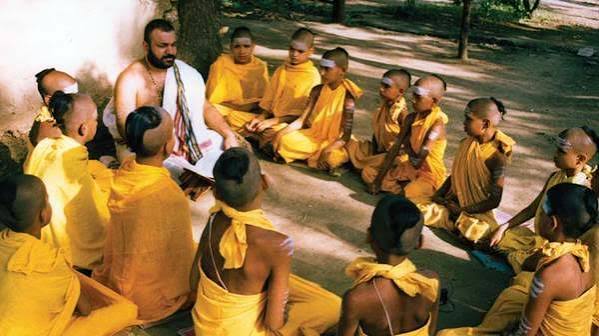
In a Vedic school in a small town in Karnataka, a boy of about eleven is reciting a verse he does not fully understand. Then his teacher says a word, and the boy recites the same verse again — this time pairing each word with the one after it, then reversing the pair, then moving on. Then again, in a different weave. Then again, in a pattern so intricate that a single misplaced syllable collapses the whole structure audibly, the way a wrong note collapses a raga.
He is not memorising. He is running an error-checking algorithm, and the method he is using is roughly three thousand years old. It exists because a civilisation decided, very early, that a particular body of sound had to survive intact — and that paper, bark, stone and human memory were all too unreliable on their own. So they built redundancy into the recitation itself.
That is the thing most worth understanding about Sanskrit — samskrta, meaning refined, polished, put together with care. It is not important mainly because it is old. India has several ancient languages. Sanskrit is important because of what was done with it and in it: the most rigorous grammar produced anywhere before the twentieth century, a transmission system of astonishing fidelity, and a thousand years of philosophy, poetry, mathematics, medicine, drama and law that still sets the vocabulary of Indian thought.
What Sanskrit Actually Is — and What It Is Not
Sanskrit is an Indo-Aryan language with two broad historical layers. Vedic Sanskrit is the older stratum, the language of the Rigveda and the other Vedic texts, with a tonal accent system and a looser, more archaic grammar. Classical Sanskrit is the later, standardised form — conventionally dated from Panini’s grammar onward — and it is the language of the epics, the Puranas, the great plays and poems, and the vast commentarial and scientific literature.
Two confusions are worth clearing first.
Sanskrit is not Devanagari. The script is not the language. Sanskrit was written in Brahmi, then in a whole family of regional scripts — Sharada in Kashmir, Grantha in the Tamil country, Bengali, Odia, Telugu-Kannada, Nandinagari, Modi — and is still written in several of them today. Devanagari became the default printing script for Sanskrit largely in the nineteenth century, through colonial-era presses and then standardised textbooks. A Sanskrit manuscript from Thanjavur and one from Srinagar may be the same text in two completely different alphabets.
And Sanskrit was never the only language in the room. Classical Sanskrit drama operated on an explicit convention: high-status male characters spoke Sanskrit, while women, servants, jesters and many ordinary figures spoke Prakrit — the vernacular Middle Indo-Aryan languages. Shauraseni was given to the heroine and her companions; Maharashtri was favoured for lyrical verse; other Prakrits were assigned to foresters, rogues and regional types. Kalidasa’s plays switch registers constantly. The picture of an India that simply spoke Sanskrit is a modern invention, and the texts themselves disprove it.
How the Vedas Survived Without Writing
The Rigveda was composed and transmitted for centuries before it was written down, and the tradition treated writing as a weaker medium than trained voice. To make that possible, Vedic schools developed a layered system of recitation known as the pathas.
The three natural styles, called prakrti, are:
- Samhita-patha — continuous recitation with the words fused according to sandhi, the euphonic rules that change sounds at word boundaries.
- Pada-patha — word by word, with pauses, which pulls compounds apart into their original components.
- Krama-patha — in overlapping pairs: word one with word two, then word two with word three, and onward, so every junction is spoken twice.
Beyond these sit eight vikrti or complex styles, including jata (words braided forward and backward), shikha, mala, rekha, dhvaja, danda, ratha and ghana. Ghana-patha, which moves through the text in a bell-shaped pattern of repetitions and reversals, is generally reckoned the hardest; a reciter who has mastered it earns the title ghanapathi. Because Vedic word order is not grammatically load-bearing in the way English word order is, reversing words does not destroy meaning — which is precisely what makes the method work as a check.
Layered on top of all this is svara — pitch accent. Vedic recitation distinguishes udatta, anudatta, svarita and the extended dirgha svarita, marked in manuscripts with underlines and small vertical strokes. Accent is not ornament; a shift in pitch can change meaning, and the tradition holds that a mantra’s power lies in its exact sound. So the transmission preserved not only the words but their music.
UNESCO proclaimed the tradition of Vedic chanting a Masterpiece of the Oral and Intangible Heritage of Humanity in November 2008 — recognition of the method, not simply the texts. It is, by any reasonable measure, one of the most successful information-preservation projects in human history.
Panini and the Grammar That Astonished the World
Sometime in the middle of the first millennium BCE, in the northwest of the subcontinent — tradition places him at Shalatura in Gandhara — a grammarian named Panini wrote a description of Sanskrit so complete and so economical that linguists are still arguing about how he did it.
The Ashtadhyayi — the eight chapters — is organised into eight adhyayas of four sections each. Editions count either about 3,959 or about 3,996 sutras, depending on how certain rules are divided. In those few thousand terse lines, Panini generates the phonology, morphology and much of the syntax of an entire language.
What makes it remarkable is not length but method. Panini built a technical metalanguage: a set of abbreviations, markers and conventions for talking about language, together with meta-rules — the paribhasha sutras — governing what happens when two rules conflict. The Shiva Sutras, a fourteen-line list of the sounds of Sanskrit arranged in a particular order, let him define any class of sounds by naming a start point and an end marker, producing compact labels called pratyaharas. Two companion texts, the Dhatupatha (a catalogue of verbal roots) and the Ganapatha (lists of nouns), supply the lexical input the rules operate on.
The result is generative. Feed it a root and a set of conditions and it produces the correct form, including irregulars, by rule rather than by list. Modern linguists have compared it to the Backus–Naur form used to specify programming languages, to Emil Post’s rewriting systems, and — more loosely — to a formal automaton. Leonard Bloomfield called it one of the greatest monuments of human intelligence, and the discipline of descriptive linguistics owes it a real debt, though scholars such as George Cardona caution against overstating its direct influence on figures like Saussure.
Panini was not working alone or from nothing. He cites at least ten predecessors — Apishali, Kashyapa, Shakatayana, Yaska among them — so he was standardising a mature tradition, not inventing a field. After him came Katyayana’s Varttika, a critical commentary, and Patanjali’s Mahabhashya, the great commentary that remains the central interpretive text. Together these three are called the munitraya, the three sages of grammar.
His date is genuinely unsettled, and anyone who gives you a firm one is overreaching. Estimates range from the seventh to the fourth century BCE. Numismatic and epigraphic arguments cluster around the mid-fourth century; linguistic arguments and Panini’s own reference to the word yavanani have been used to push earlier; Cardona argues the evidence rules out anything much later than the early-to-mid fourth century BCE. The honest summary is a range, not a year.
How Sanskrit Changed the Way the World Understands Language
On 2 February 1786, Sir William Jones addressed the Asiatic Society in Calcutta and said something that reorganised a field. Sanskrit, Greek and Latin, he argued, resembled one another in grammar and vocabulary too systematically for coincidence; they must have sprung from a common source, since perished.
That observation is the foundation of comparative philology and of the Indo-European hypothesis — the family tree that links Sanskrit to Greek, Latin, Persian, Russian, German, Irish and English. It is why pitar and matar sit beside pater and mater, why trayas sits beside tres and three, why the Sanskrit dva and the English two are cousins. Sanskrit mattered to this work disproportionately, because its archaic forms and its grammatical self-documentation gave comparatists something closer to a control sample than any other living tradition offered.
Jones was a figure of empire, and the scholarship that followed him was entangled with colonial purposes in ways worth knowing about. But the insight itself was sound, and it came out of an encounter with Indian texts and Indian pandits who taught them.
Sanskrit Beyond India
For most of a millennium, Sanskrit functioned across maritime and mainland Asia roughly as Latin did in medieval Europe: the prestige language of courts, inscriptions, religion and learning, used by people whose mother tongues were entirely unrelated to it.
Khmer kings at Angkor issued inscriptions in Sanskrit verse alongside Old Khmer. Javanese and Balinese courts produced Sanskrit and Sanskritised literature. The scripts travelled with the language: the Pallava script of the Tamil country is the ancestor of the writing systems of Thai, Khmer, Burmese, Javanese and Balinese. The vocabulary stayed even where the language did not — Thai, Khmer, Malay, Indonesian, Tagalog and Sinhala all carry substantial Sanskrit loan layers. Indonesia’s national motto, Bhinneka Tunggal Ika, and the name of its armed forces, derived from Sanskrit, are everyday instances.
Inside India, the inheritance is even more direct. Hindi, Marathi, Bengali, Gujarati, Odia, Assamese, Punjabi, Kashmiri, Nepali and Sinhala descend from the same Indo-Aryan line. Tamil, Telugu, Kannada and Malayalam belong to a separate family, Dravidian, and yet all four have absorbed large Sanskrit vocabularies — Malayalam and Telugu particularly heavily. Which means a word learned once in Sanskrit will often turn up, slightly altered, in half a dozen Indian languages at once.
Is Sanskrit a Dead Language?
This question gets argued badly in both directions, so here are the figures.
In the 2011 Census of India, 24,821 people returned Sanskrit as their mother tongue, out of a population of over 1.2 billion. Counting it as a second or third language brings the total to roughly 3.1 million — about 1.13 million second-language and 1.96 million third-language speakers. The mother-tongue number is volatile across censuses, having moved from 6,106 in 1981 to 49,736 in 1991 and 14,135 in 2001, which suggests the figure tracks how people choose to identify at least as much as household use.
Institutionally it is far from dead. Sanskrit is one of the twenty-two scheduled languages of the Indian Constitution, and it was conferred Classical Language status on 25 November 2005, the second language to receive it after Tamil in 2004. Uttarakhand made it a second official language in 2010 and Himachal Pradesh followed in 2019. There are sixteen or more Sanskrit universities, from Sampurnanand in Varanasi to the Central Sanskrit University in Delhi, and organisations such as Samskrita Bharati run large conversational-Sanskrit teaching programmes.
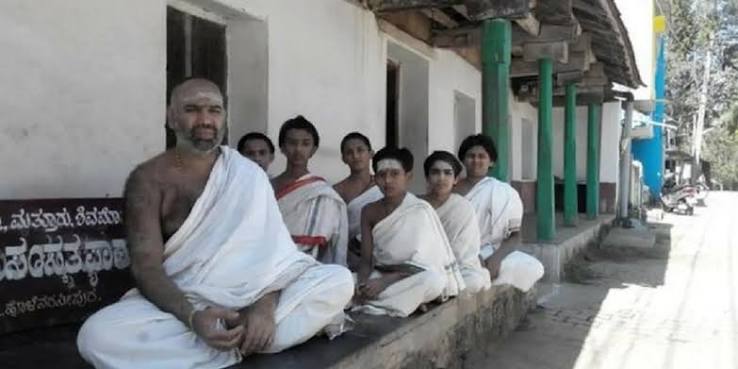
The famous Sanskrit-speaking villages deserve a careful word. Mattur in Karnataka is widely reported as a village where everyone speaks Sanskrit daily, and Sanskrit genuinely is used there to an unusual degree. But reporting has found that very few residents actually return it as mother tongue, and the researcher Patrick McCartney has questioned similar claims about Jhiri in Madhya Pradesh. Something real is happening in these places; it is just smaller and more interesting than the headline.
So the accurate description is neither dead nor ordinarily spoken. Sanskrit is a liturgical, scholarly and literary language with a committed minority of fluent users and a very large number of people who encounter it daily in prayer, ritual, naming and vocabulary without calling it speech.
Two Myths Worth Retiring
Sanskrit has a real claim to greatness and does not need the invented ones, which do active damage when they are repeated and then debunked.
NASA did not declare Sanskrit the best language for computers. The source of this story is a 1985 article by Rick Briggs, Knowledge Representation in Sanskrit and Artificial Intelligence, published in the journal AI Magazine. It is a genuinely interesting paper, arguing that concepts from the Indian grammatical and semantic tradition — particularly the analytic apparatus developed by Sanskrit grammarians and logicians — could be useful for knowledge representation in AI. It does not say Sanskrit is a programming language, does not mention supercomputers, and announces no American project. The widely shared claim that the United States is building sixth- and seventh-generation supercomputers in Sanskrit by stated deadlines has been repeatedly fact-checked and has no basis. Computational linguists working on Sanskrit, including researchers at Indian institutes, have said plainly that it is not directly usable as a programming language.
UNESCO has not declared Sanskrit the world’s best or most scientific language. No such designation exists, and UNESCO does not rank languages. What UNESCO did recognise, in 2008, was the tradition of Vedic chanting as intangible heritage — which is a more specific and genuinely impressive honour than the thing people claim.
The real case for Sanskrit is sitting right there and is much more interesting: an unmatched grammatical tradition, a transmission method of extraordinary fidelity, and a literature of enormous range. That is plenty.
Why Sanskrit Still Matters — Practically
Set aside reverence for a moment. Here is what a modest investment in Sanskrit actually buys.
It unlocks vocabulary at scale. Sanskrit builds words from roots plus prefixes with unusual transparency. Learn that jna means to know and you have a hold on jnana, vijnana, ajnana, prajna and jnani. Learn sthā, to stand, and you have the logic behind sthiti, avastha, pratishtha and sansthan. Fifty roots and a dozen prefixes will do more for your reading of formal Hindi, Marathi, Bengali or Telugu than months of word lists.
It lets you read your own texts. Translation is interpretation, and the devotional translations in widest circulation often flatten technical terms into their nearest English approximation — dharma into duty, karma into fate, maya into illusion — each of which loses most of the argument. You do not need fluency to check a translator. You need enough grammar to see where a choice was made.
It makes ritual intelligible. Most people who recite a mantra daily have never been told what it says. Learning the Gayatri or the opening of the Vishnu Sahasranama as language, not only as sound, tends to change the practice considerably — usually by making it harder to be casual about.
It is unusually well served by free resources. Digital corpora, searchable dictionaries built on Monier-Williams and Apte, online grammar engines, and recorded classes make self-study possible in a way that was not true a generation ago. A term of consistent effort gets a motivated adult to the point of reading simple verse with a dictionary.
And for Indian families abroad, there is a quieter argument. A child who learns a little Sanskrit has a thread back into something enormous — not a nostalgia object, but a working key. It opens the same doors in Chennai and in Chicago, which is more than can be said for most of what we hand down.
Frequently Asked Questions About Sanskrit
Is Sanskrit the oldest language in the world?
No, and the claim is not really well formed. Sanskrit’s oldest layer, the language of the Rigveda, is among the oldest extensively preserved Indo-European material, but Sumerian and Egyptian are attested in writing earlier, and Tamil has its own very ancient independent literary tradition. What is exceptional about Sanskrit is not a first-place finish in age but the continuity, volume and precision of its preservation.
Why is Sanskrit called the language of the gods?
The traditional epithets are devavani and devabhasha, the speech of the gods, and they reflect a theological view in which the Vedic mantras are not composed but heard — shruti — and their sound is itself efficacious. The Shiva Sutras carry a legend that the sounds of the language emerged from Shiva’s drum. These are devotional claims about the status of the language, and they sit alongside, rather than instead of, the historical account of Sanskrit as an Indo-Aryan language with traceable relatives.
Do I need to learn Devanagari to learn Sanskrit?
Not to begin. Sanskrit has been written in many scripts, and a precise Roman transliteration system, IAST, is used in scholarship worldwide. You can start in transliteration. Most learners do eventually move to Devanagari, because that is what most printed editions use and because the script maps onto the sounds very cleanly, but it is a convenience rather than a prerequisite.
Is Sanskrit the mother of all Indian languages?
No. It is the ancestor of the Indo-Aryan languages of the north, west and east — Hindi, Bengali, Marathi, Gujarati, Punjabi, Odia, Assamese, Nepali, Sinhala and others. The four major southern languages, Tamil, Telugu, Kannada and Malayalam, belong to the separate Dravidian family and are not descended from Sanskrit, though they have borrowed extensively from it. Tamil in particular has a deliberately preserved independent classical tradition. Getting this right matters, because the overclaim has a long and unhappy political history.
How long does it take to learn Sanskrit?
With a few hours a week, most adults can read simple shlokas with a dictionary within six months to a year, and work through the Bhagavad Gita with a commentary in two to three years. Sanskrit’s eight noun cases and elaborate verb system make the early grind real, but its regularity means progress compounds — unlike languages where every new word is a new fact, Sanskrit rewards you for understanding the system.
Did NASA really say Sanskrit is the best language for computers?
No. The claim distorts a 1985 paper by Rick Briggs in AI Magazine, which argued that ideas from the Indian grammatical tradition could help with knowledge representation in artificial intelligence. It did not say Sanskrit is a programming language, mentioned no supercomputer project, and was not a NASA announcement. The viral version, including specific future deadlines, has been fact-checked and found baseless.
A Closing Thought
What strikes me most about Sanskrit is not the grammar, impressive as it is. It is the decision behind the grammar — that a body of sound was worth building an entire apparatus to protect, and that the apparatus should be lodged in human beings rather than in objects, because objects burn.
They were right about the objects. Libraries were lost, manuscripts rotted in monsoon damp, temples were razed. And the Rigveda came through, syllable by accented syllable, in the mouths of boys who learned to say it backwards. That is not a fact about linguistics. It is a fact about what a civilisation chose to care about, and how seriously it meant it.
Continue Exploring
- The Meaning of Namaste: What You Are Actually Saying
- Why We Touch Feet: The Meaning of Charan Sparsh in Indian Tradition
- Bhagavad Gita Explained — Chapters and Significance
- Introduction to the Ramayana — Story, Characters and Meaning
- Who Was Swami Vivekananda: A Journey Beyond Religion