
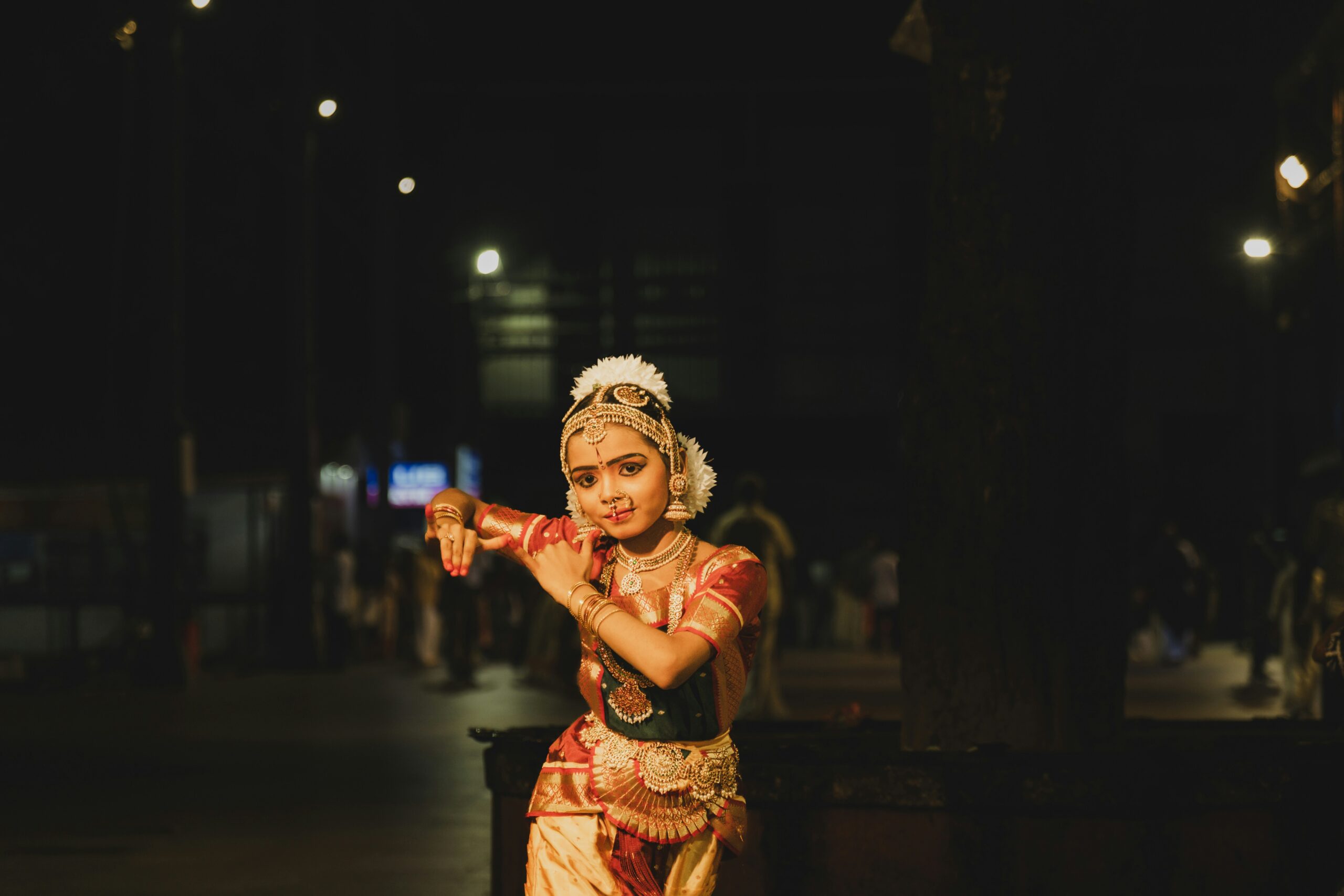
Walk into the Chidambaram temple in Tamil Nadu and look up at the gopuram. Carved into the stone, figure after figure, are dancers — one knee lifted, a hip thrown out, fingers folded into shapes that mean something specific. They are not decoration. They are a manual. The sculptors were working from a list of 108 karanas, the basic units of movement set down in an ancient treatise on performance, and they put that list on the temple wall the way another culture might carve scripture. In the sanctum stands Shiva himself, mid-step, one foot raised, caught in the dance that the tradition says sets the universe going and will one day end it.
That is the thing a newcomer to Indian classical dance usually misses. These forms did not start as entertainment that later acquired a religious veneer. They started inside temples, addressed to deities, and only later moved onto a stage.
Indian classical dance is a devotional art in which the body itself becomes the offering. Developed in temples and codified in the Natya Shastra, its eight recognised forms — Bharatanatyam, Kathak, Kathakali, Kuchipudi, Manipuri, Mohiniyattam, Odissi and Sattriya — use gesture, rhythm and facial expression to tell sacred stories and carry both dancer and audience toward spiritual experience.
This is an art with a complicated history: centuries of temple patronage, a colonial-era collapse that nearly destroyed it, a painful social reckoning, and a twentieth-century revival that saved the dance while changing it. All of that is worth understanding, because it explains why a Bharatanatyam recital in a Chennai auditorium or a New Jersey community hall still opens with a prayer.
Why Dance Counted as Worship in the First Place
Dance was worship because Hindu thought never treated the body as an obstacle to the sacred. A deity in a temple is bathed, dressed, fed, fanned, sung to and put to bed. Devotion is physical. Within that logic, offering a deity your trained movement is no stranger than offering flowers, and arguably more demanding — flowers cost money, but a dance costs years.
There is a second idea underneath it. In several strands of the tradition, creation itself is rhythmic: the cosmos is held in being by pulse and vibration rather than by stillness. A dancer keeping time with her feet is, in that frame, doing something cosmologically serious. The same instinct runs through the sound of chanting a thousand divine names and the beat of a temple drum. Rhythm is not the wrapping around the sacred. It is part of how the sacred works.
The Natya Shastra: Where Indian Dance Gets Its Theory
Indian classical dance has a founding text, and it is extraordinarily old. The Natya Shastra — roughly “the treatise on performance” — is traditionally attributed to the sage Bharata Muni, though scholars generally hold that the real authorship is unknown and may represent several hands or a single later compiler. Most place its first full compilation between about 200 BCE and 200 CE, with wider estimates running from 500 BCE to 500 CE, and some scholars arguing that material continued to be added for centuries afterwards. Its roots are traced to earlier lost works called the Natasutras.
The most studied version runs to roughly 6,000 verses across 36 chapters, though some manuscripts have 37 or 38 and the chapter titles vary. It is not a book of mystical hints. It is a working manual: how to build a theatre, how to hold your hand, which emotional states exist, how music should be tuned, how actors should train.
The text makes an enormous claim about its own subject. It calls drama and dance a fifth Veda — a scripture in its own right, assembled by Brahma from the four existing Vedas: recitation drawn from the Rigveda, music from the Samaveda, mimetic art from the Yajurveda, and the sentiments from the Atharvaveda. Tradition says the original was far longer, some 12,000 verses, and connected to a vast work called the Adibharata for which no evidence survives.
Nritta, nritya and natya: three layers of one art
The tradition splits performance into three. Nritta is pure dance — abstract, fast, rhythmic movement valued for form, speed and pattern, with no story attached. Nritya is expressive dance, slower, using gesture and the body to carry feeling and narrative, usually devotional. Natya is full drama, normally with several performers, although a soloist can play many characters through conventional signals the audience knows how to read.
A single recital typically moves through all three. The pure-rhythm passages wake the senses; the expressive passages do the emotional and theological work. Knowing the difference changes how a performance looks: the long, apparently repetitive footwork sequence is not filler before the story, it is a different mode with its own purpose.
Abhinaya: how a dancer speaks without words
Abhinaya — literally something like “carrying towards” the spectator — is the expressive craft that lets a silent dancer narrate. It works on four fronts: angika, the body, limbs and hand gestures; vachika, the sung word, music and rhythm; aharya, costume, ornament and staging; and sattvika, the performer’s genuine inner state, which the tradition treats as indispensable rather than optional.
The hand gestures are the part audiences notice first. Called mudras or hastas, they form a working vocabulary: a deer, a lotus, a bee, a flame, a refusal, a question. Odissi alone uses sixty-three of them. A dancer can say “Krishna lifted the mountain” with her hands and her face while her feet keep a separate rhythm, and a trained audience will catch it without a word of text.
Rasa: the goal the whole system is built around
Rasa is the aesthetic flavour a performance produces in the person watching — the single most influential idea in Indian aesthetics. The Natya Shastra names eight: the erotic, the comic, the pathetic, the terrible, the furious, the odious, the heroic and the marvellous. Rasa arises from the interaction of causes, visible effects and passing moods, and it is distinguished from bhava, the inner emotional state of the character being portrayed.
Here is the detail that matters for the word “worship.” The text is explicit that entertainment is a by-product. The stated aim of performance is to carry the spectator towards a heightened state and spiritual reflection. A dancer is not primarily displaying skill; she is trying to produce a particular interior condition in a room full of people. That is a liturgical ambition, not a theatrical one.
Shiva as Nataraja: The God Who Dances
No image in Indian art carries this idea more directly than Nataraja, the Lord of Dance. Shiva stands inside a ring of flame, one leg raised, one foot pressing down on a crouching figure, his hair flung outward, a small drum in one hand and fire in another. He is dancing, and the dance is the cosmos: generation, maintenance and dissolution held in one posture.
Shiva is bound into dance theory itself through the tandava, the vigorous, forceful mode of dance the tradition associates with him. The 108 karanas described in the treatise shaped actual sculpture, most famously the composite Tandava imagery at the Nataraja temple at Chidambaram. The relationship runs both ways: the text describes the movements, and the stone fixes them where every visitor and every dancer can see.
It is worth saying that not all of this tradition is Shaiva. Odissi grew up around Vaishnava devotion and the Gita Govinda; Sattriya came out of Assam’s Vaishnava monasteries; Manipuri centres on Krishna and Radha. Kathak has a long history in Mughal courts, has been performed in mosque courtyards, and carries clear Muslim elements. India is not monolithic, and neither is its dance.
The Eight Classical Dance Forms of India
The Sangeet Natak Akademi, India’s national academy for the performing arts, recognises eight classical dance forms. Each is tied to a region, a language of song, a devotional tradition and a distinct body vocabulary.
| Form | Region | Devotional centre of gravity | Distinctive quality |
|---|---|---|---|
| Bharatanatyam | Tamil Nadu | Largely Shaiva, with strong Vaishnava repertoire | Geometric lines, deep half-sit, sharp rhythmic precision |
| Kathak | Uttar Pradesh | Krishna devotion, alongside a long court tradition | Spins, intricate footwork, storytelling in spoken rhythm |
| Kathakali | Kerala | Epic and Puranic drama | Elaborate makeup and costume, highly codified eye and face work |
| Kuchipudi | Andhra Pradesh and Telangana | Vaishnava, rooted in dance-drama | Fluid movement, speech and song by the dancer, the famous plate dance |
| Manipuri | Manipur | Radha and Krishna | Soft, circular, understated; lifted rather than struck rhythm |
| Mohiniyattam | Kerala | Vishnu and Devi | Swaying torso, gentle lyricism, solo feminine grace |
| Odissi | Odisha | Jagannath worship and the Gita Govinda | The tribhanga S-curve and the squared chauka stance |
| Sattriya | Assam | Vaishnava monastic tradition of the sattras | Developed and still performed within monasteries |
You will sometimes see nine or ten forms listed instead of eight, and this is a genuine and unresolved inconsistency rather than an error on anyone’s part. Sources differ over whether Chhau, and sometimes Gaudiya Nritya, belong on the national list, and Indian government listings have not always matched the Akademi’s. Scholars have argued for including Yakshagana and Bhagavata Mela as well. If you see a different count, that is why — the boundary between “classical” and “traditional” is a matter of ongoing debate, not settled fact.
Odissi: a worked example of the temple connection
Odissi makes the temple link unusually visible. Its characteristic tribhanga — the triple bend, where head, torso and hips deflect in opposite directions into a long S-curve — is not an invention of modern choreographers. The same posture appears in Odisha’s temple reliefs, and dancers and musicians are carved in the Manchapuri cave at Udayagiri, dated to around the first or second century BCE. Its other signature stance, chauka, is a squared squat with the weight even on both feet and the spine straight. Where most classical forms work with four basic foot movements, Odissi uses six, and it carries a vocabulary of sixty-three hand gestures.
The Temple Dancers, and an Honest Account of What Happened
For centuries, the women who performed these dances inside temples were a distinct community. In Odisha they were the maharis, attached to the Jagannath temple at Puri, dancing pure dance and expressive sequences to the deity, and later concentrating on Jayadeva’s Gita Govinda. In the Tamil country the corresponding community were the devadasis, and the dance they performed was called sadir. These were trained professional artists with hereditary knowledge, temple duties and, in many periods, considerable standing.
What happened next was a collapse. In Odisha, temple destruction from the twelfth century onwards damaged the dance halls themselves; the invasion of 1360–61 is usually cited for the damage at Puri. Under colonial rule, administrators and missionaries attacked temple dance as immoral. An organised anti-dance campaign began in 1892, and in 1910 the colonial government banned dancing in temples. Dancers lost their livelihoods and their reputations in the same stroke.
Then came legal abolition. In the Madras Presidency, the reformer Muthulakshmi Reddi proposed a Devadasi Abolition Bill as early as 1930; it finally became the Madras Devadasis (Prevention of Dedication) Act on 9 October 1947, weeks after independence. The Act gave devadasis the legal right to marry and made it illegal to dedicate girls to temples. Stricter legislation followed on 14 August 1956.
This history should not be told simply. The dedication system had become entangled with real exploitation of girls and women, and the reformers who fought it were not inventing a problem. At the same time, a number of devadasis themselves objected to the legislation, insisting they were sophisticated, learned artists rather than what reformers described, and that abolition stripped them of an inheritance. Both of those things appear to have been true at once. Many hereditary dancers ended their lives poor and unrecognised while the art they had carried was taken up by others.
The Twentieth-Century Revival
The dance survived because a small number of people in the 1930s, 40s and 50s decided it had to.
In the south, Rukmini Devi Arundale (29 February 1904 – 24 February 1986) saw sadir performed at the Madras Music Academy’s annual conference in 1933, learned it from Mylapore Gowri Ammal and then, with the help of the lawyer and campaigner E. Krishna Iyer, from Pandanallur Meenakshi Sundaram Pillai. She performed publicly in 1935, at a time when the dance was widely regarded as vulgar and she faced real protest for it, and in January 1936 she founded Kalakshetra at Adyar in Chennai on a gurukul model. She and Krishna Iyer are credited with reshaping the Pandanallur style and with the renaming that gave us the word Bharatanatyam. She also introduced stage lighting and set design, costumes and jewellery modelled on temple sculpture, dance-dramas drawn from the Ramayana and the Gita Govinda, and male dancers as performers in their own right.
In Odisha, four gurus rebuilt Odissi in the late 1940s and early 1950s: Kelucharan Mohapatra, Pankaj Charan Das, Deba Prasad Das and Raghunath Dutta. Laxmipriya Mohapatra’s 1948 performance at the Annapurna Theatre in Cuttack is remembered as the first classical performance of the revival, and the writer Kavichandra Kalicharan Pattanayak is credited with giving the form the name “Odissi.” Guru Mayadhar Raut’s work from 1955 was central to its recognition as classical, and Sanjukta Panigrahi carried it to international audiences.
The revival was a rescue and an edit at the same time. Rukmini Devi deliberately removed much of the erotic sringara content associated with the devadasi repertoire, making the dance acceptable to a middle-class public that had been taught to despise it. Something was saved. Something was also lost, and serious dancers and scholars continue to argue about the balance.
Why This Still Matters Today
Classical dance is now one of the most durable ways Indian families outside India hand on tradition. In Edison and Houston, in Leicester and Melbourne, in Toronto and Singapore, children who speak English at school learn the mudra for a lotus and the Tamil or Sanskrit words of a devotional song they will understand slowly, over years. The arangetram or debut recital has become a diaspora rite of passage. Whatever else it is, it is a working transmission system for language, scripture and theology, delivered through the body of a twelve-year-old.
There is something more demanding in it too. The Natya Shastra’s insistence on sattvika abhinaya — that the performer’s real inner state is part of the technique, not a nicety — is an unusual claim for any performing tradition to make. It says you cannot fake the inside and succeed on the outside. Dancers who train for decades tend to describe exactly that: the point at which the form stops being a performance and starts being an offering is the point at which it finally works. That standard applies well beyond dance.
If you ever attend a recital, watch what happens before the dancing. The dancer will usually touch the floor and then her own eyes, asking pardon of the earth she is about to strike with her feet, and salute the space. Then comes the mangalacharana, an invocation, often to Ganesha. The stage is being treated as a temple. Everything after that follows from that first gesture — the same instinct that makes a visitor touch an elder’s feet before beginning anything that matters.
Frequently Asked Questions
How many classical dance forms does India have?
The Sangeet Natak Akademi recognises eight: Bharatanatyam, Kathak, Kathakali, Kuchipudi, Manipuri, Mohiniyattam, Odissi and Sattriya. You will often see nine or ten quoted instead, because some government listings and many scholars add Chhau, and sometimes Gaudiya Nritya, Yakshagana or Bhagavata Mela. The count genuinely differs between sources, so it is not a question with one settled answer.
Is Indian classical dance a religious practice or a performing art?
Historically it was both, and the sharp distinction between them is a modern one. These forms developed as temple offerings addressed to deities, with repertoire drawn from scripture and devotional poetry, and the Natya Shastra states that the aim of performance is spiritual elevation rather than entertainment. Today the same dances are performed in concert halls by dancers of every background and belief, and many treat them primarily as art. Most classical repertoire remains devotional in content either way.
Who was Bharata Muni and did he really write the Natya Shastra?
Tradition attributes the Natya Shastra to the sage Bharata Muni. Scholars treat the actual authorship as unknown. Some argue the surviving text reflects a single compiler, others that multiple authors contributed across centuries, and there is evidence of later additions and interpolation. The name Bharata is best understood as the traditional authority attached to the text rather than a documented historical author.
What is the difference between nritta and nritya?
Nritta is pure dance: abstract, rhythmic, often fast, concerned with line, pattern and timing, and carrying no narrative. Nritya is expressive dance, usually slower, that uses hand gestures, body movement and facial expression to convey emotion and story. A full recital normally alternates between them, and natya — complete drama — is the third category in the same scheme.
Why is Shiva called Nataraja, the Lord of Dance?
Shiva is depicted as Nataraja because the tradition associates him with the tandava, the forceful mode of dance, and reads his dance as the rhythm by which the universe is created, sustained and dissolved. The Natya Shastra connects him to dance theory directly, and its 108 karanas of movement influenced temple sculpture, most famously at the Nataraja temple at Chidambaram in Tamil Nadu.
What happened to the devadasis and the maharis?
Hereditary temple dancers were pushed out of their role by a combination of colonial-era hostility to temple dance, an organised anti-dance campaign from 1892, a 1910 ban on dancing in temples, and finally abolition of the dedication system — the Madras Devadasis (Prevention of Dedication) Act of 9 October 1947, followed by stricter legislation in 1956. Reformers were responding to real exploitation of girls, while many dancers objected that they were learned artists being stripped of an inheritance. Both concerns had substance, and the hereditary communities largely lost their position while the art itself was taken up by others.
Do you have to be Hindu to learn Indian classical dance?
No. These forms are taught and performed by people of every religion and nationality, and have been for decades — Kathak in particular has a long history of Muslim practitioners and patrons, and has been performed in mosque courtyards as well as temples. Teachers generally ask for respect towards the material rather than belief in it. What the tradition does ask of everyone, believer or not, is that the devotional content be treated as meaning something rather than as costume.
There is a moment in most recitals when a dancer who has been keeping furious time suddenly stops, and holds one shape, and the room goes quiet with her. Nothing is being narrated. Nothing is being explained. The tradition that produced that moment thought very carefully about what it was for, and decided it was not for applause. Two thousand years later, in temple courtyards and suburban auditoriums, people are still turning up to find out whether it works.
Continue Exploring
- Who Is Lord Shiva? The Story, Symbolism and Worship of Mahadeva
- Why We Touch Feet: The Meaning of Charan Sparsh
- Tilak and Bindi: Why Hindus Mark the Forehead
- Female Saints of India: Seven Women Who Changed Indian Devotion
- Indian Wedding Rituals Explained: The Meaning Behind Every Step