
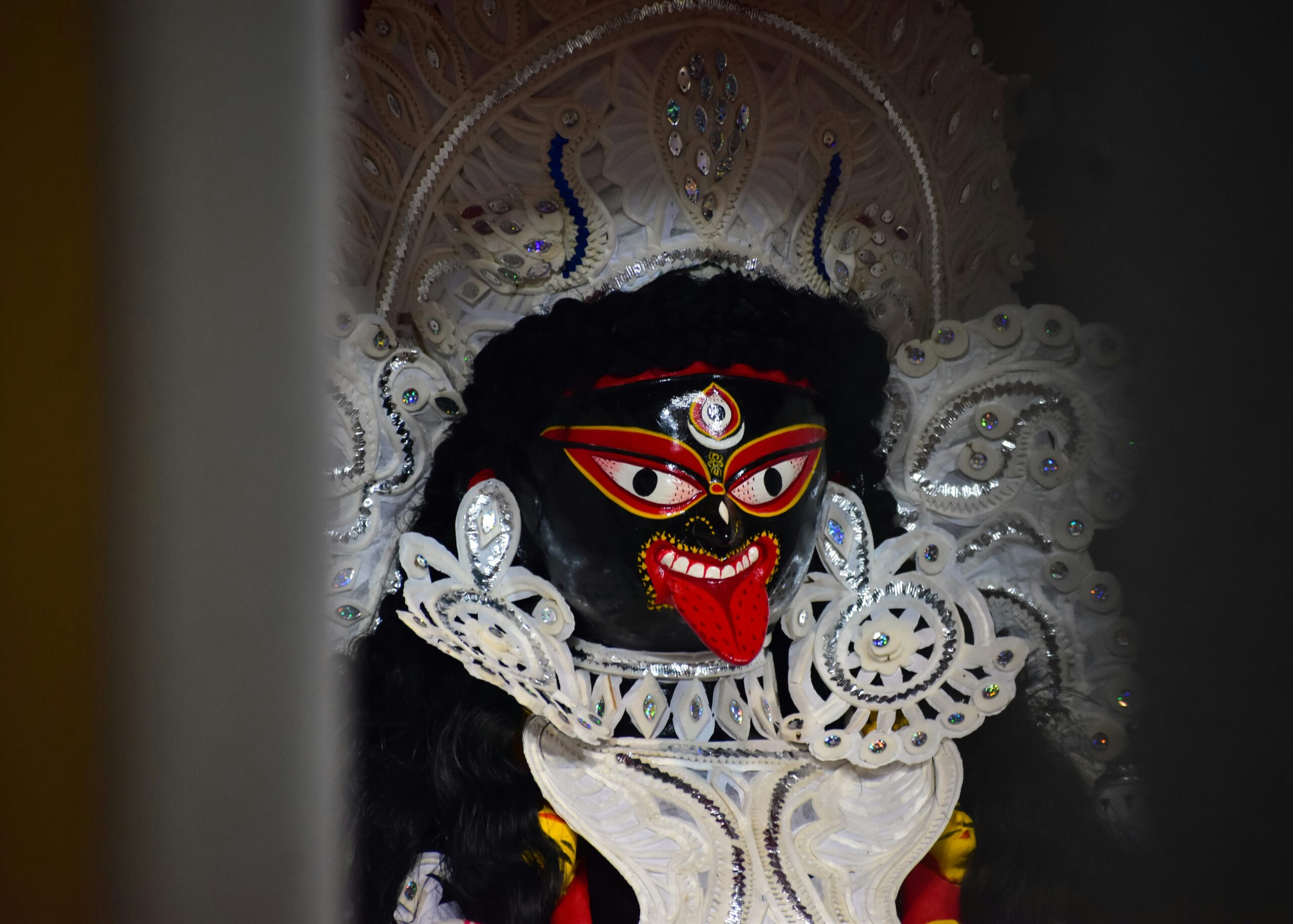
Almost every deity in the Hindu world is worshipped in daylight. The bell rings in the morning, the lamp is lit at dusk, the temple doors open with the sun. Kali is the exception. Her great annual worship happens on amavasya — the new moon, the darkest night of the month — and it happens around midnight, in the hour the tradition calls nishita, when the night is at its deepest. The clay image is made, worshipped in the dark, and immersed. Families across Bengal, Odisha, Assam, Bihar and Tripura stay awake for it.
That one fact tells you more than any definition could. Here is a goddess approached at the hour most traditions avoid, in the form most traditions soften. She stands on a corpse. She wears severed heads. Her tongue hangs out. And millions of people call her, without irony, Ma — Mother.
Understanding how those things fit together is the whole work of understanding Kali. The tradition that produced her has thought about her for fifteen hundred years and has never found her simple.
What Does the Name Kali Mean?
Here is the first thing most articles get wrong. You will read everywhere that Kali means “time,” and that she is therefore the goddess of time and its devouring power. It is a beautiful idea, and it is also a different word.
Sanskrit has two relevant terms. Kala can mean “time.” Kala as an adjective means “black, dark-coloured.” Kali (काली) is the feminine of the second — the dark one. Wendy Doniger, writing the Britannica entry on her, glosses the name as “She Who Is Black” or “She Who Is Death.” The link to time is what linguists call a popular etymology: a connection people have made because it is meaningful, not because the grammar requires it. The theological version — kalah shivah, tasya patniti kali, “Shiva is Kala, therefore his consort is Kali” — comes from a Sanskrit lexicon of the nineteenth century. It is late, not Vedic.
And here is the twist. When a Tantric text does take up the time connection, it inverts it. The Mahanirvana Tantra (4.30–32) says that at the dissolution of all things it is Kala who devours everything — and then, addressing her: “since Thou devourest Mahakala Himself, it is Thou who art the Supreme Primordial Kalika.” She is not the goddess of time. She is what remains when time itself has been eaten. That is the basis of the Bengali name Adya Shakti, the primordial power.
One more clarification, because the confusion is constant: Kali the goddess and Kali the demon of the Kali Yuga are not the same name. The goddess is काली, both vowels long, grammatically feminine. The age is named from कलि, both vowels short, masculine — a word whose older senses include the losing throw of the dice. Different words, different roots, no relationship.
Where Kali Comes From
You will sometimes read that Kali appears in the Rigveda. The word does, twice, at 1.112.15 and 10.39.8 — but not as a goddess. In both verses Kali is the name of a male sage whom the Ashvins protected and rejuvenated; Sayana, the great fourteenth-century commentator, says so plainly. No serious scholar places the goddess in the Rigveda.
What the oldest layers give us instead is a thread of imagery. The Mundaka Upanishad (1.2.4) lists the seven flickering tongues of Agni, the fire that consumes the oblation; the first is named Kali. Scholars have long noticed how naturally the flaming tongue of the sacrificial fire becomes, centuries later, the lolling tongue of a dark goddess who drinks what is offered. That is an argument about imagery rather than a scriptural identification, but it is the most elegant genealogy anyone has proposed. And in the Mahabharata, in the Sauptika Parva, warriors on the night of slaughter see a terrifying female figure with a blood-red mouth and blood-red eyes — but the text calls her Kalaratri, “the Night of Death,” and uses kali as a description rather than an established name. An antecedent, not an arrival.
Her real arrival is the Devi Mahatmya — chapters 81 to 93 of the Markandeya Purana, seven hundred verses in thirteen chapters, generally dated between 400 and 600 CE. We know it cannot be later than 608 CE, because an inscription of that year at Dadhimati Mata quotes it.
In chapter 7 the goddess Ambika faces the demon generals Chanda and Munda. Her face turns dark as ink with anger — and then, “out from the surface of her forehead, fierce with frown, issued suddenly Kali of terrible countenance” (7.6). She carries a skull-topped staff, wears a garland of human heads, is clothed in a leopard skin, and is gaunt to the bone. Her mouth gapes, her tongue lolls, her sunken eyes are red, and her roar fills every direction (7.7–7.8). She takes Chanda by the hair and strikes off his head. Because she came holding Chanda and Munda, the goddess names her Chamunda (7.25–27; numbering varies between editions).
Note what has happened. Kali is not born. She comes out of another goddess, at the moment that goddess’s anger exceeds what her own face can hold. That structure recurs: the Shiva Purana has Parvati shed her dark outer sheath to become the fair Kaushiki, and the discarded sheath becomes Kali. She is, in these tellings, the part that was set aside.
Raktabija: The Story Everyone Half-Remembers
The most famous Kali episode is Devi Mahatmya chapter 8, and it is worth getting right, because the popular version has an ending the text does not contain.
Raktabija — “blood-seed” — has a gift that makes him unkillable. Every drop of blood that falls from him to the ground becomes another demon of his own size, fully armed (8.41, 8.44). Then Chandika laughs and gives an order: “O Chamunda, open out your mouth wide… catch the drops of blood that fall when my weapons strike him” (8.53–54). And so, at verse 57: “Then Kali drank Raktabija’s blood with her mouth.” The clones cannot form because the blood never reaches the earth. Drained, “stricken with a multitude of weapons and bloodless,” the demon falls.
Two precisions. The killing blow is delivered by the Devi, not by Kali; Kali’s work is the drinking. And more importantly: there is no Shiva in this chapter. The story in which Kali becomes drunk on blood, begins a dance that will shatter the world, and is stopped only when Shiva lies down beneath her feet is real, old and deeply loved — but it is a later Puranic and devotional layer, not the Devi Mahatmya. Some versions have Shiva lying down not to stop her but to seek her grace. Read it as the tradition’s own commentary on its most difficult image, not as the scriptural account of the battle.
Reading the Form
Kali’s image is a vocabulary, and the Shakta commentators are explicit about most of it.
The arms. In the standard Dakshina Kali form the two left hands hold a khadga (sword) and a freshly severed head; the two right hands are empty, raised in abhaya mudra (do not be afraid) and varada mudra (receive what you need). That is the whole theology in one gesture — the instruments of severance on one side, the hands of reassurance on the other, in the same body at the same moment. The sword is standardly read as discriminating knowledge and the head as the ego it cuts away. The meditation verse opening the Devi Mahatmya describes Mahakali with ten faces, ten legs and ten arms, “luminous like a blue jewel.” Other Tantric texts give a sixteen-armed Bhadrakali and a Guhyakali with fifty-four arms — four and ten are the common forms, not the only ones.
The garland of heads — the mundamala. The Devi Mahatmya (7.7) says heads, not skulls, a distinction popular accounts usually collapse. The number is most often fifty, and the reading argued at length by the scholar David Kinsley is that the fifty are the letters of the Sanskrit alphabet, making Kali shabda Brahman — ultimate reality as sound, the mother of language and mantra. You will also see fifty-one and fifty-two, matching different counts of the syllabary, and 108, which is a generically auspicious number with no alphabet logic behind it.
The colour. Her name says black; the Devi Mahatmya’s meditation verse says blue; the Kalika Purana gives her “a soothing dark complexion” and a blue lotus. This is less a contradiction than a problem of translation — Sanskrit colour words like krishna, nila and shyama cover a range English splits into black, blue and dark, and as the art historian Cristin McKnight Sethi has pointed out, we do not know with confidence what krishna meant to early painters. In Bengali devotion she is simply Shyama, the dark one.
The nudity. She is digambara, sky-clad. Shakta commentary reads this as her being beyond maya, the veil of appearances, and therefore nirguna — without attributes. She wears nothing because there is nothing outside her to put on.
The tongue. Here the common claim is backwards. You will read that the protruding tongue is a late Bengali invention representing Kali biting her tongue in shame at having stepped on her husband. The second half of that is late and regional. The first half is false. The lolling tongue is in Devi Mahatmya 7.8, in the sixth century, long before Bengal’s Kali devotion existed, and there it marks ferocity and blood-drinking. What is late is the explanation: the reading of the tongue as lajja, embarrassment, is documented by ethnographers as the prevalent view among Odia Hindus and a common one in Bengal, reinforced by a Bengali legend about the image’s origin recorded only in the twentieth century. A third, Shakta reading makes the red tongue the rajasic nature, bitten and held in check by the white sattvic teeth. Several readings; one very old image.
The vahana is genuinely unsettled: some sources give a lion, some a jackal, and the Kalika Purana a kabandha, a headless living trunk. Anyone who states Kali’s mount flatly has picked one source and ignored the rest.
Kali Standing on Shiva
The image that stops newcomers is the one where she stands on the body of her own husband. It is old in Tantric literature: the Karpuradi Stotra, which Kinsley dates to around the tenth century, describes her standing on the breast of corpse-like Shiva in the cremation ground. The distinction between the two main forms turns on a foot — in Dakshina Kali the right foot rests on his chest, in Vama Kali the left, and the latter is worshipped mainly by renunciates rather than householders.
The doctrinal reading is consistent across Tantric and Shakta sources: Shiva is consciousness, Kali is energy, and consciousness without energy cannot act. The cleanest scriptural statement is the first verse of the Saundarya Lahari, traditionally attributed to Adi Shankaracharya — Shiva can create only when joined with Shakti; without her he cannot even stir. You will often see this in the folk form, “Shiva without Shakti is shava, a corpse.” That is a genuine Tantric aphorism and a good pun, but a pun is all it is: shiva and shava are unrelated words, and the verse stating the doctrine does not contain the second.
So the image is not a wife humiliating a husband, and not a goddess out of control. It is a diagram. The inert principle lies still; the active principle stands on it and moves.
Her Forms, and Her Place Among the Goddesses
Kali is a family of figures rather than one. Banglapedia’s list runs Dakshina, Siddha, Guhya, Bhadra, Shmashana, Raksha and Mahakali, with Dakshina Kalika the most widely worshipped. Shmashana Kali belongs to the cremation ground; Raksha Kali is invoked against epidemic and drought, a reminder that in village religion she has long been the one you call when something is actually threatening you; Bhadrakali is explicitly the propitious aspect and dominates in Kerala. She is also the first of the Dasha Mahavidya, the ten great wisdom goddesses, though those lists vary between texts.
Her relationship to Durga depends on which text you read, and the tradition holds several positions at once. In the Devi Mahatmya she comes out of Ambika’s forehead and is later reabsorbed — an aspect. In the Puranas she is Parvati’s discarded darkness. In Shakta theology she is Adya Shakti and the others are her expressions. A reader who holds these loosely understands the tradition better than one who tries to rank them.
Where Kali Is Worshipped
Kalighat, Kolkata gave the city its name. According to the Ministry of Tourism the present structure was completed around 1809, under the patronage of the Sabarna Roy Chowdhury family. The shrine is older than the building — the site appears in the fifteenth-century Mansar Bhasan and in seventeenth-century Bengali poetry — so be careful with claims that the temple itself is two thousand years old. Legend attaches it to the Shakti Peetha tradition: the toe of Sati’s right foot is said to have fallen here. The icon is unusual, and the official description is worth quoting exactly: sandstone, with three eyes, four hands, and a protruding tongue made of gold. (The gold is the tongue; accounts of golden hands are not supported.) Timings are given as 5:00 AM–2:00 PM and 5:00 PM–10:30 PM. I could find no officially published dress code, so treat what circulates online as custom rather than rule. One lovely local detail: on Kali Puja night at Kalighat, she is worshipped as Lakshmi.
Dakshineswar is the best-documented of the great Kali temples, because the temple publishes its own records. Rani Rashmoni bought the land on 6 September 1847; the images were installed on 31 May 1855. The deity is Bhavatarini, “she who liberates her devotees from the ocean of existence.” It is a nine-spired navaratna structure in the Bengal style, with twelve identical Shiva temples along the riverfront; the image shows Kali standing on a supine Shiva on a silver thousand-petalled lotus. Official darshan timings are 6:30 AM–12:30 PM and 3:30 PM–7:30 PM — and the temple notes its trustees may change these, so confirm before travelling.
In Kerala she is Bhadrakali or Bhagavathy, held at the Kodungallur Sree Kurumba Bhagavathy Temple in her fierce form, facing north with eight hands, carrying the head of the demon Darikan. Her ritual theatre, Mudiyettu, was inscribed on UNESCO’s Representative List of Intangible Cultural Heritage in 2010: performers purify themselves by fasting, then draw an enormous image of the goddess on the temple floor in coloured powders — the kalam — through which her presence is invoked.
Three corrections, because these errors are everywhere. Kamakhya in Guwahati is not a Kali temple — Kamakhya is the presiding goddess, the sanctum holds no image but a yoni-shaped rock kept wet by a spring, and Kali is one of the ten Mahavidyas with a separate shrine on the hill. Tarapith is a Tara temple, Tara being the second Mahavidya — related to Kali, not identical with her. And Munneswaram in Sri Lanka is a Shiva temple with a famous, separate Kali shrine inside the complex.
Kali Puja: The Night, and the 2026 Date
The main annual worship is Kali Puja, also called Shyama Puja or Dipanwita Kali Puja, held on the new moon of Kartik. In 2026 it falls on Sunday, 8 November — the same night as Diwali.
Two things about that are routinely garbled. First, Kali Puja and Diwali do not always coincide. They are dated by different rules: Kali Puja takes the day on which the new moon prevails at midnight, the nishita window, while Lakshmi Puja takes the day on which it prevails at pradosha, dusk. In some years those fall on different days and Kali Puja lands a day earlier. In 2026 they align.
Second, and almost universally misreported: it is not true that Bengal celebrates Kali Puja and Lakshmi Puja on the same night. Bengal, Odisha and Assam do their principal Lakshmi worship at Kojagari Purnima, the full moon of Ashvin, roughly a fortnight before Diwali. On Kartik new moon those regions worship Kali instead. That is why a Bengali household’s autumn looks so different from a Gujarati one’s.
A necessary word on timings. Any nishita or muhurta window you see printed has been calculated for one specific city — usually Ujjain — and it does not travel. The midnight window in Kolkata is not the window in Guwahati, and neither is the window in London, Toronto, New Jersey or Sydney. If you are observing Kali Puja outside India, check a panchang set to your own city or ask the temple you attend. Printing one national time for a midnight rite is simply bad arithmetic.
There are other Kali pujas through the year — Ratanti in the dark fortnight of Magh, and Phalaharini in Jyaishtha. The Bengali form of Dakshina Kali worship is reputedly the work of Krishnananda Agamavagisha, placed in the fifteenth or sixteenth century and credited with softening the rite into something domestic — an attribution that is traditional rather than demonstrated. Its eighteenth-century spread is credited chiefly to Raja Krishnachandra Roy of Nadia (1710–1783).
One distinction matters for anyone attending: animal sacrifice is part of Kali Puja in the Tantric tradition, while homes and pandals following the Brahmanical, non-Tantric style do not sacrifice animals. Both are real; they are not the same ritual.
Mantras: What Is Sung Freely, and What Comes From a Teacher
I want to be straightforward here, because much of what circulates online is not.
Kali’s seed syllable is Krim (क्रीं). The Karpuradi Stotra‘s commentator calls it a mantraraja, a king among mantras. There is also a twenty-two-syllable Vidyarajni, “queen of vidyas,” which Sir John Woodroffe called the greatest of Dakshina Kalika’s mantras, and the Mantra Mahodadhi grades Kali mantras from one syllable to twenty-two.
Graded, form-specific mantras tied to particular yantras and particular practice regimes are precisely what Shakta and Tantric lineages transmit through diksha, initiation from a teacher. The texts are explicit about fitness and concealment — the Karpuradi Stotra‘s own preface says the meaning of its symbols “is not known to any but the Sadguru.” So I am not going to hand you Krim and tell you to chant it ten thousand times. In most lineages that mantra comes from a person, not an article.
What is sung freely and publicly, and printed in every Bengali devotional songbook: the Adya Stotram, a twenty-verse hymn framed as a dialogue between Brahma and Narada; the Shyama Sangeet repertoire of devotional songs; and the public recitation of the Devi Mahatmya itself. If you want somewhere to begin, begin there. It is the tradition’s own front door.
The Poets Who Made Her a Mother
Kali’s transformation from battlefield apparition into the Mother of Bengali devotion happened substantially in song. Ramprasad Sen is the hinge. His dates are genuinely unsettled — estimates for his birth run to about 1718 or 1723, his death to around 1775 or 1781, and a legal document of 1794 bearing his signature complicates both. The achievement is not in doubt: he took the Shakta song tradition, blended folk melody with classical and kirtan styles, and addressed the most fearsome image in the Hindu repertoire with complete intimacy — arguing with her, scolding her, pleading, teasing. The genre he shaped was carried on by Kamalakanta Bhattacharya (c. 1772–1821) and is still sung.
Ramakrishna Paramahamsa (18 February 1836 – 16 August 1886) is the figure through whom most of the modern world met her. He served at Dakshineswar from the mid-1850s and said his education began at the hands of the goddess, from whom he learned that all deities are one; in 1861 the woman ascetic known as the Bhairavi Brahmani initiated him into Tantra. He was blunt about the difference between the image and what it pointed to: “I do not worship Kali made of clay and straw… My Kali is infinite, all-pervading, and consciousness itself.”
Swami Vivekananda wrote the poem “Kali the Mother” on 24 September 1898, on a houseboat on Dal Lake in Srinagar, in what Sister Nivedita called a fever of inspiration. It begins, “The stars are blotted out.” It is not a comfortable poem, and was not meant to be.
Why This Matters Today
One correction first, because it still shapes how Kali is seen. In the 1830s a British officer, William Sleeman, built a career on the claim that India was riddled with a secret hereditary brotherhood of ritual stranglers killing in the name of a goddess. The campaign against “thuggee” produced thousands of convictions and helped lay the groundwork for the Criminal Tribes Act of 1871. Modern historians have taken the archive apart, and the key finding is sharp: the informants’ own testimony mostly named Bhavani, not Kali — and the scholar Cynthia Ann Humes found that even Bhavani came up largely in answer to Sleeman’s leading questions. Kali “appears only in Sleeman’s own comments.” Scholars differ on how much real banditry lay underneath, but the “Kali death cult” of Victorian imagination is substantially an artefact of one man’s framing. When you see Kali used as shorthand for bloodthirst in a film or a novel, that is where the shorthand comes from.
So what is she actually for?
The most useful thing about Kali is that she is the tradition’s refusal to make the divine polite. There is a kind of religiosity that can only handle the parts of life that are already pleasant, and leaves people alone with everything else — illness, rage, grief, the death of those they love, the plain fact of their own ending. Kali’s devotees do not have that problem. The goddess is already standing in the cremation ground; there is nowhere you can go that is outside her.
And look again at what her hands are doing. Two hold the sword and the head; two say do not be afraid and take what you need. The tradition did not resolve that tension; it built it into the icon and left it there. The practical reading, the one Ramprasad’s songs keep circling, is that destruction and care are not opposites, and that whatever cuts away is not therefore hostile to you. If you have ever had to end something you loved — a job, a relationship, a version of yourself — in order to keep living, you have some purchase on what the image is about.
She is also, consistently, the goddess who receives what is rejected: born of what another goddess set aside, living where bodies are burned. For many of her devotees that is not an accident of iconography. It is the entire point.
Frequently Asked Questions
Is Goddess Kali good or evil?
Good, in the tradition’s own terms, and the question slightly misreads the categories. The Mahanirvana Tantra (4.34) calls her Creatrix, Protectress and Destructress together. Her right hands grant fearlessness and boons. In Tamil Nadu and Kerala she is widely a benevolent mother goddess, and Bhadrakali means the auspicious Kali. Her fierceness is directed at what threatens her devotees, not at them.
Why does Kali stand on Lord Shiva?
The doctrinal reading is that Shiva is consciousness and Kali is energy, and consciousness cannot act without energy — the position stated in the first verse of the Saundarya Lahari. The narrative explanation, that Shiva lay down to absorb her world-shattering dance, is a devotional layer rather than scripture: it is not in the Devi Mahatmya. Both are worth knowing; only the first is doctrine.
Why is Kali’s tongue sticking out?
In the oldest source, Devi Mahatmya 7.8, the lolling tongue marks ferocity and blood-drinking — a sixth-century feature, not a Bengali addition. The familiar explanation that she is biting her tongue in shame at having stepped on her husband is a much later regional gloss, documented mainly in Odisha and Bengal.
Are Kali and Durga the same goddess?
It depends on the text, and the tradition holds more than one position. In the Devi Mahatmya, Kali emerges from Ambika’s forehead and is later reabsorbed — an aspect of the greater goddess. In several Puranas she is Parvati’s shed darkness. In Shakta theology she is Adya Shakti, of which other goddesses are expressions. Closely related; not simply interchangeable.
When is Kali Puja in 2026, and what time should it be done?
Kali Puja 2026 falls on Sunday, 8 November, the same night as Diwali, on the new moon of Kartik. The worship is traditionally done around midnight, in the nishita window. There is no single correct clock time: nishita is calculated for a specific location, so check a panchang set to your own city. The figures circulating online are usually computed for Ujjain and will not be right for Kolkata, let alone London or New Jersey.
Can anyone chant Kali’s mantras?
Devotional hymns and songs — the Adya Stotram, the Shyama Sangeet repertoire, the public recitation of the Devi Mahatmya — are sung freely and openly, and anyone may take them up. The bija mantras, including Krim and the twenty-two-syllable Vidyarajni, belong to Tantric and Shakta lineages that transmit them through initiation, and the texts themselves are explicit about fitness and concealment. Practice varies between lineages, and this is a tradition-internal norm rather than a universal rule — but it is the tradition’s own norm, and worth respecting.
A Closing Thought
There is a moment in the Devi Mahatmya, after the blood is drunk and the demon has fallen, where the text simply moves on. No one apologises for Kali; no one explains her away. She did what the situation required, in the only form that could have done it, and the hymn continues.
It would have been easy for a tradition to lose her — to let the frightening image soften into something more marketable, as so much religious imagery does. Hinduism did not. It kept the sword and the heads and the cremation ground, and then did something braver: it taught its children to call that figure Mother.
That is the inheritance. Not a goddess who promises that nothing will be taken from you, but one who is already standing in the place where things are taken — two hands full, and two hands open.
Continue Exploring
- Who Is Goddess Durga? — the goddess from whose forehead Kali emerges, and our fullest account of the Devi Mahatmya.
- Who Is Lord Shiva? — for the other half of the image Kali stands on.
- Durga and Mahishasura: The Story Behind the Battle — the central episode of the Devi Mahatmya, told in full.
- The Nine Forms of Durga: Navadurga Explained — including Kalaratri, the form closest to Kali.
- The Significance of Diwali — the festival Kali Puja shares its night with in 2026.
- Who Is Goddess Lakshmi? — the other great autumn goddess, and why Bengal worships her a fortnight earlier.