
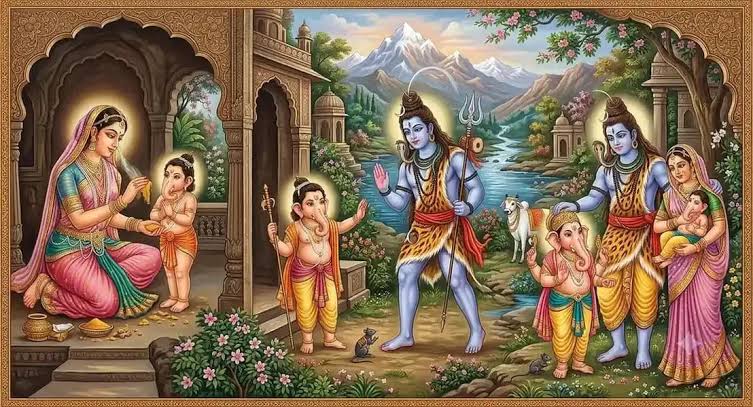
A few minutes after a baby is born, before the umbilical cord has been cut, the father is supposed to dip his ring finger into a mixture of honey and ghee and touch it to the newborn’s tongue. Then he leans close to the right ear and murmurs a formula asking that intelligence be born in this child. The rite is called the medha janana — the generating of intelligence — and it is set out, step by step, in the Paraskara Grihya Sutra (1.16.3–4), a manual of household ritual composed something like two and a half thousand years ago.
Many Indian families still do a version of this. Most have no idea they are following a sutra. The honey has survived; the Sanskrit has largely gone.
That gap — between the rites people perform and the texts those rites came from — is what this article is about. The Hindu tradition developed an extraordinarily detailed system for marking the thresholds of a human life: conception, birth, naming, first food, first haircut, first letters, initiation, graduation, marriage, death. These are the samskaras. And the first honest thing to say is that the number everyone quotes is not quite what people think.
What “Samskara” Actually Means
The word comes from sam (“together, thoroughly”) plus the root kr (“to make, to do”). Monier-Williams glosses samskara as “putting together, making perfect, getting ready, to prepare,” and then “a sacred or sanctifying ceremony.” It is a word about forming something.
The sharpest definition in the whole literature is not from a ritual manual. It is from the Caraka Samhita, the classical Ayurvedic text, at Vimanasthana 1.22: samskaro hi gunantaradhanam ucyate — “samskara is said to be the imparting of another quality to a substance.” That is the engineering sense of the word. You do something to a material and it becomes capable of what it was not capable of before. Milk becomes curd; ore becomes metal; a person, passing through a threshold with the right words said over them, becomes something their previous self was not. The digest tradition gives a tidy three-part rationale: dosha marjana (removing defects), guna adhana (adding qualities), and hinanga purti (filling in what is deficient).
A caution, because a popular modern claim goes wrong here. The same word has a separate technical use in Indian philosophy, where it means a latent mental impression — the residue a past action leaves in the mind, conditioning what you do next. It appears in exactly that sense in Patanjali’s Yoga Sutras (1.18, 2.15, 4.9) and in Buddhism as Pali sankhara. You will often read that the ritual samskaras were designed to lay down good mental samskaras — a kind of ancient psychological engineering. It is an attractive idea, but it is a modern synthesis rather than the tradition’s own claim: reference works list the two senses as separate entries and do not connect them. Both grow from the same root sense of forming, which is a real connection — but not evidence that the authors of the Grihya Sutras had a theory of child development.
Are There Really Sixteen?
This is worth slowing down for, because the standard answer is repeated everywhere and is not what the texts say.
Sixteen is a late standardisation. You will not find it fixed in any Veda, any Grihya Sutra, or any Dharma Sutra. The texts that actually prescribe these rites count them very differently. The Grihya Sutras collectively give between eleven and eighteen — Ashvalayana lists eleven, Paraskara and Baudhayana thirteen each but not the same thirteen, Varaha twelve, Vaikhanasa eighteen. Manusmriti gives thirteen. Yajnavalkya Smriti gives twelve. The Gautama Dharmasutra gives forty. One scholarly survey puts the full attested range at “ten to fifty-two.”
So where does sixteen come from? It is traced to the Samskaradipika, a medieval compendium; two independent sources make exactly that point — the Samskaradipika “decided” which sixteen are essential. John Bowker’s Concise Oxford Dictionary of World Religions puts it economically: “The number varies, but a standard list has sixteen.”
And here is the detail that settles it. Even among authorities that say sixteen, the sixteen are not the same sixteen. The list reproduced on practically every Indian website today includes Nishkramana, Karnavedha, Vidyarambha, Vedarambha and Keshanta. The Samskaradipika‘s own sixteen — the list belonging to the text credited with fixing the number — omits all five, reaching sixteen instead by counting the four Vedavratas as separate items and adding Godana. The Arya Samaj’s published list drops Vidyarambha and Keshanta and adds Vanaprastha and Sannyasa. One traditional scholar folds the boy’s first shave and the girl’s menarche rite into a single “puberty rites” slot. Another counts eight “major” and eight “minor.”
None of this makes the sixteen illegitimate. It makes them a sensible later consolidation of a genuinely varied tradition. And that tradition had its own rule for handling variation, more elegant than picking a winner: because the Grihya Sutras disagree, you follow your own — the manual belonging to your family’s Vedic branch. A Rigvedi family follows Ashvalayana or Shankhayana; a Shukla Yajurvedi follows Paraskara; a Samavedi follows Gobhila; a Krishna Yajurvedi follows Apastamba or Baudhayana.
That is the single most useful thing to understand about regional and community difference in Hindu practice. The variation is not corruption or forgetting; it is built into the system by design. When a neighbour’s family does a ceremony on a different day, in a slightly different form, with different mantras, the likeliest explanation is that they follow a different sutra — and both families are doing it correctly.
A Note on Gautama’s Forty
Since it comes up: the Gautama Dharmasutra (chapter 8, verses 14–25; numbering varies by edition) does enumerate forty samskaras and then eight qualities of the soul. Two things are usually misreported. First, the forty are mostly sacrifices — seven pakayajnas, seven haviryajnas, seven soma sacrifices, the five daily offerings, the four study-vows. Only eight of the forty are life-cycle rites in our sense, and funeral rites are not among them. Second, the eight are not samskaras at all; they are atma-gunas, virtues of the soul: compassion toward all creatures, patience, freedom from anger, purity, tranquillity, auspiciousness, freedom from avarice, freedom from covetousness.
Gautama’s point in listing them is startling. Verse 8.24: a man sanctified by all forty rites but lacking the eight virtues “will not be united with Brahman, nor does he reach his heaven.” Verse 8.25: a man who has performed only a few but possesses the eight “will be united with Brahman, and will dwell in his heaven.” That is a ritual law text saying in its own voice that character outranks ceremony. Reformers from Dayananda Saraswati onward have leaned on it heavily, and they were entitled to.
The Rites, One by One
What follows is the list most commonly reproduced today. Where the sources conflict, I have said so rather than smoothing it over.
Before Birth
1. Garbhadhana — “placing the embryo,” at or before conception. The sources diverge on whether this is a full ceremony or essentially the marital act undertaken with declared intention and prescribed mantras, and on whether it is performed at every conception or once only. Effectively obsolete today.
2. Pumsavana — and here I will be direct, because sanitising this one is a disservice. Most modern accounts call it a prayer for a healthy baby. The texts are more specific: Bühler’s translation of Gautama Dharmasutra 8.14 glosses the rite as “the ceremony to cause the birth of a male child,” and the Shankhayana Grihya Sutra (1.20.1) places it in the third month and says it is “meant to secure the birth of a male child,” with a pounded substance — often the last shoot of a banyan trunk — sprinkled into the wife’s right nostril. (The widely repeated detail about the left nostril for a daughter is not in the Grihya Sutras I can verify.)
That is what the rite was for, and pretending otherwise would obscure something more interesting: the broader corpus is not uniformly son-focused. Atharvaveda 4.6.17 has charms for a child of either sex; the Brihadaranyaka Upanishad (6.4.17–18) prescribes different foods according to whether a learned daughter or a learned son is wanted. The tradition contains both impulses; this named rite belongs to one of them. Contemporary Hindus mostly handle it by not performing it — Hinduism Today, a Hindu publication, states flatly that Pumsavana is “not practiced today” — and prenatal sex selection has been a criminal offence in India since 1994. Know what the text says, say so, and leave the rite alone.
3. Simantonnayana — “parting the hair upwards,” usually the sixth to eighth month, though the texts disagree on the month and on whether it precedes or follows Pumsavana. The Paraskara Grihya Sutra has the husband part his wife’s hair upward three times — with unripe udumbara figs and darbha grass, with a porcupine quill marked with three white spots, and with a stick and a full spindle — reciting bhur, bhuvah, svah. Yajnavalkya Smriti 3.79 adds that the pregnant woman’s wishes should be satisfied, for the baby’s development and to prevent miscarriage.
That last line is the root of something very much alive. The Vedic hair-parting rite has largely lapsed; its descendants are thriving — Valaikaapu in Tamil Nadu, Seemantham across the south, Godh Bharai in the Hindi belt, Dohale Jevan in Maharashtra, Shimant in Gujarat, Shadh in Bengal. The bangles and the indulged cravings are the sutra’s own instruction in a different idiom.
Infancy and Childhood
4. Jatakarma — the birth rite with which this article opened. Beyond the honey and ghee, there is a remarkable passage at Paraskara 1.16.10–16 in which five brahmanas stand toward the five directions and tell the child to breathe — east for prana, south for apana, west for vyana, north for udana, and the fifth, looking upward, for samana. If none are available the father does it himself, circling the child. In the Brihadaranyaka Upanishad he says into the baby’s ear, three times, “Speech, speech,” and then: “You are the Vedas — so, live a hundred autumns.”
5. Namakarana — naming. The day is genuinely unsettled, and anyone who states flatly that it is the eleventh is overstating. Paraskara 1.17.1 says the tenth; Manusmriti 2.30 the tenth or twelfth; Vyasa Smriti the eleventh; Gobhila’s supplement allows the hundredth day or the end of the first year, Brihaspati the thirty-second. The commentator Harihara reads Paraskara’s “tenth day” as the day after the ten-day impurity period ends — which gives the eleventh in practice, and probably explains the figure everyone quotes.
The naming rules are precise and, in one respect, ugly. Paraskara 1.17.2–3 gives two or four syllables for a boy’s name and an uneven number for a girl’s. Manusmriti 2.31–32 assigns name-meanings by varna — auspiciousness for a brahmana, power for a kshatriya, wealth for a vaishya, and for a shudra “something contemptible.” If you cite Manu’s naming rules, cite all four or none; quoting the first three is how a tradition gets prettified.
6. Nishkramana — the first outing, in the fourth month (Paraskara 1.17.5; Manusmriti 2.34). The prescribed act is lovely in its simplicity: the father has the child look at the sun. It survives everywhere as family custom — the first trip out, the first temple visit — rather than as a Vedic rite.
7. Annaprashana — the first solid food, in the sixth month (Paraskara 1.19.1; Manusmriti 2.34). A correction, because it is widely repeated: the Grihya Sutras give the sixth month without distinguishing boys from girls. The familiar rule of odd months for daughters and even for sons is a later Bengali, Telugu and Ayurvedic-astrological convention. And in several Grihya Sutras this is a meat rite — Paraskara 1.19.7–11 prescribes a particular bird for fluency of speech, partridge for abundance of food, fish for swiftness. The modern kheer is a vegetarian substitution, and a very successful one.
Its regional forms are gorgeous. In Bengal it is mukhe-bhat or mama-bhat, “the maternal uncle’s rice” — he or the maternal grandfather feeds the child, kheer is cooked in a silver vessel, conches are blown, and then comes the object game: the baby chooses from a plate holding soil, a book, a pen and coins, and the family reads its future off the choice. In Kerala it is choroonu, held in a temple, the baby in kasavu, fed from a banana leaf by an uncle or grandfather, often followed by a tulabharam. In Himachal Pradesh, bhat khulai; in Nepal, pasni, and among Newars maca janko.
8. Chudakarana — tonsure, the rite most Indians know as mundan, in the first or third year. The sutra’s account is extraordinarily detailed: the mother bathes the boy, sits west of the fire with him in her lap, moistens the hair near the right ear invoking Savitr, untangles it with a porcupine quill, fixes three young kusha shoots in it, and cuts with a copper razor; the cut hair goes onto a lump of bull dung and is hidden in a cow-shed or near water. There is a verse asking the razor not to take the boy’s life, and a request to the barber not to wound him.
And then, at Paraskara 2.1.22, a line I find delightful: “Remaining locks are arranged according to family custom.” That is the shikha — and the sutra prescribes no pattern for it at all, deferring it by textual design to your lineage. Any claim that the shikha must be one particular tuft in one particular place, for one particular physiological reason, is not coming from here.
9. Karnavedha — ear-piercing, which needs an honest flag: it is weakly attested in the ritual law texts. Among the Grihya Sutras only Baudhayana includes it. Its real home is Ayurveda: Sushruta Samhita Sutrasthana 16 gives the purpose as twofold — raksha (protection) and bhushana (ornament) — places it in the sixth or seventh month, and specifies the right earlobe first for a boy, the left first for a girl. That right-left rule is Ayurvedic, not Vedic. You will also find a claim that Sushruta held ear-piercing to protect against hernia and hydrocele; that appears in modern secondary literature, I could not verify it in the primary text, and there is no modern medical evidence for it. Treat it as a claim about a text, not a medical fact.
10. Vidyarambha — the beginning of letters, and the most instructive entry in the list, because it is absent from the Grihya Sutras and Dharma Sutras entirely while being, today, among the most vigorously practised of the sixteen.
The reason for the absence is wonderful once you see it. In the Vedic period Upanayana itself was the beginning of education, and education meant memorising oral mantra. There was no rite for “beginning letters” because, as the historian A. S. Altekar argued, there were effectively no letters to begin — writing was likely not yet in use for this purpose. Vidyarambha enters later, in the medieval digests. And look at it now: in Kerala, on Vijayadashami, thousands of three-year-olds are taken to temples to trace their first letters, guided by an elder’s finger — the ceremony called Vidyarambham, reported in the newspapers every year. A rite no ancient manual mentions has become one of the most visible religious events in a modern Indian state, pulled onto a fixed festival date rather than computed child by child. If you want one example of how a living tradition actually works, this is it.
Youth
11. Upanayana — the sacred thread, and the pivot of the system. The word means “leading near”: taking the child near the teacher. It is known regionally as Janeu, Poonal, Jandhyam, Janivara, Munja, Mekhal and, in Nepal, Bratabandha. Manusmriti 2.36–38 sets the ages: a brahmana in the eighth year from conception, a kshatriya in the eleventh, a vaishya in the twelfth.
The ritual in Paraskara 2.2 is a scene worth picturing. The boy, head shaved, stands west of the fire and declares he has come for studentship; he is given a garment with a verse recalling Brihaspati clothing Indra in immortality; he ties a girdle of munja grass and receives the staff; the teacher fills his joined hands with water, makes him look at the sun, touches his heart reaching over his right shoulder, takes his right hand and asks his name. “Whose pupil are you?” “Yours.” And the teacher answers that he is Indra’s pupil, that Agni is his teacher, and “I am thy teacher.”
Two things popular accounts almost always get wrong. First, the thread: Manusmriti 2.44 specifies cotton for a brahmana, hemp for a kshatriya, wool for a vaishya, but Gobhila Grihya Sutra 1.2.1 says the yajnopavita may be “a cord of threads, or a garment, or a rope of kusha grass” — the thread as we know it is not textually mandatory. And the scholar Patrick Olivelle makes a point that surprises people: no text requires brahmanas to wear a sacred string at all times. The permanently worn thread is a medieval and modern development.
Second, the Gayatri. Paraskara 2.3.5–10 contradicts the standard account twice over. The verse may be given “after one year, or six months, or twenty-four days, or twelve days, or six days, or three days” — not necessarily on the day of initiation at all. And: “To a brahmana he should recite a Savitri verse in the Gayatri metre… a Trishtubh verse to a rajanya, a Jagati to a vaishya — or a Gayatri to persons of all castes.” So the famous verse (Rigveda 3.62.10, seer Vishvamitra, deity Savitr) is the brahmana’s verse; the texts prescribe different verses in different metres for other varnas, with the universal Gayatri offered only as an alternative. Almost nobody mentions this.
And the “twice-born”? Manusmriti 2.169 gives three births: from one’s natural mother; from the munja girdle, in which — in a line of real beauty — “the Savitri verse is the mother and the teacher is the father”; and a third from initiation into a Vedic sacrifice.
12. Vedarambha — beginning Vedic study proper. Another later addition, missing from the older texts and unstable even in its position in the list. Hinduism Today calls it “fading into obscurity, except among priests.”
13. Keshanta — the first shave, at sixteen; Manusmriti 2.65 gives the sixteenth year for a brahmana, twenty-second for a kshatriya, twenty-fourth for a vaishya, mapping exactly onto the upper age limits for Upanayana. The ritual reuses the tonsure frame but includes the beard, and the gift is a cow — hence the alternative name Godana. Usually treated as one rite, though the Samskaradipika lists Godana separately and later. Obsolete now.
Worth noting what sits beside this slot. The girl’s menarche rite — Ritu Kala, known as Langa Voni in Telugu, Pavadai Dhavani in Tamil, the “half-sari function,” and Tuloni Biya in Assam — is in some sixteens and absent from others. It is widely performed in Andhra, Telangana, Tamil Nadu, Karnataka and Assam, and I could find no classical textual citation for it at all. It is the clearest case in the system of a rite that is robustly alive and only intermittently canonical — and the only one specific to girls.
14. Samavartana — graduation, also called Snana, “the bath,” because the ceremonial bath is the central act. The graduate is a snataka, literally one who has bathed, and in the lovely phrase vidya-snataka, one bathed in knowledge. The address given at this moment is the Taittiriya Upanishad 1.11, the best single text in the tradition for understanding what the whole system was for: “Never err from Truth. Never err from Dharma. Never neglect study and teaching.” Treat mother, father, teacher and guest as divine. Let your actions be beyond reproach. Give with faith, with sympathy, with modesty, with cheerfulness. That is a convocation speech from roughly the middle of the first millennium BCE, and it would not be out of place at one today.
Household and Ending
15. Vivaha — marriage, which opens the householder stage and which we have covered separately in our guide to Indian wedding rituals. One line from the digest tradition ties it to the system’s deepest logic: devapitri-rinapagamah vivahasya phalam smritam — “the removal of the debts to the gods and the ancestors is declared the fruit of marriage.”
16. Antyeshti — “the last sacrifice”: the dying person moved from the bed to the earth, then cremation, ten days of ritual impurity, the rites performed by the son, monthly offerings for a year, then annual ones. Whether it belongs among the sixteen is itself contested — the Samskaradipika makes it the sixteenth, Gautama and most Dharma Sutras omit it, Manu and Yajnavalkya include it, two major digests exclude it, and on the purva/apara division the sixteen are the pre-death rites, leaving it outside the count altogether.
It is often said that Antyeshti is the one samskara performed for a person rather than by them. That is nearly right and worth tightening, since the three prenatal rites are also performed by others. The precise version: it is the only rite performed on a person’s own body without any participation from them.
The Logic Underneath
Manusmriti 2.26–28 gives the clearest statement of purpose. The rites “sanctify the body and purify from sin” (2.26); the oblations during pregnancy, the birth rite, the tonsure and the girdle-tying remove “the taint, derived from both parents” (2.27). And then 2.28: “Through Vedic study, vows, offerings, sons, and great sacrifices, this human body is made fit for union with Brahman.” Manu’s great commentator Medhatithi reads that verse as meaning the samskaras can lead to moksha. That is the highest claim the system makes for itself.
Running alongside it is the doctrine of the three debts, the rinas, whose locus classicus is Taittiriya Samhita 6.3.10.5: a person is born owing a debt to the sages, discharged by study; to the gods, discharged by sacrifice; and to the ancestors, discharged by progeny. Map that onto the list and the architecture appears. Upanayana, Vedarambha and Samavartana pay the sages. Vivaha pays the ancestors. The sacrifices — which is why Gautama’s forty are mostly sacrifices — pay the gods.
You will also read that the sixteen map onto the four ashramas, the life-stages. The joints are real: Upanayana opens studentship, Samavartana closes it, Vivaha opens householdership. But notice what is missing — Vanaprastha and Sannyasa have no samskara in most lists, and the rites run densely from conception to marriage and then stop almost entirely until death. Which is precisely why the Arya Samaj’s list adds those two: it is visibly engineered to complete a mapping the older texts never made. The ashrama framing is a useful lens, not a textual doctrine.
The Hard Parts
An account of this system without its exclusions would not be worth reading, so let me state them plainly.
Caste. Manusmriti 10.126 is unambiguous: na shudre patakam kim chin na cha samskaram arhati — “For the shudra there is no sin; nor is he worthy of any sacraments; he is not entitled to any sacred rites.” Manu 2.36 specifies Upanayana for the three higher varnas only; Paraskara 2.3.7–10 assigns initiation verses to three varnas and names no fourth; Manu 2.172 says an uninitiated person is “on a level with a shudra.”
The commentarial picture is more granular, and the granularity matters. Medhatithi, explaining Manu 10.126, holds that the shudra is excluded from the initiatory rite and from Shrauta ritual but not from rites the Smritis prescribe for all men. The Nirnayasindhu, quoting earlier authorities, allows shudras six samskaras plus the five daily offerings; the Varahapurana permits a brahmana to recite the mantras on a shudra’s behalf. So: not exclusion from all ritual, but exclusion from mantra-bearing, Veda-grounded ritual — which is the definitional core of what a samskara is.
Gender. The central verse is Manusmriti 2.66: the series of ceremonies applies to females too, to sanctify the body, mantravarjam — “without the recitation of sacred texts.” And 2.67: “The nuptial ceremony is stated to be the Vedic sacrament for women,” with serving the husband standing in place of residence with a teacher. That is Manu’s settled position: the rites minus the mantras, and marriage in place of initiation.
There is also a genuine counter-record, which should be stated carefully in both directions. P. V. Kane, collating the sources, found that the Harita Dharmasutra, the Ashvalayana Grihya Sutra and the Yama Smriti permit women to undertake Vedic study after Upanayana, and preserve a distinction between brahmavadinis — girls initiated around the age of eight who pursued study and wore the thread over the left shoulder — and sadyovadhus, who had an interim Upanayana during the wedding itself.
Three qualifications. This is a textual record of permission in a few authorities, not evidence of widespread practice, and there is no scholarly consensus on how common it was. Harita and Yama survive largely through quotation in medieval digests, so these citations reach us at second or third hand. And the sadyovadhu provision is in substance what Manu 2.67 says — the wedding doing the work of initiation. Its most concrete surviving trace is something you can still watch at Hindu weddings: the bride wearing her upper cloth over the left shoulder in the manner of the sacred thread.
So neither slogan survives contact with the sources. “Women were always initiated and the restriction is a later corruption” overstates a thin record. “Women were never permitted Vedic study” is contradicted by Harita, Yama, Gobhila, that bridal garment, and by documented modern history.
On which: the clearest documented reform is specific and dated. At the Kanya Mahavidyalaya in Jalandhar, an Arya Samaj institution, the educator known as Savitri became the first woman principal in 1913 and introduced the practice of bestowing the yajnopavita on the school’s girls. An Indian Social Reformer report from the 1890s records that at the same school “the girls are taught Veda Mantras and are made to perform Sandhya” — and the scholar Madhu Kishwar, writing in the Economic and Political Weekly, notes pointedly that this material was traditionally held not to be meant for women. More broadly, modern Hindu reform movements worked to extend these rites to everyone, and in large measure succeeded — a story our piece on the female saints of India approaches from another direction.
Why This Matters Today
Here is the most practically useful thing in this article, and it is a point about compression.
Almost every Hindu family worries at some point that they are doing this wrong — that the real tradition had sixteen elaborate ceremonies at precisely specified ages, and they have managed four, late and combined. There is a particular version of this anxiety in the diaspora, where a priest may be a long flight away and a ceremony has to fit the weekend everyone could get off work.
The texts anticipated you.
Jatakarma and Namakarana were already merged in antiquity — separate rites in the earliest Dharma Sutras, a single observance around the tenth day by the time of Patanjali. Compression is not a modern failure; it is as old as the tradition. Chudakarana is often combined with Upanayana, and in Nepal’s Bratabandha the two are routinely performed as one event. Vidyarambha has moved from the fifth year to the third in modern families, and has been fixed to Vijayadashami rather than calculated per child. And the commentator Harihara, writing centuries ago, had already shifted the naming day from the tenth to the eleventh in practice and built in provisions for postponement around Sankranti, an eclipse or a shraddha.
In other words, the commentarial tradition itself treats rescheduling, combining and simplification as legitimate moves. The priest who tells your family to do the mundan and the ear-piercing in one morning because that is when everyone can gather is not cutting corners. He is doing what the Grihya tradition has always done.
And then there is the deeper point, which Gautama made in a single verse. Forty rites without the eight virtues get you nowhere; a few rites with them get you everywhere. A tradition that put that sentence in its own law book is not a tradition that wants you anxious about a checklist.
What the samskaras offer, stripped of the anxiety, is a technology for not letting the important thresholds pass unmarked. A child is born and something is said over them. A child eats for the first time and the family gathers. A child learns to write and an elder holds their finger. A student finishes and is told, formally and in front of witnesses, how to live. Someone dies and the body is handled with words, not just efficiency.
Modern life is very good at letting thresholds pass unmarked. You can start a job, end a marriage, bury a parent and go back to the inbox. What this system knew is that human beings do not transition well in silence, and that how you mark a change shapes what the person on the other side of it becomes. Samskaro hi gunantaradhanam ucyate. The imparting of another quality.
Frequently Asked Questions
How many samskaras are there in Hinduism?
Sixteen is the standard modern answer, but it is a late consolidation rather than a scriptural fixture, traced to the medieval Samskaradipika. The underlying texts count differently: the Grihya Sutras give eleven to eighteen, Manusmriti thirteen, Yajnavalkya Smriti twelve, the Gautama Dharmasutra forty. Even among lists that say sixteen the contents differ — the Samskaradipika‘s own sixteen omits five rites that appear on the list most websites reproduce. That standard modern list runs: Garbhadhana, Pumsavana, Simantonnayana, Jatakarma, Namakarana, Nishkramana, Annaprashana, Chudakarana, Karnavedha, Vidyarambha, Upanayana, Vedarambha, Keshanta, Samavartana, Vivaha, Antyeshti.
Which samskaras are still performed today?
Widely: Namakarana, Annaprashana, Chudakarana (mundan), Karnavedha (especially for girls), Vidyarambha (especially in Kerala and the south), Vivaha and Antyeshti. Upanayana remains alive but is largely confined to brahmana and some kshatriya and vaishya families, and is often performed shortly before a wedding rather than at eight. Simantonnayana’s folk descendants — Valaikaapu, Godh Bharai, Seemantham, Dohale Jevan — are thriving even though the Vedic hair-parting rite has lapsed. Pumsavana, Vedarambha, Keshanta, Samavartana and the four Vedavratas are largely or wholly obsolete.
Can girls have the sacred thread ceremony?
Historically the dominant position is Manusmriti 2.66–67: women receive the rites without the mantras, and marriage takes the place of initiation. But a minority textual record, collated by P. V. Kane, has the Harita Dharmasutra, Ashvalayana Grihya Sutra and Yama Smriti permitting women’s Vedic study after Upanayana, and preserves the brahmavadini and sadyovadhu categories. How widespread that was is unknown. In the modern period the Arya Samaj’s Kanya Mahavidyalaya in Jalandhar conferred the sacred thread on its girls from 1913, and girls’ Upanayana is performed in some families today.
What is the difference between samskara as a ritual and samskara in yoga?
They are two distinct technical uses of one word. In ritual law a samskara is a consecrating ceremony that makes a person fit for something. In Yoga and Buddhist psychology a samskara (Pali sankhara) is a latent mental impression left by past action, which conditions future action — the sense used in Yoga Sutras 1.18, 2.15 and 4.9. Both come from the root sense of “forming.” The popular idea that the ceremonies were designed to lay down good mental impressions is a modern synthesis, not the tradition’s own claim.
Is it a problem if we only do a few of the samskaras, or combine them?
Not by the tradition’s own standards. Jatakarma and Namakarana were already merged into one rite in antiquity; Chudakarana is often combined with Upanayana, routinely so in Nepal; the medieval commentator Harihara built postponement rules into the naming rite. The Gautama Dharmasutra goes further, stating that a person who performs only a few of its forty rites but possesses the eight virtues of the soul reaches Brahman, while one who performs all forty without them does not.
Why do families in different regions perform the same samskara differently?
Because the tradition is built that way. The Grihya Sutras genuinely disagree on timings and details, and the traditional rule for resolving this is to follow your own — the manual of your family’s Vedic branch. A Rigvedi family follows Ashvalayana or Shankhayana, a Shukla Yajurvedi follows Paraskara, a Samavedi follows Gobhila, a Krishna Yajurvedi follows Apastamba or Baudhayana. Difference between families is usually a difference of sutra, not a mistake.
A Closing Thought
The scholar who gave us the most exhaustive account of all this, P. V. Kane, spent decades on the History of Dharmasastra — five volumes in eight parts, published between 1930 and 1962 — mapping every variant reading and every disagreement between authorities. What emerges from that labour is not a rulebook. It is the record of a very long argument India has been having with itself about how to mark a human life.
The argument is still running. Every family that shortens a ceremony, or moves it to a Saturday, or holds it in a community hall in Edison or Wembley instead of a courtyard in Thanjavur, is contributing to it — exactly as Harihara was when he decided that “the tenth day” really meant the eleventh.
The honey and the ghee are still going onto the newborn’s tongue. The sutra is still there, whether or not anyone in the room can read it. That is probably how a tradition stays alive: not by being obeyed exactly, but by being used.
Continue Exploring
- Indian Wedding Rituals Explained — Vivaha, the samskara treated only briefly here, in full.
- Why We Touch Feet: The Meaning of Charan Sparsh — the everyday gesture carrying the same teacher-and-elder logic as Upanayana.
- Dussehra and Vijayadashami: Significance and Meaning — the day on which Kerala performs Vidyarambham.
- The Meaning of Namaste — more on how ritual gesture carries meaning in daily Hindu life.
- Adi Shankaracharya: Life, Teachings and Legacy — the thinker who shaped how much of this tradition reads its own texts.
- The Female Saints of India — women who found their own routes into a tradition that often restricted them.