In a yoga studio in Edison or Harrow, thirty people sit cross-legged and are told to chant Om three times. They do it self-consciously, trailing off at different moments, and the teacher says something about the vibration of the universe. Four thousand miles away, a priest at a village shrine says the same syllable before he says anything else, the way you might clear your throat — because nothing begins without it. Neither of them is wrong. But the gap between those two rooms is where almost everything interesting about Om actually lives.
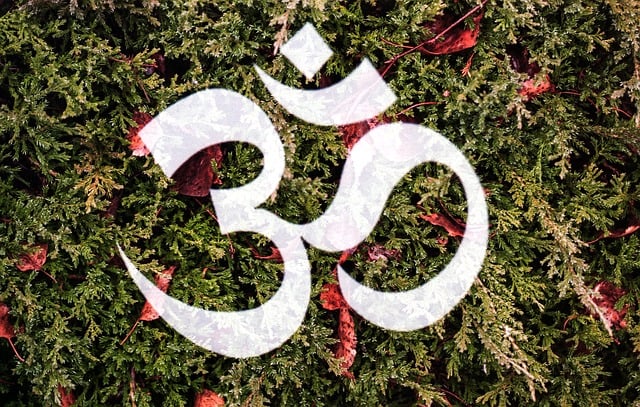
Om (also written Aum, Sanskrit ॐ) is not a word with a dictionary meaning. It is a sacred syllable — called pranava, the fore-sound, and akshara, the imperishable — which the Upanishads treat as a sonic form of Brahman, the ultimate reality. Hindu tradition reads it as having three sounded parts, A, U and M, and a fourth silent part: the silence that follows. It is chanted at the beginning and end of recitation, prefixed to the Gayatri mantra, and used on its own in meditation.
That is the short answer. The longer one is better, because the tradition itself argues about this syllable, and the arguments are more instructive than any single tidy definition.
Where Om actually comes from
Om emerges in the Vedic corpus, and its oldest home is chant rather than speech. It is closely bound up with the Samaveda — the Veda of melody — and is often described as an encapsulated form of Samavedic chanting. In the Aitareya Brahmana (7.18.13) it functions as a melodic acknowledgement that gives energy to a hymn: the singer’s assent, the sound that lets the recitation take off. Elsewhere (5.32) the same text associates its three components with three stages of cosmic creation.
Its earliest names tell you how it was used before anyone theorised about it. Udgitha means song or chant. Pranava means the fore-sound, the sound that goes in front. Omkara means the Om-maker, the act of making the sound. Akshara means imperishable — and also, in ordinary Sanskrit, simply syllable. Om is the syllable that does not perish.
Now the honest part. Nobody knows for certain what Om originally was. The Upanishads themselves propose several competing etymologies — from am (yes), from av (to urge), from ap (to attain) — which is exactly what you would expect if the sound was already ancient and opaque by the time people started explaining it. Maurice Bloomfield proposed in 1889 that it descends from a Proto-Indo-European introductory particle au. Asko Parpola has argued it is a borrowing from Proto-Dravidian am, meaning yes, cognate with Tamil am. Max Muller observed that the Upanishadic explanations of Om run the whole range from what he called artificial and senseless all the way to identification with Brahman and Atman.
None of this is a problem for devotion. It is a problem only for the kind of writing that wants Om to mean one definite thing. The tradition’s own position is subtler and much more interesting: Om is not a word that has a meaning. It is a sound you are asked to sit inside until it does something.
One small point of pronunciation, since it causes endless confusion. In Classical Sanskrit the initial o is the guna grade of u, so the syllable is a single long monophthong — om, not a-u-m. The three-phoneme reading comes from the archaic Vedic diphthong au, and in Vedic recitation the vowel may be pluta, drawn out to three beats. So both the long single o of most Indian practice and the deliberately separated A-U-M of the Upanishadic analysis are legitimate. They are doing different jobs: one is how you say it, the other is how you take it apart.
A, U, M and the silence: the Mandukya Upanishad
If you read only one thing about Om, read the Mandukya Upanishad. It is twelve short prose verses — the shortest of the principal Upanishads — and it is almost entirely about this syllable. It is assigned to the Atharvaveda, though it is also associated with a Rig Vedic school.
Its dating is genuinely unsettled, and the spread is wide: Hajime Nakamura puts it around the first or second century CE, Richard King within the first two centuries CE, Patrick Olivelle not much older than the start of the Common Era, while W.K. Mahony argues for the late fifth to early fourth century BCE. R.D. Ranade places it in the last group of the principal Upanishads. Anyone who tells you confidently that it is five thousand years old is not reporting scholarship.
The text’s move is elegant. It opens by declaring that this syllable is the whole of what is — past, present and future — and whatever lies beyond time as well. It then identifies Brahman, the ultimate reality, with Atman, the self. And then it does something no other text had done: it maps the syllable onto states of consciousness you already experience every day.
| Sound | State | Aspect of the Self | What it is |
|---|---|---|---|
| A | Jagrat — waking | Vaishvanara | Outward-knowing; the gross world of objects |
| U | Svapna — dream | Taijasa | Inward-knowing; the subtle world of impressions |
| M | Sushupti — deep sleep | Prajna | Undistracted, unified; the source from which the other two arise |
| (silence) | Turiya — the fourth | Turiya | Beyond all three; no element corresponds to it |
Sit with the structure for a moment. You spend your life in three states and you have never thought of them as a sequence. The Mandukya says they are, and that the sequence is embedded in a sound your throat makes without effort: A opens at the back of the mouth, U rolls forward, M closes the lips, and then the mouth is shut and something continues. Turiya — literally the fourth — is not a fourth state added to the list. It is what is there when the other three are seen through.
This is why serious practitioners say the silence after Om is the point. You are not chanting three sounds and stopping. You are chanting three sounds in order to arrive at a fourth thing that cannot be chanted.
The Mandukya’s influence runs mostly through Gaudapada, whose Mandukya Karika — a metrical commentary traditionally dated to the sixth century CE, incorporating the Upanishad’s full text — is the earliest systematic exposition of Advaita Vedanta we have. Adi Shankaracharya commented on both the Karika and the Upanishad, and the text became one of the foundations of his system. The Muktika Upanishad, in a dialogue between Rama and Hanuman, has Rama say that the Mandukya alone is enough for an aspirant’s liberation. Twelve verses, and a tradition that says you could stop there.
Om across the Upanishads
The Mandukya is the most focused treatment, not the only one. The syllable runs through the early Upanishads like a thread:
- Chandogya Upanishad 1.1 opens the whole text with Om, calling it the udgitha and the highest song, and recommending meditation on it. Chandogya also describes the division of ritual labour around it — the Adhvaryu invoking, the Hotr reciting, the Udgatr singing.
- The Taittiriya Upanishad, in its eighth anuvaka, connects the sound to the inner substance of the word Brahman.
- Katha Upanishad 1.2.15–16 identifies the syllable straightforwardly with Brahman — this is the famous passage in which Om is given as the support, the highest, the goal.
- The Mundaka Upanishad uses an archery image in which Om is the bow, the self is the arrow, and Brahman is the target. Aim matters more than force.
- Shvetashvatara Upanishad 1.14–16 compares it to the fire-stick: you kindle awareness by friction, by repeated application, not by a single dramatic gesture.
- The Maitrayaniya Upanishad (sixth prapathaka) states that the syllable’s three roots are A, U and M, and runs them out across gender, deities, Vedas, worlds and divisions of time.
Notice what these have in common. None of them defines Om. All of them give you something to do with it — sing it, aim with it, kindle with it, rest on it.
Om in the Bhagavad Gita and the Yoga Sutras
By the time of the Bhagavad Gita, Om is settled enough that Krishna can use it as shorthand. At 8.13 he describes the one who departs the body uttering the single syllable Om, which is Brahman, while remembering him — placing the syllable at the moment of death, which is as high a status as Hindu practice gives anything. At 9.17 Krishna identifies himself with Om among a list of cosmic functions, a verse Jeaneane Fowler reads as holding monist and devotional theology together in one breath.
Then there is Om Tat Sat. At 17.23 the Gita gives this threefold formula as a designation of the Supreme, with which the Brahmanas, the Vedas and sacrifice were made at the beginning. The verses that follow unpack it: 17.24 says the knowers of the Veda begin sacrifice, charity and austerity by uttering Om; 17.25 assigns Tat to acts done without desire for reward; 17.26–27 give Sat as eternal existence, goodness and steadfast action; and 17.28 says that any of these done without faith is asat, and comes to nothing. So Om begins the act, Tat releases the claim on its fruit, and Sat makes it real. Read that way, Om Tat Sat is not a sign-off. It is a compressed ethics of action.
In Patanjali’s Yoga Sutras 1.27, having introduced Ishvara, Patanjali says plainly: tasya vachakah pranavah — his designating word is the pranava. The sutra immediately after instructs the practitioner to repeat it and contemplate its meaning. This is the oldest surviving instruction manual for exactly what the yoga studio is attempting, and it is worth noting that Patanjali gives repetition and reflection on meaning as a pair. Sound without attention is not the practice.
A is Brahma, U is Vishnu, M is Shiva — and when that reading arrived
The most widely repeated explanation of Om in popular Hinduism assigns A to Brahma the creator, U to Vishnu the preserver and M to Shiva the dissolver. This is a real reading with real textual backing — the Vayu Purana gives it — and Shakta traditions do the parallel thing with creative, preserving and destructive energies.
But it is later than the Upanishadic reading, not earlier, and it is one interpretation among several rather than the original meaning of the sound. The Ganapatya Atharvashirsa (verse 6) identifies Ganesha with Om outright, which is how Ganesha comes to be called omkarasvarupa, the one whose form is Om — and that text is probably a late Upanishad, sixteenth or seventeenth century. The Maitrayaniya threefold scheme maps A, U and M onto several triads at once. The Mandukya maps them onto states of consciousness.
These do not cancel each other. They are different things the tradition found when it looked at the same syllable, and a reader who holds all of them loosely is closer to how Hinduism actually works than one who insists on a single correct decoding.
The written symbol
The familiar ॐ is a cursive ligature — a joining of the letters a and u with the chandrabindu, the moon-dot that marks nasalisation. Spelled out in full Devanagari it is ओम्. It has its own Unicode code point, U+0950, and there is a separate generic Om sign at U+1F549.
It also looks different depending on where you are, which diaspora readers often find surprising: Bengali-Assamese ওঁ, Tamil ௹, Kannada ಕಂ, Tibetan ༀ. None is more authentic than the others. The symbol follows the script, not the other way round.
Where its visual form came from is contested. Harit Krishna Deb argued in 1921 for a link with the swastika; a commentary in Nature the following year called the theory unproven. A.B. Walawalkar proposed in 1951 that it derives from Brahmi letters for A, U and M. Treat these as hypotheses rather than history.
Om outside Hinduism
Om crossed every border that Indian religion crossed.
In Buddhism it opens mantras and dharanis, most famously Om mani padme hum, associated with Avalokiteshvara. The fourteenth Dalai Lama has explained A, U and M as corresponding to body, speech and mind. In Japanese Buddhism, a-un transliterates a and hum and stands for beginning and end — the pair of temple guardian statues, one open-mouthed and one closed, are saying it.
In Jainism, Om is read as a condensation of the Pancha-Parameshthi, the five supreme beings, and appears in connection with the Namokar mantra.
In Sikhism, Ik Onkar opens the Mul Mantar at the very beginning of the Guru Granth Sahib and is usually rendered as one Om-maker, one creator. Sikh tradition reads this on its own terms, as a declaration of the oneness of God, and Sikh institutions are the authority on Sikh scripture. It is a shared inheritance, not a Hindu loan.
What Om is not: four claims worth dropping
This section exists because the internet is full of confident nonsense about Om, and repeating it does the tradition no favours. Hinduism does not need bad physics to be impressive.
Om is not 432 Hz, and 432 Hz is not the frequency of the universe. There is no scientific basis for the claim. A frequency is a property of a vibration in a medium; the universe is not a medium with a pitch. The 432 Hz story is a modern musical-tuning enthusiasm that got attached to Om later.
NASA did not record Om coming from the sun. What exists is real and much more interesting: the sun oscillates, and heliophysicists study those pressure waves. But they are far below audible frequency and travel through plasma, not air. Researchers speed them up and shift them into hearing range so that human ears can analyse them. What you hear in those recordings is a deliberate scientific translation, not a sound the sun makes. Nobody has measured the sun chanting.
Om is not proven to rewire your brain. There is one much-cited study worth knowing accurately: Kalyani and colleagues at NIMHANS, Bengaluru, published Neurohemodynamic correlates of OM chanting: a pilot functional magnetic resonance imaging study in the International Journal of Yoga in 2011. It reported deactivation in limbic regions during Om chanting, which the authors noted resembled patterns seen with vagus nerve stimulation. That is a genuinely intriguing finding. It is also a pilot study with a very small number of participants, describing a resemblance rather than demonstrating a mechanism or a clinical effect. Cite it as a promising early result, which is what it is. Do not cite it as proof that chanting treats depression.
Om is not a Hindu trademark that others are stealing. Its presence in Buddhist, Jain and Sikh practice is historical, not appropriative. What is reasonable to ask is that it not be printed on shoes and bathmats, which is a question about respect rather than ownership.
Why this matters today, and how to actually use it
Strip away the physics and what remains is a practice, and it is unusually accessible. Om is the only major Hindu mantra that requires no initiation, no lineage, no language competence and no theology you have to sign up to first. You can begin this evening.
If you want to do it properly rather than decoratively:
- Let the three parts have their time. Open with the A at the back of the throat, let it move forward through the U, close on the M, and then — this is the part people skip — do not immediately start again. The silence is not the gap between repetitions. It is the fourth part.
- Make the M longer than feels natural. Most of what people describe as the vibration of Om is the sustained nasal resonance of that final consonant. It is also the part that quiets the chest and lengthens the exhale, which is why the practice tends to settle people.
- Use it as a frame, not a performance. Classical usage puts Om at the start and end of recitation and before the Gayatri mantra (Om bhur bhuvah svah). The habit of opening and closing something with the same sound is itself the teaching: it marks the activity off from the rest of the day.
- If you count, 108 is the convention. A mala of 108 beads is the standard unit of japa, repetition. Nothing is wrong with nine, or three, or one.
- Do not strain over pronunciation. A long om and a deliberate a-u-m are both correct, for the reasons above. The self-consciousness in that yoga studio comes from people worrying they are saying it wrong. They are not.
And the quieter reason it matters. We live surrounded by sound chosen by other people — notifications, playlists, the open-plan office, the phone. Om is the one sound in the day that you make on purpose, that means nothing you have to decode, and that ends in silence you are instructed to pay attention to. Whatever metaphysics you hold, that is a useful thing to own.
Frequently asked questions
What does Om actually mean?
Om has no dictionary meaning the way an ordinary word does. The Upanishads treat it as a sonic form of Brahman, the ultimate reality — the Mandukya Upanishad says the syllable is everything past, present and future and whatever is beyond time. Its traditional names describe its function rather than a definition: pranava, the fore-sound; udgitha, the chant; akshara, the imperishable.
Is it Om or Aum, and which is correct?
Both are correct. In Classical Sanskrit the syllable is a single long vowel, om, which is how most Indian practice says it. The three-part a-u-m spelling preserves the archaic Vedic diphthong and is the form the Upanishads analyse, because splitting it is what allows the mapping onto waking, dream and deep sleep. Say it as a long om; understand it as A-U-M.
What do the three sounds of Om represent?
It depends which text you ask, and the tradition offers several answers rather than one. The Mandukya Upanishad maps them onto waking, dream and deep sleep, with the silence after them as turiya, the fourth state. The Vayu Purana assigns them to Brahma, Vishnu and Shiva. The Maitrayaniya Upanishad runs them across several triads at once, and the Dalai Lama has explained the Buddhist reading as body, speech and mind.
Can anyone chant Om, including non-Hindus?
Yes. Om requires no initiation, no priest and no lineage, which distinguishes it from many Hindu mantras that are traditionally received from a teacher. It is also already shared across Buddhist, Jain and Sikh practice. The only thing worth bringing is attention — the Yoga Sutras pair repetition of the syllable with contemplation of its meaning, not repetition alone.
Is Om really the sound of the universe at 432 Hz?
No. There is no scientific basis for assigning a frequency to the universe, and the 432 Hz claim comes from a modern debate about musical tuning, not from Hindu tradition or from physics. The related story that NASA recorded Om from the sun misdescribes real research: solar oscillations are inaudible pressure waves in plasma that scientists shift into hearing range in order to study them.
Which Upanishad should I read about Om?
The Mandukya Upanishad — twelve short verses, the shortest of the principal Upanishads, almost entirely about this syllable. Read it with Gaudapada’s Karika if you want the philosophical development, or on its own first. The Muktika Upanishad has Rama tell Hanuman that the Mandukya by itself is enough for liberation, which is the tradition’s own recommendation.
A closing thought
The oldest thing anyone can say about Om is that Vedic singers used it to launch a hymn — a sound made before the real content began, to give the recitation somewhere to stand. Centuries of philosophy later, the syllable had become the content: the whole of time in one breath, three states of consciousness in three movements of the mouth, and a fourth thing waiting in the silence afterwards.
It is a strange trajectory for a sound that may originally have meant nothing more than yes. Or perhaps it is not strange at all. Everything in this tradition begins with assent — and then finds out what it has agreed to.
Continue Exploring
- Bhagavad Gita Chapter 8: The Eternal and the Perishable — where Krishna places Om at the moment of death
- Bhagavad Gita Chapter 17: The Three Divisions of Faith — the home of Om Tat Sat
- Adi Shankaracharya: Life, Teachings and the Four Mathas — who commented on the Mandukya and built a system on it
- Who Is Lord Ganesha? The Story, Symbolism and Worship of Ganapati — the deity identified with Om as omkarasvarupa
- Bhagavad Gita Chapter 6: The Yoga of Meditation
- The Meaning of Namaste: What You Are Actually Saying