
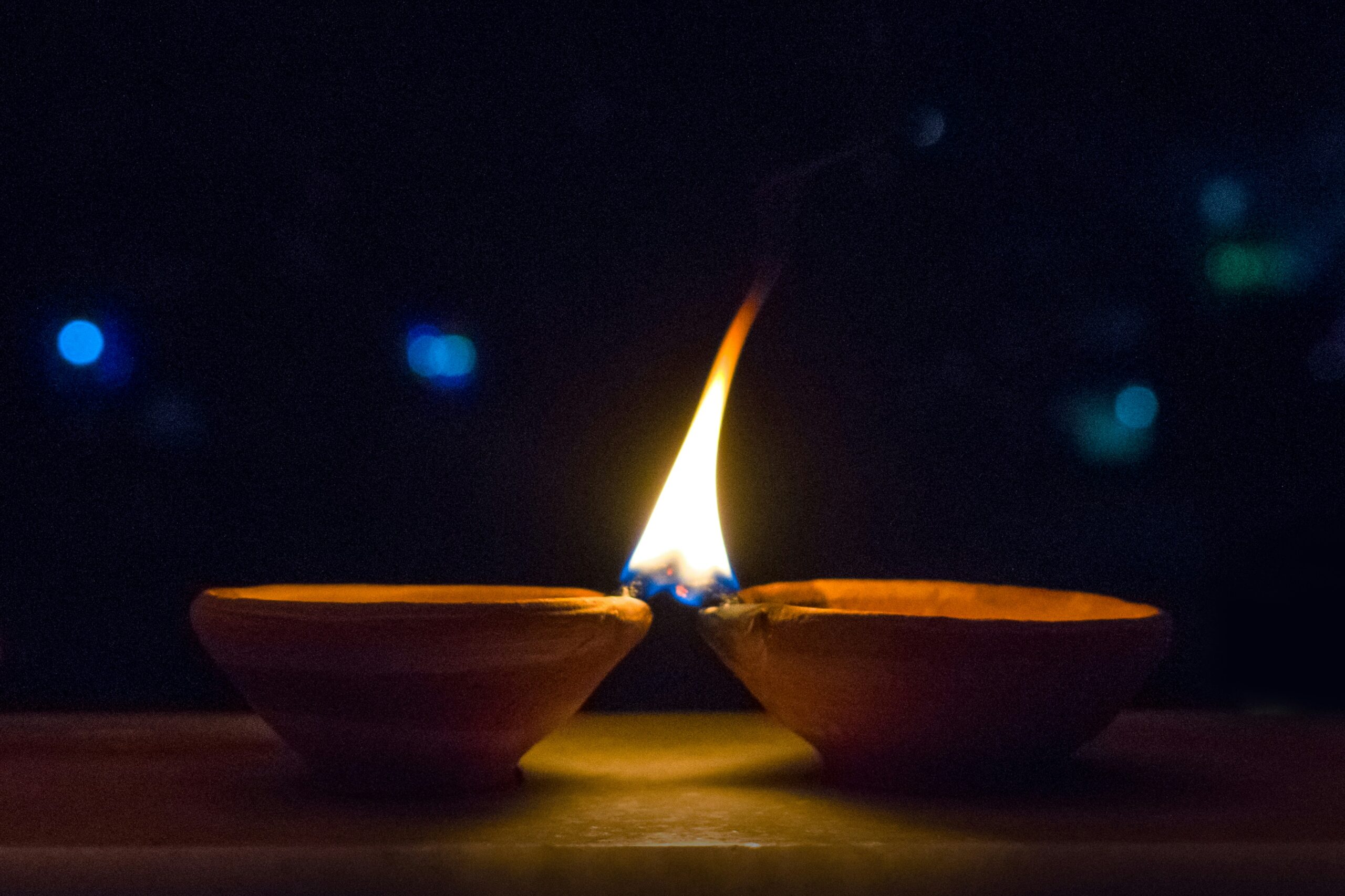
By four in the afternoon the terrace has already been swept twice. Someone has dragged down the cardboard box that lives on top of the wardrobe for eleven months of the year, and inside it are the diyas — small unglazed clay lamps, the colour of dry earth, still holding last year’s soot in their grooves. They go into a bucket of water for an hour so that the clay does not drink up all the oil. Somebody is arguing about whether the marigold string should hang across the doorframe or around it. And outside, a neighbour’s child has already set off a single firework, far too early, purely out of impatience.
This is the afternoon before. Not Diwali itself — because Diwali is not a single evening, though that is how most of the world has learned to picture it. What we call Diwali is a five-day sequence, and each of those days carries its own name, its own deity, its own story and its own small set of things you are meant to do. Learning the five days is what turns Diwali from a beautiful light show into something you can actually take part in.
Diwali 2026: The Five Days at a Glance
In 2026 the festival falls in early November. Here is the sequence, as the widely used North Indian purnimanta reckoning (a calendar in which the lunar month ends at the full moon) counts it:
- Day 1 — Dhanteras: Friday, 6 November 2026
- Day 2 — Naraka Chaturdashi / Choti Diwali: Saturday, 7 November 2026 (see the note below — some panchangs place the pre-dawn bath on the morning of the 8th)
- Day 3 — Lakshmi Puja, the main Diwali night: Sunday, 8 November 2026
- Day 4 — Govardhan Puja / Bali Pratipada / Gujarati New Year: Tuesday, 10 November 2026 (some calendars print 9 November)
- Day 5 — Bhai Dooj: Tuesday 10 or Wednesday 11 November 2026, depending on the panchang you follow
You have probably noticed that the last two entries are hedged rather than stated flatly. That is deliberate, and it is not evasion — it is how the Hindu calendar actually works. There is a section further down that explains exactly why, and it is worth reading before you commit to a date with your family.
One thing to settle immediately: every timing in this article is calculated for New Delhi and given in Indian Standard Time. If you are reading this in New Jersey, Leicester, Toronto, Melbourne or Dubai, these clock times do not apply to you. Tithis are astronomical, so the day usually holds; the hour almost never does. Check a panchang set to your own city.
Why Five Days, and Not One
The five days are not an arbitrary stretching-out of one festival. They are five genuinely separate observances that happen to sit next to each other in the calendar, and over centuries they fused into a single season the way a row of shops eventually becomes a bazaar.
Look at what each day is actually about and the variety is striking. One day honours wealth and the physician of the gods. One remembers the killing of a demon and involves a ritual bath before sunrise. One is the great night of the new moon, when Lakshmi is invited indoors. One commemorates a hill being lifted over a village — and, in a completely different region, the return of a defeated king. One is about the bond between a brother and a sister, and has nothing obvious to do with light at all.
What holds them together is the arc: from acquiring, to cleansing, to invoking, to giving thanks, to repairing relationships. Read in that order, the five days are a rather sophisticated piece of spiritual design.
And the regional differences are real. In Bengal, Assam and Odisha, the Amavasya night of Diwali is Kali Puja, and the goddess worshipped is not Lakshmi in her gold-and-lotus form but Kali, dark and terrifying and liberating. In Gujarat, the day after Diwali is Bestu Varas, the new year, and the ledgers are opened afresh. In much of Maharashtra and Karnataka the fourth day is Bali Pratipada, honouring the demon-king Bali. In Tamil Nadu the emphasis falls almost entirely on the oil bath of Naraka Chaturdashi, and the festival is called Deepavali without much of the five-day scaffolding. For Jains, the Amavasya of Kartika is the anniversary of Mahavira’s nirvana. For Sikhs it is Bandi Chhor Divas, marking Guru Hargobind’s release from imprisonment at Gwalior. India is not one place, and Diwali is not one festival.
Day One: Dhanteras — Friday, 6 November 2026
The first day is named for what it celebrates: dhan (wealth) and teras (the thirteenth lunar day). It falls on Krishna Trayodashi in the month of Kartika, and its most visible modern expression is a queue outside a jeweller’s shop.
But the day has an older and more interesting occupant. Dhanteras is also Dhanvantari Jayanti, the appearance day of Dhanvantari, the physician of the gods who rose from the churning of the cosmic ocean holding a pot of amrita, the nectar of immortality. The Bhagavata Purana places him among the treasures that emerged during that churning. Ayurvedic practitioners across India observe this day as their own, and the Government of India has designated it National Ayurveda Day.
That pairing tells you something. On the first day of Diwali the tradition puts wealth and health side by side and treats them as the same category of blessing. It is not a subtle point, and it is not a bad one.
What people actually do on Dhanteras
Metal is bought — gold and silver if the budget allows, and if it does not, then a steel or brass vessel, which carries the same intent without the markup. The custom is about bringing something durable and shining into the house, not about the price tag. Doorways are cleaned and decorated. In many homes thirteen lamps are lit. In Maharashtra and parts of the west, cattle are washed and garlanded, a reminder that for most of Indian history wealth had four legs and gave milk.
There is also a small, rather beautiful custom of lighting a lamp outside the house at dusk on Dhanteras for Yama, the lord of death — the Yama deepam — as a prayer for the long life of the family. Light for the god of death, on the day you celebrate abundance. The tradition rarely does only one thing at a time.
Day Two: Naraka Chaturdashi — Saturday, 7 November 2026
The second day goes by several names. In the north it is Choti Diwali, the little Diwali. In Gujarat it is Kali Chaudas. In Maharashtra and the south it is Naraka Chaturdashi, and in Tamil Nadu it is essentially the main event.
The story behind the name comes from the Puranic account of Narakasura, a demon who had terrorised the earth and imprisoned thousands of women. Krishna, in most tellings accompanied and assisted by his consort Satyabhama, killed him on this Chaturdashi. Before dying, Narakasura asked that his death be remembered not with mourning but with celebration and lights — which is why in a good part of India the festival of lamps begins here rather than on Amavasya.
The signature ritual is the abhyanga snan, a pre-dawn oil bath. Sesame oil is massaged into the body, often with a paste of ubtan (gram flour, turmeric and herbs), and the bath is taken before sunrise while it is still dark. The idea is that bathing before dawn on this day is equivalent to bathing in the Ganga, and that the body is being cleansed the way the earth was cleansed of Narakasura. In Tamil households a small firecracker is often lit before the bath, and the family eats Deepavali legiyam, a medicinal jaggery-and-spice preparation that exists, very practically, to help the digestive system survive the sweets that are coming.
A note on the date, and why Day 2 is the slipperiest
Here is where honesty matters more than tidiness. The Chaturdashi tithi in 2026 continues until roughly 11:28 AM IST on Sunday 8 November. Because the abhyanga snan is prescribed for the pre-dawn hours of Chaturdashi, and because the pre-dawn of 8 November still falls within that tithi, a number of panchangs place the ritual bath on the morning of 8 November — the same day as Lakshmi Puja that evening — while marking the evening of 7 November as Choti Diwali or Roop Chaudas for the purpose of lighting lamps. Both are defensible readings of the same astronomy. Follow what your family or your regional panchang has always done; there is no single right answer being withheld from you here.
Day Three: Lakshmi Puja — Sunday, 8 November 2026
This is Diwali as most people mean it. The night of Kartika Amavasya, the darkest night of the lunar month, chosen deliberately as the night to fill a house with light.
In 2026 the Amavasya tithi begins at approximately 11:28 AM IST on Sunday 8 November and ends at approximately 12:31 PM IST on Monday 9 November (New Delhi). Because Lakshmi Puja is performed after sunset, and because Amavasya is running through the evening of the 8th, Sunday 8 November is the date on which the calendars agree — the one unambiguous day in the whole sequence.
The muhurat, and how much to worry about it
Lakshmi Puja is performed in Pradosh Kaal, the twilight window that follows sunset. For New Delhi in 2026 that window runs roughly from 6:00 PM to 8:40 PM IST, with the core recommended puja period falling around 6:29 PM to 8:29 PM IST. Some households prefer Nishita Kaal, close to midnight, which is the traditional preference for Tantric worship and for Kali Puja in the east.
Treat these numbers as what they are: sunset-derived windows for one city. The pradosh window in Chennai and in Ahmedabad differ by close to an hour. For readers in the United States, the United Kingdom, Canada or Australia, the Indian clock time is meaningless — what you want is the twilight period after your own sunset on the day your local panchang marks as Amavasya, which in some years and some longitudes lands on a different calendar date altogether. Use a panchang app set to your city, or ask the priest at your local temple, who will have already worked it out.
What the puja involves
Lakshmi is worshipped alongside Ganesha — he is invoked first, as he is at the start of nearly everything — and in many homes alongside Kubera, treasurer of the gods, and Saraswati. Businesses perform Chopda Pujan, the worship of account books, opening new ledgers for the coming year.
The essentials are not complicated: a clean house, a clean cloth on a raised platform, images or idols of Lakshmi and Ganesha placed facing east or north-east, a lamp lit with ghee or oil, water, rice, flowers, kumkum, sweets, and a coin or piece of jewellery placed before the goddess. The main door is left open or at least unbarred, and lamps are placed at the threshold and along the balcony, because the whole ritual grammar of the night is invitation. Rangoli at the entrance, footprints drawn leading inward, doors open, lamps burning. You are not petitioning a distant deity. You are making a house that a guest would want to enter.
And the guest matters. Lakshmi in this tradition is not simply money. She is shri — grace, auspiciousness, the quality that makes a life feel abundant rather than merely funded. Which is why the tradition insists on the cleaning, the lamps and the open door, and is largely indifferent to how expensive the offerings are.
Day Four: Govardhan Puja and Bali Pratipada — Tuesday, 10 November 2026
The fourth day is the one that varies most from region to region, because more than one observance occupies it.
In the Braj region and across Vaishnava communities it is Govardhan Puja or Annakut, remembering the episode in the Bhagavata Purana in which the young Krishna persuades the cowherds of Vrindavan to stop propitiating Indra and to honour instead the hill that actually feeds their cattle. When Indra retaliates with a week of devastating rain, Krishna lifts Govardhan hill on one finger and shelters the entire village beneath it. The ritual response is annakut, a mountain of food — grains, sweets, vegetables, sometimes hundreds of preparations — built up before the deity and then distributed. A small hill of cow dung or of food is often made at home and worshipped, and cattle are bathed, painted and garlanded.
In Maharashtra, Karnataka and parts of the south the same day is Bali Pratipada, marking the annual return of King Bali to the earth he once ruled. Bali was a demon-king of genuine virtue, so generous that Vishnu had to take the dwarf form of Vamana to contain him — and so, in the deal that follows, Bali is granted one day each year when he may revisit his people. In Gujarat the day is Bestu Varas, the first day of the new year, with new clothes, temple visits and the settling of old accounts.
Why some calendars print 9 November instead
Govardhan Puja is observed on Kartika Shukla Pratipada. In 2026 that tithi begins at approximately 12:31 PM IST on Monday 9 November and ends at approximately 2:00 PM IST on Tuesday 10 November (New Delhi). By the standard rule — the tithi that is current at sunrise governs the day — the observance belongs to Tuesday 10 November, and the morning puja is performed before the tithi lapses at 2 PM. That is the reading most detailed panchangs give.
Some popular calendars nevertheless print 9 November, because that is the day on which the Pratipada tithi begins and because “the day after Diwali” is an easy shorthand. If you see both dates in circulation, this is why. Check your own panchang, and if your temple has announced a date, follow the temple.
Day Five: Bhai Dooj — 10 or 11 November 2026
The last day closes the season with something completely different from everything preceding it: not a deity, not a demon, but a sibling.
Bhai Dooj — Bhai Bij in Gujarat and Maharashtra, Bhai Phota in Bengal, Bhau Beej, and closely related to the Nepali Bhai Tika — is observed on Kartika Shukla Dwitiya. A sister applies tilak to her brother’s forehead, performs aarti, prays for his long life and feeds him; he gives her a gift and, in the older framing, a standing promise of protection. The traditional story is that Yama, lord of death, visited his sister Yamuna on this day; she welcomed him so warmly that he granted a boon that any brother honoured by his sister on this tithi would be spared untimely death. It is a festival about a relationship being maintained deliberately, on a fixed date, whether or not the year has been kind to it.
The date genuinely splits in 2026
The Dwitiya tithi in 2026 begins at approximately 2:00 PM IST on Tuesday 10 November. Bhai Dooj tilak is prescribed for aparahna, the afternoon. So one school places the observance on the afternoon of 10 November, because Dwitiya is live during the aparahna window that day. Another applies the sunrise rule and places it on Wednesday 11 November, when Dwitiya prevails at daybreak. Reputable panchangs print both, and you will find Hindi-language calendars in 2026 openly asking which it is.
This is not a failure of the system. Sibling festivals are family festivals, and the honest answer is: ask the elders in your family what they have always done, or follow the panchang your household has always used. If you have siblings in different countries, pick a date that lets you actually speak to each other, and do not lose sleep over the tithi.
Why the Dates Move, Explained Once and Properly
If you have ever wondered why Diwali arrives in mid-October one year and mid-November the next, or why two aunties with two apps get two answers, this is the mechanism.
The Hindu calendar is lunisolar. Months follow the moon; the year is kept in step with the sun by inserting an extra month periodically. The unit that governs festivals is not the day but the tithi — the time the moon takes to gain twelve degrees of angular distance from the sun. A tithi can run anywhere from about 19 to about 26 hours, so it does not line up neatly with a sunrise-to-sunrise day. It starts and ends at a clock time, and that clock time depends on your longitude and latitude.
So three things can move a festival: which tithi the rule prescribes; whether the rule keys off sunrise, midday, afternoon or twilight; and where on earth you are standing. When two calendars disagree, it is almost always because they are applying a different one of these three, not because one is wrong.
Two practical consequences for readers outside India. First, a tithi that is current at sunrise in Delhi may not be current at sunrise in Toronto, so your date can legitimately differ by a day. Second, timings expressed as clock hours — every muhurat in this article included — are useless to you unless recalculated for your city. The fix is simple: use a panchang set to your location, or follow your local temple, which does this arithmetic every year.
What the Five Days Are Actually For
It would be easy to treat all of this as heritage — charming, inherited, performed because it has always been performed. But the five days have a structure that repays attention, and it is a structure you can use.
They begin with acquiring and they end with relationship. In between comes cleansing, then invitation, then gratitude. That is not a random order. It says: bring something in, but clean before you do; make the space worth entering; then remember what actually fed you; then go and mend the person you have been neglecting. Read as a sequence, Diwali is a small annual audit of a household — its finances, its hygiene, its hospitality, its gratitude and its relationships, in that order.
A few things worth doing with that, this year:
- Take the cleaning seriously, and treat it as the ritual rather than the prelude. The tradition is unusually explicit that Lakshmi does not enter a neglected house. Clearing out what you have stopped using is the first act of worship, not the chore before it.
- Keep Dhanteras honest. The day is about welcoming something durable, not about spending to a benchmark. A brass vessel discharges the custom completely. So, arguably, does putting money into something that will still matter in ten years.
- Put Dhanvantari back into Dhanteras. If health and wealth are paired on day one, use the day to schedule the check-up you have been deferring. This is a more faithful observance than it sounds.
- Light lamps, not just lights. An electric string is fine, but one ghee or oil lamp that you fill and light yourself does something to a room, and to the person lighting it, that a plug-in cannot. The whole festival is built on the difference.
- Use Bhai Dooj as it was designed. Not as a gift transaction but as a fixed annual appointment with a sibling. If you are in the diaspora and the tithi is inconvenient, keep the appointment and move the hour.
- Be thoughtful about fireworks. Air quality in Indian cities in early November is a genuine public-health matter, and neither the Puranic sources nor the ritual grammar of the festival require them. Lamps are the tradition; explosives are a recent and negotiable addition.
Frequently Asked Questions
When is Diwali in 2026?
The main Diwali night — Lakshmi Puja on Kartika Amavasya — falls on Sunday, 8 November 2026. The five-day festival runs from Dhanteras on Friday 6 November through Bhai Dooj on 10 or 11 November, depending on the panchang followed. Readers outside India should confirm the date against a calendar set for their own city.
What are the five days of Diwali in order?
Dhanteras, then Naraka Chaturdashi (Choti Diwali or Kali Chaudas), then Lakshmi Puja on Amavasya — the main Diwali night — then Govardhan Puja or Bali Pratipada, and finally Bhai Dooj. Not every region observes all five with equal weight: Tamil Nadu centres on Naraka Chaturdashi, Bengal observes Amavasya as Kali Puja, and Gujarat treats the fourth day as new year.
What is the Lakshmi Puja muhurat for Diwali 2026?
For New Delhi, the Pradosh Kaal window on 8 November 2026 runs roughly from 6:00 PM to 8:40 PM IST, with the core recommended puja period around 6:29 PM to 8:29 PM IST. These are sunset-derived timings for one city; Chennai and Ahmedabad differ by close to an hour, and IST timings do not transfer to the United States, United Kingdom, Canada or Australia at all. Use a panchang set to your location.
Why do different calendars give different dates for Govardhan Puja and Bhai Dooj?
Because festivals are fixed to tithis, not to dates, and a tithi begins and ends at a clock time that shifts with your location. In 2026 the Pratipada tithi runs from about 12:31 PM on 9 November to about 2:00 PM on 10 November IST, so the sunrise rule places Govardhan Puja on the 10th while some calendars print the 9th. Dwitiya begins about 2:00 PM on 10 November, so Bhai Dooj is printed as either the 10th (afternoon tilak window) or the 11th (sunrise rule). Both readings have respectable backing.
Is Diwali a Hindu festival only?
No. Jains observe the Amavasya of Kartika as the anniversary of Mahavira attaining nirvana. Sikhs observe Bandi Chhor Divas, marking Guru Hargobind’s release from imprisonment at Gwalior and his arrival at Amritsar. Some Buddhist communities, particularly Newar Buddhists in Nepal, also observe the season. The lights are shared; the meanings differ.
Can I perform Lakshmi Puja at home without a priest?
Yes. Household Lakshmi Puja has always been performed by families themselves. A cleaned space, a raised platform with a clean cloth, images of Lakshmi and Ganesha facing east or north-east, a ghee or oil lamp, water, rice, flowers, kumkum, sweets and a coin are sufficient. Invoke Ganesha first. If you would like a priest, temples in most diaspora cities arrange household pujas during the season, and many now do so over video.
Do I have to light fireworks for Diwali?
No. The scriptural and ritual core of the festival is the lamp — the deepa that gives Deepavali its name. Fireworks are a later addition, widespread but not prescribed, and many families now omit them entirely on grounds of air quality, noise, animal welfare or cost without any loss of religious observance.
A Closing Thought
What stays with you about Diwali, years later, is rarely the biggest light or the loudest night. It is something smaller: the smell of the oil soaking into old clay, the particular silence of a house that has just been cleaned, an argument about marigolds, a lamp at the threshold going out in the wind and being lit again.
The five days are a kind of instruction in that. They take a house and make it worth entering, then take a family and make it speak to itself again. The new moon does what new moons do — it makes the night as dark as the month allows. The tradition’s response is not to wait for the moon. It is to put out a row of small flames and open the door.
Continue Exploring
- The Significance of Navratri
- How to Celebrate Navratri at Home
- The Nine Forms of Durga: Navadurga Explained
- Why We Celebrate Holika Dahan
- How to Chant the Vishnu Sahasranama