
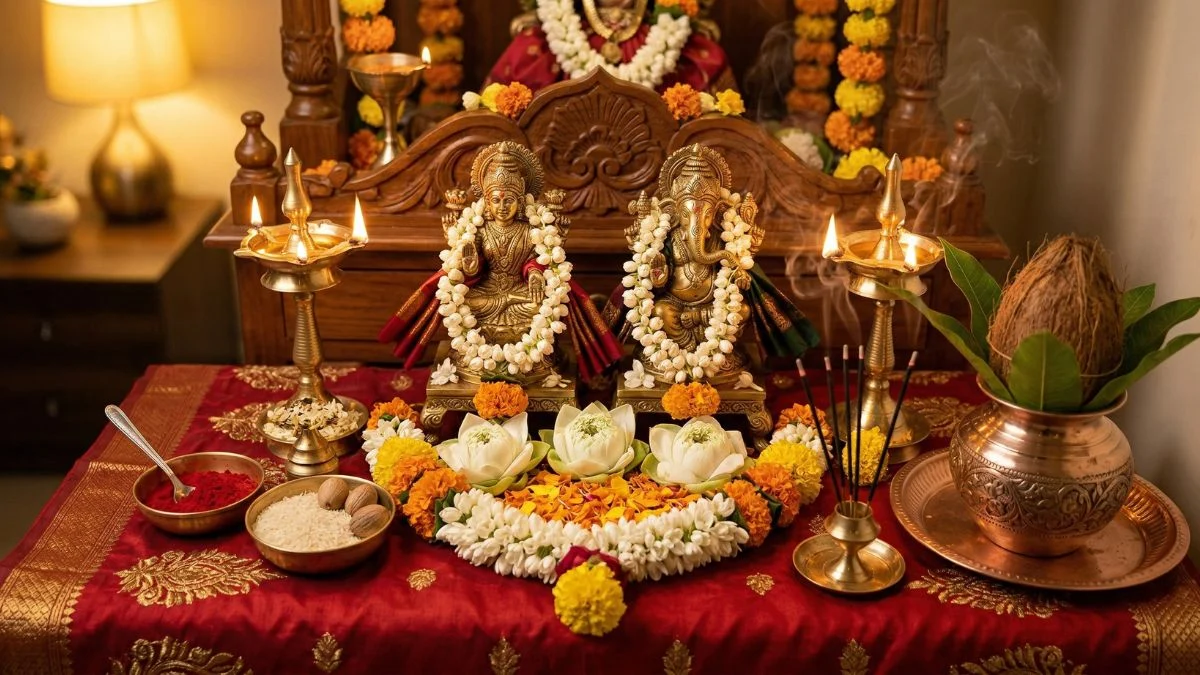
There is a particular half-hour on Diwali evening when a house stops being a building. The last of the daylight has gone grey, the first diya is lit at the threshold, and somebody is still kneeling on the floor finishing the rangoli — two small footprints drawn at the doorway, pointing inward. The kitchen smells of ghee. Someone is hunting for the matchbox. Then the lamps go up along the parapet, one after another, and the house turns golden from the outside in.
That half-hour has a name. It is called Pradosh Kaal — the twilight that begins at sunset — and it is when Lakshmi Puja, the central rite of Diwali, is traditionally performed. In 2026 it falls on the evening of Sunday, 8 November.
If you have ever stood slightly to one side at a family Lakshmi Puja, half-knowing the words, this is written for you. So is the opposite case — the person who has always done the puja and has begun to wonder why. Why the Taurus hour. Why Ganesha on that side. Ritual that is only inherited tends to shrink; ritual that is understood tends to deepen.
Where Lakshmi Puja Sits in the Festival of Lights
Diwali is not one festival but a cluster of five observances stacked across the dark end of one lunar month and the bright beginning of the next. Dhanteras opens it, Narak Chaturdashi follows, and then comes the new-moon night — Amavasya — which is Diwali proper, with Lakshmi Puja at its centre. Govardhan Puja and Bhai Dooj close the sequence.
A word about the month, because it is the commonest small error in Diwali writing. In North India the calendar is purnimanta, counting full moon to full moon, and Diwali falls in Kartik. In Gujarat, Maharashtra and the south the calendar is amanta, counting new moon to new moon, and the same night is the last day of Ashvin. Neither is wrong — it is the same darkness, the same moon, the same night, and the two systems simply draw the month’s boundary in different places.
Diwali’s roots also run deeper than the version most of us were told. The association with Rama’s return to Ayodhya is beloved and real as living tradition, but there are no references to Diwali or Deepavali in Valmiki’s Ramayana, nor in Tulsidas’s Ramcharitmanas. The earliest datable references to a festival of lamps lie elsewhere — Harsha’s seventh-century play Nagananda speaks of Dipapratipadotsava, and Vatsyayana’s Kamasutra describes Yaksha Ratri, a night of dice-play by Kubera’s attendants that some scholars take to be Diwali’s ancestor. The Rama story is a later and magnificent overlay on an older night.
Lakshmi Puja 2026: Dates and Muhurat
Amavasya tithi begins at 11:27 AM on Sunday 8 November and ends at 12:31 PM on Monday 9 November (Indian Standard Time; a tithi boundary is a single clock time across one time zone). Lakshmi Puja requires Amavasya to be present at twilight — on 8 November it is, and on 9 November it has already ended before sunset. So Diwali 2026 is Sunday 8 November, and panchangs agree. If you have seen a site claiming 10 November, it has made an error.
The five days, as most Indian panchangs give them:
- Friday 6 November — Dhanteras, with Dhanvantari Jayanti and Yama Deepam
- Saturday 7 November — Kali Chaudas / Chhoti Diwali (the night rituals)
- Sunday 8 November — Narak Chaturdashi at dawn and Diwali / Lakshmi Puja in the evening, both on one day
- Tuesday 10 November — Govardhan Puja / Annakut / Bali Pratipada, and Gujarati New Year (Bestu Varas), Vikram Samvat 2083
- Wednesday 11 November — Bhai Dooj / Bhau Beej / Yama Dwitiya
Two honest caveats. Chaturdashi runs from late morning on the 7th to late morning on the 8th, so the midnight Kali Chaudas customs fall on the night of 7–8 November while the pre-dawn abhyanga snan falls on the morning of the 8th. And because Amavasya runs past noon on the 9th, most panchangs push Govardhan Puja to the 10th — though a minority place it on the 9th, and Bhai Dooj on the 10th rather than the 11th. If those days matter in your family, check the panchang your family actually follows.
The Muhurat — and Why You Cannot Borrow Someone Else’s
A muhurat is not a clock time that travels. It is calculated from local sunset and the sign rising on the local horizon, combined with the tithi — which is the single most useful thing to understand about Diwali timings, and the thing most festival content gets wrong by publishing one window as if it were universal. For 8 November 2026, the Lakshmi Puja window — Pradosh Kaal overlapping the fixed ascendant of Vrishabha (Taurus) — works out roughly as:
- New Delhi — about 5:54 to 7:50 PM IST
- Mumbai — about 6:27 to 8:27 PM IST
- London — about 4:35 to 6:12 PM GMT
- New York — about 5:04 to 6:52 PM EST
These come from Drik Panchang’s city-specific calculations as of early October 2026 and are offered as illustration, not instruction. Please look up your own city on a panchang that lets you select a location. Delhi and Mumbai are thirty-three minutes apart; London’s window closes before most working families have eaten. And a trap for North American readers: US clocks fall back on 1 November 2026, so the muhurat sits in standard time and will feel an hour earlier than you remember.
Why Taurus? Jyotisha classes the signs as movable, fixed (sthir) and dual. Lakshmi is traditionally described as chanchala — restless, inclined to leave — and a fixed ascendant is held to confer stability on whatever begins within it, so wealth invoked in one is said to stay. Vrishabha happens to be the fixed sign rising just after sunset around Kartik Amavasya, which is why it overlaps Pradosh Kaal so neatly. That overlap, not Taurus alone, defines the window.
And a correction worth making plainly: household Lakshmi Puja does not belong at midnight. The midnight window — Mahanishita Kaal, and the Simha ascendant after it — is the one panchangs describe as suited to tantric practitioners and practising pandits, and it is the window Bengal uses for Kali Puja. The family puja belongs in the twilight.
Who Lakshmi Actually Is
She is older than the stories most of us know her by. The earliest hymn addressed to her is the Sri Suktam, and its placement is worth getting right: it is not part of the Rigveda Samhita proper but one of the khilani, the appendix hymns, usually attached to the fifth Mandala and preserved only in the Bashkala recension. The recited hymn runs to fifteen rks. Its opening line asks Agni to bring her:
ॐ हिरण्यवर्णां हरिणीं सुवर्णरजतस्रजाम् ।
चन्द्रां हिरण्मयीं लक्ष्मीं जातवेदो म आवह ॥
oṃ hiraṇyavarṇāṃ hariṇīṃ suvarṇarajatasrajām | candrāṃ hiraṇmayīṃ lakṣmīṃ jātavedo ma āvaha || — “O Jatavedas, bring to me that Lakshmi who is golden-hued and tawny, wearing garlands of gold and silver, moon-like and made of gold.”
Notice what the hymn is about: cattle, grain, horses, the banishing of hunger and thirst. This is not a hymn about money. It is a hymn about a household not going short.
Her emergence from the churning of the ocean — samudra manthana — is told most fully in the Bhagavata Purana, Canto 8, Chapter 8, and there is a detail there that rarely survives the retellings: she is not handed to Vishnu. She surveys everyone assembled, gods and sages and asuras alike, finds each of them flawed, and then chooses him. For a goddess so often spoken of as a prize, the text is remarkably clear that she is an agent. The Vishnu Purana (Book 1, Chapter 9) carries its own version, and the Padma Purana places her birth on Dhanteras and her choosing of Vishnu on Diwali itself. Those are the places to look — much Diwali writing cites “the Puranas” with no chapter at all.
Her image repays a second look. Four hands, for the four ends of human life — dharma, artha, kama, moksha. A lotus held and a lotus sat upon, for knowledge and liberation. Two elephants pouring water from raised trunks, in the Gaja Lakshmi form that is among the oldest attested Lakshmi images in Indian art. One hand in abhaya mudra, fearlessness; the other in varada, the gesture that grants. And the owl, her occasional vahana — which popular writing has backwards, calling it inauspicious when iconographically it signifies patient observation and the ability to see in the dark.
And Her Elder Sister
There is a figure Diwali’s cheerfulness tends to edit out. Alakshmi — “not-Lakshmi” — also called Jyeshtha, the elder, is Lakshmi’s sister and her shadow: poverty, misfortune, discord. The Sri Suktam itself petitions for her removal, the Padma Purana and Linga Purana describe her, and in the churning narrative she emerges first. This is the real sense behind customs that otherwise look like superstition — the deep cleaning, the lime and green chillies strung at the doorway, the new broom honoured with kumkum. None of these are about dirt. They are about sweeping out the elder sister so the younger one has somewhere to sit. Alakshmi is not a demon but a sequence: struggle precedes abundance, and the household that has known one recognises the other.
Why Ganesha Sits Beside Her
Almost every Diwali altar has two deities on it and almost nobody can say what the relationship is. So, plainly: Lakshmi is not Ganesha’s wife. Nor his mother, nor his daughter. Ganesha’s traditional consorts are the personified Siddhi, Buddhi and Riddhi, and in Bengal he is reckoned the brother of Lakshmi and Saraswati. Their pairing at Diwali rests on something simpler: functional equivalence, and centuries of joint worship by trading communities. A merchant lighting lamps over a new ledger wants both prosperity and the removal of obstacles, and wants the obstacle-remover honoured first, as he is in every Hindu rite.
Which brings us to the question that generates more Diwali-eve arguing than any other. The confusion is entirely about whose left and right is meant, so stated in the viewer’s terms: as you stand facing the altar, Ganesha goes on your left and Lakshmi on your right — which places Ganesha at Lakshmi’s right hand, the position of honour. If Saraswati is included, she goes on your right. Half the instructions in circulation look contradictory only because some are written from the deity’s point of view.
What You Will Need
Nothing here is mandatory, and no priest is required for a home puja.
- Murtis or framed images of Lakshmi and Ganesha; a low wooden chowki and red or yellow cloth
- A kalash — a copper or brass pot of water with a coin, a betel nut, mango or betel leaves ringing the mouth, and a coconut on top
- Raw rice (akshat), kumkum, haldi, sandal paste; fresh flowers, lotus if you can find it, and a garland
- Diyas with cotton wicks, ghee or oil; incense, camphor, a bell, an aarti thali
- Betel leaves and nuts; panchamrit (milk, curd, ghee, honey, sugar)
- Naivedya: ladoo, kheer, batasha, kheel; fruit, especially pomegranate, sugarcane and water chestnut
- Coins, new notes, any gold or silver in the house; optionally a Shri Yantra and the new account books
The Puja, Step by Step
The classical framework is the upachara — the acts of service offered to a guest. Traditions count five, sixteen (shodasha upachara) or sixty-four, and orderings differ, so treat this as a shape rather than a script.
- Prepare the house. Clean it thoroughly, especially the entrance — the cleaning is part of the observance, not preparation for it. Bathe, wear clean or new clothes, and draw the rangoli at the threshold with Lakshmi’s footprints turned inward.
- Set the altar. Place the chowki in the north-east of the room, the direction called Ishaan, and spread the cloth over a bed of rice. The images face north or east; you sit facing east or north.
- Arrange the deities. Ganesha on your left, Lakshmi on your right, kalash beside them. If your family keeps a Kubera kalash or a representation of the household safe, it goes here too — a living custom among traders rather than a textual prescription.
- Purify and resolve. Sip water in achamana, light the first diya and the incense, ring the bell. Then make the sankalpa: holding water, rice and a flower in your right hand, state your family’s name and what you are doing and why. This is the hinge of the whole rite. A puja without sankalpa is decoration.
- Ganesha first, with kumkum, akshat, a flower and something sweet: oṃ gaṃ gaṇapataye namaḥ. Then invoke the kalash, and the Navagraha if your tradition includes them.
- Then Lakshmi. Meditate on her, invoke her, offer a seat, water for her feet and hands, a bath of water or panchamrit, cloth and ornament, sandal paste, flowers, incense, the lamp, food and betel — closing with the camphor flame.
- Place your wealth before her — coins, notes, ornaments, the new ledgers — and chant a round of her mantra, or the Sri Suktam.
- Aarti, with an odd number of wicks, five being usual. Then pranam, an apology for whatever you got wrong, and prasad for everyone in the house.
Keep at least one lamp burning through the night, and light the rest along the threshold, windowsills and balcony — but not behind the deities.
Chopda Pujan: Worshipping the Ledger
Among Gujarati, Marwari and Maharashtrian trading families the main puja is preceded by the consecration of the new account books — chopda pujan in Gujarati, bahi khata in the north, sharda pujan elsewhere. The Hindu accounting year turns the day after Diwali, which is exactly why the new ledgers are blessed now. On the first page, in kumkum and turmeric: Shubh and Labh — auspiciousness and gain — a swastika, and Shri Ganeshay Namah. In the Gujarati form Saraswati is honoured before Lakshmi, which is why it is also called Sharda Pujan: knowledge consecrated before the profit knowledge earns. The custom has modernised, too — laptops and card machines now get the kumkum that once went on a cloth-bound ledger.
Mantras, With Their Attributions Straight
The beeja mantra is often mangled online as “Om Shreem Mahalakshmiyei Namaha.” That is a mis-transliteration; “Mahalakshmiyei” is not a Sanskrit word. The correct form:
ॐ श्रीं महालक्ष्म्यै नमः — oṃ śrīṃ mahālakṣmyai namaḥ — “Om. Shrim. Salutations to Mahalakshmi.” श्रीं is her seed syllable, महालक्ष्म्यै the dative, “to Mahalakshmi,” and नमः the bow.
The Lakshmi Gayatri, in the form given in the compiled Gayatri collections:
ॐ महालक्ष्म्यै च विद्महे महाश्रियै च धीमहि । तन्नः श्रीः प्रचोदयात् ॥ — oṃ mahālakṣmyai ca vidmahe mahāśriyai ca dhīmahi | tannaḥ śrīḥ pracodayāt || — “We know Mahalakshmi; we meditate on Mahashri. May that Shri impel us.”
A variant substituting viṣṇupatnyai, “the consort of Vishnu,” circulates even more widely. Both are legitimate in practice, but neither is Vedic, and it is worth saying so: the canonical Vedic deity-gayatris sit in the Mahanarayana Upanishad (the tenth prapathaka of the Taittiriya Aranyaka), and that set has gayatris for Ganapati, Rudra, Vishnu and Durga — but none for Lakshmi. The Lakshmi Gayatri is a post-Vedic composition on the Gayatri template, and loses nothing by being described accurately.
One Night, Many Countries
India is not monolithic, and Diwali is where that is most visible. North India keeps the full five days with Lakshmi Puja at the centre, Rama’s return as the governing story, and Chitragupta Puja alongside Bhai Dooj in Kayastha households. Gujarat and the Marwari communities open with Vagh Baras, perform Chopda Pujan, and greet the Gujarati New Year the day after with Saal Mubarak. Maharashtra begins with Vasu Baras, when cows and calves are garlanded, and brings the karit fruit crushed underfoot for Narakasura and the faral platter to the Lakshmi Pujan. Tamil Nadu and the South centre Deepavali on the Naraka Chaturdashi morning instead of the Amavasya evening — the oil bath before sunrise, crackers at first light, and Deepavali marundhu, the herbal paste taken to survive the festival food. Kerala largely does not observe Diwali as a major festival at all.
Bengal, Odisha and Assam need the most care, because this is where Diwali writing most often goes wrong. On Diwali night Bengal worships Kali, not Lakshmi; the Bengali Lakshmi Puja is a different festival on a different date altogether — Kojagari Lakshmi Puja, on the full moon of Ashwin, which in 2026 fell on 25 October. Its name comes from the question the goddess is said to ask as she passes in the night, Ko jagarti?, “Who is awake?”, so the household stays up with alpona at the door and the Lakshmi Panchali read aloud. In Odisha, Naraka Chaturdashi brings Bada Badua Daka, when bundles of jute sticks are burned to call the ancestors home: Bada badua ho, andhaara re aasa, alua re jaa — “O ancestors, come from the darkness, go towards the light.”
Outside Hindu practice, the same night carries other meanings. Jains observe Kartik Amavasya as the nirvana of Mahavira at Pawapuri, offering Nirvana Laddu and avoiding firecrackers on grounds of ahimsa. Sikhs mark Bandi Chhor Divas, the release of Guru Hargobind from Gwalior Fort with fifty-two imprisoned Rajput rulers — a commemoration of liberation in its own right, not a Hindu Diwali in Sikh dress.
Why This Matters Now — Especially Far From Home
Most readers of an article like this are not standing in an Indian courtyard. They are in Edison or Hounslow or Mississauga or Melbourne, and the question is logistical: how do you do this properly when the muhurat lands at five o’clock in a city where the sun sets at half past four?
Three things genuinely help. First, the tithi is determinable anywhere on earth — November 2026’s new moon instant falls at about 07:01 UTC on the 9th. What changes with your location is not whether it is Diwali but when the twilight window opens, so look up your own city rather than Delhi’s.
Second, separate the puja from the party. Community celebrations — the mela, the cultural programme, the fireworks — are routinely held on the nearest convenient weekend and nothing is lost by that. The home puja is the part that belongs on the correct tithi in the correct local window. Families who cannot manage the exact window are generally advised by their own priest to perform it at the nearest feasible time on the right day; that is common practice rather than anybody’s formal dispensation, and worth asking your local temple about rather than taking a website’s word for it. In 2026 the diaspora gets lucky: Diwali is a Sunday.
Third, let the ritual do what it was designed to do. The Sri Suktam is not a hymn about getting rich; it asks for grain, cattle and the absence of hunger — for a household that is not in want and can therefore be generous. The deep clean before the lamps, the ledger opened in public, the prasad that goes round to the whole staff: these are the gestures of a tradition that understood prosperity as something held in common and maintained by attention. A Lakshmi Puja performed as a transaction is a small thing. Performed as an annual act of housekeeping — of the house, and of the self — it is considerably larger.
Frequently Asked Questions
What is the Lakshmi Puja muhurat for Diwali 2026?
Diwali 2026 falls on Sunday 8 November. The muhurat is the overlap of Pradosh Kaal with the Vrishabha (Taurus) ascendant — roughly 5:54 to 7:50 PM in New Delhi and 6:27 to 8:27 PM in Mumbai, by Drik Panchang’s calculation. Because a muhurat depends on local sunset and the local rising sign, these do not transfer to other cities; look up your own location on a panchang that lets you select a city.
Can I do Lakshmi Puja at home without a pandit?
Yes. A home Lakshmi Puja is a householder’s rite and has always been performed by families themselves. The essentials are a clean space, a properly arranged altar, the sankalpa in which you state your intention, Ganesha honoured first, the offerings to Lakshmi, and aarti. Imperfect Sanskrit is not an obstacle; the tradition is clear that intention carries the rite.
Which side should Ganesha be placed on during Lakshmi Puja?
As you stand facing the altar, Ganesha goes on your left and Lakshmi on your right — which puts Ganesha at Lakshmi’s right hand. If Saraswati is included, she sits on your right. The contradictory instructions online are mostly the same instruction written from the deity’s point of view.
Should Lakshmi Puja be done at midnight?
Not for a household. Midnight — Mahanishita Kaal, and the Simha ascendant after it — is described in the panchangs as suited to tantric practitioners and practising pandits, and is the window Bengal uses for Kali Puja. Family Lakshmi Puja belongs in Pradosh Kaal, the twilight beginning at sunset.
Do Bengalis do Lakshmi Puja on Diwali?
No — this is the commonest regional mix-up in Diwali writing. Bengal performs Kali Puja on Diwali night. The Bengali Lakshmi Puja is Kojagari Lakshmi Puja, on the full moon of Ashwin, which in 2026 fell on 25 October, about three weeks earlier.
Is Diwali the Hindu New Year?
Only in some traditions. The Kartikadi Vikram Samvat used in Gujarat and Rajasthan turns the day after Diwali, as do the Jain Vira Nirvana Samvat and the Newar Nepal Sambat. Most of India’s new year falls elsewhere — Gudi Padwa and Ugadi in spring, Baisakhi and Poila Boishakh in April.
The Lamp and the Dark
A diya is a very small thing. Clay, a thumb of oil, a twist of cotton. It will not light a room properly and it will not last the night without tending — which is, probably, the point. The festival does not ask you to abolish the dark. It asks you to put one flame into the middle of the darkest night of the darkest fortnight and keep it going. The new moon is not an obstacle to Diwali; the new moon is the occasion.
When you set the lamps out on 8 November, the same thing will be happening at slightly different clock times along the whole curve of the earth — in Ujjain at twilight, in London in the late afternoon, in New Jersey as the light goes. Same tithi, same goddess, same small flame.
Continue Exploring
- Significance of Navratri: The Spiritual Meaning of the Nine Nights
- How to Celebrate Navratri at Home: Ghatasthapana, Puja Vidhi and Fasting
- The Nine Forms of Durga: Navadurga Explained, Day by Day
- Dussehra (Vijayadashami): Meaning, the Two Legends, and How India Celebrates
- How to Chant Vishnu Sahasranama