
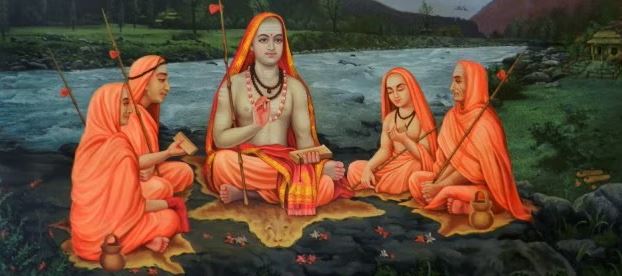
The story goes that a young monk, barely out of his teens, walked up to a scholar’s house in Mahishmati and found a ritual in progress. The householder was Mandana Mishra, the most formidable ritualist of his generation, and the monk had come to debate him. Mandana, mid-ceremony and in no mood, dismissed him with a lawyer’s insult about the irrelevance of renouncers.
The monk stayed. The debate was held. It ran, in the telling, for days — and when Mandana finally conceded, his wife Ubhaya Bharati, herself a scholar, stepped in and continued the argument on her husband’s behalf, probing the young monk on the one subject a lifelong celibate could not possibly know. He asked for a month’s recess, got it, and came back with an answer.
Almost none of that can be verified. It survives in hagiographies written centuries after the fact, and historians treat the details as literature rather than record. But the scene is worth beginning with anyway, because it captures the thing that made Adi Shankaracharya matter: a man who believed a question about the nature of reality could be settled by argument, in public, with anyone who showed up — and who then walked the length of India looking for people to argue with.
He is said to have died at thirty-two. In that time, tradition credits him with reorganising Hindu philosophy, establishing four monastic centres at the four corners of the subcontinent, and writing commentaries that people are still unpicking line by line twelve hundred years later. He is the reason “Advaita” is a word most educated Indians recognise, and the reason a sannyasi in Joshimath and one in Sringeri can trace themselves to the same teacher.
Who Was Adi Shankaracharya?
Shankara — the honorifics Adi (first) and Acharya (teacher) were added by later tradition to distinguish him from the long line of Shankaracharyas who hold his seats to this day — was a philosopher, commentator, poet and monastic organiser. His life’s work was the systematisation of Advaita Vedanta, the school of Indian philosophy holding that reality is non-dual: that the self within and the ultimate ground of existence are not two things.
Modern scholarship is careful on one point here, and it is a point worth absorbing rather than resisting. Shankara did not invent Advaita. The non-dual reading of the Upanishads existed before him — his own teacher’s teacher, Gaudapada, had already argued it in the Mandukya Karika. What Shankara did was organise it, defend it against every rival school then in the field, and anchor it to the texts so firmly that it became the default reference point for Hindu metaphysics. He is a systematiser of genius rather than an originator, which is in some ways the harder and rarer thing to be.
The Dating Problem, Stated Honestly
Here is where most popular accounts become confident and should not be. We do not know when Shankara lived.
The figure you will see most often is 788-820 CE — born in 788, died at thirty-two in 820. This dating entered circulation through nineteenth-century Indology, was adopted by Max Muller, Deussen and Radhakrishnan, and is now printed on nearly every panchang and school textbook. It is a reasonable guess with a long pedigree. It is not a settled fact.
Against it stand two other bodies of claim. The Advaita mathas themselves preserve dates far earlier — the Kanchi tradition places him at 509-477 BCE, with Sringeri, Puri, Dwarka and Jyotirmath each holding dates in the fifth century BCE. And recent academic work, weighing which authors Shankara engages with and who in turn engages with him, tends to place him in the first half of the eighth century, roughly 700-750 CE. Other proposals have ranged from the first century BCE to the late ninth century CE.
None of this diminishes him. It does mean that when a website tells you flatly that Adi Shankaracharya was born in 788 CE, it is reporting a convention rather than a discovery. The traditional observance of Shankara Jayanti falls on Panchami tithi in the bright fortnight of Vaishakha — in 2026, that is 21 April — and that tithi is fixed by custom, not by any surviving record of his birth.
The Life as Tradition Tells It
The biographies we have — the Shankara Vijayas, of which the Madhaviya version is the best known — were composed many centuries after his death, and they contradict each other on major points. Read them as devotional literature, which is what they are, and they are magnificent. Read them as biography and they will mislead you. With that caveat held firmly:
He was born at Kalady on the banks of the Periyar in what is now Kerala, to Shivaguru and Aryamba, a devout and long-childless couple who are said to have received him as a boon from Shiva — hence the name. His father died while he was a boy, and it was his mother who performed his upanayanam, the thread ceremony, an unusual detail that the hagiographies preserve without apology.
Every account tells the crocodile story. At eight, bathing in the river, the boy is seized by a crocodile. He calls to his mother on the bank that the creature will release him only if she permits him to take sannyasa — renunciation — at once. She consents, the crocodile lets go, and the child leaves home a monk. Whether one reads this as event or as parable about a mother forced to give up a son she had prayed for, it is the hinge of the whole life.
He travelled north and found Govinda Bhagavatpada on the banks of the Narmada, and studied the Vedas, the Upanishads and the Brahma Sutras with him, including Gaudapada’s work. Then came the thing he is most remembered for: the digvijaya, the “conquest of the directions” — years of travel from Kerala to Kashmir, from Gujarat to Bengal, debating in public with scholars of Mimamsa, Samkhya, Nyaya, Buddhism and Jainism, at a time when a philosophical defeat in open assembly cost a school its students and its patronage.
He is said to have been at Kashi, at Prayag, at Badari in the high Himalaya where he wrote much of his commentary on the Brahma Sutras. And he died young — on this, if little else, every tradition agrees.
What Advaita Vedanta Actually Says
It is possible to make Advaita sound either trivially simple or impenetrable, and both are failures of explanation. The core of it, as Shankara argues it, is this.
There is one reality, which the Upanishads call Brahman — not a god among gods but existence itself, unchanging, without parts, without a second. And there is what seems to be the case: a world of separate objects, and inside each of us a separate self that is born, wants things, suffers and dies. Shankara’s claim is that the separate self, the jivatman, is not a small piece of Brahman or a creature related to Brahman. It is Brahman, misdescribed.
The misdescription is the problem — not sin, not distance from God, but a case of mistaken identity so complete that it feels like the floor of reality. The classic illustration is rope and snake: in poor light you see a snake and your body floods with fear, and the fear is entirely real even though the snake never was. You do not need to kill the snake. You need light.
Hence Shankara’s emphasis on knowledge — jnana — as the operative instrument of liberation, and his reading of the Upanishadic mahavakyas, the “great sayings”, as direct statements of fact rather than poetry: tat tvam asi, “that you are”; aham brahmasmi, “I am Brahman”; prajnanam brahma, “consciousness is Brahman”; ayam atma brahma, “this self is Brahman.”
Two further terms you will meet constantly:
- Maya — the power by which the one appears as the many. It is routinely mistranslated as “illusion”, which suggests the world is a hallucination to be dismissed. Shankara’s position is subtler: the world is not unreal, it is dependently real, real in the way a reflection is real, with no existence of its own apart from what it reflects.
- Jivanmukti — liberation while living. This is one of Advaita’s most consequential commitments. Because the problem is a misidentification, its removal does not require death, a different birth, or a journey to another world. Someone can be free now, eating lunch, in this body.
Shankara did not treat devotion as opposed to this. His own hymns are among the most intensely devotional poetry in Sanskrit, and his commentary on the Gita takes bhakti entirely seriously — a point worth noting if you have come across the caricature of Advaita as cold. If you want the Gita’s own map of these paths, see our overview of the three paths to liberation in the Bhagavad Gita and of what Krishna says about the atman.
The Four Mathas
Shankara’s most visible legacy is institutional. Tradition holds that he founded four mathas — monastic seats — at the cardinal points of the subcontinent, placed four of his principal disciples at their head, and assigned to each one of the four Vedas and one of the four mahavakyas. The arrangement is strikingly deliberate: a philosophy given a geography.
Sringeri Sharada Peetham – South
At Sringeri in the Chikmagalur district of Karnataka, on the Tunga. Assigned the Yajur Veda and the mahavakya aham brahmasmi. First head: Sureshvaracharya, described as his eldest disciple. Its presiding deity is Sharada, a form of Saraswati; the Vidyashankara temple on the site was completed in 1338. Sringeri is the matha whose historical record is best documented, in large part because of its patronage by the Vijayanagara emperors.
Dwarka Sharada Peetham – West
At Dwarka in Gujarat, by the Arabian Sea. Assigned the Sama Veda and the mahavakya tat tvam asi. First head: Hastamalakacharya. Also known as the Kalika Matha.
Govardhan Math – East
At Puri in Odisha, beside the Jagannath temple. Assigned the Rig Veda and the mahavakya prajnanam brahma. First head: Padmapadacharya. Its associated deities are Jagannath and the goddess Vimala.
Jyotir Math – North
At Joshimath in the Chamoli district of Uttarakhand, on the road to Badrinath. Assigned the Atharva Veda and the mahavakya ayam atma brahma. First head: Totakacharya. Associated with Narayana and Purnagiri.
Each matha became the headquarters of particular branches of the Dashanami order — the ten monastic “names” (Saraswati, Bharati, Puri, Tirtha, Giri, Parvata, Sagara, Aranya, Vana, Ashrama) that a renunciate in this lineage carries as a suffix. If you have ever wondered why so many Indian monks are called Giri or Saraswati, this is why. It should be said that several Hindu monastic traditions were never part of this structure, and the Dashanami attribution to Shankara himself is a matter of later tradition.
The Kanchi Kamakoti Peetham in Tamil Nadu also holds itself to be a Shankara foundation, which is contested by some of the other seats — a live dispute that is best reported as such rather than adjudicated by a blog post.
What He Wrote – and What He Did Not
Over three hundred works carry Shankara’s name. Most are not his. Sorting this out has been a century-long scholarly project, and the results are genuinely useful to know, because the two most quoted “Shankara” texts in circulation are among the doubtful ones.
Widely accepted as authentic:
- The Brahma Sutra Bhashya — his commentary on the Brahma Sutras, and the foundation of the whole system.
- Commentaries on the principal Upanishads — Brihadaranyaka, Chandogya, Taittiriya, Aitareya, Isha, Kena, Katha, Prashna, Mundaka, and probably Mandukya.
- The Bhagavad Gita Bhashya, the earliest surviving commentary on the Gita.
- Upadesasahasri, “A Thousand Teachings” — his one major independent treatise, and the best place to meet him without a commentary’s scaffolding.
- Several hymns, including Bhaja Govindam, the Dakshinamurti Stotra, Shivanandalahari and Dasha Shloki.
Disputed or generally rejected:
- Vivekachudamani — the famous “Crest Jewel of Discrimination”. Most scholars do not accept it as Shankara’s, though it remains a much-loved and widely taught Advaita primer. Read it; just do not cite it as his.
- Atma Bodha and Aparokshanubhuti — generally held not to be his.
- Soundarya Lahari — devotionally beloved, authorship debated.
Nothing here is an attack on these texts. A hymn does not become less beautiful because a devotee rather than the master wrote it. But a tradition that cares about accuracy in its scriptural citations should extend the same care to its own history.
Panchayatana Puja and the Reconciling Instinct
Tradition also credits Shankara with Panchayatana puja — the worship of five deities together, Ganesha, Surya, Vishnu, Shiva and Devi, arranged with whichever one the family holds dearest at the centre. The sixth-deity version, adding Skanda, is Shanmata, the “six paths.”
The intent attributed to him is a reconciling one: at a moment when Shaivas, Vaishnavas and Shaktas were in genuine sectarian competition, this was a liturgical argument that all of them were addressing one Brahman under different names, and that no household needed to choose a side. Archaeology suggests forms of five-deity worship predate Shankara, so this is better described as something he endorsed and propagated than something he invented — but the instinct it embodies, that the quarrel is a category error, is very much his.
Where He Died, and the Making of a Legend
Four or five traditions claim his final days, and they cannot all be right.
The hagiographies associated with the four cardinal mathas place his death at Kedarnath in the Himalaya, where a samadhi sthal is maintained behind the temple; the site was rebuilt after the 2013 floods and a twelve-foot statue of him was unveiled there in 2021. The Kanchi tradition holds that he attained siddhi at Kanchipuram, where a shrine within the Kamakshi Amman temple marks it. The Vyasachaliya and Madhaviya accounts point to Kashmir. Some accounts say Kerala. The Tibetan Buddhist historian Taranatha reports, from a decidedly unfriendly vantage, that he drowned himself in the Ganga.
There is a larger historical point folded into this, and it deserves to be stated plainly rather than hidden. Scholars note that the historical Shankara appears to have been relatively obscure in his own time — overshadowed for generations by Mandana Mishra, with no contemporary mention in Hindu, Buddhist or Jain sources until much later. The towering, India-striding Shankara of the popular imagination was substantially assembled in the fourteenth century, when Vidyaranya, a minister of the Vijayanagara empire and later head of Sringeri, gathered and amplified the legends into the figure of a conquering teacher who unified the subcontinent.
It would be easy to read that as deflation. I do not think it is. What it tells us is that a tradition recognised, five hundred years later, exactly what it had been given and what it needed — and chose to make the author of its central philosophy into a national figure at a moment of political and religious consolidation. The commentaries were always there, doing their work. The legend is a later act of recognition, and recognising someone correctly is not the same as making them up.
Why Adi Shankaracharya Still Matters
He made a geography out of an idea. Before the railway, before the postal service, before any notion of India as a single administrative space, there were four seats at the four corners of the subcontinent, holding one philosophy between them, and monks walking the roads in between. Whatever one makes of the historical details, the design is extraordinary: unity maintained not by central authority but by four independent centres that acknowledge a common source. It is worth noticing that the four-dham pilgrimage circuit works on the same logic — the country knitted together by people walking across it.
He insisted that liberation is a knowledge problem, not a merit problem. This has an edge to it that gets lost in gentle paraphrase. If the obstacle is misidentification rather than insufficient virtue, then no amount of accumulated good conduct will, by itself, do the job — and equally, nobody is disqualified by a deficit of it. The ritual economy of the time, in which standing depended heavily on correctly performed observances, found this genuinely threatening. It still unsettles any spirituality organised around earning.
He modelled disagreement as a form of respect. Shankara’s commentaries do something most modern argument does not: they state the opponent’s case at full strength, in the opponent’s own terms, before answering it. The Buddhist, the Mimamsaka, the Samkhyan each get a fair hearing on the page — and many of their positions survive only because he quoted them so carefully. There is a practical lesson in that for anyone who argues on the internet. If you cannot state the other side’s view in a way they would recognise, you have not earned the right to refute it.
And he leaves you with something to actually do. Advaita’s practice is not primarily ritual. It is viveka, discrimination — the repeated, unglamorous question of which of the things you are identified with is actually you. Not the body, which was different ten years ago. Not the roles, which change. Not the thoughts, which you can watch. Done honestly for a few minutes a day, this is a demanding exercise, and it requires no equipment, no initiation and no travel.
Frequently Asked Questions
Who was Adi Shankaracharya in simple terms?
He was an Indian philosopher and monk who systematised Advaita Vedanta — the teaching that the individual self and ultimate reality are not two — wrote the foundational commentaries on the Brahma Sutras, the principal Upanishads and the Bhagavad Gita, and is traditionally credited with founding four monastic seats at the four corners of India. He is said to have accomplished all of it before dying at thirty-two.
When was Adi Shankaracharya born?
Genuinely uncertain. The most commonly cited dates are 788-820 CE, a nineteenth-century scholarly convention now printed almost everywhere. Recent academic work tends toward the first half of the eighth century (roughly 700-750 CE), while the Advaita mathas themselves preserve much earlier dates in the fifth century BCE. Shankara Jayanti is observed on Vaishakha Shukla Panchami — 21 April in 2026.
What is Advaita Vedanta in one paragraph?
Advaita means “not two.” It holds that Brahman — existence itself, without parts or change — is the only reality, and that the self you call “I” is that reality, misdescribed under the influence of maya. Because the problem is mistaken identity rather than distance or sin, it is removed by knowledge rather than by acquisition, and liberation can be realised in this life (jivanmukti).
What are the four mathas established by Adi Shankaracharya?
Sringeri Sharada Peetham in Karnataka (south, Yajur Veda, aham brahmasmi); Dwarka Sharada Peetham in Gujarat (west, Sama Veda, tat tvam asi); Govardhan Math at Puri in Odisha (east, Rig Veda, prajnanam brahma); and Jyotir Math at Joshimath in Uttarakhand (north, Atharva Veda, ayam atma brahma). The Kanchi Kamakoti Peetham in Tamil Nadu also claims Shankara foundation, a claim contested by some of the other seats.
Did Adi Shankaracharya write the Vivekachudamani?
Probably not. Most scholars reject the attribution, as they do for Atma Bodha and Aparokshanubhuti. It remains a widely taught and much-loved Advaita text; it is simply safer to describe it as belonging to the Shankara tradition rather than to Shankara. His securely attributed works are the Brahma Sutra Bhashya, the Upanishad and Gita commentaries, the Upadesasahasri, and a number of hymns including Bhaja Govindam.
Where did Adi Shankaracharya die?
Traditions differ. The accounts linked to the four cardinal mathas say Kedarnath, where a rebuilt samadhi and a statue unveiled in 2021 mark the site. The Kanchi tradition says Kanchipuram; other accounts name Kashmir or Kerala. There is no historical resolution, and each claim is held sincerely by the institution that preserves it.
Was Adi Shankaracharya a Shaiva or did he worship all deities?
He was named for Shiva, wrote some of the most beloved Shiva hymns in Sanskrit, and is associated with Shaiva institutions — but his position was that all deities are forms of the one Brahman, and he is credited with promoting Panchayatana puja, the joint worship of Ganesha, Surya, Vishnu, Shiva and Devi, precisely to defuse sectarian quarrels. His Gita commentary treats devotion with full seriousness.
A Closing Thought
What stays with me about Shankara is not the metaphysics, formidable as it is. It is the walking.
A boy leaves a village in Kerala and spends what turns out to be a very short adult life on foot, going from one argument to the next, across a subcontinent with no shared language and no reason to listen to him. He writes the commentaries in the gaps. He sets up four houses so that the conversation can continue after he is gone, and then — if the cardinal mathas have it right — he climbs into the Himalaya and stops.
He was arguing, the whole time, that there is nowhere to go and nothing to acquire, because what you are looking for is what is looking. And he walked the length of India to say it to people in person.
There is no contradiction in that, though it takes a while to see why. The knowledge is already yours; the walk is for the person who has not yet heard so. That is what a teacher is.
Continue Exploring
- The Three Paths to Liberation in the Bhagavad Gita
- What Krishna Says About the Soul (Atman) in the Gita
- Kashi and Its Significance for Hinduism
- Who Was Swami Vivekananda: A Journey Beyond Religion
- Somnath Temple: The First Jyotirlinga and the Shrine That Kept Being Rebuilt